I received a free copy of this book in exchange for a fair and honest review. All opinions are my own.
After a father and powerful businessman manipulates his three sons and his empire begins to crumble, three women find themselves falling in love with the brothers and find themselves fighting to find happiness and stability in the wake of these manipulations in author Athina Paris’s “Love & Madness”.
Advertisements
The Synopsis
Benjamin Powell believes he has begun an empire. He has three sons and owns the most successful construction company. But it all begins to crumble when he chooses to manipulate their lives. Twenty-seven years later, the consequences of his decisions are still being felt.
Three women enter this world and fall in love with the Powell men – Sofia, Christie, and Gloria – they will suffer, fight, win, and lose. Can one or all find their way back to happiness; whether with the man she loves, or with someone else?
The Review
This was a rich and captivating romance novel. The detailed and engaging story does an incredible job of showcasing the complexities and emotional entanglements that come with relationships. The way author explored not only the romantic side of this narrative but the familial relationships of the narrative as well, showcasing how family relationships and bonds can be tested by everything from who we date to differences in career choices and even the cultural background of those we choose to spend our lives with.
The character development and rich setting of this narrative added to the depth of emotional development that this story dove into. Immediately readers can feel the tension between Benjamin and his children, especially his oldest Robert. The complex story of how each of the Powell children was affected by both their mother’s passing and their father’s manipulations kept me as a reader invested in the story. The way the author was able to dive into the backstory of each of these characters showcased the depth that the author’s storytelling capabilities were able to reach, including the women who came into these men’s lives.
The Verdict
Heartfelt, emotional, and thought-provoking, author Athina Paris’s “Love & Madness” is a beautiful and epic romance and drama saga that readers won’t be able to put down. The twists and turns in the narrative, as well as the wellspring of emotions the narrative takes readers into, will have the reader enthralled and mesmerized at the same time, and the way the author is able to perfectly showcase the depth of humanity itself was a great storytelling device that will resonate long after the final page is turned. If you haven’t yet, be sure to grab your copy today!
Rating: 10/10
Advertisements
About the Author
Athina Paris lives in South Africa but spent her formative years in Mozambique, where she was born. Years in convents and boarding schools prompted a deep curiosity, which quickly developed into an avid interest in reading and storytelling that led to a lifelong obsession with the written word and books. By fifteen she had discovered ancient civilizations and became fascinated with various mythologies; a love she has kept to this day.
She became a spectator of human nature, but quiet and shy, she preferred recording conduct, and so built a treasure-trove of relationship observations from which she eventually drew backgrounds for the characters in her romantic novels.
She studied Interior Design then turned to Creative Writing, and followed that with Script-writing.
Set in faraway and exotic places, Athina’s epic romances take her characters on voyages of self-discovery while dealing with catastrophic love lives in an imperfect world.
A stint as a high school English teacher polished her skills but she now concentrates on her professional goals of writing, editing, and proofreading.
I received a free copy of this book in exchange for a fair and honest review. All opinions are my own.
A young woman must leave her village and find her place in the world after discovering the power within herself in author Kinga Szumska’s “The Sacred Mountains”.
Advertisements
The Synopsis
We are all on a journey. Some of us see our mountain very clearly but some can see just a glimpse of it from a distance. Some of us are confident that there must be another world than the one we were born in, while others don’t question it. But far beyond the forests in a village was a girl who decided to go on a journey and learn which world she was really from. This is a story about finding the world we belong to. I am sure you’re on your quest too.
I dedicate this book to all who one day felt out of place but had the courage to cross the bridge.
The Review
This was a beautifully written and profound story of mythology and legends meets coming-of-age storytelling. The imagery and atmosphere spoke to the power of storytelling itself, exploring the power that stories have on a people’s culture and how future generations can learn from the past to grow into their futures. The themes the author explores here, from the iconic “hero’s journey” to the power of dreams and the importance of forging our own paths in life kept me invested in the story of Lola and her journey into the mountains outside of her own village.
The dynamic character development and world-building balanced out the emotional pull of the journey the narrative itself takes. The story of Lola will resonate greatly with many readers, as her heart and her passions in life lead her to an almost outsider status in her village, with her dreams separating her from the lessons taught and embedded into the majority of the villagers. The power she discovers and her otherworldly origins play well into the mythos the author builds upon and keep the reader both entertained and enthralled by the journey.
The Verdict
Thoughtful, captivating, and engaging, author Kinga Szumska’s “The Sacred Mountains” is a must-read folklore and mythology-driven narrative. The empowerment and encouragement Lola’s journey gives the reader and the magic of the storytelling made this a compelling and entertaining journey to go on and made this a brilliant story that showcases the amazing talent of this up-and-coming author. If you haven’t yet, be sure to grab your copy today!
Rating: 10/10
Advertisements
About the Author
Kinga was born in Poland and now lives in London. She writes inspirational stories on personal and professional development, work, and travel on her blog: http://www.kinga.blog. Kinga is certified by the Chartered Institute of Personnel and Development and is a Qualified Performance Coach and talent hunter. Besides writing and creative living, Kinga is a keen traveller, speaker, painter, foodie, and social media junkie.
I received a free copy of this book in exchange for a fair and honest review. All opinions are my own.
A young woman works to keep her family together as she grows into a stronger role within her family and she begins to be courted by British nobility in author David Bowles’s “Children of the Revolution”, the third book in the Westward Sagas series.
Advertisements
The Synopsis
Children of the Revolution is the story of the progeny of patriot Adam Mitchell, who fought during the American Revolution at the Battle of Guilford Courthouse on March 15, 1781. This pivotal battle culminated in his cornfields, which adjoined the one-acre site of the first Guilford County, North Carolina courthouse.
The hundred-year odyssey of the Westward Sagas is not about war, but about how it affected the Mitchell family. Children of the Revolution: Book 3 in the Westward Sagas Series takes up where Adam’s Daughters: Book 2 left off-in Tennessee shortly after statehood. The series continues with the next generation of the Mitchell Family. Peggy, the protagonist in Adam’s Daughters, takes on a stronger role as she matures into a confident woman courted by British nobility. Children of the Revolution uncovers the untold reason North Carolina never ratified the U.S. Constitution. Adventure, intrigue, romance and tragedy are woven into the story of the first generation of Americans.
The Review
This was an engaging and emotional addition to this captivating historical fiction series. The author did an incredible job of showcasing the realities of war and the psychological effects that these battles had on the survivors and the innocent people caught in the crossfire as a decisive battle that would eventually turn the tide of the war effort left deep scars on the land and those who worked it. The imagery really did an incredible job of breathing life into this rich setting as it not only showcased the hardships of life on the frontier, but early life in pre-American lands ravaged by war.
The heart of this narrative came in the author’s ability to bring a dash of emotion and heart to the character’s evolution along with the historical elements that made this story feel alive and vibrant on the page. The exploration of this family saga and the evolution of Peggy’s story in particular were fascinating to behold, and the strength of her character and her choices made the impact of those choices feel that much more prevalent.
The Verdict
Captivating, engaging, and thoughtful in its approach, author David Bowles’s “Children of the Revolution” is a fantastic continuation of the Westward Sagas and the story of the Mitchell family. The history and culture of the era kept the story flowing smoothly, and the rich character development will keep readers invested in this growing historical fiction series. If you haven’t yet, be sure to grab your copy today!
Rating: 10/10
Advertisements
About the Author
David Bowles is the fifth generation of his family to be born in Austin, Texas. Both parents are from pioneer settlers. His great grandmother Elnora Van Cleve was the first child born in Austin on April 14, 1841. His stories are based on many years of historical and genealogical research. He and Becka his yellow lab travel extensively telling the stories of the Westward Sagas. A prolific writer Bowles has written hundreds of stories about history and the true-life characters he has met. The fifth book in the Westward Sagas will be released in the Spring of 2023.
I received a free copy of this book in exchange for a fair and honest review. All opinions are my own.
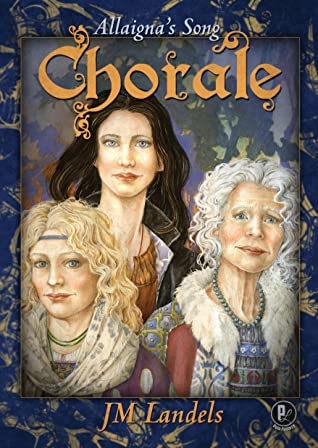
A young woman must return home and prevent a war from erupting in author J.M. Landels’s “Allaigna’s Song: Chorale”.
Advertisements
The Synopsis
The breathtaking conclusion to the Allaigna’s Song Trilogy
In the six years since Allaigna left home, killed her betrothed, and joined the Brandishear Rangers, she has hidden her family name and her ability to sing music into magic. Confronted with the dire implications of her grandfather’s exploration into long-forbidden arcana, Allaigna must swallow her pride and summon her courage to return home with the ashes of her cousin to prevent yet another war, or worse, an arcane catastrophe to rival that of the legendary Cataclysm.
Bonus content includes the novella Allaigna’s Song: Oburakor.
The Review
This was such a powerful and captivating story. The author once again did a fantastic job of world-building and fleshing out the mythos greatly for this world. The powerful and lyrical nature of the author’s writing style lent itself greatly to the magic and sorcery behind the protagonist’s particular gifts with music and song, and the imagery the author used in that writing allowed the reader to feel transported into this magical realm.
The heart of this narrative was the character development and complex relationships the protagonist made. The slippery slope the character was forced upon by the dangers facing her realm and the way she was forced to choose between her only remaining family and the needs of the people themselves of her kingdom was what really helped push her into the final leg of her heroic journey, one brought with danger and loss over the course of this series. The emotional weight of this third book and the way the author explored so many different generations of the women of this family and how life impacted their shared connection made this a memorable fantasy read.
The Verdict
Heartfelt, engaging, and adventurous, author J.M. Landels’s “Allaigna’s Song: Chorale” is a must-read sword and sorcery fantasy read. The mythos and beauty of the magical realms of this narrative blend well into the more emotional and rich character evolutions we see perform here, and the twists and turns in the final pages of this book will have readers eager to have more adventures in this magical realm come to life. If you haven’t yet, be sure to grab your copy today!
JM Landels divides her professional time between writing, editing, drawing, and teaching people to swordfight from horseback. She has no hobbies, since they all tend to turn into professions.
“I’m a poet and don’t even know it!” At some point, you’ve probably said something in an unintentional rhyme. Poetry? Sure, maybe those two seemingly silly sentences you shared with your spouse or with a parent were a little poetic:
Every year an ornament cracks
And there’s the cat – his smile is back!
The main obstacle with those considering writing poetry or getting into reading it, is that they assume it has to be serious, Shakespearean, and therefore, a little irrelevant and bland. But poetry can be found everywhere and in everything.
During one school visit, I asked the students to consider an ordinary object right there in the classroom to write their poem about. After several minutes passed, a flummoxed child asked, “Miss Raven, all the ‘good’ regular items are already being written about. How can I write a verse about a staple remover?”
Advertisements
I asked her what those metal clamps reminded her of. Oh! Metal teeth! Suddenly she saw the staple remover as a metal-mouthed gnasher with only one goal: gnawing and twisting those tin soldier staples from a paper battlefield. How’s that for finding a little poetry in something ordinary?
Tell me, what happened today? Were you frustrated that the wind blew away your scarf or hat? Think there’s no poetry in that? Try a haiku to get yourself going. The pattern is simple (traditional haiku: 3 lines, 5/7/5 syllables per line).
Wind stole my red scarf
Old man winter craves color
Scarlet for snow’s white.
This is just a quick idea off the top of my head, but the point is, attempt to add a little wonder and mindfulness somewhere in your words. Here, the ivory white canvas of winter is unintentionally decorated with the red scarf you lost.
You can look up the various formats of poems and their history online or research in the library, but my goal is to stir up some inspiration because that spark will begin your poetry journey. And – it’s not as hard as you may think.
I’ve found even those who don’t think they’d have any interest in poetry, find themselves with a smile or a tear in their eyes when they hear or read a good poem.
My new children’s poetry book, The 20 Little Poems for 20 Little Gnomes explores the world around us from the whimsical child’s perspective. Because I’ve been a full-time writer now for decades, and somehow naturally end up composing a verse or idea daily, it wasn’t too difficult for me to pick out 20 poems from my files for the compilation.
I already had the title of the book. Not much rhymes with “poems” and my manuscript was originally being submitted to a publisher called Gnome Publishing, so I put together that title – The 20 Little Poems for 20 Little Gnomes, thinking it sounded cute and was appropriate. Although the publishing house I signed with is a different one, the book title was already etched in my brain and I believed in the verse I imagined a group of magical gnomes or elves would enjoy reading while enjoying tea and honey biscuits perched under a mushroom cap. And so it came to be!
I hope that reading the poems in my book, and viewing the playful artwork illustrator Naz Tarcan provided, may provide a good place for you to jump start your own love of poetry – and your own way of expressing or enjoying it!
Advertisements
Book Summary
Discover the magic in simple moments when a child peers in the mirror to unintentionally come upon his smile, where kittens nap in boots, fairy hugs feel good, mice delight in reading books, and January snowflakes taste yummy.
Twenty whimsical poems warm the heart and inspire cheer; a collection enticing both the young and seasoned reader to explore the enchantment of the wonderful world of poetry.
Raven Howell writes stories and poetry for children. Having published several award-winning picture books, she enjoys sharing her love of literature by visiting classrooms and libraries. Raven is Creative & Publishing Advisor for Red Clover Reader, served as Poetry Director for Monster Magnificent, and writes The Book Bug column for Story Monsters Ink magazine. Her poems are found in children’s magazines such as Ladybug, Spider, Highlights for Children,Humpty Dumpty, and Hello Magazine. She’s an editor, and collaborating author for Reading is Fundamental SoCal.
When not writing, Raven enjoys sunshine and the beach, spending time with her family, hiking, laughing, reading, goofing around with artwork, and inventing new recipes.
Join us at our WOW! blog today, The Muffin, for the blog tour launch of The 20 Little Poems for 20 Little Gnomes by Raven Howell. You can read an interview with the author and have a chance to win a copy of the book for yourself.
Visit Glenda’s blog today to read her review of The 20 Little Poems for 20 Little Gnomes by Raven Howell. You’ll also have a chance to win a book copy too!
Preop is a hive of activity at 6:45am. Metal charts clink, heart monitors beep, and a mingled aroma of betadine, hand sanitizer, and rubbing alcohol wafts through the air. Nurses, aides, mid-levels, and doctors side-step one another as they check orders, see patients, and sign consents.
“Hi, I’m Karen, and I’ll be your anesthetist this morning,” I say as I enter the preop bay. An elderly man is lying on a stretcher. He answers my questions and I turn back to the chart to double check his paperwork.
“Young lady,” he rasps, and reaches out his liver-spotted hand out. I take it. Wrinkles crisscross his face like a cracked desert landscape. “I need to tell you something.”
After a long career in healthcare, I’ve learned to listen to my patients. Our eyes lock and he squeezes my hand.
“You will never be able to accomplish everything that you want to accomplish without a life of sobriety.” An impulse flickered between us, an undeniable shared action potential.
Advertisements
“Okay,” I nod, taken aback. Why would he say this to me? Did I look like a heavy drinker?
His matter-of-fact way of speaking stayed with me. There was no possible way that this man knew that I was struggling to accomplish my goals. At that point I’d been writing, editing, and re-writing my first novel, not to mention that I was working long shifts at the hospital, raising two young children, and struggling to keep my marriage and our finances together. I wasn’t a heavy drinker, a few glasses of wine over dinner to unwind after a long day. What did he see in me that compelled him to speak his truth? I chewed on his words but wasn’t ready to quit drinking, yet.
One Sunday morning I lay in bed with a large bottle of Gator-aide praying for the nausea and pounding headache to recede. It was my day to write, and I could barely lift my head from the pillow. This hangover is a waste of my time, I fumed. I thought about my adoptive mother, and how she steadily drank herself into dementia. I spent most of that day on the couch lamenting the loss of the most precious thing that I possessed: time. I couldn’t write while I was drinking, and my hangover rendered me completely useless. This was the beginning of me developing a distaste for alcohol.
Clarity followed sobriety. My energy skyrocketed, I was writing more consistently, and better. I reasoned that I’d unknowingly been in a constant state of dehydration. My scale started a downward trend as I began to exercise, which increased oxygenation to my brain, and increased my energy even more. I began to see how much time I had wasted by drinking, and to understand that I had been self-medicating with wine.
Most people are not ready to hear my patient’s words, and in truth, it took me ten years to process and act on them. These days I drink half a glass of wine on special occasions, but I write every day. Time is precious and limited, make every effort to use your to the fullest.
Advertisements
About the Author
K. E. Bonner, author of Witching Moon,was always the first kid to sit down during a spelling bee. It wasn’t until she was an adult that she was diagnosed with dyslexia, which explained why she always had to study three times harder than her peers. Being dyslexic taught her perseverance and kindness, her two favorite attributes. She lives in Georgia with her husband, two sons, and two dogs. When not writing, she loves to read, swim, explore new places, and meet fascinating people. If you have a dog, she would love to scratch behind its ears and tell it what a good pup it is.
Learn more about K.E. Bonner on her website or follow her on Instagram @kebonnerwrites.
December 19th @ The Muffin Join WOW as we celebrate the launch of K.E. Bonner’s blog tour of Witching Moon. Read an interview with the author and enter to win a copy of the book! https://muffin.wow-womenonwriting.com
December 20th @ Mindy McGinnis’s blog Stop by Mindy’s blog to read “Release the Idea of Getting Rich or Published and Focus on Your Craft.” by K.E. Bonner https://www.mindymcginnis.com/blog
December 30th @ Author Anthony Avina’s blog Revisit author Anthony Avina’s blog to read “The Best Writing Advice I Received” by K.E. Bonner. http://www.authoranthonyavinablog.com
January 10th @ World of My Imagination Stop by Nicole’s blog where K.E. Bonner is a guest for “Three Things on a Saturday Night.” https://worldofmyimagination.com
January 16th @ the Freeing the Butterfly blog Visit Freeing the Butterfly to read “Life is Short, Do What You Love” by K.E. Bonner. https://www.freeingthebutterfly.com/blog
January 18th @ Jill Sheets’s blog
Stop by Jill’s blog to read her interview with K.E. Bonner.
In writing this memoir, I combined my two loves, journalism and creative writing.
The journalist’s task is to find the dark corners of the world of injustice and sadness and illuminate them. The bigger job is to be the watchdog of democracies, to ensure there are checks and balances in governance on behalf of the people.
If there is one thing it taught me is that humans are essentially the same. Everyone is looking for a way to survive the dark days of our mortality and the trials of being human, whether they are gangsters who end up getting shot at 20 and buried with gold chains down to their stomachs; or priests who have lived ascetic lives; or indeed, families around the commonwealth navigating the damage of Empire.
Advertisements
It was with this understanding that I began to write a memoir.
As an immigrant to Tobago, where my parents moved when I was a child, and later to Trinidad, I felt the past was being cut away from me.
My son was born, and I had begun forgetting words in Urdu and Hindi. As an immigrant to Trinidad, I started feeling the past was being cut away from me. I wrote it to remember the past and understand the present of the glittering islands of Trinidad and Tobago, where my parents moved when I was a child.
As I wrote about my experience as a journalist, somebody who chronicles the events that shape a country, I realised that my past was not unique. My grandmother told me how my ancestor was brought from Uzbekistan to put down the mutiny in India in 1856. As a recruited member of the British Army, he was forced to shoot his fellow Muslims, something he regretted till he died. I began making connections. It was also the story of colonial islands in the new world, where people were stripped of language. The narrative continued with my parents travelling to Trinidad and Tobago, which also has a complicated history of colonisation by the French Spanish and English. That interested me – how the personal can be so political, how the unravelling of one family living under decades of colonialism can echo a crumbling empire.
The overall theme of the crumbling Empire is relevant, especially now; after the death of Queen Elizabeth 11, we can see how similar post-colonial worlds are. The history of brutality was identical. In India, we grew up with stories of the Jallianwala Bagh massacre in Amritsar Puja when General Dyer ordered the British
Indian Army to open fire on over a thousand unarmed, nonviolent protestors, Churchill’s active role in perpetuating the Bengal famine, or the signs my mother remembers in exclusive clubs that read “No Dogs or Indians” and the sly inroads of the East India Company. In Trinidad, as in much of South America, there is the brutal history of slavery, indentureship and genocide of millions of native Indians. In India from 1765 to 1938. the British got an estimated 45 trillion U.S. dollars’ worth of goods like textiles, rice, iron, and timbre, not to mention jewels from the Raj, which are housed in
British museums today. Similarly, Caribbean islands like ours were looted for sugar and cocoa. It’s a shared history of exploitation.
When my grandmother left India to join our family in Trinidad, she told me stories about a vanished India of the British Raj. She told me of generations of women born into Muslim Indian princely families of Bhopal and Savanur. I had to infer the calamity upon her life when my mother broke hundreds of years of tradition and understand why my grandmother disinherited my mother for marrying a Hindu army officer.
There were unanswered questions. I wondered why my grandmother ended up alone and penniless despite all her privileges- born a princess into Indian royalty, beauty, and musical talent.
As I wrote the story, the puzzle came together. I began to understand how patterns are created in how we treat our daughters and how that damages the people we love. At my grandmother’s funeral, I was aware of how incongruous this was, a woman born in colonial India dying in the new world so far from everything she grew up with and knew. It was a way of bringing tother the old and new worlds and introducing the question of how and why this happened. How did a princess of the Raj die in Trinidad?
Advertisements
The colonial idea that subjugation, cruelty and even corporal punishment can be justified for the greater good filtered down to how people in colonies viewed their children.– how neglect, abandonment or abuse is passed on to their daughters and that pattern is continued.
Migration is also a very personal issue. At the funeral of the late Queen Elizabeth, dozens of security guards were of South Asian origin. According to an Indian Ministry of External Affairs report, 32 million Non-Resident Indians live outside India, overseas Indians comprise the world’s largest overseas diaspora, and over 2.4 million Indians migrate overseas yearly. Our family was just one in this ocean of movement. So the themes aren’t heavy, but
illustrates how politics always becomes personal and affects families.
When I wrote it, I did not expect it to resonate with so many people across continents. Michael Portillo for Times Radio was moved by the story of Poppet, the child in the book. Anita Rani of Times Radio was moved by the story of migration. The Observer found it was reminiscent of the times of the Raj in India, which has connected India and Britain for generations.
Advertisements
About the Author
Ira Mathur is the author of Love The Dark Days – a Peepal Tree published a memoir on the emotional ruins of Empire on three generations of women set in Trinidad, St Lucia, India and the U.K., bookended with a weekend with Derek Walcott. Love The Dark Days was selected as a UK Guardian Best Book of the Year 2022 ( Memoir and Biography)
Mathur is an Indian-born Trinidadian multimedia journalist and columnist with a body of writing that includes over 800 columns over 20 years. (www.irasroom.org) She was longlisted for the 2021 Bath Novel Award for Touching Dr Simone. (Out in 2023)
Mathur studied creative writing in London with The University of East Anglia/Guardian & the Faber Academy with Gillian Slovo, Maggie Gee, and James Scudamore. In 2019 Mathur was longlisted for the Johnson and Amoy Achong Caribbean Writers Prize. She holds degrees in literature, law and journalism.
I received a free copy of this book in exchange for a fair and honest review. All opinions are my own.
A thief comes into contact with the spirit of a woman who lost her child when she was wrongfully thrust into an asylum for her inheritance in the 1940s, and together with his daughter they must contend with her vengeful spirit and the men who wronged her in life in order to uncover the truth behind her child’s fate in author Matthew Hughes’s “Ghost Dreams”.
Advertisements
The Synopsis
Commercial burglar Stan Winkelman encounters the ghost of Jane Manchester, wrongly confined for life in a 1940s insane asylum by a powerful family. She wants to know what happened to Harmon, the baby boy that was stolen from her.
Aided by Jeannie, his ghost-obsessed autistic daughter, Stan and Jane begin a quest to find Harmon, or his descendants. But their search will run them afoul of Andrew Bigelow, reclusive heir to the fortune Jane was robbed of.
And Bigelow is in cahoots with a murderous crew who deal in guns and blood diamonds and will stop at nothing to keep their crimes hidden.
Stan uses his burglar skills to uncover the truth, but that will draw him and Jeannie into a deadly confrontation, with the vengeful spirit of Jane Manchester his only ally.
The Review
This was a brilliant and powerful story. The blend of crime thriller, mystery, and horror that this story infuses into itself was captivating to read. The heavy atmosphere and compelling chemistry between the cast of characters made this feel like the perfect modern-day gothic ghost story, with a tone that felt like it could have easily fit into a more Victorian-era period if not for the modern-day Washington setting.
The heart of this narrative had to be in the mystery components of the story and the character development, especially for the protagonist. The complexity of the protagonist’s background and journey, from a thief and morally questionable history to his somewhat heroic turn to find justice and answers for the spirit of this young woman and how they bond together in the face of this tragic backstory, made this a thrilling read. The shocking series of events that unearth the truth behind not only Jane’s history but the truth behind Bigelow’s life, in general, will keep readers hanging off of the author’s every word.
The Verdict
Thought-provoking, chilling, and entertaining, author Matthew Hughes’s “Ghost Dreams” is a must-read crime thriller and horror mystery read. The twists and turns in the narrative help elevate the character growth of the protagonist and the cast of characters greatly, and readers will be invested heavily as the story and mystery unravel over time. If you haven’t yet, be sure to grab your copy today!
Rating: 10/10
Advertisements
About the Author
Born in Liverpool, his family moved to Canada when he was five years old. Married since late 1960s, he has three grown sons. He is currently relocated to Britain. He is a former director of the Federation of British Columbia Writers.
A university drop-out from a working poor background, he worked in a factory that made school desks, drove a grocery delivery truck, was night janitor in a GM dealership, and did a short stint as an orderly in a private mental hospital. As a teenager, he served a year as a volunteer with the Company of Young Canadians.
He has made his living as a writer all of his adult life, first as a journalist in newspapers, then as a staff speechwriter to the Canadian Ministers of Justice and Environment, and, since 1979, as a freelance corporate and political speechwriter in British Columbia.
His short fiction has appeared in Alfred Hitchcock’s, Asimov’s, The Magazine of Fantasy & Science Fiction, Postscripts, Interzone, and a number of “Year’s Best” anthologies. Night Shade Books published his short story collection, The Gist Hunter and Other Stories, in 2005.
He has won the Arthur Ellis Award from the Crime Writers of Canada. His novels and stories regularly make the Locus Magazine annual recommended reading list.