
I received a free copy of this book in exchange for a fair and honest review. All opinions are my own.
A fallen angel must contend with her growing friendship with a human tribesman and the promise of her dream of returning to heaven by a secret, beautiful angel who visits her at night as the war continues between humanity and heaven in author Richard Harland’s “Ferren and the Doomsday Mission”, the second book in the Ferren Trilogy.
The Synopsis
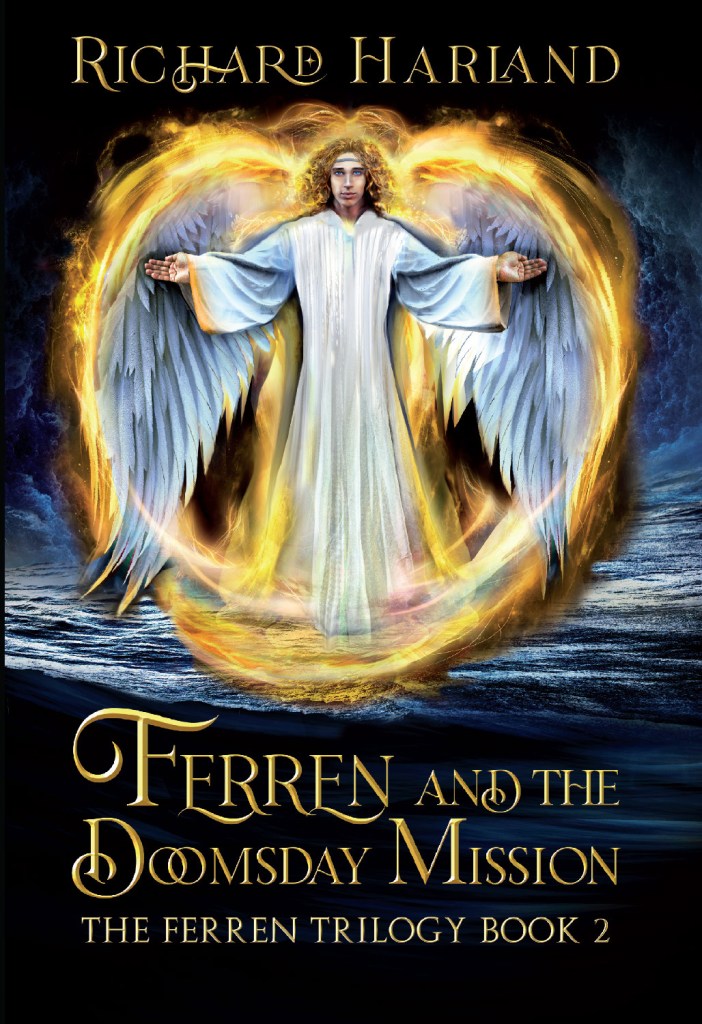
The unique friendship between an angel and a human is the only hope for the future – but can they remain friends?It’ s one thousand years since medical scientists brought a dead brain back to consciousness. When they discovered the reality of life after death, they laid claim to Heaven and set off a war against the angels.Now the Earth is a ruined wasteland. Descendants of the original scientists continue the war with their armies of artificially created Humen. When the greatest of Doctors, the all-knowing Doctor Saniette, takes control of the Bankstown Camp, the fighting moves to a terrible new phase.Miriael is the angel who fell to Earth, ate mortal food and can no longer return to Heaven. Ferren is the young tribesman who has been her only friend since her own kind abandoned her. Together, they work to unite the tribes in an alliance independent of the Humen.But suddenly Miriael has another friend. A beautiful, caring angel visits her in secret and offers her what she most desires: the chance to return to Heaven. The consequences will be extreme … for her, for Ferren, for the world.
The Review
This was another fantastic entry into the author’s rich, fantasy-driven dystopian world. The immense scope of the world-building the author took on in bringing this story to life was incredible to see expanded upon in this book. The threat of Dr. Saniette and the Humen in this story and the action-packed drama that unfolds as the battle rages on make this narrative genuinely memorable.
Yet the action and drama are so well balanced, thanks to the rich character dynamics. The friendship and the evolution of the relationship between the protagonists, Miriael and Ferren, is the core heart of the narrative. However, the exciting directions their journey takes them on as individuals, from the interesting romance/love triangle between Ferren, Kiet, and Zonda to the twist connection Miriael has to Asmodai, and the impact Miriael has on the growing alliance amongst the last of the tribes of humanity made this a remarkable narrative to get lost in.
The Verdict
Exhilarating, thrilling, and heartfelt, author Richard Harland’s “Ferren and the Doomsday Mission” is a brilliant sequel and a memorable fantasy-driven story that readers won’t put down. The twists and turns in the story will keep readers on the edge of their seats, and the cliffhanger final moments will bring readers back for the third book of the Ferren trilogy. If you haven’t yet, be sure to grab your copy today!
Rating: 10/10
Interview with Richard Harland
What is the biggest difference between writing a solo novel and a series?
I don’t have much experience of starting out to write a series! The only time I’ve done it was with my Wolf Kingdom quartet, and they were kids’ books. My first novel The Vicar of Morbing Vyle was a standalone until fans pushed for a sequel. My SF/detective movel The Dark Edge was a standalone until my publisher demanded sequels. And ditto with my steampunk fantasy, Worldshaker – I was ready to be asked for a sequel, but I’d spent 20 years planning the novel as a standalone.
With Ferren and the Angel, I wasn’t even ready to be asked for a sequel. I loosened it up at the end when my publisher first talked of a sequel, but that was only in the last stage of editing before publication. There’s a whole complicated story there, which I haven’t much explained to anyone anywhere.
ANTHONY: Let’s hear it.
OK, confession time! There’s an earlier version of The Ferren Trilogy called The Heaven and Earth Trilogy. It came out only in Australia, published by Penguin Australia, had some success, but wasn’t marketed very well (internal publisher politics!) and Penguin let it go out of print. That first publication was twenty years ago.
My new publisher, IFWG, sells mainly into the US, and it seemed a smart move not to make a lot of noise about the first version, which never even existed in America. Why create confusion? But it ended up being confusing anyway, because the audio format of Ferren and the Angel is under a separate contract and still on sale on Amazon. Not so smart after all!
But here’s the best bit of the story. After the Penguin version dropped out of print, and after I’d moved on to some international success with Worldshaker and its sequels, there were still fans of the original trilogy who’d fallen in love with it and refused to forget about it. They wanted those novels out there and wouldn’t let them die! They hounded publishers year after year, until they finally succeeded. One day, out of the blue, I received an email from IFWG Publishing, saying they’d like to do a reprint of the Ferren books. Yay!
ANTHONY: So is this a reprint or a new version or what?
It’s a total rewrite! Although I’d moved on to writing other books, I always had the feeling that the trilogy deserved better than it got. The fans of the book believed that it deserved better from publishers, but I believed it deserved better from its author too! The raw material was there, the incredible future world where the armies of Heaven do battle with the armies of the Earth – so much potential! But not fully realized. When IFWG offered to do a reprint, I said I wanted time to rewrite the books first. After twenty years of mulling over the stories in the back of my mind, I just knew they could be better told. And now they are!
It’s a wonderful thing, to be given a second chance. I haven’t wanted that chance for any other novel I’ve written, only the Ferren books. They’re finally turning into the books they were always meant to be!
Um, maybe I’ve left the question behind … What was your first question again?
ANTHONY: What is the biggest difference between writing a solo novel and a series?
Right! I knew there was some connection! The thing is that when Penguin Australia were about to bring out the early version of Ferren and the Angel, they hit me with the request for a sequel to be written within twelve months. Which was great, but … I’m not a fast writer, and, even more, I needed time to recharge my batteries for imagining a whole further expansion of the world and story. I think I did well – better than I could ever have expected – with the ideas I came up with. Trouble was, I was forever playing catch up and never had time to shape them into a truly effective story dynamic.
I always felt that Book 2, originally called Ferren and the White Doctor but now called FERREN AND THE DOOMSDAY MISSION, needed more of a rewrite than any other volume, I read through the Penguin version before starting, but then hardly looked at it again while I went through the rewrite. And the rewriting just flowed! I guess the difference was that I knew where the story was going, so I knew how to set it up right! I’d planted the seeds properly in Book 1 and got them growing at the start of Book 2. When I wrote the original Ferren and the White Doctor, I remember always struggling to pull the story back into line. With the rewrite, it just unfolded all by itself!
I guess I experienced the hard way what makes a series a series. The three novels in the new Ferren Trilogy all have their own individual story dynamic, but now they’re not merely tacked on one after the other – they grow out of each other, bigger and bigger with every volume.
So what’s the biggest takeaway you want readers to have when finishing your series?
I suppose as the trilogy develops, it puts you more and more on the side of Heaven. For all their blinkered sense of superiority, the angels and archangels do hold strong ethical principles – and they learn to shed their sense of superiority in the end. Their basic goodness comes through, whereas the Humen who make up the armies of Earth are just plain bad and nasty. But there’s no religious message. The beauty of angelology – the traditional lore about angels and Heaven – moves me emotionally, but I’m still an agnostic.
I think the takeaway would be more of a humanist one – for human beings to believe in themselves, respect themselves and stand up for themselves. That’s what the Residuals, descendants of the original human beings, learn to do in the course of the trilogy, even as they eventually choose to fight alongside Heaven.
As for the moral balance between Heaven and the Humen, I’d say that the Humen lack reverence for anything and everything – they’re only interested in what they can exploit for their own purposes. I suppose that’s my religion – a humanism that isn’t self-centered but has respect for what’s other than ourselves. It’s not a message, and I’m not preaching it, but it probably colours the story and events.
Do you plot out your novels and the characters within them, or do you write and let the story develop at its own pace?
I don’t like the word ‘plot’ because it’s sounds mechanical and controlling, but it’s true I do a huge amount of thinking and imagining before turning a story into actual words. I’ve always had a very vivid visual imagination, so I tend to watch my story unfold like a movie before verbalizing it.
One thing I love is a narrative that builds and converges to a huge rolling climax. In Ferren and the Angel and Ferren and the Doomsday Mission, the climactic scenes take up nearly a quarter of the book – and the climax of Book 3, Ferren and the Invaders of Heaven, will be the biggest of the lot! But you can’t produce those sorts of climaxes just by ambling along page after page. I don’t believe in weak endings or fade-out endings (I mean, I don’t believe in fade-out endings for fantasy fiction), but I also don’t believe in artificially imposed big endings. The climax has to grow naturally out of everything that’s gone before.
Am I starting to sound like a broken record? I believe you have to grow those big climaxes by planting the seeds early on. I’m the sort of author who’s always looking ahead – I don’t know exactly how the final development will work out, but I can sense when I’ve got all the material for it. Like the volume of a wave that’ll just sweep me along at the end!
I think of being an author as like being on the back of some humungous, lumbering beast! The beast is the story, with its own vast mass and momentum. You can’t drag it round suddenly to where you want it to go, e.g. a big, rolling climax. You have to begin guiding and nudging it right from the start, looking far ahead and applying tiny prods that are all the influence you ever get to have.
About the Author
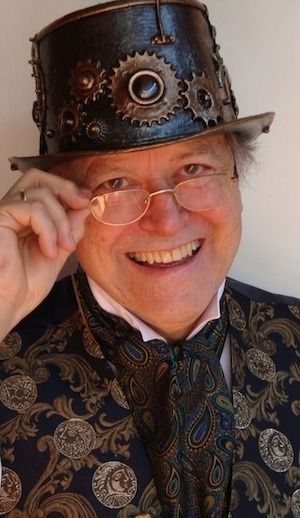
Richard was born in Yorkshire, England, then migrated to Australia at the age of twenty-one. He was always trying to write, but could never finish the stories he began. Instead he drifted around as a singer, songwriter and poet, then became a university tutor and finally a university lecturer. But after twenty-five years of writer’ s block, he finally finished the cult novel, The Vicar of Morbing Vyle. When he contracted his next book to a major publisher, he immediately resigned his lectureship to follow his original dream.
https://www.facebook.com/richardharland.books
Discover more from Author Anthony Avina
Subscribe to get the latest posts sent to your email.
