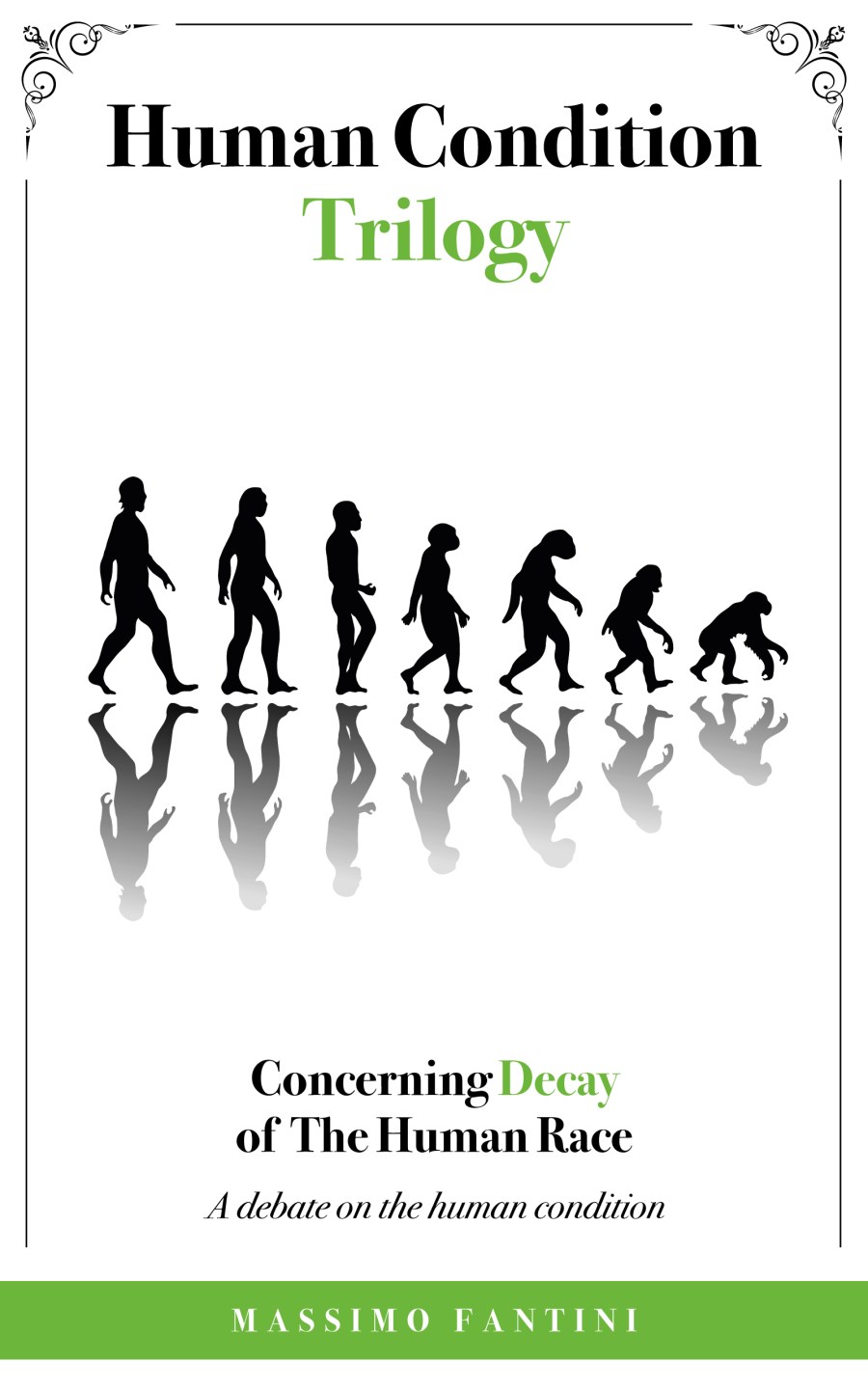
I received a free copy of this book in exchange for a fair and honest review. All opinions are my own.
An island isolated from the world shows the perils of social evolution (or the lack thereof) in author Massimo Fantini’s “Concerning Decay of The Human Race), the third book in the Human Condition Trilogy.
The Synopsis
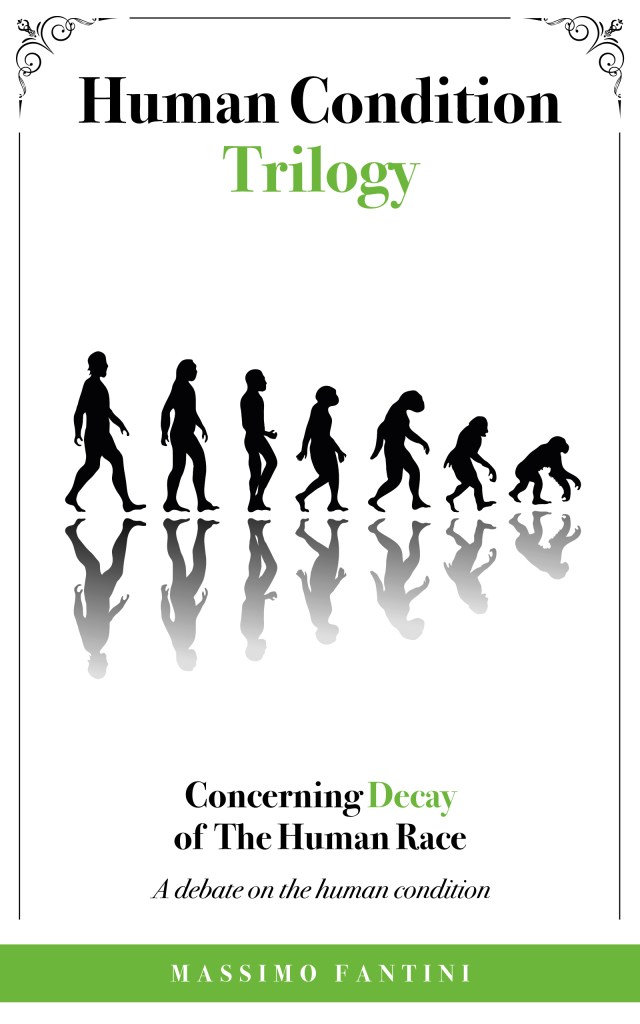
The small village of the Island of the Iguanas experiences the succession of different communities – sometimes forced to live together, sometimes taking over from a former generation. Each community possesses a culture and an assortment of certainties which it does not intend to give up, judging a priori the customs of those who preceded it as uncivilized or unreasonable.
Over the years, the community consolidates and grows, together with their prejudices, social injustices, and religious superstitions. The structural transformations of the village have repercussions on the ecosystem of the island which – starting as a protected nature reserve – becomes a hunting place, a tourist destination, and a favorable terrain for smugglers to exploit.
Thus, faced with the opportunity to adopt a new lifestyle – concerning principles of equality, safeguarding personal freedoms, and restoring the ancient harmony between man and nature – there are those who choose to follow the tested path of the government of man over man, which makes discrimination its founding principle, and those who choose to defy it. Social contrasts – delineated by origin, by social background, by acquired privileges – begin to arise within these communities, which are made up of heterogeneous families and members of different ages and ambitions.
Given the possibility to make a clean sweep of the past and rebuild the social fabric from scratch, will those who position themselves as leaders avoid the mistakes made by their predecessors or will they end up mechanically following the same steps laid out by human history?
The editing and translation of this book was done by Ian Zwaschka.
The Review
This was such a unique and compelling narrative. The author does a beautiful world-building in this book, allowing the reader to become immersed in this island world and develop such unique cultures and different communities. The imagery the author utilizes within the narrative brings this island setting to life in a vibrant way, allowing the narrative to come alive in the reader’s mind.
Yet, as with every fantastic book in this trilogy, the author soars when delving into the philosophy and themes behind this story. The tension that builds slowly over time as readers read how each generation on this island evolves and takes on the prejudices and judgments of those who came before speaks to the very cyclical nature of humanity in a social setting and how giving into the government’s role in our society plays a significant role in that, as bigotry and injustice, along with particular religious beliefs, tend to impact the laws and social settings the rest of the community must live in, leading to a significant disparity between social classes. The exploration of why some people can rise above the bigotry of the past while others remain seething in that hatred was so remarkable to behold.
The Verdict
Thought-provoking, insightful, and engaging author Massimo Fantini’s “Concerning Decay of The Human Race” is a must-read contemporary fiction narrative. The twists and turns in this island setting and the impeccable discussions of these themes drive the reader to make this a thoughtful and remarkable book. If you haven’t yet, be sure to grab your copy today!
Rating: 10/10
About the Author

Greetings, readers.
I am Massimo Fantini, an Italian author and free thinker, writing from my home in the hills just outside Bologna. In quiet moments, when I am not writing, I enjoy classical music, particularly orchestral works for violin and the Italian opera.
I graduated from a university in Bologna with a degree in civil engineering. However, the studies of my youth do not represent my life’s obsession—that is, delving into those realities which unite all members of the human race: suffering, frustrations, conflicts, and the human reactions to these. They are the events and forces that take every human as an innocent in the crib and twist and turn them into 8.1 billion unique (but intimately connected) forms.
In short, I am obsessed with exploring the intimate recesses of the human condition.
In 2018, entirely dissatisfied with my job, I sought a new form of expression. Thus, I began to write. Incessantly.
I experimented with many kinds of writing. How best to give my ideas form? Then, I found my voice through stories, giving life to characters who explore, triumph, and fail for us to watch.
In each installment of my Human Condition Trilogy, these same all-encompassing issues are approached from different directions, under different circumstances, and by different characters.
Echoing the sentiment of Heraclitus, no two people may look at the same problem, because it is different to each. From the old cynical Leonard in Concerning Fanaticism to young Tommaso (a character inspired by my own youth) in Concerning Intellectual Suicide, I tried to cast a light on a path that is a constant part of our lives, but also constantly shifting.
Through my writing, I encourage readers to find their own perspective on life. Rather than embracing the comfortable mold which society provides, like a goldfish “free” to swim around in its little bowl, I hope my readers can use my books as a steppingstone toward their own unique way of thinking. And then, I wish them the freedom to pursue it.
Art is wonderful because it is a representation of what we otherwise cannot express. I seek not to provide myself and my readers with a mere distraction (what so often passes for “entertainment”). Not a hole in which to stick our heads for a few hours, only to emerge weakened and even less able to face our reality. Rather, I offer up a representation of our shared condition.
The Human Condition.
Discover more from Author Anthony Avina
Subscribe to get the latest posts sent to your email.
