
1) Tell us a little bit about yourself. How did you get into writing?
I’m probably like a lot of folks who love to read — I always loved words. I actually got my first paying writing job by accident. I wrote a series of articles for a small local newspaper about a fabulous 1920s hotel that used to be frequented by the movie stars from LA. The hotel was long-gone, but a local couple who used to work there was still around. So I interviewed them, wrote stories about their recollections of the hotel, and included their own love story (they’d met there and married, using a paper “ring” because they had no money!) I never expected to be paid for those stories; I just wrote them for fun. Several weeks later, the editor handed me a check and said the stories had gotten more comments than he’d ever had before — people loved the stories! So he felt I should be paid. It wasn’t much, but that was an eye-opener for me that I could tell stories people were eager to read!
2) What inspired you to write your book?
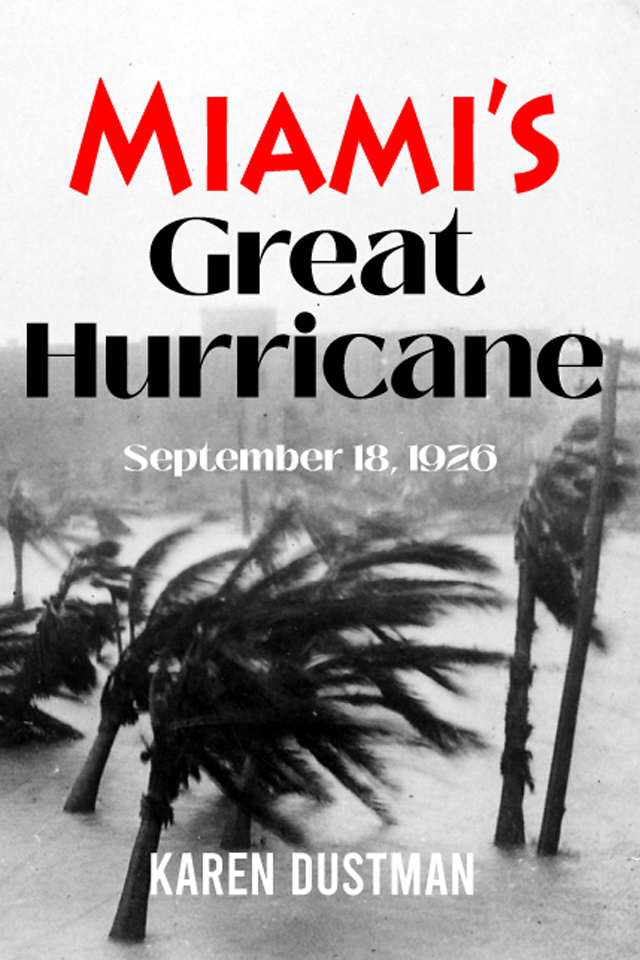
I’ve wanted to write about Miami’s “Great Hurricane” for over 20 years. My dad lived through that terrifying storm when he was just ten years old. Other family members, too, would occasionally bring up the story. Sometime in the ’90s I began collecting original photographs, postcards, and other memorabilia from the storm. The era of personal photography had just begun to shine in the 1920s, so immediately after the hurricane swept through, hundreds or even thousands of people grabbed their little Brownie camera and went outside to snap pictures. Thousands of those photographs have survived, and they’re a fascinating first-hand look at the devastation from that storm. Commercial photographers, too, documented the storm. And wire news services sent photographers to Miami to document the rebuilding and relief efforts. I’ve collected hundreds of those photos, and always felt like “some day” they would become a book. And finally, last year, it just felt like it was time. The timing is really fortuitous, in a way. The “Great Hurricane” struck in September, 1926. Just one year from now, it’ll be exactly a century in the rearview mirror. Folks like my dad who actually lived through it are gone. It’s important that their stories will continue on.
3) What theme or message do you hope readers will take away from your book?
The thing that struck me the most, writing this book, was the way people pulled together in 1926 to meet the challenges of a completely unexpected disaster. There was no FEMA back then. But people across the country came together to rush relief to where it was needed. Trains were assembled with medical personnel, surgical supplies, nurses and medicines. The Red Cross organized food distribution and other relief, and set up vaccination stations against typhoid and yellow fever. People reached out to neighbors whose homes had been destroyed and offered their own houses for weeks at a time. Carpenters and tradesmen turned down paying restoration work, and instead helped repair houses in their own neighborhoods for no pay at all. Miami, too, managed to rally despite its terrible setbacks. . . the 1926 storm, and then the Great Depression that followed. If there’s a message in this book, it’s that even in the worst of times, the best of human nature often comes out. And even in disaster, there’s hope.
4) What drew you into this particular genre?
I’ve long been drawn to writing non-fiction history — this is probably my 30-something-est book in the genre. What’s most fascinating to me are always the people-stories. I’d always thought history was boring in high school. But when you dig into the personal sagas and struggles, that’s when history comes to life. A king who reigned from X date to Y date? Boring. A queen who was married off by her family before she was 16, to a husband who kicked her to the curb for failing to produce a male heir, then went on to marry a second king (who cheated on her). . . now, there’s a story! There’s similar real-life drama in my Hurricane book, including the first-person account of a man standing on a table as the water in his home keeps rising, eventually having to hang onto the chandelier. . . spoiler alert, he did survive!
5) What social media site has been the most helpful in developing your readership?
Facebook and my own author newsletter have both been incredibly helpful in keeping me connected with readers. And those readers and their feedback are what keep me writing.
6) What advice would you give to aspiring or just starting authors out there?
My best advice to beginning writers is to just write. Pick a topic or a storyline that interests you, and go for it! And most of all, don’t let anyone’s critique or “helpful” words discourage you. Ignore all that. Just keep writing.
About the Author
Author Bio – Karen Dustman

(fiction pen name: Abby Rice):
Karen Dustman is the author of over 25 books ranging from non-fiction history to captivatig Southern mysteries. With multiple careers as a former criminal prosecutor, full-time freelance writer, and hands-on homebuilder, Karen swears by the joy of not always taking the straight-and-narrow path.
Author Links:
Karen’s latest books (Amazon): https://www.amazon.com/Cold-Spring-Southern-Thriller-Van-Life-ebook/dp/B0DBFSDFNW/
eMail: kdustman21@gmail.com
Websites: www.Clairitage.com (“Claire” + heritage),
Facebook Author Page: www.facebook.com/KarenDustmanAuthor
Facebook fiction (Abby) Page: www.facebook.com/AbbyRiceAuthor
X (Twitter): @KDustmanAuthor
Instagram: @AbbyRiceAuthor
Bookbub: @AbbyRice
Goodreads: www.goodreads.com/abby_rice
Discover more from Author Anthony Avina
Subscribe to get the latest posts sent to your email.
