
1) Tell us a little bit about yourself. How did you get into writing?
I’ve loved stories for as long as I can remember. I grew up as a theatre and music kid – the sort who memorised Shakespeare before he could understand a fraction of the themes at play – and performing off-Broadway at thirteen probably quietly set my course. Writing fiction became the place where all my interests and obsessions converged. Even when I swapped the theatre performances for swordplay (I fenced at international level for several years), drifted through a series of martial arts, and later studied film and comparative mythology, I always returned home to the page.
I was sixteen when I began writing my first novel that would eventually see both completion and publication – oftentimes during maths lectures, which explains where I found the time – and I’ve never really stopped. These days I divide my time between several disparate fields – engineering in the family business, a new venture in agriculture and wine-making, and occasionally teaching writing workshops at university – but a love of storytelling remains the constant. It’s why I founded Endangered Poet Productions: a small, fiercely independent studio devoted to narrative art in all its forms. That’s the centre of gravity I always return to.
2) What inspired you to write your book?
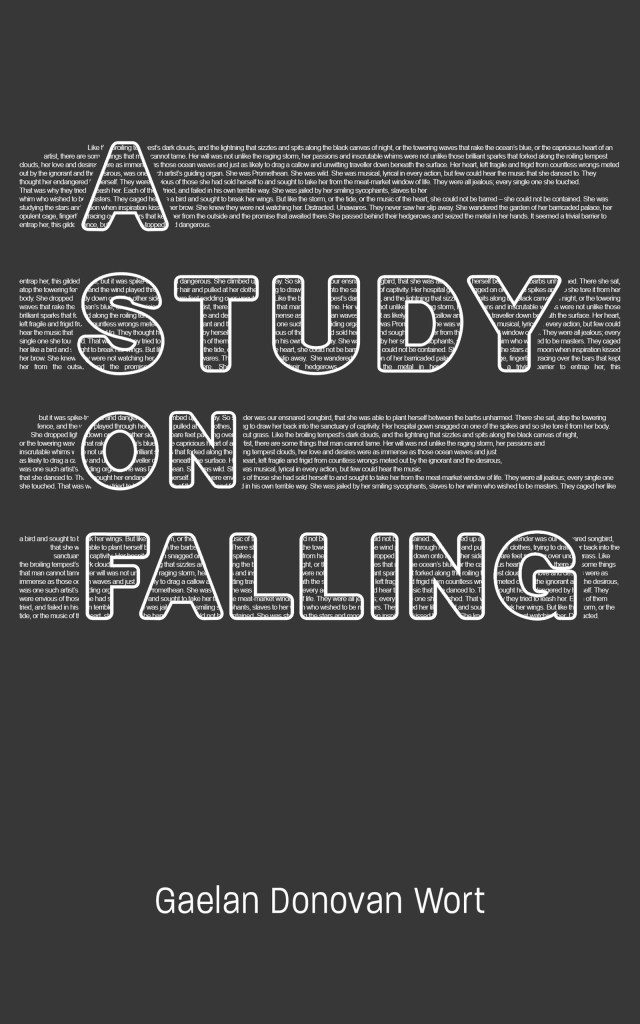
I began writing A Study on Falling while working on my honours thesis, drawing on narratology and comparative mythology, with a focus on the persistence of myth in contemporary storytelling. What struck me then is how little our myth-making impulse has changed, even in the increasingly secular culture of the modern West. We continue to shape our lives through narrative; allegory is how human beings construct meaning – it’s literally baked into the architecture of our brains. And we still reach instinctively for allegory whenever rote rationality inevitably fails to account for our fears, our griefs, or our sense of purpose.
That idea was the seed of the book. I wanted to explore the reciprocal relationship between fiction and the people who create and consume it: how stories shape us, and how we, in turn, inscribe ourselves into the stories that enter the cultural bloodstream. Filtering Henry Levi’s personal drama through the surreal metatext of The Shambling Lords felt like the most vivid way to show that exchange happening in real time; the author influencing the fiction, the fiction transforming the author – for good or ill.
My natural genre inclination leans toward the gothic, so some darkness inevitably crept in, but at its core the book is about something far simpler than the overt conflicts that unfold throughout: the human need to believe in something. To have a story to cling to, a myth to vest oneself in. The act of thought is a story told in the present tense; memory is a story told in the past; hope, fear, and anxiety are stories projected into the future. We build meaning through narrative. That gradual realisation was more than academic and it became the emotional engine that compelled the book into existence.
3) What theme or message do you hope readers will take away from your book?
The book is deliberately semi-open-ended, so I’m hesitant to prescribe a singular, overt lesson. If there’s something I hope readers come away with, it’s the idea that even when so much of life lies beyond our control, we’re never entirely powerless. We may not be able to choose the maze that we stray into, but we can choose how honestly we confront it.
One of the quiet touchstones for me was the Greek myth of Ariadne’s thread – the idea that there is always some guiding line back out of the darkness, if you’re willing to acknowledge the shape of the maze and depths of your descent first. Denial, fantasy, and self-deception only deepen the corridors. Clarity, however painful, creates orientation. The act of paying attention becomes an ethical choice.
At heart, the story suggests that meaning isn’t found by mastering the world, but by mastering the self. You can’t control the weather, the past, or the minds of others – but you can decide how you respond, what truths you refuse to look away from, and how you author the next page in the proverbial novel of your life. As meaning is constructed through allegory, it is through the stories that surround us that we learn how to refine our own in turn. That, to me, is where agency still lives.
4) What drew you into this particular genre?
I’ve never been bound to any single genre. While I have a natural affinity for gothic horror, I’m also drawn to exploring other modes and the spaces where genres overlap. In this case, part of the appeal was precisely that I was blending distinct traditions rather than settling into one.
What interested me most was the friction between the two narrative layers. A Study on Falling functions as literary fiction and psychological drama, while The Shambling Lords is dark fantasy and cosmic horror. Allowing those disparate genres to coexist and inform one another became a meaningful part of the book’s structure.
In that sense, writing the novel was also an exploration of genre itself: how different narrative forms shape our expectations, and how testing those boundaries can reveal new ways of telling a story.
5) If you could sit down with any character in your book, what would you ask them and why?
I’d choose to sit down with Henry Levi – a bit like holding up a mirror to a part of myself I haven’t visited in a while. But I wouldn’t ask him about the events of the book – he’s already told that story in his own way.
What I’d want to know is what came after. Whether things truly worked out for him once the narrative wrapped up; whether he managed to stay out of the maze, keep the light burning, and live honestly with what he discovered about himself. Not in any grand, redemptive sense, but in the ordinary, everyday way that actually matters.
I’d also ask him for an update on what he’s writing next. Admittedly, even I’ve been curious. An advance reader copy wouldn’t hurt either…
6) What social media site has been the most helpful in developing your readership?
Social media has never been my natural habitat, and I’ve learned not to pretend otherwise. I’m an analogue person at heart, far more comfortable with books, margins, and long-form work than with feeds and algorithms.
That said, as a studio we’ve come to recognise its importance, and we’re in the process of rebuilding our online presence more thoughtfully. You may start seeing more of me there – though I suspect I’ll always approach it a little more reluctantly than most.
7) What advice would you give to aspiring or just starting authors out there?
Read constantly and write more broadly than you think you should. Experiment, push yourself, try styles and voices far outside your comfort zone. Practical habits matter too. My personal work tradition: putting together a playlist that aligns with a project’s setting or emotional register. It helps to shut out distraction and keep you anchored in the work.
More broadly, I’d say learn to kill your darlings early, but also learn when not to. Listen to critique, but don’t let anyone talk you out of the plot, voice, or character that feels essential to you. A unique style is hard-won, so don’t compromise it lightly.
8) What does the future hold in store for you? Any new books/projects on the horizon?
My primary focus at the moment is the ongoing development of The Hollow Waltz – a long-form horror series conceived as a kind of “greatest hits” of the genre. Each entry stands alone, but together they form a subtle, shared mythology spanning different eras, cultures, and horror subgenres, from gothic and folkloric horror to cosmic, liminal and institutional dread. I have two exciting releases scheduled for February 2026, with another pair of brand-new titles already deep in development and nearing readiness for global distribution soon afterwards.
After that, I’m planning a brief shift away from horror to revisit Riftbreakers, a teenage and YA science-fiction comedy series I’m in the process of rebooting and re-releasing. It’s a project rooted in direct experience, aimed at that most elusive reader demographic of all: teenage boys. As a former one myself – and as someone with close friends who seem to have never really grown up – I’d sensed this gap for a while. More recently, through opportunities to mentor, teach, and simply listen, I’ve been able to ask teenage guys plainly why they aren’t reading. The answer is rarely hostility toward books themselves so much as it’s bewilderment. Much of what’s on offer feels either inaccessible, academically distant, or simply not written for them.
I understand that disconnect. I grew up on the classics, but I can see why works like The Odyssey or the Poetic Edda feel impenetrable as entry points for most young guys, just as I can see how much contemporary teen/YA fiction, centred on distinctly female interiority, just doesn’t appeal. Riftbreakers is my attempt to meet those readers where they are – with stories that are high-octane and unhinged – while still carrying the same foundational concerns about identity, responsibility, and higher meaning that have always shaped myth and literature.
Alongside the books, Endangered Poet Productions is also preparing to move further into interactive media later in the year. There are a few long-term projects in development that I shouldn’t divulge yet, but once our renewed online presence is up and running, we’ll be sharing previews and early material. Looking a little further ahead, we’re also exploring some unusual crossovers, like a fusion of literature and wine – because good stories and good shiraz are a match made in heaven.
All in all, it’s an unusually full creative season – and a very exciting one.
About the Author

Gaelan Donovan Wort penned his first novel, The Nature of Predation, at the age of seventeen, driven by a restless passion for storytelling that has since deepened into a lifelong craft. Since that early beginning, he has followed the shadows that gather between myth and memory, reverie and ruin – threads that continue to weave throughout his stories. His fiction drifts between genres – gothic horror, mythic tragedy, psychological thriller, speculative drama, and satirical science fiction – but is always drawn to the liminal, the haunted, and the human. Whether eerie or elegiac, his stories linger where the rational frays – and the unknowable begins.
Discover more from Author Anthony Avina
Subscribe to get the latest posts sent to your email.
