Long synopsis:
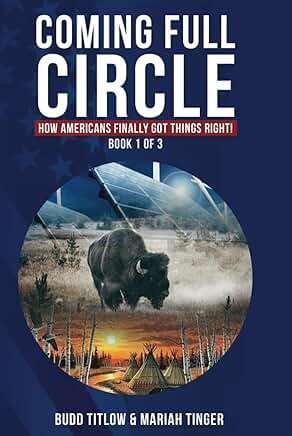
As a career wildlife ecologist and conservationist, I am often asked to recommend a book that tells the full story of our Nation’s land conservation ethic and the environmental movement that it eventually spawned. I can never come up with a good suggestion—mainly because such a book doesn’t exist. Until now, that is.
Following the fortunes and foibles of a multi-generational American family, this book explains how we took our country to the brink of both the Climate Crash and the Sixth Extinction and then back again. Chock full of tall tales—liberally blended with historic facts—the engaging text provides an entertaining and enlightening description of how our Nation’s natural history unfolded from colonial days through the present.
As the journey progresses, readers experience a vivid array of frontier vignettes—including wagon-crushing landslides, badlands raiding parties, frontier smack-downs, buffalo killing fields, life-threatening blizzards, deadly avalanches, alpha predator battles, Gold Rush boomtowns, and bounteous wildlife habitats. Along the way, they also witness heart-warming friendships among white settlers and Native Americans while also meeting wildlife slaughtering ne’er do wells, fun-loving nomads, racist ferrymen, grizzled mountain men, trickster trappers, and ambushing poachers.
Then—as the story moves through the Industrial Revolution and into modern times—merchants and developers start to dominate with their tawdry acts of wiping out entire bird rookeries for women’s hats, ditching and draining south Florida’s wilderness, blasting away mountaintops for coal, damming pristine rivers, destroying coastal shorelines, and fracking entire landscapes into oblivion.
Emphasizing optimism, the last part of the book features the human resiliency that has allowed us to overcome the many existential threats—the Civil War, the Great Depression, the Dust Bowl, Nazi Germany, the Cold War, COVID-19—we have faced as a Nation. Strategic resolution begins with making Sustainable Design, Low Impact Development (LID), and Best Management Practices (BMP’s) the catch phrases for achieving world-wide Harmonic Equilibrium Design (HED) and Smart Growth.
As an aside to the main story, readers will get to know the myriad “natural resource heroes” who spawned and nurtured our Nation’s bold conservation movement. People like John Muir, Harriett Hemenway, Roger Tory Peterson, Marjory Stoneman Douglas, Ding Darling, Aldo Leopold, Rachel Carson, Bob Marshall, David Brower, and Gaylord Nelson—who instilled within us the courage and will power to do the right things. The end of the book will also feature the current leaders of the environmental battles against the climate crisis and biodiversity loss—including such luminaries as Bill McKibben, Al Gore, James Balog, Mark Jacobson, Elizabeth Kolbert, Naomi Klein, Naomi Oreskes, Katherine Hayhoe, Reverend Sally Bingham, and—yes—even Pope Francis.
Short synopsis:
Following the fortunes and foibles of a multi-generational American family, this book explains how we took our country to the brink of both the Climate Crash and the Sixth Extinction and then back again. Chock full of tall tales—liberally blended with historic facts—the engaging text provides an entertaining and enlightening description of how our Nation’s natural history unfolded from colonial days through the present.
As an aside to the main story, readers will get to know the myriad “natural resource heroes” who spawned and nurtured our Nation’s bold conservation movement. People like John Muir, Harriett Hemenway, Roger Tory Peterson, Marjory Stoneman Douglas, Ding Darling, Aldo Leopold, Rachel Carson, Bob Marshall, David Brower, and Gaylord Nelson—who instilled within us the courage and will power to do the right things. The end of the book will also feature the current leaders of the environmental battles against the climate crisis and biodiversity loss—including such luminaries as Bill McKibben, Al Gore, James Balog, Mark Jacobson, Elizabeth Kolbert, Naomi Klein, Naomi Oreskes, Katherine Hayhoe, Reverend Sally Bingham, and—yes—even Pope Francis.
Author bio:
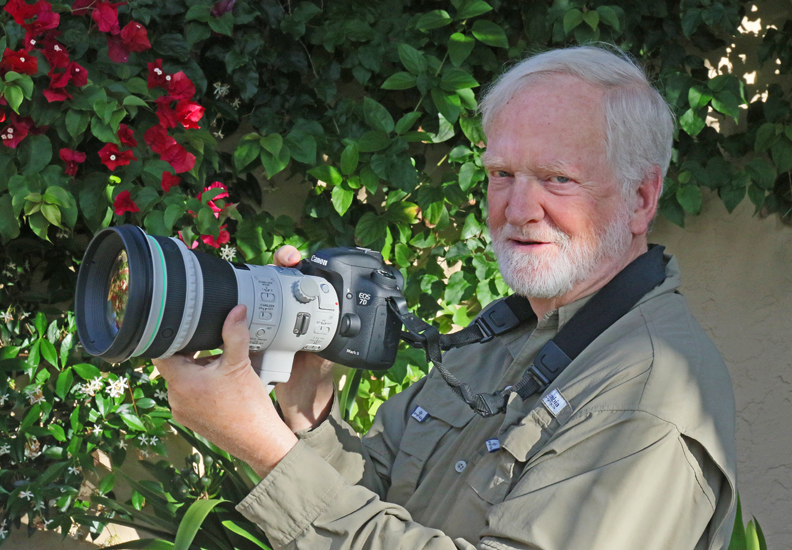
For the past 50 years, professional ecologist and conservationist Budd Titlow has used his pen and camera to capture the awe and wonders of our natural world. His goal has always been to inspire others to both appreciate and enjoy what he sees. Now he has one main question: Can we save humankind’s place within nature’s beauty, before it’s too late?
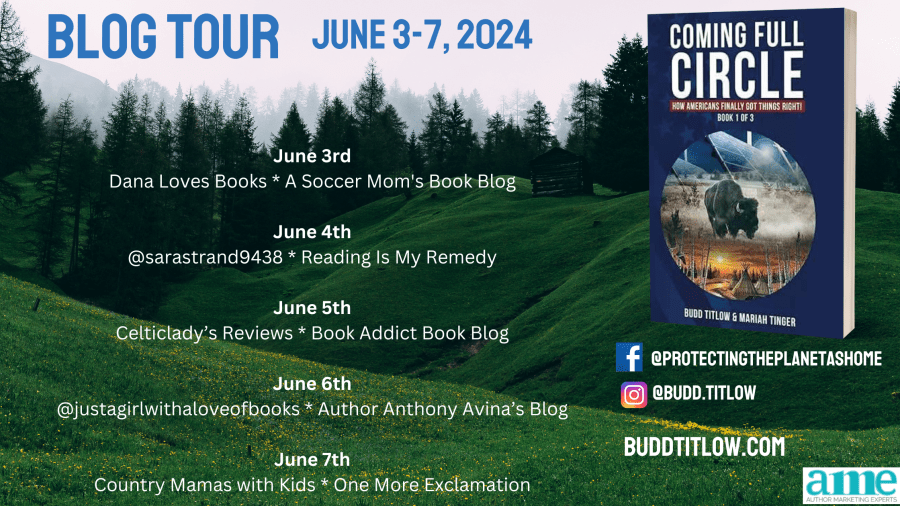
Budd’s two latest books are dedicated to answering this perplexing dilemma. Protecting the Planet, a non-fiction book, examines whether we still have the environmental champions among us needed to accomplish this goal. Next, using fact-filled and entertaining story-telling, his latest book — Coming Full Circle — provides the answers we all seek and need.
Having published five books, more than 500 photo-essays, and 5,000 photographs, Budd Titlow lives with his music educator wife, Debby, in San Diego, California.
Website: https://buddtitlow.com/
Facebook: https://www.facebook.com/protectingtheplanetashome/
Instagram: https://www.instagram.com/budd.titlow/
Amazon: https://amzn.to/49GPaG1
Goodreads: https://www.goodreads.com/book/show/201613673-coming-full-circle
Praise:
“An adventurous, passionate historical novel about an eco-friendly balance between humans and nature.” – Kirkus Reviews
“Using a blend of historical fiction and poignant truths, the (book’s) narrative delivers a spirited discourse on conservation, our environment, oneness, and chiefly, the concept of coming full circle. Overall, the authors’ expertise in the topic of conservationism and their knack for storytelling is on full display, making for a highly recommended read.” – US Review of Books
“I recommend Coming Full Circle to fans of issues-focused fiction who also enjoy family sagas and tales of growth, learning, and self-discovery.” – Readers’ Choice
EXCERPT
PROLOGUE
There is a lot that our U.S. biology and history books don’t tell us.
Tracking the triumphs and travails of a multi-generational American family, this book sets the record straight.
From a biological perspective, many American colonists didn’t care about protecting our native wildlife or conserving our natural resources.
Just think about the once abundant species that are no longer with us — the passenger pigeon, the eastern elk, the Carolina parakeet, the heath hen, the American bison (almost), and the black-footed ferret (almost).
Then consider our native tallgrass and midgrass prairies — most of which were swallowed up by settlers’ plows and then blown away during the Dust Bowl of the 1930s. Finally, look at our air and water quality — both poisoned by industrialization and still trying to recover.
On the history side of the ledger, no group of U.S. citizens has ever been more disrespected and abused than our Native American tribes.
They respected all species as equals and managed their lands not just in sustainable ways, but in ways that enhanced the flourishing of the ecosystem. Yet they lost both their ancestral lands and their cultural societies to colonial progress.
But — in the end — this book carries a very positive, hopeful message. We can still extract ourselves from our past faux pas. By shedding our polarized viewpoints and working cooperatively, we can still save our planet before it’s too late.
For both of us, this book is a career self-examination. For me (Budd) the text expresses many things I’ve learned about the natural world during my fifty years as a wildlife ecologist and resource conservationist.
For me (Mariah), the book’s content captures the joy of the natural world that my dad (Budd) taught me, how that joy has shaped my career as an educator and science communicator, and how I hope it influences my children’s paths. We both see reflections of our past and visions of our future modeled in the multi-generations of families connected to nature.
Throughout this book, we also emphasize our lifelong beliefs in the sanctity and equality of all living things — both human and non-human.
Our belief system encompasses all races, religions, cultures, and lifestyles — but especially those of the Indigenous (or Native) Peoples of the world.
As expressed in our main title, Coming Full Circle, our book’s central theme revolves around two primary terms — the circle of life and biodiversity.
Many of us — especially those with kids or grandkids — know the first term, the circle of life, as the mega-hit song from the Broadway musical and blockbuster movie, The Lion King. In reality, the circle of life is a symbolic representation of birth, survival, and death — which leads back to birth. For example, an antelope may live for years — grazing peacefully on African grasslands and producing several healthy calves. But — as she nears the end of her life and thus her speediness — a hungry lioness captures and kills her. The antelope dies, but the lioness brings her body back for the nourishment of her hungry cubs. In this way, the antelope’s death sustains the life of the lioness’s pride — or family of lions.
Life is thus represented as a circle because it is a constant loop. The idea of life as a circle exists across multiple religions and philosophies. This belief was prevalent throughout the early Indigenous Peoples of Earth. Unfortunately — owing to what some may term ‘progress’ — this fervent belief in the circle of life is much less common in today’s world.
The second term — biological diversity, or biodiversity for short — is primarily used by biologists and ecologists. Biodiversity means the variety of life — the total number of species, both plants and animals —living on Earth. This includes everything from the tiniest microbial spores to the gargantuan blue whale. Generally speaking, the greater the biodiversity — the total number of species present — the healthier our planet.
As career environmental scientists, we believe that these two terms are very closely related. In fact, they build off of and intensify one another. Picture the diameter of the circle of life as the number of species that participate in that circle. In our antelope-lioness example above, the diameter would include the lioness and her pride, the antelope and her calves, the grass that the antelope eats, the vultures that feed upon the remainder of the antelope’s carcass, the decomposers that help break down what the vultures leave behind — and so on. In this manner, the circle of life is always intricately populated with species and interdependencies. The larger the circle — in terms of its diameter — the greater Earth’s biodiversity and vice versa. Because of this, we use these terms interchangeably throughout this text.
Unfortunately, the circle of life — or biodiversity — of the United States has decreased dramatically since the first European immigrants landed on our shores. By telling this fictional account — partially based on historical facts — of one multi-generational family of American immigrants, this book explores how and why this change has occurred and how we will — eventually — come back around to again achieve closure of the circle of life.
Our story begins with quite different — but keenly interrelated —anecdotes about two American heroes whose lives were separated by more than half a century.