
1) Tell us a little bit about yourself. How did you get into writing?
I joined the Marine Corps at 17, but I always wanted to create and share stories. This was initially by way of video games, but as time went on and I began approaching 30, I realized that making my own game studio is unlikely for me. Still wanting to share stories and coming around to teaching, my wife actually suggested that I write and publish my ideas as books! I began looking high and low for how to structure a story, writing habits and advice, and of course information on publishing. I started in fiction, which remains unpublished, but shifted my focus to educational non-fiction as a start.
2) What inspired you to write your book?
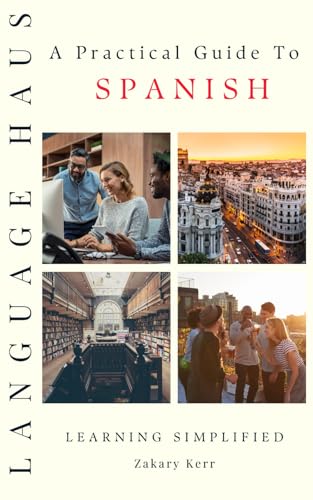
A Practical Guide to Spanish was inspired by three things. First, my love of languages. Spanish is the fifth foreign language that I’ve taken seriously and I’d like to think that, by now, I have something of a process down. Second, is how I enjoy teaching. The more I learned, the more people came to me for advice. After noticing a series of FAQs I got and how I was able to help those around me, I figured getting it all into one place might be helpful. Third, frankly, is my personal aversion to publishing my fiction. In this genre, it’s fact-based, tried and true, where fiction is much more personal. This route was undeniably easier in more ways than one.
3) What theme or message do you hope readers will take away from your book?
What I hope my readers take from A Practical Guide to Spanish is really two things. First, that Spanish is a series of logic and patterns that can be quickly mastered if you have a keen eye for said patterns, chunk the language down to what will directly benefit you, and develop a sense of fluidity with meaning. Second, that this mindset can be applied to any language. Grammar is finite worldwide; things are things and actions are actions, no matter the language. If you understand the “theory” of grammar, learning the “practice” is exponentially easier and even more so when you can notice patterns and similarities.
4) What drew you into this particular genre?
I started taking educational non-fiction seriously because I love learning and I deeply enjoy teaching. Not only is it an opportunity for me to share what I’ve learned and to help people reach their language goals, but it’s also a form of self-help exercise in my opinion. I believe that many people, at least in the US, believe that learning a language is simply out of reach for them and they couldn’t be more mistaken. There are a series of problems with how we approach language acquisition in the US whether it’s via apps, classes, or courses, ranging from the material of the media to the very mindset that they instill. Over time, I developed a strong sense of wanting to remedy that in whatever way I could which is another reason why I paused my fiction to pursue this genre.
5) What social media site has been the most helpful in developing your readership?
While I have a page on Facebook and I’m active on YouTube, I’ve found the most success and engagement on TikTok. Language Haus is the channel on both YouTube and TikTok, where I share my language focused material, habits, and resources. Now that I’m posting on social media, I’m discovering first hand the challenges with it, but I’d never say no to a good learning experience even if that’s all I get from it.
6) What advice would you give to aspiring or just starting authors out there?
Let your ideas run and understand that it’s as hard and expensive as you make it. Whether it’s a daydream that inspires a series or a passion or interest that you want to share, make a basic outline and start writing. The hardest part is starting, but once you do, not only is it extremely rewarding to see your final product online and/or physically, it opens up a world of opportunity. 95% of the writing, editing, and publishing processes can be done by yourself and if you have a decent eye for design, know someone with high attention to detail, and use technology as a tool (not a replacement for the human touch), then cover design, editing, and marketing can also be free or low cost. You are your own worst enemy; a limiting mindset will ruin your book a hundred times before anything else.
7) What does the future hold in store for you? Any new books/projects on the horizon?
A Practical Guide to Spanish is the first in what I call the Spanish Master Suite of Language Haus. I’ve also published a language journal and one beginner story book, but I have another Spanish story book, coloring books for kids and adults with vocabulary, and courses in the works for Spanish. This same model is going to be ported into other languages like French, Mandarin, German, and others that I know or can find partners for. I haven’t let go of my fiction though. Over time, I’d like to get back to that since psychological thrillers and historical fiction definitely take up some of my headspace. For now, though, I’m set on Spanish.
About the Author

Zakary Kerr is the founder of Little House Publishing and the creative force behind Language Haus, a unique educational initiative dedicated to making language learning accessible and enjoyable for adults and children alike. With a passion for linguistic education and a deep understanding of the challenges faced by language learners, Zakary has developed the Language Haus Master Suite, a comprehensive series of educational resources designed to guide learners from beginner to advanced levels.
The first Language Haus Master Suite, focused on Spanish, combines a concise, practical guide, graded readers, children’s books, and engaging multimedia content. Zakary’s approach emphasizes real-world application, cultural understanding, and a structured yet flexible learning process. His materials are crafted to help learners independently achieve fluency in their target language while enjoying the journey.
Zakary continues to expand Language Haus with new language offerings, aiming to foster a global community of enthusiastic language learners.