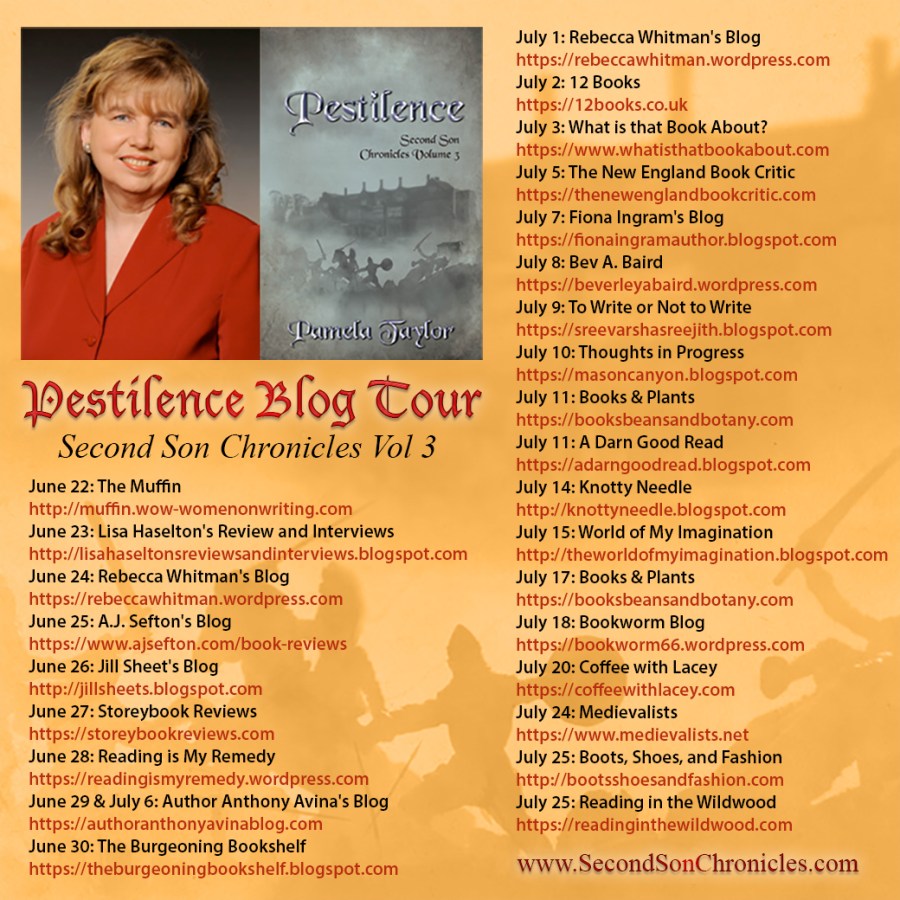
Pestilence (Second Son Chronicles Volume 3) by Pamela Taylor

I received a free copy of this book in exchange for a fair and honest review. All opinions are my own.

Alfred, also known as the Second Son, must challenge all he has ever known to fulfill his father’s dream of keeping his kingdom safe from his power-mad brother in author Pamela Taylor’s novel “Pestilence”, the third volume of the Second Son Chronicles. 

Advertisements

The Synopsis

At the dawn of the Renaissance, Alfred – the eponymous second son – must discover the special destiny foreseen for him by his grandfather. Now, the unthinkable has happened: Alfred’s brother is king. And it isn’t long before everyone’s worst fears are realized. Traditional allegiances are shattered under a style of rule unknown since the grand bargain that formed the kingdom was struck over two hundred years ago. These will be the most dangerous years of Alfred’s life, forcing him to re-examine his duty to personal honor and to the kingdom, while the threats posed by his brother constantly remind him of his father’s final words of advice. What choices will he have to make to try to protect the things he holds most dear?

The Review

As a fan of ancient history, especially the age of the Vikings and the Angelo-Saxon days of early Europe, it was a treat to see a setting in a similar fashion take center stage in this amazing read. Although I have not read the previous two entries in the series, the book does an excellent job of creating a story and atmosphere that holds strong on its own, although for character reference it is probably a good idea to read the first two books. 

The author beautifully captured the tone and feel of a classic tale of ancient kingdoms and knights, warring kings, and politically driven family dramas. Although a fictional setting, the influence of history is evident in every page of this book and creates a unique flow of the story as the characters grow and evolve throughout this story.

The Verdict

A must-read novel, author Pamela Taylor has a smith hit with Pestilence, the third book in her Second Son Chronicles. Evenly paced and entertaining, the novel does a great job of leaving readers on the edge of their seats and sets up a cliffhanger ending that should take readers deep into the future of the series. If you haven’t yet, be sure to grab your copy today!

Rating: 10/10

Pestilence is available to purchase as a print copy and as an e-book at Amazon.com and Barnes and Noble. Be sure to add this to your GoodReads reading list too!

Advertisements

About the Author

Pamela Taylor brings her love of history to the art of storytelling in the Second Son Chronicles. An avid reader of historical fact and fiction, she finds the past offers rich sources for character, ambiance, and plot that allow readers to escape into a world totally unlike their daily lives. She shares her home with two Corgis who frequently reminder her that a dog walk is the best way to find inspiration for that next chapter.

You can follow her online at:

Author Website: https://pamela-taylor.com

Series Website: https://www.SecondSonChronicles.com

Twitter: @PJTAuthor

Instagram: PJTAuthor

Facebook: https://www.facebook.com/TheSecondSonChronicles

GoodReads: https://www.goodreads.com/en/book/show/51487326

Advertisements

Blog Tour Dates

June 22nd @ The Muffin

What goes better in the morning than a muffin? Join us as we celebrate the launch of Pamela Taylor’s blog tour for her book Pestilence. You can read an interview with the author and enter to win the first three books in her series “The Second Son Chronicles.”

http://muffin.wow-womenonwriting.com

June 23rd @ Lisa Haselton’s Review and Interviews

Stop by Lisa’s blog today where she interviews author Pamela Taylor about her book Pestilence.

http://lisahaseltonsreviewsandinterviews.blogspot.com/

June 24th @ Rebecca Whitman’s Blog

Visit Rebecca’s blog today and you can read Pamela Taylor’s guest post discussing the allegory (themes) embedded in the narrative of Pestilence specifically and the Chronicles generally.

https://rebeccawhitman.wordpress.com/

June 25th @ A.J. Sefton’s Blog

Visit A.J. Sefton’s blog and read her review of Pamela Taylor’s book Pestilence.

https://www.ajsefton.com/book-reviews

June 26th @ Jill Sheet’s Blog

Visit Jill’s blog today and read Pamela Taylor’s guest post about getting historical details accurate.

http://jillsheets.blogspot.com/

June 27th @ Storeybook Reviews

Join Leslie today as she shares Pamela Taylor’s guest post about her life with corgis.

https://storeybookreviews.com/

June 28th @ Reading is My Remedy

Visit Chelsie’s blog today and you can read her review of Pamela Taylor’s book Pestilence.

https://readingismyremedy.wordpress.com/

June 29th @ Author Anthony Avina’s Blog

Visit Anthony’s blog today and you can read Pamela Taylor’s guest post about the authors and books that inspired the creation of the Chronicles.

https://authoranthonyavinablog.wordpress.com/

June 30th @ The Burgeoning Bookshelf

Visit Veronica’s blog today and you can read a guest post by Pamela Taylor about the trap of linguistic anachronism – getting the language and word usage right for historical narratives.

https://theburgeoningbookshelf.blogspot.com/

July 1st @ Rebecca Whitman’s Blog

Visit Rebecca’s blog again and you can read her review of Pamela Taylor’s book Pestilence.

https://rebeccawhitman.wordpress.com/

July 2nd @ 12 Books

Visit Louise’s blog today and read her review of Pamela Taylor’s book Pestilence.

https://12books.co.uk/

July 3rd @ What is that Book About?

Visit Michelle’s blog today and you can check out a spotlight of Pamela Taylor’s book Pestilence.

https://www.whatisthatbookabout.com/

July 5th @ The New England Book Critic

Visit Vickie’s blog today and read her review of Pamela Taylor’s book Pestilence.

https://thenewenglandbookcritic.com/

July 6th @ Author Anthony Avina’s Blog

Visit Anthony’s blog today and read his review of Pamela Taylor’s book Pestilence.

https://authoranthonyavinablog.wordpress.com/

July 7th @ Fiona Ingram’s Blog

Join Fiona Ingram today when she shares Pamela Taylor’s guest post about data encryption in ancient times.

https://fionaingramauthor.blogspot.com/

July 8th @ Bev A. Baird

Visit Bev’s blog today and read her review of Pamela Taylor’s book Pestilence.

https://beverleyabaird.wordpress.com/

July 9th @ To Write or Not to Write

Visit Sreevarsha’s blog and read her review of Pamela Taylor’s book Pestilence.

https://sreevarshasreejith.blogspot.com/

July 10th @ Thoughts in Progress

Visit Mason Canyon’s blog today and you can read a guest post by Pamela Taylor about deriving details for your setting from historical maps.

https://masoncanyon.blogspot.com/

July 11th @ Books & Plants

Visit Ashley’s blog and read her review of Pamela Taylor’s book Pestilence.

https://booksbeansandbotany.com/

July 11th @ A Darn Good Read

Join Yvonne as she reviews Pamela Taylor’s book Pestilence.

https://adarngoodread.blogspot.com/

July 14th @ Knotty Needle

Visit Judy’s blog and read her review of Pamela Taylor’s book Pestilence.

http://knottyneedle.blogspot.com/

July 15th @ World of My Imagination

Visit Nicole’s blog and read Pamela Taylor’s guest post about period-appropriate names for characters.

http://theworldofmyimagination.blogspot.com

July 17th @ Books & Plants

Visit Ashley’s blog and read Pamela Taylor’s guest post about ways to do historical research.

https://booksbeansandbotany.com/

July 18th @ Bookworm Blog

Stop by Anjanette’s blog today where you can read her review of Pamela Taylor’s book Pestilence. Plus you can read an interview with the author!

https://bookworm66.wordpress.com/

July 20th @ Coffee with Lacey

Visit Lacey’s blog where you can read her review of Pamela Taylor’s book Pestilence.

https://coffeewithlacey.com/

July 24th @ Medievalists

Stop by Medievalists where you can check out a spotlight of Pamela Taylor’s book Pestilence.

https://www.medievalists.net/

July 25th @ Boots, Shoes, and Fashion

Stop by Linda’s blog today and read her extensive interview with author Pamela Taylor about her book Pestilence.

http://bootsshoesandfashion.com/

July 25th @ Reading in the Wildwood

Join Megan today and read her review of Pamela Taylor’s book Pestilence.
https://readinginthewildwood.com/

Just Like That (Albin Academy #1) by Cole McCade Review

I received a free copy of this book in exchange for a fair and honest review. All opinions are my own. 

A young teacher returns to the school that tormented his youth, and is surprised by the bond he creates with his former teacher, who soon becomes something much more than colleagues in author Cole McCade’s “Just Like That”. 

Advertisements

The Synopsis

Summer Hemlock never meant to come back to Omen, Massachusetts.

But with his mother in need of help, Summer has no choice but to return to his hometown, take up a teaching residency at the Albin Academy boarding school—and work directly under the man who made his teenage years miserable.

Professor Fox Iseya

Forbidding, aloof, commanding: psychology instructor Iseya is a cipher who’s always fascinated and intimidated shy, anxious Summer. But that fascination turns into something more when the older man challenges Summer to be brave. What starts as a daily game to reward Summer with a kiss for every obstacle overcome turns passionate, and a professional relationship turns quickly personal.

Yet Iseya’s walls of grief may be too high for someone like Summer to climb…until Summer’s infectious warmth shows Fox everything he’s been missing in life.

Now both men must be brave enough to trust each other, to take that leap.

To find the love they’ve always needed…

Just like that.

In Just Like That, critically acclaimed author Cole McCade introduces us to Albin Academy: a private boys’ school where some of the world’s richest families send their problem children to learn discipline and maturity, out of the public eye.

The Review

A powerful and emotional read, the author does a great job of building a complex story that focuses on character development above anything else. The bond between Summer and Professor Fox is engaging and real and draws the reader in immediately. 

The balance of the two characters and their personalities was unique to see unfold here, as was the way they balanced one another. From Summer’s submissive, quiet, and yet determined personality to Professor Fox’s strong, reserved, and more assured personality, these two drive home the romance and drama of the two character’s pasts, which compliments their growing bond as well. 

The Verdict

A moving, engaging, and emotional read that plunges the depths of the reader’s hearts, author Cole McCade’s novel “Just Like That” is a fantastic LGBTQ read that pushes the genre forward and creates memorable and relatable characters. If you haven’t yet be sure to grab your copies today! 

Rating: 10/10

Advertisements

Buy Links

Amazon: https://www.amazon.com/dp/1335146458 

Barnes & Noble: https://www.barnesandnoble.com/w/just-like-that-cole-mccade/1135613577

Apple Books: https://books.apple.com/us/book/just-like-that/id1491922418 

Google Play: https://play.google.com/store/books/details/Cole_McCade_Just_Like_That?id=tsbEDwAAQBAJ 

Kobo: https://www.kobo.com/us/en/ebook/just-like-that-12 

About the Author

Cole McCade is a New Orleans-born Southern boy without the Southern accent, currently residing somewhere in Seattle. He spends his days as a suit-and-tie corporate consultant and business writer, and his nights writing contemporary romance and erotica that flirts with the edge of taboo—when he’s not being tackled by two hyperactive cats. 

He also writes genre-bending science fiction and fantasy tinged with a touch of horror and flavored by the influences of his multiethnic, multicultural, multilingual background as Xen. He wavers between calling himself bisexual, calling himself queer, and trying to figure out where “demi” fits into the whole mess—but no matter what word he uses he’s a staunch advocate of LGBTQIA and POC representation and visibility in genre fiction. And while he spends more time than is healthy hiding in his writing cave instead of hanging around social media, you can generally find him in these usual haunts: 

Advertisements

Excerpt

“Extinguisher first, then sand,” the voice ordered. “Dr. Liu, if you insist on getting in the way, at least make yourself useful and remove anything else flammable from the vicinity of the blaze. Quickly, now. Keep your mouths covered.”

Summer’s entire body tingled, prickled, as if his skin had drawn too tight. That voice—that voice brought back too many memories. Afternoons in his psychology elective class, staring down at his textbook and doodling in his notebook and refusing to look up, to look at anyone, while that voice washed over him for an hour. Summer knew that voice almost better than the face attached to it, every inflection and cadence, the way it could command silence with a quiet word more effectively than any shout.

And how sometimes it seemed more expressive than the cold, withdrawn expression of the man he remembered, standing tall and stern in front of a class of boys who were all just a little bit afraid of him.

Summer had never been afraid, not really.

But he hadn’t had the courage to whisper to himself what he’d really felt, when he’d been a hopeless boy who’d done everything he could to be invisible.

Heart beating harder, he followed the sound of that voice to the open doorway of a smoke-filled room, the entire chemistry lab a haze of gray and black and crackling orange; from what he could tell a table was…on fire? Or at least the substance inside a blackened beaker was on fire, belching out a seemingly never-ending, impossible billow of smoke and flame.

Several smaller fires burned throughout the room; it looked as though sparks had jumped to catch on notebooks, papers, books. Several indistinct shapes alternately sprayed the conflagration with fire extinguishers and doused it with little hand buckets of sand from the emergency kit in the corner of the room, everyone working clumsily one-handed while they held wet paper towels over their noses and mouths with the other.

And standing tall over them all—several teachers and older students, it looked like—was the one man Summer had returned to Omen to see.

Professor Iseya.

He stood head and shoulders above the rest, his broad-shouldered, leanly angular frame as proud as a battle standard, elegant in a trim white button-down tucked into dark gray slacks, suspenders striping in neat black lines down his chest. Behind slim glasses, his pale, sharply angled gray eyes flicked swiftly over the room, set in a narrow, graceful face that had only weathered with age into an ivory mask of quiet, aloof beauty.

The sleek slick of his ink-black hair was pulled back from his face as always—but as always, he could never quite keep the soft strands inside their tie, and several wisped free to frame his face, lay against his long, smooth neck, pour down his shoulders and back. He held a damp paper towel over his mouth, neatly folded into a square, and spoke through it to direct the frazzled-looking group with consummate calm, taking complete control of the situation.

And complete control of Summer, as Iseya’s gaze abruptly snapped to him, locking on him from across the room. “Why have you not evacuated?” Iseya demanded coldly, his words precise, inflected with a softly cultured accent. “Please vacate the premises until we’ve contained the blaze.”

Summer dropped his eyes immediately—habit, staring down at his feet. “Oh, um—I came to help,” he mumbled through the collar of his shirt.

A pause, then, “You’re not a student. Who are you?”

That shouldn’t sting.

But then it had been seven years, he’d only been in two of Iseya’s classes…and he’d changed, since he’d left Omen.

At least, he hoped he had.

That was why he’d run away, after all. To shake off the boy he’d been; to find himself in a big city like Baltimore, and maybe, just maybe…

Learn not to be so afraid.

But he almost couldn’t bring himself to speak, while the silence demanded an answer. “I’m not a student anymore,” he corrected, almost under his breath. “It’s…it’s me. Summer. Summer Hemlock. Your new TA.” He made himself look up, even if he didn’t raise his head, peeking at Iseya through the wreathing of smoke that made the man look like some strange and ghostly figure, this ethereal spirit swirled in mist and darkness. “Hi, Professor Iseya. Hi.”

Copyright © 2020 by Cole McCade

Guest Blog Post: Reading that led to the Second Son Chronicles by Pamela Taylor

I suppose it’s arguable that everything I’ve ever read about the era in which the Second Son Chronicles are set has, in some way, influenced the creation of the narratives. After all, there’s a certain amount of osmosis that happens with every book we enjoy. But within that broad-brush landscape, some highlights do stand out (in no particular order).

Alison Weir’s non-fiction has been a rich source of details about life in Medieval and Renaissance times. Regardless of the specific subject, her books describe in great depth what daily life was like during these periods – it’s an immersive experience, and the osmosis factor helped me to create the world of the Chronicles.

I also found inspiration in Ken Follett’s Kingsbridge series, particularly The Pillars of the Earth and World Without End.  Follett’s detailed depiction of the building of the great Gothic cathedrals got me thinking about architecture, engineering, and building from Roman times through the Renaissance and led to the inclusion of some building projects in my own books. His narrative of the inventive ways that those outside mainstream medicine of the day began to understand the nature of the spread of infection and the importance of hygiene and other methods for containing it helped inspire my own exploration of how people dealt with disease over six hundred years ago.

Whether it’s in the shield wall with Uhtred of Bebbanburg or in the fields of Agincourt with Henry V, Bernard Cornwell doesn’t shy away from the gritty and brutal realism of the battlefields of long ago. My battle scenes pale by comparison to Cornwell’s ability to bring the sights and sounds and stench and fear and blood-lust of medieval war to life. But I happily acknowledge my debt to him for showing how to make my battles more realistic than they might otherwise have been.

While the time period is much earlier than that of my stories, Jack Whyte’s re-imagining of the Arthurian legends in his Camulod Chronicles influenced a number of decisions I made for my own series. Whyte postulates a world that might have existed in post-Roman Britain and an entirely realistic history that could, in the absence of any surviving written record, have been the basis for the legends. So what does this have to do with the Second Son Chronicles?

My stories are set at the dawn of the Renaissance, a time when so much is well-known about the characters and events of northern Europe. Asking readers to accept that an entirely different set of royalty, nobility, and events could have existed seemed like too great a suspension of disbelief. But if Whyte could create an entirely imagined history, why couldn’t I create an imagined setting for my own narrative? If readers notice some similarities to northern Europe, then perhaps that only adds to the flavor of the world where my characters play out their lives.

I hope you enjoy reading the Second Son Chronicles as much as I’ve enjoyed bringing the stories to life.

Advertisements

Book Summary

At the dawn of the Renaissance, Alfred – the eponymous second son – must discover the special destiny foreseen for him by his grandfather. Now, the unthinkable has happened: Alfred’s brother is king. And it isn’t long before everyone’s worst fears are realized. Traditional allegiances are shattered under a style of rule unknown since the grand bargain that formed the kingdom was struck over two hundred years ago. These will be the most dangerous years of Alfred’s life, forcing him to re-examine his duty to personal honor and to the kingdom, while the threats posed by his brother constantly remind him of his father’s final words of advice. What choices will he have to make to try to protect the things he holds most dear?

Print Length: 234 Pages

Genre: Historical Fiction

Publisher: Black Rose Writing

ASIN: B08563V87C

ISBN-10: 1684334810

ISBN-13: 9781684334810

Pestilence is available to purchase as a print copy and as an e-book at Amazon.com and Barnes and Noble. Be sure to add this to your GoodReads reading list too!

Advertisements

About the Author, Pamela Taylor

Pamela Taylor brings her love of history to the art of storytelling in the Second Son Chronicles. An avid reader of historical fact and fiction, she finds the past offers rich sources for character, ambiance, and plot that allow readers to escape into a world totally unlike their daily lives. She shares her home with two Corgis who frequently reminder her that a dog walk is the best way to find inspiration for that next chapter.

You can follow her online at:

Author Website: https://pamela-taylor.com

Series Website: https://www.SecondSonChronicles.com

Twitter: @PJTAuthor

Instagram: PJTAuthor

Facebook: https://www.facebook.com/TheSecondSonChronicles

GoodReads: https://www.goodreads.com/en/book/show/51487326

Advertisements

— Blog Tour Dates

June 22nd @ The Muffin

What goes better in the morning than a muffin? Join us as we celebrate the launch of Pamela Taylor’s blog tour for her book Pestilence. You can read an interview with the author and enter to win the first three books in her series “The Second Son Chronicles.”

http://muffin.wow-womenonwriting.com

June 23rd @ Lisa Haselton’s Review and Interviews

Stop by Lisa’s blog today where she interviews author Pamela Taylor about her book Pestilence.

http://lisahaseltonsreviewsandinterviews.blogspot.com/

June 24th @ Rebecca Whitman’s Blog

Visit Rebecca’s blog today and you can read Pamela Taylor’s guest post discussing the allegory (themes) embedded in the narrative of Pestilence specifically and the Chronicles generally.

https://rebeccawhitman.wordpress.com/

June 25th @ A.J. Sefton’s Blog

Visit A.J. Sefton’s blog and read her review of Pamela Taylor’s book Pestilence.

https://www.ajsefton.com/book-reviews

June 26th @ Jill Sheet’s Blog

Visit Jill’s blog today and read Pamela Taylor’s guest post about getting historical details accurate.

http://jillsheets.blogspot.com/

June 27th @ Storeybook Reviews

Join Leslie today as she shares Pamela Taylor’s guest post about her life with corgis.

https://storeybookreviews.com/

June 28th @ Reading is My Remedy

Visit Chelsie’s blog today and you can read her review of Pamela Taylor’s book Pestilence.

https://readingismyremedy.wordpress.com/

June 29th @ Author Anthony Avina’s Blog

Visit Anthony’s blog today and you can read Pamela Taylor’s guest post about the authors and books that inspired the creation of the Chronicles.

https://authoranthonyavinablog.wordpress.com/

June 30th @ The Burgeoning Bookshelf

Visit Veronica’s blog today and you can read a guest post by Pamela Taylor about the trap of linguistic anachronism – getting the language and word usage right for historical narratives.

https://theburgeoningbookshelf.blogspot.com/

July 1st @ Rebecca Whitman’s Blog

Visit Rebecca’s blog again and you can read her review of Pamela Taylor’s book Pestilence.

https://rebeccawhitman.wordpress.com/

July 2nd @ 12 Books

Visit Louise’s blog today and read her review of Pamela Taylor’s book Pestilence.

https://12books.co.uk/

July 3rd @ What is that Book About?

Visit Michelle’s blog today and you can check out a spotlight of Pamela Taylor’s book Pestilence.

https://www.whatisthatbookabout.com/

July 5th @ The New England Book Critic

Visit Vickie’s blog today and read her review of Pamela Taylor’s book Pestilence.

https://thenewenglandbookcritic.com/

July 6th @ Author Anthony Avina’s Blog

Visit Anthony’s blog today and read his review of Pamela Taylor’s book Pestilence.

https://authoranthonyavinablog.wordpress.com/

July 7th @ Fiona Ingram’s Blog

Join Fiona Ingram today when she shares Pamela Taylor’s guest post about data encryption in ancient times.

https://fionaingramauthor.blogspot.com/

July 8th @ Bev A. Baird

Visit Bev’s blog today and read her review of Pamela Taylor’s book Pestilence.

https://beverleyabaird.wordpress.com/

July 9th @ To Write or Not to Write

Visit Sreevarsha’s blog and read her review of Pamela Taylor’s book Pestilence.

https://sreevarshasreejith.blogspot.com/

July 10th @ Thoughts in Progress

Visit Mason Canyon’s blog today and you can read a guest post by Pamela Taylor about deriving details for your setting from historical maps.

https://masoncanyon.blogspot.com/

July 11th @ Books & Plants

Visit Ashley’s blog and read her review of Pamela Taylor’s book Pestilence.

https://booksbeansandbotany.com/

July 11th @ A Darn Good Read

Join Yvonne as she reviews Pamela Taylor’s book Pestilence.

https://adarngoodread.blogspot.com/

July 14th @ Knotty Needle

Visit Judy’s blog and read her review of Pamela Taylor’s book Pestilence.

http://knottyneedle.blogspot.com/

July 15th @ World of My Imagination

Visit Nicole’s blog and read Pamela Taylor’s guest post about period-appropriate names for characters.

http://theworldofmyimagination.blogspot.com

July 17th @ Books & Plants

Visit Ashley’s blog and read Pamela Taylor’s guest post about ways to do historical research.

https://booksbeansandbotany.com/

July 18th @ Bookworm Blog

Stop by Anjanette’s blog today where you can read her review of Pamela Taylor’s book Pestilence. Plus you can read an interview with the author!

https://bookworm66.wordpress.com/

July 20th @ Coffee with Lacey

Visit Lacey’s blog where you can read her review of Pamela Taylor’s book Pestilence.

https://coffeewithlacey.com/

July 24th @ Medievalists

Stop by Medievalists where you can check out a spotlight of Pamela Taylor’s book Pestilence.

https://www.medievalists.net/

July 25th @ Boots, Shoes, and Fashion

Stop by Linda’s blog today and read her extensive interview with author Pamela Taylor about her book Pestilence.

http://bootsshoesandfashion.com/

July 25th @ Reading in the Wildwood

Join Megan today and read her review of Pamela Taylor’s book Pestilence.

https://readinginthewildwood.com/

Curses of Scale by S.D. Reeves Review

I received a free copy of this book in exchange for a fair and honest review. All opinions are my own. 

A young girl must outrun destiny as a powerful threat emerges while others chase her through another realm entirely in author S.D. Reeves novel, “Curses of Scale”. 

Advertisements

The Synopsis

Sixteen-year-old Niena wants nothing more than to attend an elite bardic college, but when the dragon that shattered the empire awakens again she finds herself on the run, through the fey realm of Fairhome, to the city where she was born. On her trail are her army veteran grandfather, thrown into a commander’s role he doesn’t want, the lord of the fairies, trying to steer her to his own ends, and the husband she won’t meet for fifteen years. If she kills the dragon, she’ll save everyone she holds dear. But if she kills the dragon, she’s cursed instead to become it.

The Review

A fantastic prequel to the author’s novel “The Melody of Three”, the author does an amazing job of building up this magical, fantasy world. From ancient curses and alternate timelines to the fae, dragons, and a young woman fighting destiny in an attempt to make her own path in life, this book hits every mark for a great epic fantasy novel.

The mythology and character arcs were the highlights of this read. The main character Niena was someone the reader could really stand behind and root for and did a great job of showcasing a well-rounded story arc that felt authentic to who she was as a character. The action was intense and the final chapters of the book proved emotional and rewarding all at once. 

The Verdict

A well rounded, in-depth and evenly paced read, author S.D. Reeves does an amazing job of capturing the reader’s attention early on and creating complex characters, some of which you eagerly wait to see if they prove trustworthy or not. An epic quest that challenges the notion of expectations and destiny, this was a fantasy whirlwind adventure that fully realized the fantasy genre and showcased the ever-growing mythology the author has created. Be sure to grab your copy today!

Rating: 10/10

About the Author

Stephen Reeves was born in 1980 in Huntsville, Alabama, but grew up in a small community just on the edge called Madison. His writing career began during a boring math class in college and has blossomed over the last couple of decades into something decidedly not boring. His works have been published in numerous zines including The Blotter, Chantwood, Yellow Chair Review, and The Writers Drawer. Stephen has also reviewed books for Oxford University Press, including Micheal Newtons Victorian Fairy Tales.

Curses of Scale is his debut novel, written over the course of four years in the inspirational country of Switzerland, where he now resides with his wife, two cats, and an obsessive Pomeranian.

Amazon: https://www.amazon.com/gp/product/194684912X/ref=x_gr_w_bb_sin?ie=UTF8&tag=x_gr_w_bb_sin-20&linkCode=as2&camp=1789&creative=9325&creativeASIN=194684912X&SubscriptionId=1MGPYB6YW3HWK55XCGG2#customerReviews

Goodreads: https://www.goodreads.com/author/show/17067943.S_D_Reeves

Guest Blog Post by Author/Poet Elizabeth Hazen

I am honored to share with you a fantastic guest blog post from author and poet Elizabeth Hazen, as part of the wonderful blog tour for “Girls Like Us”.

Advertisements

For Christmas, which seems like three lifetimes ago, my parents gave my husband a book of interesting words from around the world*. An engineer who has a soft spot for spoonerisms, puns, and wordplay in every form, he found instant delight in this book. Did you know that Germans have a word for the weight we gain from stress-eating? Kummerspeck. Or that the Scots have a word for that awkward pause when you’ve forgotten the name of the person you’re introducing? Tartle. Among my favorites are the whimsical Swedish smultronställe, a place of wild strawberries; the romantic Italian dormiveglia, the space between sleeping and waking; and the essential Japanese tsundoku, that pile of unread books on my bedside table that grows with each passing month. 

Needless to say, I took that book of words from my husband, adding one more to my stack.

Getting through my tsundoku – or at least managing it – is one of my goals for this summer. I am a teacher, and the summer brings with it the beautiful freedom of longer days and fewer responsibilities, but the lack of structure –ironically, frustratingly, and inevitably – invites bad habits and a gradual decline into despair over the time I fear I am wasting. As a result, I know I need to impose some kind of schedule – a routine that will keep me on track. Part of that routine, I have decided, will include reading more poetry. 

One of the lessons I most love to teach to my seventh-grade students involves defining poetry. We examine a range of definitions – the top of our heads being blown off, the best words in the best order, language at its most distilled and most powerful. We can debate the specifics, note our preferences, but that words are the poet’s medium is indisputable. Imperfect, delicious, malleable, living, breathing words. It is my love of words that I always return to during the darkest moments, and boy are these days dark. 

In a review of my recent collection, Girls Like Us, Nandini Bhattacharya defines the poem as “ineffable interrogator, ethicist and chronicler of human history.” Indeed, I certainly have found more accuracy and truth in poems than in the newspaper, more solace in poems than in meditation or exercise, more freedom in poems than in the endless walks I take to escape the confines of quarantine. As when I was in the thick of adolescent depression, poems come to rescue me, to remind me that the legacy of human sadness and loss and pain is infinite, but so is our legacy of resilience and power and change. 

Perhaps poems allow us to do what the Dutch call uitwaaien: “to take a break and walk away from the demands of life to clear one’s head.” Or maybe life demands poems, and it is precisely in these moments of trauma and fear and violence that we must dive in head-first. Whatever they do, I am grateful for them. Here are several recent collections by women that I highly recommend. Each, in its own way, has given me what the Icelandic call radljóst: enough light to find my way.

Difficult Fruit by Lauren K. Alleyne, Peepal Tree, 2014

Thrust by Heather Derr-Smith, Persea Books, 2017

American Samizdat by Jehanne Dubrow, Diode Editions, 2019

The Miracles by Amy Lemmon, C&R Press, 2018

Voyage of the Sable Venus by Robin Coste Lewis, Knopf, 2016

Code by Charlotte Pence, Black Lawrence Press, 2020

How to Exterminate the Black Woman by Monica Prince, [Pank Books], 2019

American Lyric Trilogy by Claudia Rankine, Graywolf, 2004, 2014, 2020

The State She’s In by Lesley Wheeler, Tinderbox Editions, 2020

*The book of words I refer to is Other Wordly: Words Both Strange and Lovely from Around the World by Yee-Lum Yak with illustrations by Kelsey Garrity-Riley

Advertisements

About the Author:

Elizabeth Hazen is a poet, essayist, and teacher. A Maryland native, she came of age in a suburb of Washington, D.C. in the pre-internet, grunge-tinted 1990s, when women were riding the third wave of feminism and fighting the accompanying backlash. She began writing poems when she was in middle school, after a kind-hearted librarian handed her Lawrence Ferlinghetti’s A Coney Island of the Mind. She has been reading and writing poems ever since.

Hazen’s work explores issues of addiction, mental health, and sexual trauma, as well as the restorative power of love and forgiveness. Her poems have appeared in Best American Poetry, American Literary Review, Shenandoah, Southwest Review, The Threepenny Review, The Normal School, and other journals. Alan Squire Publishing released her first book, Chaos Theories, in 2016. Girls Like Us is her second collection. She lives in Baltimore with her family.

GoodReads Link: https://www.goodreads.com/book/show/50162841-girls-like-us

Amazon Link: https://amzn.to/2U4wdtg

Alan Squire Publishing (also available is a SoundCloud Audio reading from her first collection): https://alansquirepublishing.com/book-authors/elizabeth-hazen/

Schedule for Blog Tour:

May 4: Musings of a Bookish Kitty (Review)

May 15: Allie Reads (Review)

May 19: the bookworm (Guest Post)

May 26: The Book Lover’s Boudoir (Review)

May 28: Impressions in Ink (Review)

June 2: Vidhya Thakkar (Review)

June 9: Everything Distils Into Reading (Review)

June 11: Read, Write and Life Around It (Review)

June 15: Readaholic Zone (Review)

June 16: Read, Write and Life Around It (Interview – tentative)

June 24: Anthony Avina Blog (Review)

June 26: Anthony Avina Blog (Guest Post)

June 30: Review Tales by Jeyran Main (Review)

July 9: The Book Connection (Review)

July 22: Diary of an Eccentric (Review)

July 7: CelticLady’s Reviews (Spotlight/video)

a Rafflecopter giveaway

Girls Like Us by Elizabeth Hazen Review

I received a free copy of this book in exchange for a fair and honest review. All opinions are my own. 

A powerful book of poetry that dives into the complex nature of female identity and the roles they’ve been forced into playing in society throughout history comes to life in author and poet Elizabeth Hazen’s book, “Girls Like Us”. 

Advertisements

The Synopsis

Girls Like Us is packed with fierce, eloquent, and deeply intelligent poetry focused on female identity and the contradictory personas women are expected to embody. The women in these poems sometimes fear and sometimes knowingly provoke the male gaze. At times, they try to reconcile themselves to the violence that such attentions may bring; at others, they actively defy it. Hazen’s insights into the conflict between desire and wholeness, between self and self-destruction, are harrowing and wise. The predicaments confronted in Girls Like Us are age-old and universal—but in our current era, Hazen’s work has a particular weight, power, and value. 

The Review

What a moving work of poetry. The author does an incredible job of bringing the pain and emotion that many women in life have had to endure through society’s expectations and the roles cast upon them through her work. As someone who considers himself a feminist and someone who has always wanted to live in a world where my mother and sister could live knowing they were viewed by everyone as equals and were respected, this poetry really spoke to me on a personal level while also feeling personal to the author at the same time. 

What really captured my attention as a reader was the way the author writes, in which many of the poems were written with such precision and detail-oriented writing, and yet felt personal to the author and broad enough for others to connect to on their own personal levels. The complexity of the layers of this poetry speaks to the simple desire for equality so many seek throughout their lives, and the ongoing fight to bring that equality to life. 

The Verdict

A truly one of a kind read, the author and poet Elizabeth Hazen and her book “Girls Like Us” is a truly amazing work of poems. The raw emotions combined with the true and often sad realities the poems capture of life connect with readers on an intimate level, and the theme and heart of the book speak to so many that readers will not be able to put it down. Be sure to grab this quick yet powerful read today!

Rating: 10/10

About the Author:

Elizabeth Hazen is a poet, essayist, and teacher. A Maryland native, she came of age in a suburb of Washington, D.C. in the pre-internet, grunge-tinted 1990s, when women were riding the third wave of feminism and fighting the accompanying backlash. She began writing poems when she was in middle school, after a kind-hearted librarian handed her Lawrence Ferlinghetti’s A Coney Island of the Mind. She has been reading and writing poems ever since.

Hazen’s work explores issues of addiction, mental health, and sexual trauma, as well as the restorative power of love and forgiveness. Her poems have appeared in Best American Poetry, American Literary Review, Shenandoah, Southwest Review, The Threepenny Review, The Normal School, and other journals. Alan Squire Publishing released her first book, Chaos Theories, in 2016. Girls Like Us is her second collection. She lives in Baltimore with her family.

GoodReads Link: https://www.goodreads.com/book/show/50162841-girls-like-us

Amazon Link: https://amzn.to/2U4wdtg

Alan Squire Publishing (also available is a SoundCloud Audio reading from her first collection): https://alansquirepublishing.com/book-authors/elizabeth-hazen/

Schedule for Blog Tour:

May 4: Musings of a Bookish Kitty (Review)

May 15: Allie Reads (Review)

May 19: the bookworm (Guest Post)

May 26: The Book Lover’s Boudoir (Review)

May 28: Impressions in Ink (Review)

June 2: Vidhya Thakkar (Review)

June 9: Everything Distils Into Reading (Review)

June 11: Read, Write and Life Around It (Review)

June 15: Readaholic Zone (Review)

June 16: Read, Write and Life Around It (Interview – tentative)

June 24: Anthony Avina Blog (Review)

June 26: Anthony Avina Blog (Guest Post)

June 30: Review Tales by Jeyran Main (Review)

July 9: The Book Connection (Review)

July 22: Diary of an Eccentric (Review)

July 7: CelticLady’s Reviews (Spotlight/video)

a Rafflecopter giveaway

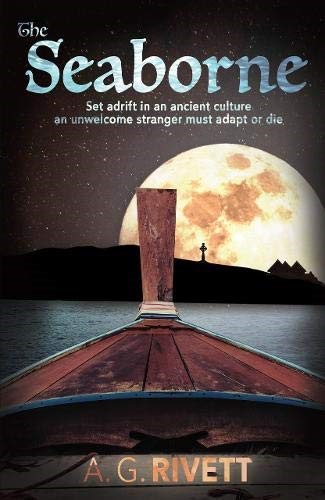
The Seaborne by A.G. Rivett Review

I received a free copy of this book in exchange for a fair and honest review. All opinions are my own.

A man shipwrecked and rescued finds himself on not only a different world, but a different time altogether in author A.G. Rivett’s novel “The Seaborne”. 

Advertisements

The Synopsis

Seaborne. The word echoes in Dermot’s mind. Washed up from who knows where, with no people to belong to, no clan to speak for him: aa man alone in the world. If this man lives, what will he turn out to be? What might he bring among the Islanders?

John had not dreamed that anywhere in the North Atlantic could be this remote. There must be someone, if not here, then not far away, who even if they didn’t speak English would at least recognise it.

John Finlay, engineer, is running away from his failed business, his failed relationship and his debts. He runs away to sea. Dermot, pulling a body, barely alive, from the water, has never seen anyone so strangely dressed. His Celtic island knows nothing of debt or of engineering. And John, waking among a people who cannot understand his language, struggles to accept that he has been carried across time and into another world.

From this starting point, tensions build between cultures and outlooks, and focus on Shinane, the blacksmith’s daughter, who is looking for something beyond. John and Dermot find themselves stretched to their limits. It is a matter of survival, or transformation. Choice is key – and not only for John, Dermot and Shinane: the whole community finds itself caught up in conflict over The Seaborne.

The Review

This was such an engaging read. The author does a great job of creating a breathtaking world that draws the reader in and populates it with characters that keep the reader invested throughout. 

The interesting concept of how society has evolved and the ways in which people choose to live are thoroughly showcased throughout the narrative. The thing that fascinates me as a reader is how John’s mentality and way of life from his own time and the way of life he learns to have while in this new world is interesting to see, both in their similarities and differences. In the end, is it not true that the past and the future both have their ups and downs, and can impact the present? 

The Verdict

A powerful, memorable, and evenly paced read, author A.G. Rivett has masterfully told a brilliant tale of a man outside of his own time, and the community impacted by his appearance, both good and bad. Fueled by culture, romance, questions of morality, and advancements in technology, mentality, and society, the novel does an excellent job of creating a thought-provoking narrative that will keep readers wanting more. Be sure to grab your copy of “The Seaborne” today!

Rating: 10/10

Advertisements

About the Author

Andrew (A.G.) Rivett was born in London. He has lived in England, Nigeria, Scotland (where The Seaborne was drafted) and now in Wales.

The inspiration for The Seaborne, his debut novel, came twenty years ago on holiday in Ireland, at which time he wrote some opening chapters, relics of which remain in the published book. The Seaborne, the first book of the planned Island trilogy, was published in November 2019.

Author Interview with Lorin Morgan-Richards

1. Tell us a little bit about yourself. How did you get into writing?

I grew up in a place called Beebetown, Ohio, at the corner of four counties. When I was a kid, it had a lot of old buildings from the 1800s. I lived in an old converted schoolhouse with a well for water. The old blacksmith shop was across the street and used by the neighbor as a barn. Fields and horses were nearby, and a little creek to sail wood boats along was down a hill with a giant pear tree. My parents had plenty of animals to care for, and I would spend many hours drawing them into my stories. Though I struggled with dyslexia, it did not prevent me from being creative. So doodling in class was familiar, but with the help of a tutor and plenty of reading, I eventually gravitated towards highly imaginative works by Lewis Carroll, L. Frank Baum, Edward Lear, and others.

Advertisements

2. What inspired you to write your book?

The Goodbye Family and The Great Mountain, is the second novel in the Great Mountain series, about eccentric undertakers living in the Old Weird West. It follows Me’ ma and the Great Mountain that focuses on an Indigenous child named Me’ma who uses her traditional knowledge to battle a tyrant of the land. Shockwaves of this conflict are felt in the community of Nicklesworth, where the goodbyes have their business. 

Back in 2009, my wife Valerie and I visited parts of the United Kingdom and later Paris. We always have had a morbid curiosity and interest in the Victorian era, spirit, and funerary customs. After all, my wife and I met at a Gothic club in 1996. So we visited as much of these places as we could, and I took to writing down ideas and a diary of our trip. On the streets of Paris, I began doodling the Goodbye family and their traits.    

3. What theme or message do you hope readers will take away from your book?

The readers will find it full of laughs, adventure, and quirkiness that all together makes the Goodbye family so oddly unique. I will let the readers find their messages and takeaways from the book. I will say, though, that an underlying theme of my series is that you can fulfill your goals in life by being yourself and taking that first step outside the norm. 

4. What drew you into this particular genre?

If the genre is Weird West, Gothic, Western, or Dark Humor, I suppose a lifetime of interest in it did the trick. However, I don’t think anyone of these quite describes what it is by itself. It’s dark, humorous, weird, and western. At one time, I thought Down West was a good moniker until people started calling it a Gothic Western, but then that sounds maybe too serious for the series? I’m not sure what to call it, but I guess a Western Gothic may be plausible. Now, what was the question? Oh yes, as a child, I wanted to be like Robert Conrad from the series The Wild Wild West and sought out every book I could on the subject of Native Americans and the Old West. I sometimes would wear a wool poncho to school and even made a Cowboy movie about the OK Corral in my early teens. I guess it all solidified for me with family trips visiting the Native American reservations, historic parks, Mexican American areas, and ghost towns in New Mexico, Colorado, Utah, and Arizona. I lived in New York City for a time but knew I had to be out west. My wife and I moved across the country, visiting many more of the same on our way, and landed in Los Angeles where I worked at the Southwest Museum of the American Indian/the Autry Museum of the American West while receiving a bachelors in Anthropology. Then after, I started a Native American film series with some friends. I now live across from the CBS Lot where they filmed many TV Westerns including, you guessed it, The Wild Wild West.

Advertisements

5. If you could sit down with any character in your book, what would you ask them and why?

What an interesting question. In my novels, there is one character that has appeared throughout, Frank Thorne, and we slowly understand his complexities. He will be unraveling more in my third novel, for better or worse. However, if I had a chance to ask him anything, I think I’d pass for fear of being shot.    

6. What social media site has been the most helpful in developing your readership?

Unfortunately, social media comes and goes. So you have to be on the tip of just about everything to some degree. All platforms should go back to one site. For me, it is lorinrichards.com. Facebook has been around the longest for me, so I have invested more time in it than others. But around the corner will be something new, and like any company/brand, I’ll need to put on my glasses and look into it (all while sighing, of course).

7. What advice would you give to aspiring or just starting authors out there?

Just be yourself, don’t waste time, work routinely on your craft, explore new avenues, and find your niche. Once you find it, don’t take yourself too seriously and be open to accepting everyone as a potential reader.

8. What does the future hold in store for you? Any new books/projects on the horizon?

As mentioned, I am writing my next novel called Hollis Sorrow and the Great Mountain. It continues the story of Hollis Sorrow and Madeline Sage, whom readers that are familiar with the first book know their adventure to find Hollis’ old pals during the war is still ongoing. The story will take them into the sky world for answers. For fans of The Goodbye Family, I work daily on telling their stories through my comic series that appears on my social media and Tapas, a comic syndicate. Also, I am gradually putting together an animated series about their lives. I partnered with The Heathen Apostles for the series theme song.   

Please visit lorinrichards.com if you’d like to learn more about my stories.

Advertisements

About the Author

Lorin Morgan-Richards is an author and illustrator, known mostly for his YA fiction. A fan favorite is his daily comic series The Goodbye Family about a family of eccentric undertakers living in the Old Weird West with their daughter Orphie who oversees the town of Nicklesworth as their sheriff. Richards writing career started in 2009, with his latest novel The Goodbye Family and the Great Mountain (2020) being his thirteenth release. In addition to writing and illustrating, Richards colorizes Old West and Victorian-era photography.

The Goodbye Family and the Great Mountain follows the lives of Weird West undertakers Otis, Pyridine, and their daughter Orphie. Pyridine is a witch and matriarch mortician, Otis is a brainless but bold hearse driver, and Orphie is appointed grave digger for her strength of twenty men. Through bumbling, Otis discovers his neighbors are turning into zombies, a mystery that is directly affecting their burial business. In their backyard cemetery, they travel to the underworld for answers and uncover a plot to surface the evil entities that would otherwise burn in the Lake of Fire, have risen again through oil pumps that are bottled up as a tonic medicine for the ground above. The tonic goes fast, and the host takes over the body when the body perishes. Can the Goodbyes hilarious gaffes and revelations plug up the works? 

Some important links: https://en.wikipedia.org/wiki/Lorin_Morgan-Richards

https://www.lorinrichards.com (Official page)

https://www.facebook.com/lorinmorganrichards (Facebook)

https://www.instagram.com/lorin_morgan_richards/ (Instagram)

https://twitter.com/LMorganRichards (Twitter)

Interview with Author Robert J. Sawyer

1) Tell us a little bit about yourself. How did you get into writing?

My father was an author of books on macroeconometrics, his field of specialty, and my great uncle had written a definitive volume on antique salt shakers, so the concept of writing a book was never daunting to me.

I had some great school teachers—particularly in the fifth and sixth grade, where it happened to be the same woman, although she was Miss Matthews the first year and Mrs. Jones the second!—and also in high school who were very encouraging.

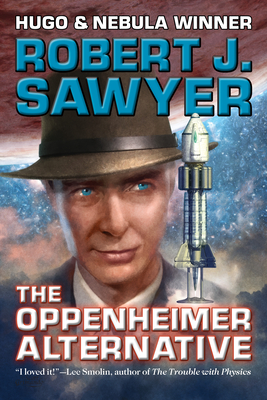
In fact, I’ve got a phone message on my answering machine right now from one of those high-school teachers, Bill Martyn, that I need to return. It’s been forty-one years since I graduated from high school, but he just called to say he’d loved my latest novel, The Oppenheimer Alternative.

Advertisements

2) What inspired you to write your book?

This is the 75th-anniversary year of the birth of the atomic age, with the bombings of Hiroshima and Nagasaki. It seemed like a good time to try to delve, as only a novelist can, into the inner lives of the people who were responsible for unleashing hell on Earth: Edward Teller, Leo Szilard, General Leslie R. Groves, and, most notably, the scientific leader of the Manhattan Project, the mercurial, tortured J. Robert Oppenheimer.

3) What theme or message do you hope readers will take away from your book?

The theme of not just The Oppenheimer Alternative but some of my 23 other novels, too, is that the world would be a far better place if the brightest people simply stopped making the things the stupidest people wanted them to make. No general, president, or dictator can make an atomic bomb—only geniuses could do that—and instead of saying nope, they dove right in.

The great irony is this: it’s arguable that, although Oppenheimer and others were salivating at the notion of an essentially unlimited budget—the spent two billion 1945 dollars, which is the equivalent of $28 billion today—to create the atomic bomb, the head of the German bomb project, Werner Heisenberg, knew the folly of letting a madman like Hitler have such a thing and so he may very well have deliberately failed to build one.

4) What drew you into this particular genre?

Well, “this particular genre” is one that actually I may well have created: hard-science fiction secret/alternate history.

My novel is a real, honest-to-goodness accurate and carefully extrapolated science-fiction tale built on sound science woven into the gaps about what we know really did occur between 1936, when The Oppenheimer Alternative begins, and 1967, when the novel ends. Nothing in it contradicts anything we know to be true, but the reader will be treated to what I hope they’ll consider a mind-blowing science-fiction tale as well as a heart-wrenching historical-fiction story.

Advertisements

5) If you could sit down with any character in your book, what would you ask them and why?

Perhaps surprisingly, it would not be my main character, the J. Robert Oppenheimer of the book’s title, but rather his erstwhile friend and then betrayer, Edward Teller.

Although ironically Teller wrote his memoirs and Oppie never did, it’s Teller—the man often cited as the principal inspiration for the title character in the movie Dr. Strangelove—who leaves me scratching my head.

Teller really said, “No amount of fiddling will save our souls” and he really did go to see his dying colleague, Nobel laureate Enrico Fermi, to, in Teller’s own words “confess his sins.”

But even with such apparent misgivings he just went right on pushing for bigger and bigger bombs—ranging in size from merely genocidal to ones that would trigger the extinction of most life on our planet—as well as shilling for Ronald Reagan’s fatally flawed Strategic Defense Initiative (“Star Wars”) until the day he died.

What the hell was Teller thinking? He was great with kids, often carrying candy for them in his pockets, and he loved his own children and grandchildren—and yet he was monstrous.

6) What social media site has been the most helpful in developing your readership?

Facebook, for a few reasons.

One: I’m a long-form writer—a novelist!—and so the character-count constraints of Twitter make it ill-suited for me.

And two, as all good writers know, the heart of good writing is revision: you can’t edit a tweet, and but you can go back even years later and correct typos or ambiguous phrasing on Facebook.

I long ago hit the hard-coded 5,000-friend limit Facebook has built into its architecture, but you can still follow me there—as 6,500 additional people do—and join in the daily lively discussions and debates we have there.

7) What advice would you give to aspiring or just starting authors out there?

In 1997, I came out of a deli in Los Angeles and saw Gordon Jump, one of the stars of WKRP in Cincinnati standing on the sidewalk, so I went up to him and said, “I’d just like to shake the hand of the man who uttered the funniest line in sitcom history.”

We chatted for a bit, and I asked what he was doing just hanging out in front of a deli. He replied a young wannabe actor had said he’d take him to lunch here in exchange for some advice about getting into the industry. I asked, “What advice are you going to give him?” And Gordon replied, “Don’t get into the industry.”

Seriously, this is an awful time to be a traditionally published author. In the thirty years I’ve been a novelist now, there have been enormous cost reductions for publishers—no more re-keyboarding typed manuscripts, no more sending page proofs by courier, instead of servicing thousands of small bookstore accounts mostly just servicing a few big ones, having authors do their own promotion via social media instead of publishers advertising their books, etc.

But every penny of those costs savings—every single one—has been kept by publishers, with none passed onto authors. Meanwhile, in addition to the production of print books for distribution to bookstores—the one thing publishers are good at—they also demand ebook rights, audiobooks rights, and they’re trying to get a piece of the film and TV action, too.

So, my advice is simply this: license your intellectual property as narrowly as possible and only let a licensee have rights to specific aspects of it that they have a great track record with, and make sure they’re making real money not just for themselves but for you, too.

8) What does the future hold in store for you? Any new books/projects on the horizon?

I’ve been asked to write a lengthy original audio drama, and I may, or may not, sign the contract for that; we’ll see. But really, the new books on my horizon right now are books that are new to me: I’m just catching up on my reading!

Advertisements

About the Author

Robert J. Sawyer is one of Canada’s best known and most successful science fiction writers. He is the only Canadian (and one of only 7 writers in the world) to have won all three of the top international awards for science fiction: the 1995 Nebula Award for The Terminal Experiment, the 2003 Hugo Award for Hominids, and the 2006 John W. Campbell Memorial Award for Mindscan.

Robert Sawyer grew up in Toronto, the son of two university professors. He credits two of his favourite shows from the late 1960s and early 1970s, Search and Star Trek, with teaching him some of the fundamentals of the science-fiction craft. Sawyer was obsessed with outer space from a young age, and he vividly remembers watching the televised Apollo missions. He claims to have watched the 1968 classic film 2001: A Space Odyssey 25 times. He began writing science fiction in a high school club, which he co-founded, NASFA (Northview Academy Association of Science Fiction Addicts). Sawyer graduated in 1982 from the Radio and Television Arts Program at Ryerson University, where he later worked as an instructor.

Sawyer’s first published book, Golden Fleece (1989), is an adaptation of short stories that had previously appeared in the science-fiction magazine Amazing Stories. This book won the Aurora Award for the best Canadian science-fiction novel in English. In the early 1990s Sawyer went on to publish his inventive Quintaglio Ascension trilogy, about a world of intelligent dinosaurs. His 1995 award winning The Terminal Experiment confirmed his place as a major international science-fiction writer.

A prolific writer, Sawyer has published more than 10 novels, plus two trilogies. Reviewers praise Sawyer for his concise prose, which has been compared to that of the science-fiction master Isaac Asimov. Like many science fiction-writers, Sawyer welcomes the opportunities his chosen genre provides for exploring ideas. The first book of his Neanderthal Parallax trilogy, Hominids (2002), is set in a near-future society, in which a quantum computing experiment brings a Neanderthal scientist from a parallel Earth to ours. His 2006 Mindscan explores the possibility of transferring human consciousness into a mechanical body, and the ensuing ethical, legal, and societal ramifications.

A passionate advocate for science fiction, Sawyer teaches creative writing and appears frequently in the media to discuss his genre. He prefers the label “philosophical fiction,” and in no way sees himself as a predictor of the future. His mission statement for his writing is “To combine the intimately human with the grandly cosmic.”