I received a free copy of this book in exchange for a fair and honest review. All opinions are my own.
A young troll finds herself desperate and forced to turn to a crime so dangerous it neared suicidal in author Sarah J. Sover’s “Double-Crossing The Bridge”.
The Synopsis
Rent in New Metta is through the cavern ceiling. When Granu barely survives her first gig teaching students who attempt to fillet her for lunch, the baby-eating troll ends up unemployed and facing eviction. Granu’s only prospect for income is grueling work in the tar pits. That is, until her playboy best friend devises a perfect, if suicidal, scheme—a heist!
The Covered Bridge, the largest source of income for the city, has New Metta well under hoof. In a week, TCB Corporation pulls in enough cash to buy a small country. It’s the ideal target, but security is top-notch. Granu needs three things to survive this heist: a crew of specialists, impenetrable sun protection, and gallons of grog.
There’s just one thing Granu doesn’t plan for—those damn meddling billy goats.
The Review
This was truly one of a kind read in the fantasy genre. Blending humor with fantasy-driven narratives, the author does a great job of bringing a sense of normalcy to the world of trolls and other fantasy creatures.
The author does a fantastic job of mirroring the life of protagonist Granu with that of humanity and their everyday lives, from the nature of the food chain to dating life and the desperation one feels after losing a job. Yet the action takes center stage once desperation forces Granu to take a role in a prominent theft, only to face a surprising obstacle.
The Verdict
A rich, layered world of fantasy and action, author Sarah J. Sover’s “Double-Crossing the Bridge” is a must-read fantasy and humor novel. Filled with powerful characters and a unique plot, this is a truly marvelous read that you will not be able to put down. Be sure to grab your copy today!
Rating: 10/10
Advertisements
About the Author
Sarah J. Sover writes fantasy crossover novels while raising two energetic little people. A Georgia Southern Bell Honor’s graduate who grew up living near Detroit, London, Miami, and Atlanta, Sarah’s background is as varied as her answers to the dreaded “where are you from” question. She’s done everything from wildlife rehabilitation to data management, leaving notebooks filled with bad poetry in her wake.
Sarah resides in John’s Creek, Ga with her brilliant husband Alex, two vibrant daughters, cranky old dog, and seemingly immortal snake. In addition to writing, Sarah loves craft beer, blues dancing, binging superhero Netflix shows, hobby jumping, Disney, and groove metal.
I received a free copy of this book in exchange for a fair and honest review. All opinions are my own.
Alfred, also known as the Second Son, must challenge all he has ever known to fulfill his father’s dream of keeping his kingdom safe from his power-mad brother in author Pamela Taylor’s novel “Pestilence”, the third volume of the Second Son Chronicles.
Advertisements
The Synopsis
At the dawn of the Renaissance, Alfred – the eponymous second son – must discover the special destiny foreseen for him by his grandfather. Now, the unthinkable has happened: Alfred’s brother is king. And it isn’t long before everyone’s worst fears are realized. Traditional allegiances are shattered under a style of rule unknown since the grand bargain that formed the kingdom was struck over two hundred years ago. These will be the most dangerous years of Alfred’s life, forcing him to re-examine his duty to personal honor and to the kingdom, while the threats posed by his brother constantly remind him of his father’s final words of advice. What choices will he have to make to try to protect the things he holds most dear?
The Review
As a fan of ancient history, especially the age of the Vikings and the Angelo-Saxon days of early Europe, it was a treat to see a setting in a similar fashion take center stage in this amazing read. Although I have not read the previous two entries in the series, the book does an excellent job of creating a story and atmosphere that holds strong on its own, although for character reference it is probably a good idea to read the first two books.
The author beautifully captured the tone and feel of a classic tale of ancient kingdoms and knights, warring kings, and politically driven family dramas. Although a fictional setting, the influence of history is evident in every page of this book and creates a unique flow of the story as the characters grow and evolve throughout this story.
The Verdict
A must-read novel, author Pamela Taylor has a smith hit with Pestilence, the third book in her Second Son Chronicles. Evenly paced and entertaining, the novel does a great job of leaving readers on the edge of their seats and sets up a cliffhanger ending that should take readers deep into the future of the series. If you haven’t yet, be sure to grab your copy today!
Rating: 10/10
Pestilence is available to purchase as a print copy and as an e-book at Amazon.com and Barnes and Noble. Be sure to add this to your GoodReads reading list too!
Advertisements
About the Author
Pamela Taylor brings her love of history to the art of storytelling in the Second Son Chronicles. An avid reader of historical fact and fiction, she finds the past offers rich sources for character, ambiance, and plot that allow readers to escape into a world totally unlike their daily lives. She shares her home with two Corgis who frequently reminder her that a dog walk is the best way to find inspiration for that next chapter.
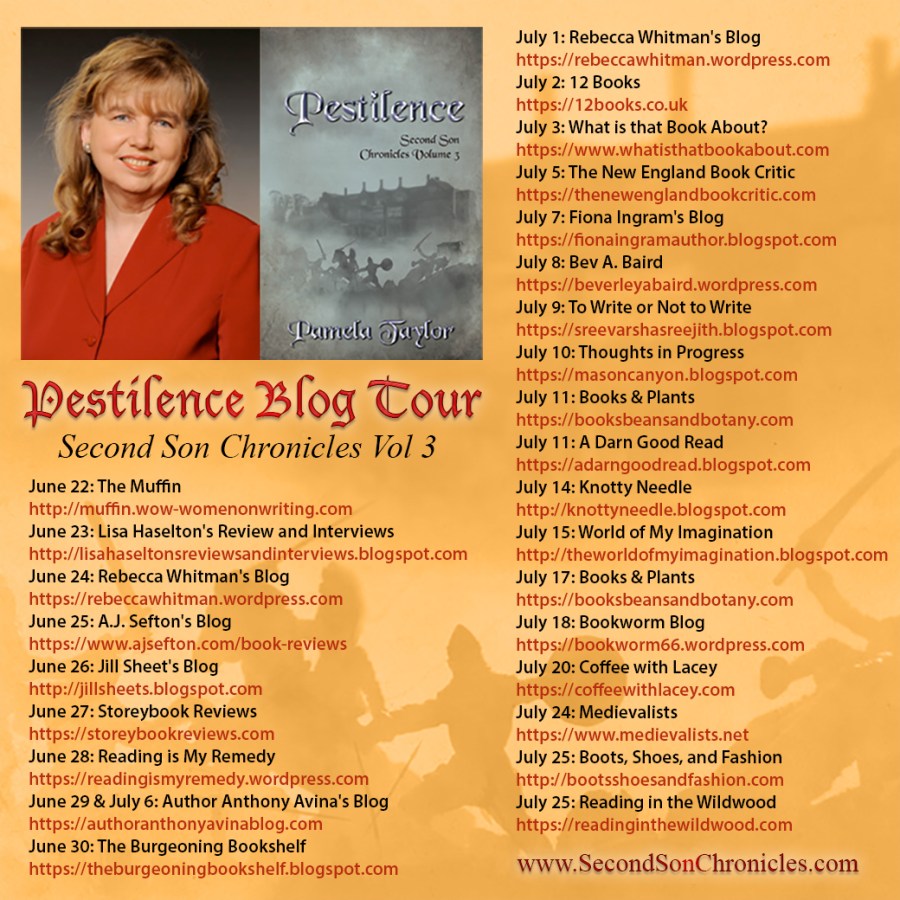
What goes better in the morning than a muffin? Join us as we celebrate the launch of Pamela Taylor’s blog tour for her book Pestilence. You can read an interview with the author and enter to win the first three books in her series “The Second Son Chronicles.”
Visit Rebecca’s blog today and you can read Pamela Taylor’s guest post discussing the allegory (themes) embedded in the narrative of Pestilence specifically and the Chronicles generally.
Visit Veronica’s blog today and you can read a guest post by Pamela Taylor about the trap of linguistic anachronism – getting the language and word usage right for historical narratives.
I received a free copy of this book in exchange for a fair and honest review. All opinions are my own.
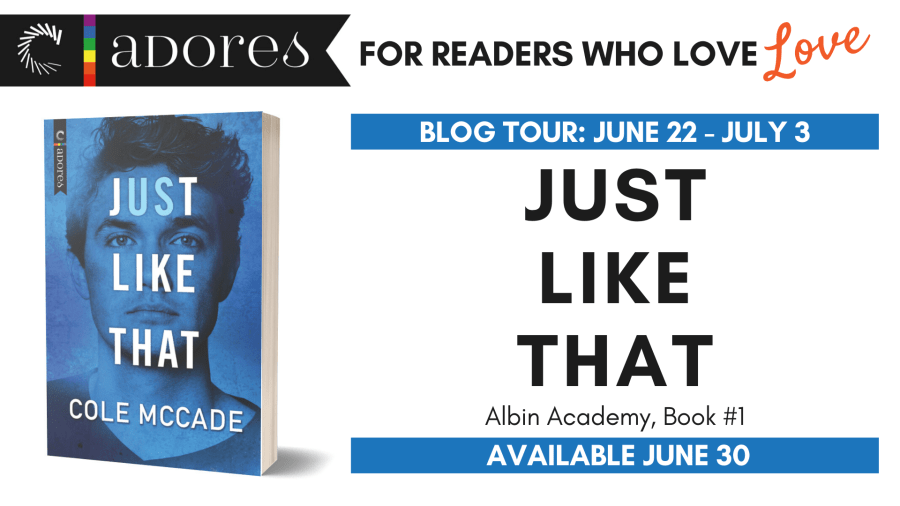
A young teacher returns to the school that tormented his youth, and is surprised by the bond he creates with his former teacher, who soon becomes something much more than colleagues in author Cole McCade’s “Just Like That”.
Advertisements
The Synopsis
Summer Hemlock never meant to come back to Omen, Massachusetts.
But with his mother in need of help, Summer has no choice but to return to his hometown, take up a teaching residency at the Albin Academy boarding school—and work directly under the man who made his teenage years miserable.
Professor Fox Iseya
Forbidding, aloof, commanding: psychology instructor Iseya is a cipher who’s always fascinated and intimidated shy, anxious Summer. But that fascination turns into something more when the older man challenges Summer to be brave. What starts as a daily game to reward Summer with a kiss for every obstacle overcome turns passionate, and a professional relationship turns quickly personal.
Yet Iseya’s walls of grief may be too high for someone like Summer to climb…until Summer’s infectious warmth shows Fox everything he’s been missing in life.
Now both men must be brave enough to trust each other, to take that leap.
To find the love they’ve always needed…
Just like that.
In Just Like That, critically acclaimed author Cole McCade introduces us to Albin Academy: a private boys’ school where some of the world’s richest families send their problem children to learn discipline and maturity, out of the public eye.
The Review
A powerful and emotional read, the author does a great job of building a complex story that focuses on character development above anything else. The bond between Summer and Professor Fox is engaging and real and draws the reader in immediately.
The balance of the two characters and their personalities was unique to see unfold here, as was the way they balanced one another. From Summer’s submissive, quiet, and yet determined personality to Professor Fox’s strong, reserved, and more assured personality, these two drive home the romance and drama of the two character’s pasts, which compliments their growing bond as well.
The Verdict
A moving, engaging, and emotional read that plunges the depths of the reader’s hearts, author Cole McCade’s novel “Just Like That” is a fantastic LGBTQ read that pushes the genre forward and creates memorable and relatable characters. If you haven’t yet be sure to grab your copies today!
Cole McCade is a New Orleans-born Southern boy without the Southern accent, currently residing somewhere in Seattle. He spends his days as a suit-and-tie corporate consultant and business writer, and his nights writing contemporary romance and erotica that flirts with the edge of taboo—when he’s not being tackled by two hyperactive cats.
He also writes genre-bending science fiction and fantasy tinged with a touch of horror and flavored by the influences of his multiethnic, multicultural, multilingual background as Xen. He wavers between calling himself bisexual, calling himself queer, and trying to figure out where “demi” fits into the whole mess—but no matter what word he uses he’s a staunch advocate of LGBTQIA and POC representation and visibility in genre fiction. And while he spends more time than is healthy hiding in his writing cave instead of hanging around social media, you can generally find him in these usual haunts:
“Extinguisher first, then sand,” the voice ordered. “Dr. Liu, if you insist on getting in the way, at least make yourself useful and remove anything else flammable from the vicinity of the blaze. Quickly, now. Keep your mouths covered.”
Summer’s entire body tingled, prickled, as if his skin had drawn too tight. That voice—that voice brought back too many memories. Afternoons in his psychology elective class, staring down at his textbook and doodling in his notebook and refusing to look up, to look at anyone, while that voice washed over him for an hour. Summer knew that voice almost better than the face attached to it, every inflection and cadence, the way it could command silence with a quiet word more effectively than any shout.
And how sometimes it seemed more expressive than the cold, withdrawn expression of the man he remembered, standing tall and stern in front of a class of boys who were all just a little bit afraid of him.
Summer had never been afraid, not really.
But he hadn’t had the courage to whisper to himself what he’d really felt, when he’d been a hopeless boy who’d done everything he could to be invisible.
Heart beating harder, he followed the sound of that voice to the open doorway of a smoke-filled room, the entire chemistry lab a haze of gray and black and crackling orange; from what he could tell a table was…on fire? Or at least the substance inside a blackened beaker was on fire, belching out a seemingly never-ending, impossible billow of smoke and flame.
Several smaller fires burned throughout the room; it looked as though sparks had jumped to catch on notebooks, papers, books. Several indistinct shapes alternately sprayed the conflagration with fire extinguishers and doused it with little hand buckets of sand from the emergency kit in the corner of the room, everyone working clumsily one-handed while they held wet paper towels over their noses and mouths with the other.
And standing tall over them all—several teachers and older students, it looked like—was the one man Summer had returned to Omen to see.
Professor Iseya.
He stood head and shoulders above the rest, his broad-shouldered, leanly angular frame as proud as a battle standard, elegant in a trim white button-down tucked into dark gray slacks, suspenders striping in neat black lines down his chest. Behind slim glasses, his pale, sharply angled gray eyes flicked swiftly over the room, set in a narrow, graceful face that had only weathered with age into an ivory mask of quiet, aloof beauty.
The sleek slick of his ink-black hair was pulled back from his face as always—but as always, he could never quite keep the soft strands inside their tie, and several wisped free to frame his face, lay against his long, smooth neck, pour down his shoulders and back. He held a damp paper towel over his mouth, neatly folded into a square, and spoke through it to direct the frazzled-looking group with consummate calm, taking complete control of the situation.
And complete control of Summer, as Iseya’s gaze abruptly snapped to him, locking on him from across the room. “Why have you not evacuated?” Iseya demanded coldly, his words precise, inflected with a softly cultured accent. “Please vacate the premises until we’ve contained the blaze.”
Summer dropped his eyes immediately—habit, staring down at his feet. “Oh, um—I came to help,” he mumbled through the collar of his shirt.
A pause, then, “You’re not a student. Who are you?”
That shouldn’t sting.
But then it had been seven years, he’d only been in two of Iseya’s classes…and he’d changed, since he’d left Omen.
At least, he hoped he had.
That was why he’d run away, after all. To shake off the boy he’d been; to find himself in a big city like Baltimore, and maybe, just maybe…
Learn not to be so afraid.
But he almost couldn’t bring himself to speak, while the silence demanded an answer. “I’m not a student anymore,” he corrected, almost under his breath. “It’s…it’s me. Summer. Summer Hemlock. Your new TA.” He made himself look up, even if he didn’t raise his head, peeking at Iseya through the wreathing of smoke that made the man look like some strange and ghostly figure, this ethereal spirit swirled in mist and darkness. “Hi, Professor Iseya. Hi.”
I suppose it’s arguable that everything I’ve ever read about the era in which the Second Son Chronicles are set has, in some way, influenced the creation of the narratives. After all, there’s a certain amount of osmosis that happens with every book we enjoy. But within that broad-brush landscape, some highlights do stand out (in no particular order).
Alison Weir’s non-fiction has been a rich source of details about life in Medieval and Renaissance times. Regardless of the specific subject, her books describe in great depth what daily life was like during these periods – it’s an immersive experience, and the osmosis factor helped me to create the world of the Chronicles.
I also found inspiration in Ken Follett’s Kingsbridge series, particularly The Pillars of the Earth and World Without End. Follett’s detailed depiction of the building of the great Gothic cathedrals got me thinking about architecture, engineering, and building from Roman times through the Renaissance and led to the inclusion of some building projects in my own books. His narrative of the inventive ways that those outside mainstream medicine of the day began to understand the nature of the spread of infection and the importance of hygiene and other methods for containing it helped inspire my own exploration of how people dealt with disease over six hundred years ago.
Whether it’s in the shield wall with Uhtred of Bebbanburg or in the fields of Agincourt with Henry V, Bernard Cornwell doesn’t shy away from the gritty and brutal realism of the battlefields of long ago. My battle scenes pale by comparison to Cornwell’s ability to bring the sights and sounds and stench and fear and blood-lust of medieval war to life. But I happily acknowledge my debt to him for showing how to make my battles more realistic than they might otherwise have been.
While the time period is much earlier than that of my stories, Jack Whyte’s re-imagining of the Arthurian legends in his Camulod Chronicles influenced a number of decisions I made for my own series. Whyte postulates a world that might have existed in post-Roman Britain and an entirely realistic history that could, in the absence of any surviving written record, have been the basis for the legends. So what does this have to do with the Second Son Chronicles?
My stories are set at the dawn of the Renaissance, a time when so much is well-known about the characters and events of northern Europe. Asking readers to accept that an entirely different set of royalty, nobility, and events could have existed seemed like too great a suspension of disbelief. But if Whyte could create an entirely imagined history, why couldn’t I create an imagined setting for my own narrative? If readers notice some similarities to northern Europe, then perhaps that only adds to the flavor of the world where my characters play out their lives.
I hope you enjoy reading the Second Son Chronicles as much as I’ve enjoyed bringing the stories to life.
Advertisements
Book Summary
At the dawn of the Renaissance, Alfred – the eponymous second son – must discover the special destiny foreseen for him by his grandfather. Now, the unthinkable has happened: Alfred’s brother is king. And it isn’t long before everyone’s worst fears are realized. Traditional allegiances are shattered under a style of rule unknown since the grand bargain that formed the kingdom was struck over two hundred years ago. These will be the most dangerous years of Alfred’s life, forcing him to re-examine his duty to personal honor and to the kingdom, while the threats posed by his brother constantly remind him of his father’s final words of advice. What choices will he have to make to try to protect the things he holds most dear?
Print Length: 234 Pages
Genre: Historical Fiction
Publisher: Black Rose Writing
ASIN: B08563V87C
ISBN-10: 1684334810
ISBN-13: 9781684334810
Pestilence is available to purchase as a print copy and as an e-book at Amazon.com and Barnes and Noble. Be sure to add this to your GoodReads reading list too!
Advertisements
About the Author, Pamela Taylor
Pamela Taylor brings her love of history to the art of storytelling in the Second Son Chronicles. An avid reader of historical fact and fiction, she finds the past offers rich sources for character, ambiance, and plot that allow readers to escape into a world totally unlike their daily lives. She shares her home with two Corgis who frequently reminder her that a dog walk is the best way to find inspiration for that next chapter.
What goes better in the morning than a muffin? Join us as we celebrate the launch of Pamela Taylor’s blog tour for her book Pestilence. You can read an interview with the author and enter to win the first three books in her series “The Second Son Chronicles.”
Visit Rebecca’s blog today and you can read Pamela Taylor’s guest post discussing the allegory (themes) embedded in the narrative of Pestilence specifically and the Chronicles generally.
Visit Veronica’s blog today and you can read a guest post by Pamela Taylor about the trap of linguistic anachronism – getting the language and word usage right for historical narratives.
I am honored to share with you a fantastic guest blog post from author and poet Elizabeth Hazen, as part of the wonderful blog tour for “Girls Like Us”.
Advertisements
For Christmas, which seems like three lifetimes ago, my parents gave my husband a book of interesting words from around the world*. An engineer who has a soft spot for spoonerisms, puns, and wordplay in every form, he found instant delight in this book. Did you know that Germans have a word for the weight we gain from stress-eating? Kummerspeck. Or that the Scots have a word for that awkward pause when you’ve forgotten the name of the person you’re introducing? Tartle. Among my favorites are the whimsical Swedish smultronställe, a place of wild strawberries; the romantic Italian dormiveglia, the space between sleeping and waking; and the essential Japanese tsundoku, that pile of unread books on my bedside table that grows with each passing month.
Needless to say, I took that book of words from my husband, adding one more to my stack.
Getting through my tsundoku – or at least managing it – is one of my goals for this summer. I am a teacher, and the summer brings with it the beautiful freedom of longer days and fewer responsibilities, but the lack of structure –ironically, frustratingly, and inevitably – invites bad habits and a gradual decline into despair over the time I fear I am wasting. As a result, I know I need to impose some kind of schedule – a routine that will keep me on track. Part of that routine, I have decided, will include reading more poetry.
One of the lessons I most love to teach to my seventh-grade students involves defining poetry. We examine a range of definitions – the top of our heads being blown off, the best words in the best order, language at its most distilled and most powerful. We can debate the specifics, note our preferences, but that words are the poet’s medium is indisputable. Imperfect, delicious, malleable, living, breathing words. It is my love of words that I always return to during the darkest moments, and boy are these days dark.
In a review of my recent collection, Girls Like Us, Nandini Bhattacharya defines the poem as “ineffable interrogator, ethicist and chronicler of human history.” Indeed, I certainly have found more accuracy and truth in poems than in the newspaper, more solace in poems than in meditation or exercise, more freedom in poems than in the endless walks I take to escape the confines of quarantine. As when I was in the thick of adolescent depression, poems come to rescue me, to remind me that the legacy of human sadness and loss and pain is infinite, but so is our legacy of resilience and power and change.
Perhaps poems allow us to do what the Dutch call uitwaaien: “to take a break and walk away from the demands of life to clear one’s head.” Or maybe life demands poems, and it is precisely in these moments of trauma and fear and violence that we must dive in head-first. Whatever they do, I am grateful for them. Here are several recent collections by women that I highly recommend. Each, in its own way, has given me what the Icelandic call radljóst: enough light to find my way.
Difficult Fruit by Lauren K. Alleyne, Peepal Tree, 2014
Thrust by Heather Derr-Smith, Persea Books, 2017
American Samizdat by Jehanne Dubrow, Diode Editions, 2019
The Miracles by Amy Lemmon, C&R Press, 2018
Voyage of the Sable Venus by Robin Coste Lewis, Knopf, 2016
Code by Charlotte Pence, Black Lawrence Press, 2020
How to Exterminate the Black Woman by Monica Prince, [Pank Books], 2019
American Lyric Trilogy by Claudia Rankine, Graywolf, 2004, 2014, 2020
The State She’s In by Lesley Wheeler, Tinderbox Editions, 2020
*The book of words I refer to is Other Wordly: Words Both Strange and Lovely from Around the World by Yee-Lum Yak with illustrations by Kelsey Garrity-Riley
Elizabeth Hazen is a poet, essayist, and teacher. A Maryland native, she came of age in a suburb of Washington, D.C. in the pre-internet, grunge-tinted 1990s, when women were riding the third wave of feminism and fighting the accompanying backlash. She began writing poems when she was in middle school, after a kind-hearted librarian handed her Lawrence Ferlinghetti’s A Coney Island of the Mind. She has been reading and writing poems ever since.
Hazen’s work explores issues of addiction, mental health, and sexual trauma, as well as the restorative power of love and forgiveness. Her poems have appeared in Best American Poetry, American Literary Review, Shenandoah, Southwest Review, The Threepenny Review, The Normal School, and other journals. Alan Squire Publishing released her first book, Chaos Theories, in 2016. Girls Like Us is her second collection. She lives in Baltimore with her family.
I received a free copy of this book in exchange for a fair and honest review. All opinions are my own.
A powerful book of poetry that dives into the complex nature of female identity and the roles they’ve been forced into playing in society throughout history comes to life in author and poet Elizabeth Hazen’s book, “Girls Like Us”.
Advertisements
The Synopsis
Girls Like Us is packed with fierce, eloquent, and deeply intelligent poetry focused on female identity and the contradictory personas women are expected to embody. The women in these poems sometimes fear and sometimes knowingly provoke the male gaze. At times, they try to reconcile themselves to the violence that such attentions may bring; at others, they actively defy it. Hazen’s insights into the conflict between desire and wholeness, between self and self-destruction, are harrowing and wise. The predicaments confronted in Girls Like Us are age-old and universal—but in our current era, Hazen’s work has a particular weight, power, and value.
The Review
What a moving work of poetry. The author does an incredible job of bringing the pain and emotion that many women in life have had to endure through society’s expectations and the roles cast upon them through her work. As someone who considers himself a feminist and someone who has always wanted to live in a world where my mother and sister could live knowing they were viewed by everyone as equals and were respected, this poetry really spoke to me on a personal level while also feeling personal to the author at the same time.
What really captured my attention as a reader was the way the author writes, in which many of the poems were written with such precision and detail-oriented writing, and yet felt personal to the author and broad enough for others to connect to on their own personal levels. The complexity of the layers of this poetry speaks to the simple desire for equality so many seek throughout their lives, and the ongoing fight to bring that equality to life.
The Verdict
A truly one of a kind read, the author and poet Elizabeth Hazen and her book “Girls Like Us” is a truly amazing work of poems. The raw emotions combined with the true and often sad realities the poems capture of life connect with readers on an intimate level, and the theme and heart of the book speak to so many that readers will not be able to put it down. Be sure to grab this quick yet powerful read today!
Rating: 10/10
About the Author:
Elizabeth Hazen is a poet, essayist, and teacher. A Maryland native, she came of age in a suburb of Washington, D.C. in the pre-internet, grunge-tinted 1990s, when women were riding the third wave of feminism and fighting the accompanying backlash. She began writing poems when she was in middle school, after a kind-hearted librarian handed her Lawrence Ferlinghetti’s A Coney Island of the Mind. She has been reading and writing poems ever since.
Hazen’s work explores issues of addiction, mental health, and sexual trauma, as well as the restorative power of love and forgiveness. Her poems have appeared in Best American Poetry, American Literary Review, Shenandoah, Southwest Review, The Threepenny Review, The Normal School, and other journals. Alan Squire Publishing released her first book, Chaos Theories, in 2016. Girls Like Us is her second collection. She lives in Baltimore with her family.
Most of us have heard that walking is good for our bodies: walking can reduce our risk of high blood pressure, high cholesterol, dementia, diabetes, several types of cancer, and more. Some of us have heard that walking is good for our brains: walking can help improve our decision-making, boost our executive function, and fuel our creativity. And many of us have heard that walking is good for our emotional well-being: walking can boost our mood and can be a valuable tool in the battle against depression.
But what about loneliness? Can walking help there too?
We believe so. A study my company undertook last year revealed that women who regularly walk with their friends are 2.5 times less likely to feel lonely often.
Why is it that walking together is so powerful?
First, we are social beings and we are wired to crave — and enjoy — shared experiences. Researchers believe this comes directly from our biological need to belong: our ancestors were a whole lot safer walking in the woods with their tribe than they were walking the woods by themselves.
Second, our hormones help. Walking increases levels of oxytocin — a hormone that heightens our connections with others. So when you walk with a friend, your biology helps foster a deeper, more meaningful connection. And yes, oxytocin is the same hormone that is released during childbirth and nursing, which makes sense because it encourages us to bond with our babies.
Third, extensive research shows that our brains process differently when we are walking. Because only part of our brain is occupied with putting one foot in front of the other, the rest of our brain is free to roam, to think more deeply. More importantly, when we are walking together, we can comfortably take the moments of quiet to process and give ourselves the chance to think, and connect, more deeply.
Finally, because conversations tend to flow more easily and because walking together provides an activity — and one that takes place away from home — it is far more comfortable to invite a new friend for a walk than to invite them to your home. Indeed, many mom friendships have been formed from the question “Do you want to take a walk after school drop off?”
In short, walking together can be an incredibly powerful antidote to loneliness. It provides the perfect environment for conversation and connection. It offers time and space, free of distractions. It gives us the increased pleasure that comes from sharing an experience. It delivers a blast of oxytocin that encourages us to connect with one another. And it provides an easy way to begin to connect with a new friend.
Advertisements
About the Author
Joyce Shulman, founder and CEO of 99 Walks and Macaroni Kid reaches millions of moms each month with hyper-local and national e-newsletters and websites, social media content, video and her Weekly Walk podcast. Having created a one-of-a-kind digital platform, she connects families to the wonders of their own communities and inspires women to chase their dreams and crush their goals.
Her most recent endeavor, 99 Walks, is on a mission to combat loneliness and improve fitness through the simple act of encouraging moms to walk together. Her mission? Nothing short of getting a million women walking.
Throughout her two decades as an entrepreneur, Joyce has guided SAHMs, teachers and even MBAs to success. Joyce shares how moms need to “take care of mama bear” and avoid the “martyr mom syndrome.” Her experience in business and leading mompreneurs makes her a coveted speaker where she shares tactics for beating burnout, fueling creativity, goal crushing, how walking can fuel productivity and performance, and more.
Joyce received her Bachelor’s in Business Management from the University of Maryland and her Juris Doctor, Cum Laude, from St. John’s University School of Law. After law school, she spent more than a dozen years as a New York City lawyer where her practice focused on complex commercial litigation.
A self-confessed idea junkie, in 1998, Joyce abandoned law firm life to liberate her entrepreneurial spirit and focus on the things that are most important to her: family, community and empowering women to chase their dreams.
What goes better in the morning than a muffin? Grab your coffee and join us in celebrating the launch of Joyce Shulman’s book Walk Your Way to Better. You can read an interview with the author and enter to win a copy of the book.
Stop by Lisa’s blog again today where you can read a guest post by author Joyce Shulman where she talks about why do women need to take care of themselves. A timely post in this day and age!
Stop by Terri’s blog today and read her review of Joyce Shulman’s book Walk Your Way to Better. You can also read a guest post written by the author about the power of yet.
I received a free copy of this book in exchange for a fair and honest review. All opinions are my own.
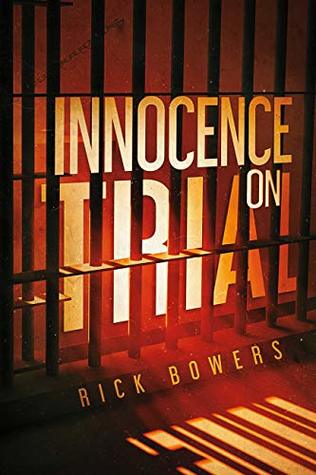
A fight to free a man suspected of being innocent of a violent crime leads an attorney on a dangerous journey against corrupt police officers and a deadly criminal who has remained in the shadows for decades in author Rick Bowers’ novel “Innocence on Trial”.
Advertisements
The Synopsis
Seeking a high profile case to jet fuel her career and striving to strike a blow for justice, attorney Laura Tobias sets out to clear a man she believes was wrongfully imprisoned for murder ten years before. The young lawyer, a rising star with the Council Against Wrongful Convictions, is the last hope for inmate Eddie Nash, serving life without parole at the infamous Attica Correctional Facility in upstate New York. Attica, one of the last of the classic “Big Houses,” is still haunted by the 1971 inmate revolt and police siege that left dozens of prisoners and hostages dead. Appealing the cast in federal court and unraveling the facts, Laura uncovers evidence that Eddie was framed by the police for the murder — the brutal hanging of a troubled young woman in the remote upstate town of Eden. Realizing that the real ‘Hangman of Eden’ may still be at large, Laura also finds herself being stalked. Are the police out to stop her from exposing their frame up? Is the real killer seeking to keep her from re-opening the investigation? Teaming up with noted innocence investigator Charles Steel, she gets a lead on evidence that could clear her client and point to the real killer. With a new trial moving forward, Laura must find the truth, and prevail in court, without becoming the next victim.
The Review
What an exciting thriller. Having the opportunity to listen to the audiobook version of the novel, narrator Eleanor Caudill does an amazing job of bringing the visceral settings and complex characters come to life for the listener.
The story itself is well woven, creating characters that are multi-layered and full of complexities that keep readers engaged throughout the entire book. The book plays out like a court-room drama taken to the tenth power, with the drama and tension of the courtroom trial blending into the thrill of a dangerous set of foes lurking ever closer as the truth fights to breakthrough.
The cast of characters are the heart of the story, with protagonist Laura Tobias fighting to prove herself and showcase her talent while trying to uncover the truth of the case and her client Eddie struggling with the sins of his own past while fighting the crime he didn’t commit or did he?
The Verdict
An emotional and thrilling story shines brightly in this novel. A must-read book, the story takes readers for a roller-coaster ride of twists and turns that will keep readers on the edge of their seat, and by books end the reader will be fully invested in Laura’s fight to get to the heart of this tragic and gruesome case. If you haven’t yet, be sure to grab your copy of author Rick Bowers’ “Innocence on Trial” today!
I received a free copy of this book in exchange for a fair and honest review. All opinions are my own.
The key to a better life is explored through the use of walking in author Joyce Shulman’s “Walk Your Way To Better: 99 Walks That Will Change Your Life”.
Advertisements
The Synopsis
This is a book about walking your way to better. Everywhere you turn, people, podcasts and gurus promise a simple path to the life you want. But few of them work. Why? Because simply reading the words is rarely enough to call your heart and mind to action. This book is different. Each section provides a thought-starter, insight or story. But I don’t want you to just read it. I want you to read a section and then lace up your sneakers and head out the door. Because while walking, your brain processes in a unique way, enabling you to recognize the things that are truly holding your back and the changes you actually need to make. You will literally Walk Your Way to Better. Along the way, you will forge a powerful connection between your mind and your body. And bonus — you’ll feel better and become fitter.
The Review
This was a well written book. The author does an outstanding job of connecting with the reader on a personal level, telling a tale of honesty that gives a sense of authenticity to the author’s methods and wisdom imparted in the book.
The author deals with the way walking opens up the mind and helps bring things into perspective. From making clear one’s goals in the here and now to not letting one failure define you as a failure yourself, the author makes good use of her own journey in life and business to get these ideas and lessons through to the reader.
The Verdict
A memorable, short yet engaging read, author Joyce Shulman’s “Walk Your Way To Better: 99 Walks That Will Change Your Life” is a must-read book on improving your life overall and changing your outlook as well. It’s a book about making time for oneself to improve their life overall. Be sure to grab your copy today!
Rating: 10/10
Walk Your Way to Better is available to purchase now on Amazon.com.
Advertisements
About the Author
Joyce Shulman, founder and CEO of 99 Walks and Macaroni Kid reaches millions of moms each month with hyper-local and national e-newsletters and websites, social media content, video and her Weekly Walk podcast. Having created a one-of-a-kind digital platform, she connects families to the wonders of their own communities and inspires women to chase their dreams and crush their goals.
Her most recent endeavor, 99 Walks, is on a mission to combat loneliness and improve fitness through the simple act of encouraging moms to walk together. Her mission? Nothing short of getting a million women walking.
Throughout her two decades as an entrepreneur, Joyce has guided SAHMs, teachers and even MBAs to success. Joyce shares how moms need to “take care of mama bear” and avoid the “martyr mom syndrome.” Her experience in business and leading mompreneurs makes her a coveted speaker where she shares tactics for beating burnout, fueling creativity, goal crushing, how walking can fuel productivity and performance, and more.
Joyce received her Bachelor’s in Business Management from the University of Maryland and her Juris Doctor, Cum Laude, from St. John’s University School of Law. After law school, she spent more than a dozen years as a New York City lawyer where her practice focused on complex commercial litigation.
A self-confessed idea junkie, in 1998, Joyce abandoned law firm life to liberate her entrepreneurial spirit and focus on the things that are most important to her: family, community and empowering women to chase their dreams.
What goes better in the morning than a muffin? Grab your coffee and join us in celebrating the launch of Joyce Shulman’s book Walk Your Way to Better. You can read an interview with the author and enter to win a copy of the book.
Stop by Lisa’s blog again today where you can read a guest post by author Joyce Shulman where she talks about why do women need to take care of themselves. A timely post in this day and age!
Stop by Terri’s blog today and read her review of Joyce Shulman’s book Walk Your Way to Better. You can also read a guest post written by the author about the power of yet.