I received a free copy of this book in exchange for a fair and honest review. All opinions are my own.
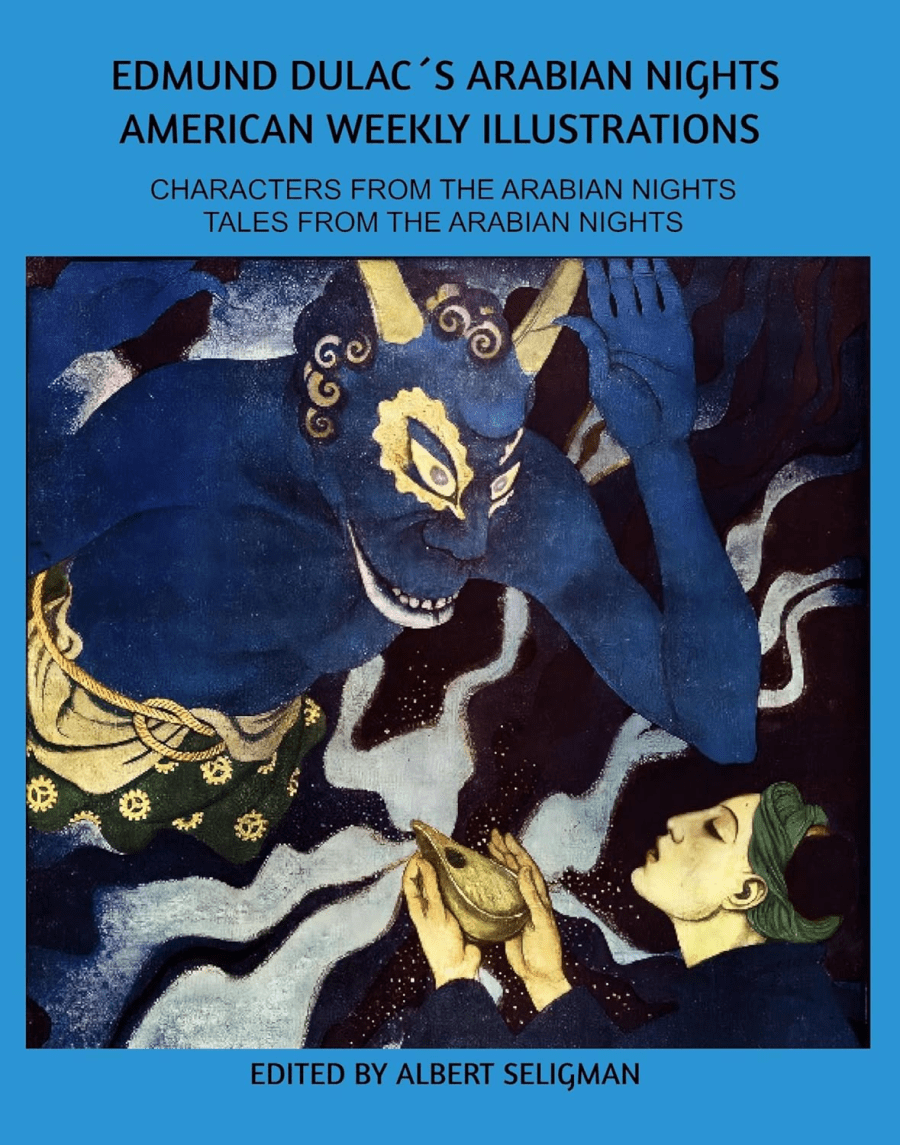
Albert Seligman shares this incredible edition of the classic Arabian Nights from Edmund Dulac.
The Synopsis
In 1923, “Edmund Dulac, the Distinguished English Artist,”as he was billed on the front covers, was contracted by the Hearst organization to paint watercolors for The American Weekly. He illustrated thirteen different series with 106 watercolors from 1924’s ‘Bible Scenes and Heroes’ through 1951’s ‘Tales from the Arabian Nights’.
The two series presented here are the 1925 ‘Characters from the Arabian Nights’ and the 1951 ‘Tales from the Arabian Nights’. The 1951 series was narrated by Watson Crewes, the staff writer for The American Weekly. We have included them with the cover illustration. There were no stories in the 1925 series, but the illustrations were all covered in the earlier book versions of The Arabian Nights which brought Dulac his initial recognition and early success.
The frontispiece for the series was Sheherezade, which was also the frontispiece for his first Arabian Nights in 1907. This was his first “Gift Book” for his publisher Hodder & Stoughton with fifty color illustrations mounted on heavy art paper at the rear of the book.
Sheherezade was, of course, the storyteller of all the 1001 stories in the Arabian Nights, which took her over three years to recount to her husband, the Sultan. She is the daughter of the Grand Vizier, and volunteered to marry the Sultan to stop him from carrying out his habit of murdering his new wife after their wedding night. She began each story, and stopped before the ending, so that the Sultan would postpone her execution till the following day to hear the ending. At the end of the three years, he renounced his vile habit, and they lived happily ever after.
The next illustration is the familiar ‘Aladdin and the Wonderful Lamp’. There are two more illustrations from this tale in this series, ‘Princess Badroulboudour’ and ‘News Lamps for Old’.
Aladdin was a young boy from China who lived with his mother. His father had died recently when mysteriously his father’s brother appeared to console the family, who had never heard of him. He tricked Aladdin into helping him find a magic lamp with a powerful Genie trapped inside. But Aladdin managed to foil his plan and used the Genie to marry the Princess and build a beautiful palace where, after a few mis-adventures, they lived happily ever after.
The Caliph Haroun Al Raschid was the Commander of the Faithful in Bagdad and was involved with several of the tales of the 1001 Nights. He often would disguise himself and go wandering at night into the city to see and talk to his subjects
The tale of ‘Ali Baba and the Forty Thieves’ was included in the 1907 edition, and repeats here with different versions of the earlier drawings of Ali Baba and his slave girl Morgiana pouring hot oil in the jars where the forty thieves are hiding. Here, Ali Baba drives his mules with a contented smile, probably as he returns home with sacks of the thieves’ gold. And Morgiana has a beatific smile as she pours boiling oil on to the thieves who threaten the life of her master and herself.
The next illustration was mistakenly captioned by the editors at Hearst. Here we see the Prince staring at a bird who holds a talisman in his beak. This is not the story of the ‘Talking Bird’, also known as ‘The Three Sisters’, but the bird who led Prince Kemerezzeman astray from Princess Badoura, as you will read in the 1951 series.
‘Sindbad the Sailor and the Roc’ is again a repeat of the illustration from the 1914 edition. Here Sindbad, in his second voyage, ties himself to the leg of the gigantic Roc bird to be carried to where the diamonds are to be found.
The final illustration is ‘The Enchanted Horse’ made of ivory and ebony which will fly through the air to any destination the rider desires. Here the Prince mounts the magic horse and, without yet knowing the secret of how to manipulate the flight, takes off into the unknown to find his Princess and his fortune.
The Review
This was a stunning and incredible read. The book perfectly captures both the love and passion for the classic Arabian Nights while also showcasing the history of Edmund Dulac. The way the editor formatted this addition perfectly allowed readers to absorb the general stories found in this classic well appreciating the unique artistry and illustrations from this 1923 edition.
Of course, as a big fan of this story, one of my favorite illustrations from the artist was of Aladdin and the genie, and seeing the power of these illustrations and how culture in history impacted the way art changed over time allowed the history in the era for which of this art came from to really shine in this book. The editor also did a great job of highlighting the history of the publication. This addition came from which was called the American weekly.
The Verdict
Entertaining, memorable, and fascinating, Albert Seligman’s “Edmund Dulac’s Arabian Nights” is a must read addition of an iconic and a well put together collection of stories. Fans of the classics and fans of illustrated books will really appreciate the history in the culture found in this collection and while each story is perfectly summarized, the book inspires readers to delve deeper into each story, not only to fully engage in the stories, but in what inspired these stories to come to fruition. If you haven’t yet, be sure to grab your copy today.