I received a free copy of this book in exchange for a fair and honest review. All opinions are my own.
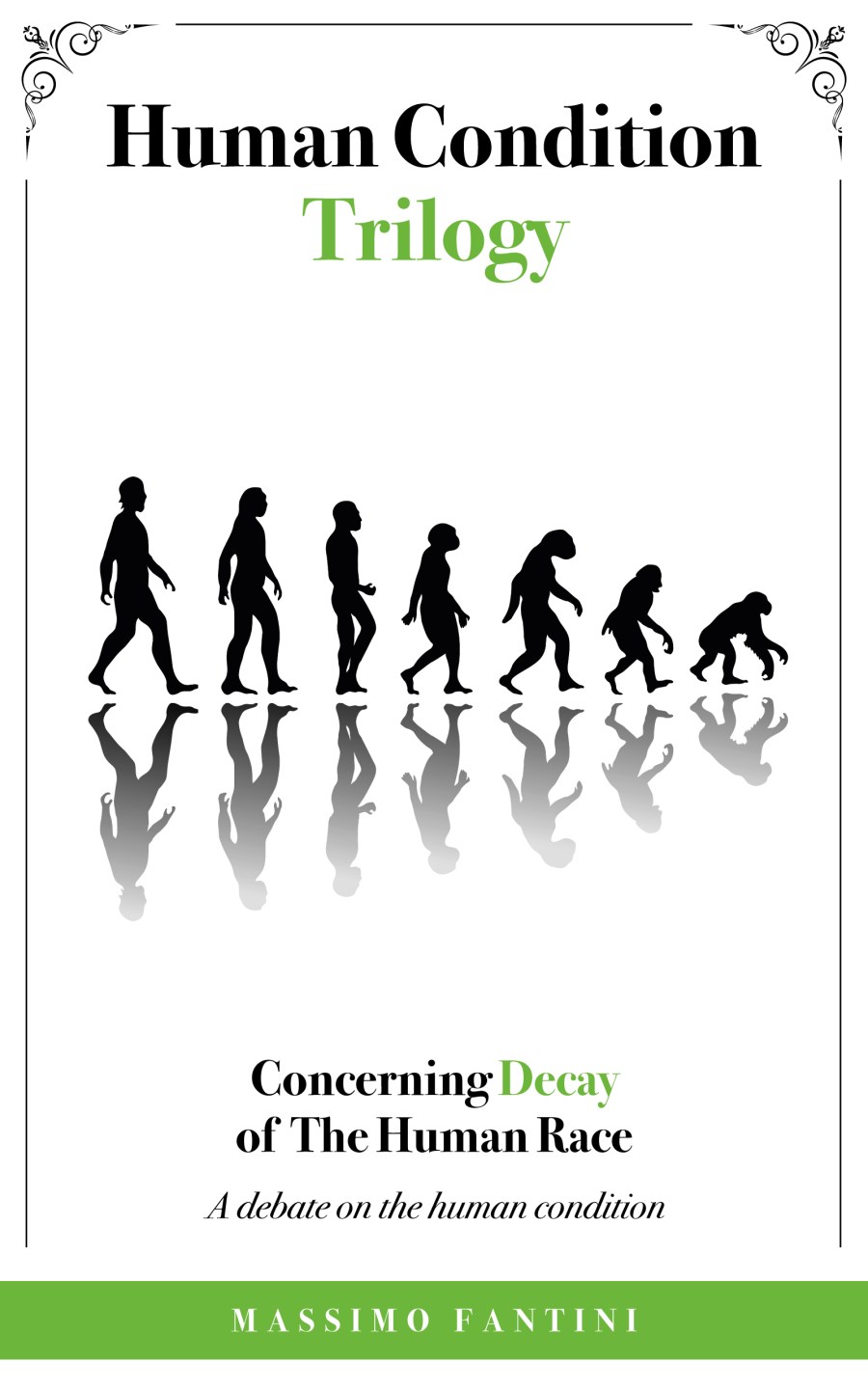
An island isolated from the world shows the perils of social evolution (or the lack thereof) in author Massimo Fantini’s “Concerning Decay of The Human Race), the third book in the Human Condition Trilogy.
The Synopsis
The small village of the Island of the Iguanas experiences the succession of different communities – sometimes forced to live together, sometimes taking over from a former generation. Each community possesses a culture and an assortment of certainties which it does not intend to give up, judging a priori the customs of those who preceded it as uncivilized or unreasonable.
Over the years, the community consolidates and grows, together with their prejudices, social injustices, and religious superstitions. The structural transformations of the village have repercussions on the ecosystem of the island which – starting as a protected nature reserve – becomes a hunting place, a tourist destination, and a favorable terrain for smugglers to exploit.
Thus, faced with the opportunity to adopt a new lifestyle – concerning principles of equality, safeguarding personal freedoms, and restoring the ancient harmony between man and nature – there are those who choose to follow the tested path of the government of man over man, which makes discrimination its founding principle, and those who choose to defy it. Social contrasts – delineated by origin, by social background, by acquired privileges – begin to arise within these communities, which are made up of heterogeneous families and members of different ages and ambitions.
Given the possibility to make a clean sweep of the past and rebuild the social fabric from scratch, will those who position themselves as leaders avoid the mistakes made by their predecessors or will they end up mechanically following the same steps laid out by human history?
The editing and translation of this book was done by Ian Zwaschka.
The Review
This was such a unique and compelling narrative. The author does a beautiful world-building in this book, allowing the reader to become immersed in this island world and develop such unique cultures and different communities. The imagery the author utilizes within the narrative brings this island setting to life in a vibrant way, allowing the narrative to come alive in the reader’s mind.
Yet, as with every fantastic book in this trilogy, the author soars when delving into the philosophy and themes behind this story. The tension that builds slowly over time as readers read how each generation on this island evolves and takes on the prejudices and judgments of those who came before speaks to the very cyclical nature of humanity in a social setting and how giving into the government’s role in our society plays a significant role in that, as bigotry and injustice, along with particular religious beliefs, tend to impact the laws and social settings the rest of the community must live in, leading to a significant disparity between social classes. The exploration of why some people can rise above the bigotry of the past while others remain seething in that hatred was so remarkable to behold.
The Verdict
Thought-provoking, insightful, and engaging author Massimo Fantini’s “Concerning Decay of The Human Race” is a must-read contemporary fiction narrative. The twists and turns in this island setting and the impeccable discussions of these themes drive the reader to make this a thoughtful and remarkable book. If you haven’t yet, be sure to grab your copy today!
Rating: 10/10
Advertisements
About the Author
Greetings, readers.
I am Massimo Fantini, an Italian author and free thinker, writing from my home in the hills just outside Bologna. In quiet moments, when I am not writing, I enjoy classical music, particularly orchestral works for violin and the Italian opera.
I graduated from a university in Bologna with a degree in civil engineering. However, the studies of my youth do not represent my life’s obsession—that is, delving into those realities which unite all members of the human race: suffering, frustrations, conflicts, and the human reactions to these. They are the events and forces that take every human as an innocent in the crib and twist and turn them into 8.1 billion unique (but intimately connected) forms.
In short, I am obsessed with exploring the intimate recesses of the human condition.
In 2018, entirely dissatisfied with my job, I sought a new form of expression. Thus, I began to write. Incessantly.
I experimented with many kinds of writing. How best to give my ideas form? Then, I found my voice through stories, giving life to characters who explore, triumph, and fail for us to watch.
In each installment of my Human Condition Trilogy, these same all-encompassing issues are approached from different directions, under different circumstances, and by different characters.
Echoing the sentiment of Heraclitus, no two people may look at the same problem, because it is different to each. From the old cynical Leonard in Concerning Fanaticism to young Tommaso (a character inspired by my own youth) in Concerning Intellectual Suicide, I tried to cast a light on a path that is a constant part of our lives, but also constantly shifting.
Through my writing, I encourage readers to find their own perspective on life. Rather than embracing the comfortable mold which society provides, like a goldfish “free” to swim around in its little bowl, I hope my readers can use my books as a steppingstone toward their own unique way of thinking. And then, I wish them the freedom to pursue it.
Art is wonderful because it is a representation of what we otherwise cannot express. I seek not to provide myself and my readers with a mere distraction (what so often passes for “entertainment”). Not a hole in which to stick our heads for a few hours, only to emerge weakened and even less able to face our reality. Rather, I offer up a representation of our shared condition.
I received a free copy of this book in exchange for a fair and honest review. All opinions are my own.
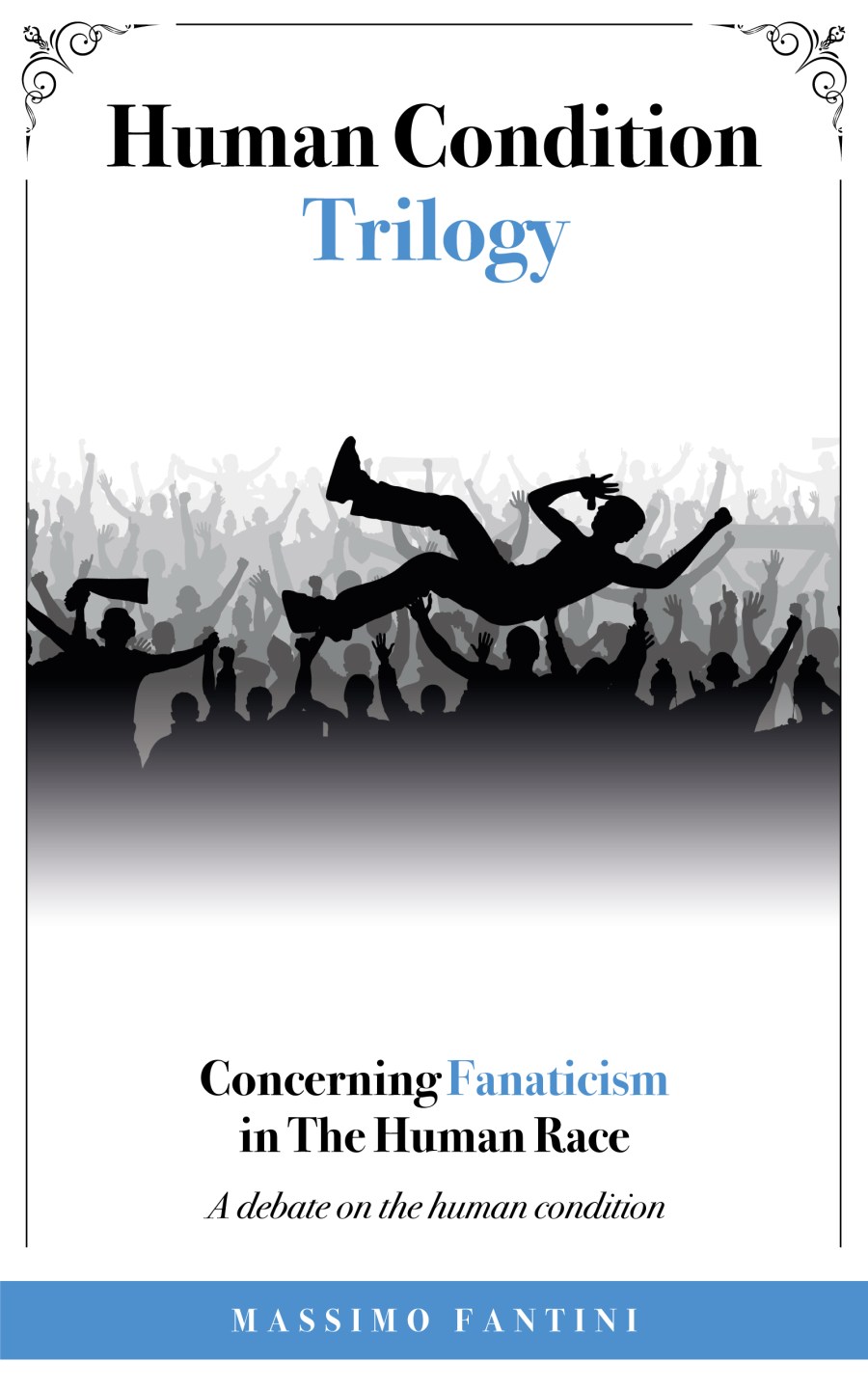
A seemingly simple law dispute turns into a gripping look into the human condition in author Massimo Fantini’s “Concerning Fanaticism in The Human Race”, the latest book in the Human Condition Trilogy.
Advertisements
The Synopsis
Elijah is a promising young lawyer, in love with his work and confident in the potential of the human race.
His law firm’s senior partner gives him his first important assignment. Elijah will have to follow the case of Leonard, an elderly engineer who lives in Montepastore, a small village in the Bolognese Apennines (Italy).
Leonard’s question concerns the supplementary contribution that engineers enrolled in the professional register are required to pay to Inarcassa, the Engineers’ Pension Fund. At first, the case seems simple. It was the subject of a previous ruling by the Court of Cassation. But Leonard is not satisfied with an institutional response. He wants to know why. He wants to know what hides behind the Supreme Court’s ruling.
Leonard’s demands grow meeting after meeting, and the subject of the dispute widens to include ethical, religious, and historical concerns.
As in the previous manuscripts, questions about the human condition are at the center of this philosophical debate. In the absence of answers, what is the point of writing about anything else?
The editing and translation of this book was done by Ian Zwaschka.
The Review
One of the most compelling questions a person can ask is whether or not to trust what is being told. The dialogue and character growth that the author brings to life on the page is rich and driven, allowing the reader to get lost in the narrative. The setting and atmosphere the author can develop and the mounting tension add to an already thoughtful story.
Yet the discussion and philosophical journey that readers are presented with makes this story so inviting. The ability to question authority and tackle mounting ethical dilemmas as they are presented to us delves into our philosophy and how we interact with religion, politics, and the human mind overall. The way the author presents this discussion to readers gets the reader’s minds working and does so without going over the line of being abstract, allowing the story to shine brightly.
The Verdict
Memorable, thoughtful, and gripping author Massimo Fantini’s “Concerning Fanaticism in the Human Race” is a must-read contemporary fiction that meets philosophical discussion. The twists in the narrative and the engaging character dynamics between Elijah and Leonard will keep readers on the edge of their seats while also looking inward at how we view blind faith and the ability to question authority for ourselves. If you haven’t yet, be sure to grab your copy today!
Rating: 10/10
Advertisements
About the Author
Greetings, readers.
I am Massimo Fantini, an Italian author and free thinker, writing from my home in the hills just outside Bologna. In quiet moments, when I am not writing, I enjoy classical music, particularly orchestral works for violin and the Italian opera.
I graduated from a university in Bologna with a degree in civil engineering. However, the studies of my youth do not represent my life’s obsession—that is, delving into those realities which unite all members of the human race: suffering, frustrations, conflicts, and the human reactions to these. They are the events and forces that take every human as an innocent in the crib and twist and turn them into 8.1 billion unique (but intimately connected) forms.
In short, I am obsessed with exploring the intimate recesses of the human condition.
In 2018, entirely dissatisfied with my job, I sought a new form of expression. Thus, I began to write. Incessantly.
I experimented with many kinds of writing. How best to give my ideas form? Then, I found my voice through stories, giving life to characters who explore, triumph, and fail for us to watch.
In each installment of my Human Condition Trilogy, these same all-encompassing issues are approached from different directions, under different circumstances, and by different characters.
Echoing the sentiment of Heraclitus, no two people may look at the same problem, because it is different to each. From the old cynical Leonard in Concerning Fanaticism to young Tommaso (a character inspired by my own youth) in Concerning Intellectual Suicide, I tried to cast a light on a path that is a constant part of our lives, but also constantly shifting.
Through my writing, I encourage readers to find their own perspective on life. Rather than embracing the comfortable mold which society provides, like a goldfish “free” to swim around in its little bowl, I hope my readers can use my books as a steppingstone toward their own unique way of thinking. And then, I wish them the freedom to pursue it.
Art is wonderful because it is a representation of what we otherwise cannot express. I seek not to provide myself and my readers with a mere distraction (what so often passes for “entertainment”). Not a hole in which to stick our heads for a few hours, only to emerge weakened and even less able to face our reality. Rather, I offer up a representation of our shared condition.
I received a free copy of this book in exchange for a fair and honest review. All opinions are my own.
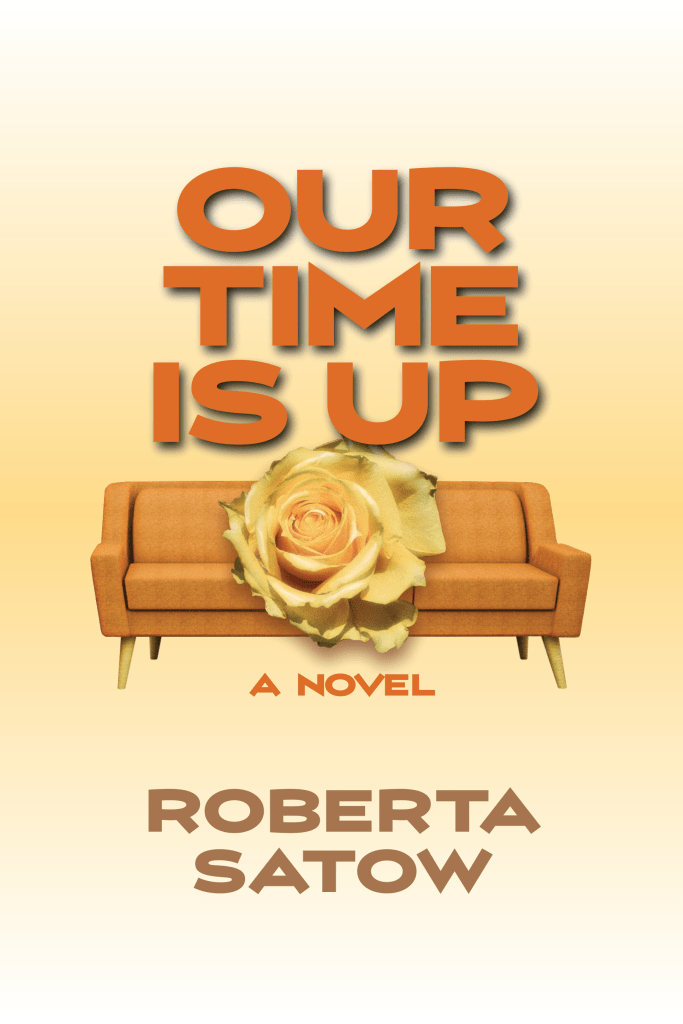
A young woman struggling with grief and her journey to owning her identity showcases the heart of a psychoanalytical relationship with her therapist in author Roberta Satow’s “Our Time is Up: A Novel”.
Advertisements
The Synopsis
This book is a memoir-like novel that captures an era, an ethos, and a sociopolitical sensibility through the eyes of a young woman struggling with autonomy, guilt, sexuality, and grief in the late 1960s. Both patients and therapists will recognize their own struggles in this depiction of Rose’s gradual blossoming in the sunlight of her analyst’s honesty, integrity, and devotion. I know of no other work that conveys analytic treatment, training, and passion so intimately and in such a pitch-perfect voice.
Our Time is Up is a profoundly moving dive into the nuance and beauty of the psychoanalytic relationship. Written with humor, compassion and an intimate understanding of the analytic process, the book shows love and loss and the true boundaries of time. It is a frank and refreshing fictionalized account of how a person comes comes through psychoanalysis to sit in the psychoanalyst’s chair herself. It is the important and deeply personal story of an interior journey.
The Review
This was a heartfelt and compelling read. The author worked intensely to highlight the rich character dynamics between the protagonist and their psychoanalyst. The balance between the protagonist’s conflicting childhood and her work to better herself and confront that trauma in her adult life was profound and powerfully moving. The honest atmosphere that the author established during the protagonist’s sessions with the analyst and the tension that mounted as each childhood experience was peeled away like a layer in an onion made this narrative feel alive and heartfelt in its delivery.
The relationship and actions taken between the protagonist and her psychoanalyst were the pinnacle of this narrative. Through honest conversations between the patient and analyst, the reader can get a heartening insight into how therapy and working through past conflict can be an enriching experience, not without struggles but emotionally rewarding. The experience of how her past experiences in childhood color her modern experiences with relationships and her understanding of her womanhood were honest and insightful and led the reader to be moved by the author’s world-building and character development in the process.
The Verdict
Ultimately, this was a story about being human and the human experience we all must endure throughout this life. While each person’s experience is unique, the direct nature of the protagonist’s relationship with her mother in childhood and later her psychoanalyst in her adult life made this an engaging, thoughtful, and remarkable story that has quickly become a must-read psychological contemporary American fiction novel. if you haven’t yet, be sure to grab your copy today!
Rating: 10/10
Advertisements
About the Author
Roberta Satow, Ph.D. is a practicing psychoanalyst in Washington, CT. She is a senior member of the faculty and control analyst at the National Psychological Association for Psychoanalysis. Dr. Satow is Professor Emerita of Sociology at Brooklyn College and the Graduate Center of the City University of New York. In addition to her non-fiction book Doing the Right Thing: Taking Care of Your Elderly Parents Even if They Didn’t Take Care of You (Tarcher/Penguin 2006), she is the editor of Gender and Social Life (Allyn
and Bacon, 2000) and she has written a novel Two Sisters of Coyoacan (2017). Dr. Satow writes a blog for Psychology Today:
I received a free copy of this book in exchange for a fair and honest review. All opinions are my own.
A woman discovers the impossible as she witnesses her marriage hanging on the verge of destruction and she must discover whether it can be saved in author Patti Lee’s “Between February and November”.
Advertisements
The Synopsis
From Firebird Book Award winning author, Patti Lee, her debut novel “Between February and November” delves into the messy uncertainty of long-term marriages. Being in the wrong place at the right time can change your life in an instant.
That February morning started out like any other; Layla Ranker got her kids ready for school and her husband off to work before she went to work herself. It went downhill from there. An unfortunate event took her two towns away from home where she happened to see her husband, Alan, with a young, attractive woman going into a hotel.
Devastated, Layla contemplates the last twenty years of her life and wonders if Alan regrets marrying her right after high school. Old wounds are opened as she struggles to figure out what went wrong.
Can they rekindle what they once had?
The Review
This was a tense and emotional read. The author did a fantastic job of crafting a narrative that felt both realistic and engaging to the reader. The tension and atmosphere the author built around the cast of characters really heightened the imagery that made this story feel more cinematic and dramatic in its delivery.
The characters were the true heart of this story. The way the author showcased the point of view of the three main players in this story and woven the backstories of these characters from their pasts into the development of these drastic turns of events in the present made this feel both grounded and mesmerizing in its delivery. The themes of love, loss, and relationships, in general, were so profoundly felt in this book and made me feel connected to the characters and their hardships in this tale.
The Verdict
Heartfelt, emotional, and thoughtful in its approach, author Patti Lee’s “Between February and November” is a must-read contemporary women’s fiction and family drama novel of 2022. The relatability of these characters and the heartbreak surrounding the situations they face all culminate in some twists and turns that make the readers feel shocked at the turn of events that this narrative takes. If you haven’t yet, be sure to grab your copy today!
Rating: 10/10
Advertisements
About the Author
Patti Lee brings women’s fiction stories to life, tapping into the hopes and sometimes fears of readers. Her debut novel, Between February and November, due to be released in 2022, placed in the top 10 in Notebook Publishing’s #IndieApril contest. An award-winning essay writer, her creative non-fiction has been included in Crone Rising by Jazz House Publications, and her short story, The Ward House, was included in the Of Cottages and Cauldrons autumn anthology, also by Jazz House Publications.
Patti Lee is currently putting the finishes touches on her second novel. When she’s not writing or playing with her grandkids, she dabbles in acrylic painting. She is a groupie of singer-songwriter Josh Ritter and alt/folk duo Parsonsfield but has also been known to play the soundtrack to Hamilton on repeat. She currently resides in Vermont, where she has more cats than throw pillows. Read more about her and her writing at http://pattileewriter.com. You can find her on Twitter @pattiauthor and Instagram @authorpattilee.
1) Tell us a little bit about yourself. How did you get into writing?
Before I start, I would like to thank you for the interview and your review of The Lone Leopard.
I was born and brought up in Kabul, Afghanistan, and claimed asylum alongside my parents in the UK in 1999. I finished all my higher education in the UK. I am married and live with my wife and three children in a quiet town in England.
How did I get into writing? I love writing, especially about my country Afghanistan. Therefore, I did my PhD on Afghanistan and subsequently published some two dozen articles and a book (more below) on my native land.
The idea for writing The Lone Leopard, however, was actually conceived in 1992 when the ‘pro-Communist’ Najibullah regime collapsed and the mujahideen took over Kabul. Turning Shia against Sunni and vice versa, setting Afghanistan’s main ethnic groups of Pashtun, Tajik, Hazara and Uzbek against each other, and accusing each other of uniting with the remnants of pro-Communist members and thus not being Islamic enough, the 15 or so mujahideen groups fought each other in the streets of Kabul, killing tens of thousands of innocent Kabulis, displacing hundreds of thousands, and turning half of Kabul into mudbrick rubble with bombs, rockets and cannon fire.
Taking refuge in the basements of our blocks while the gunfire, shelling and fighting continued, I decided (if I made it alive) to write about what we ordinary Afghans went through. Unlike thousands of Kabulis, I was fortunate enough to live, and 18 years later, in 2010, I started writing about the experience: after 12 years of writing/rewriting (and extensive research, including consulting nearly a thousand sources), The Lone Leopard is the result.
Advertisements
2) What inspired you to write your book?
I’ve partly answered this question above. I’d also like to add that my only inspiration is my people and country. I wanted to tell the contemporary Afghan and Afghanistan story from an Afghan perspective. Ahmad, the protagonist of my novel, therefore, gives a first-hand account of what I (and most Afghans) have experienced over the past four decades in Afghanistan (and in exile). My previous book, America in Afghanistan, published in 2019 by IB Tauris/Bloomsbury, was praised by reviewers for its Afghan perspectives, and is found at, among other institutions, Oxford and Harvard.
3) What theme or message do you hope readers will take away from your book?
The reader will get to know a great deal about the principles of Afghan culture, particularly independence, courage, loyalty, justice, revenge, righteousness, pride, honour, chastity, hospitality, love, forgiveness, faith (Islam) and respect of elders (parents in particular), among others, and some of these themes, in addition to jealousy, prejudice, betrayal, guilt and atonement, the book explores.
The Lone Leopard is a historical war drama. Once the reader reads it, I hope they will see how things have been in Afghanistan; they will understand the history and politics of the past four decades in Afghanistan; and they will see the real Afghan and Afghanistan.
The Lone Leopard is a work of contemporary literary fiction, too, as it is solely based on human relations. The focus of the novel is primarily on the lives of Ahmad (15, a conservatively traditional Pashtun, dutiful child, gifted student, thoughtful but faint-hearted) and Frishta (16, progressive, Tajik, women’s rights activist, compassionate, outspoken and brave): will the faint-hearted Ahmad learn from Frishta to fight his cowardly side and stand up for himself and for what is right, even if his stance opposes traditions/his controlling mother; will the fearless Frishta journey from a middle-class girl to ‘the president of Afghanistan’; will Ahmad and Frishta with conflicting personalities/backgrounds fall in love; will the middle-class Wazir (15, Ahmad’s best friend/classmate: Pashtun, fearless, the school gangster, pro-mujahideen) ever fulfil his dreams of killing a Communist and joining jihad; and will the loveable Baktash (15, Ahmad’s best friend/classmate: Tajik/Hazara, timid but lovable, pro-Communism) live a normal life without getting bullied for being different. So, the reader will get drawn into a time (the 1980s-2010s) when historical events – several invasions of Afghanistan over the past four decades in particular – give rise to nationalistic and religious conflicts and impact the lives of the four characters and their families.
Moreover, The Lone Leopard is a mother-son relationship story, as familial aspects constitute a significant part of the narrative, especially (the importance of) parental respect, which you have highlighted (and liked) in your review.
Incidentally, in addition to the Western reader, when writing the novel, I had the future Afghan generations in mind, especially for them to see what mistakes their ancestors committed and how they should avoid repeating them. One of them is how discrimination, alienation and division can destroy a country; and how unity, inclusion and empowerment of people – regardless of their sex, tribe, ethnic origin, religion, etc. – can help build a better country and, by extension, a better world.
4) What drew you into this particular genre?
The Lone Leopard can fit into several genres: literary fiction, women’s fiction, young adult fiction, coming-of-age, family drama, war drama, and romance. For me, however, it will always remain historical fiction drama, the story of contemporary Afghanistan. I chose the historical genre because I have a PhD in IR/history, have taught the history of Afghanistan and have lived through the historical periods The Lone Leopard covers. As a creative writing teacher may say, ‘write what you know’.
Advertisements
5) What social media site has been the most helpful in developing your readership?
I am not very good at social media and only use Twitter. I also have a LinkedIn account, but I have not made much use of it.
6) What advice would you give to aspiring or just starting authors out there?
Read more, research a lot, and get a good command of creative writing techniques before starting your book. And keep it consistent: make sure you write/research/read every day, even if it is for half an hour. Oh, one more thing: start today; don’t wait for tomorrow.
7) What does the future hold in store for you? Any new books/projects on the horizon?
My next book will focus on why the Doha Peace Agreement between the Taliban and America failed and the possible consequences of the failure for Afghanistan, the region and the international community.
Advertisements
About the Author
SHARIFULLAH DORANI was born and raised in Kabul, Afghanistan, and claimed asylum in the UK in 1999. He has undergraduate and master’s degrees in Law from The University of Northampton and UCL, respectively. He completed his PhD on the US War in Afghanistan at Durham University and authored the acclaimed America in Afghanistan. Sharifullah frequently returns to Afghanistan to carry out research. He is currently South Asia and the Middle Eastern Editor at The Centre for Strategic Research and Analysis (CESRAN International) and has written nearly two dozen articles on Afghanistan (and the broader region), international relations and law. He lives with his family in Bedford, England.
I received a free copy of this book in exchange for a fair and honest review. All opinions are my own.
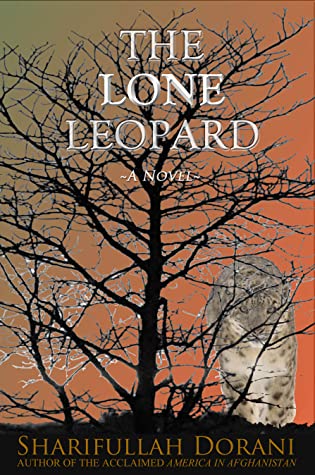
Politics, religion, and culture clash as one man must return to his home decades after civil war and a question of his cowardice threatened to upend his standing in society in author Sharifullah Dorani’s “The Lone Leopard”.
Advertisements
The Synopsis
THE LONE LEOPARD is a heart-wrenching, yet hopeful story of family, friendship and love set against the nationalistic and religious conflicts of Afghanistan’s last four decades. 15-year-old Ahmad finds it hard to live by tradition among Russians and ‘Communist Afghans’ in the liberal Makroryan, known as the ‘Little Moscow of Kabul’. It becomes harder with the arrival in the neighbourhood of the 16-year-old Frishta. Naturally, their conflicting outlooks on tradition clash. Frishta calls Ahmad a shameful coward, and Ahmad accuses Frishta of being a ‘bad woman’ who has picked a war with half of the population and their way of life.
Does Ahmad really lack courage and loyalty? Is Frishta really dishonourable? It is 1990s Afghanistan, where a man is stripped of character if he is proved a coward, and where a woman is merely seen as valuable goods, and even a perception of unchastity will lose her all her worth. And, worse, is what Ahmad does to Frishta justifiable? By the time Ahmad and Frishta have answers to these questions, it is too late, and their lives will never be the same. The mujahedeen run over Kabul, and the civil war begins, compelling Ahmad to flee to Russia and then to England.
But Ahmad does not realize that one day he will be forced to return to the homeland where his past catches up with him and puts him in a situation in which he has to choose to either live like a coward, by killing a once-loyal friend, or die with courage.
The Review
The author did an incredible job of crafting a story that both brought to life and examined the history and culture of Afghanistan and infused complex character dynamics with rich storytelling. The contemporary drama explored the historical fiction genres and Middle Eastern history expertly, and the tragedy that often comes to those caught in the crossfire of war and conflict. The exploration of Afghanistan’s somewhat troubled past with women’s rights and the conflict that emerges when faith and belief systems come into play clashes well with the exploration of outside influences bringing innocent civilians and villages into the list of casualties of a war they had nothing to do with.
Yet it was the emphasis on relationships and their impact on the cast of characters that really captured my attention. At the root and heart of this grand narrative of culture and history stands the story of a young man who along with his friends and family witnesses heartbreak, violence, and tragedy and how it impacts his relationships moving forward. The relationship between the protagonist Ahmad and his mother Mourr held a special place in my heart, as it speaks to the strength and resilience that many mothers have as they sacrifice everything for their children. This also lends to the protagonist’s future relationships with others down the road, and the complex questions of morality and culture that play into his development as a character.
The Verdict
Thought-provoking, heartbreaking, and engaging, author Sharifullah Dorani’s “The Lone Leopard” is a must-read historical fiction Middle Eastern and contemporary romance drama novel. The author’s thoughtful and brilliant writing style compliments the volume of history and culture that he brings into the narrative, and the mesmerizing and emotional story that rests at the heart of this novel will have readers hanging onto the author’s every word. If you haven’t yet, be sure to grab your copy today!
Rating: 10/10
Advertisements
About the Author
SHARIFULLAH DORANI was born and raised in Kabul, Afghanistan, and claimed asylum in the UK in 1999. He has undergraduate and master’s degrees in Law from The University of Northampton and UCL, respectively. He completed his PhD on the US War in Afghanistan at Durham University and authored the acclaimed America in Afghanistan. Sharifullah frequently returns to Afghanistan to carry out research. He is currently South Asia and the Middle Eastern Editor at The Centre for Strategic Research and Analysis (CESRAN International) and has written nearly two dozen articles on Afghanistan (and the broader region), international relations and law. He lives with his family in Bedford, England.
I received a free copy of this book in exchange for a fair and honest review. All opinions are my own.
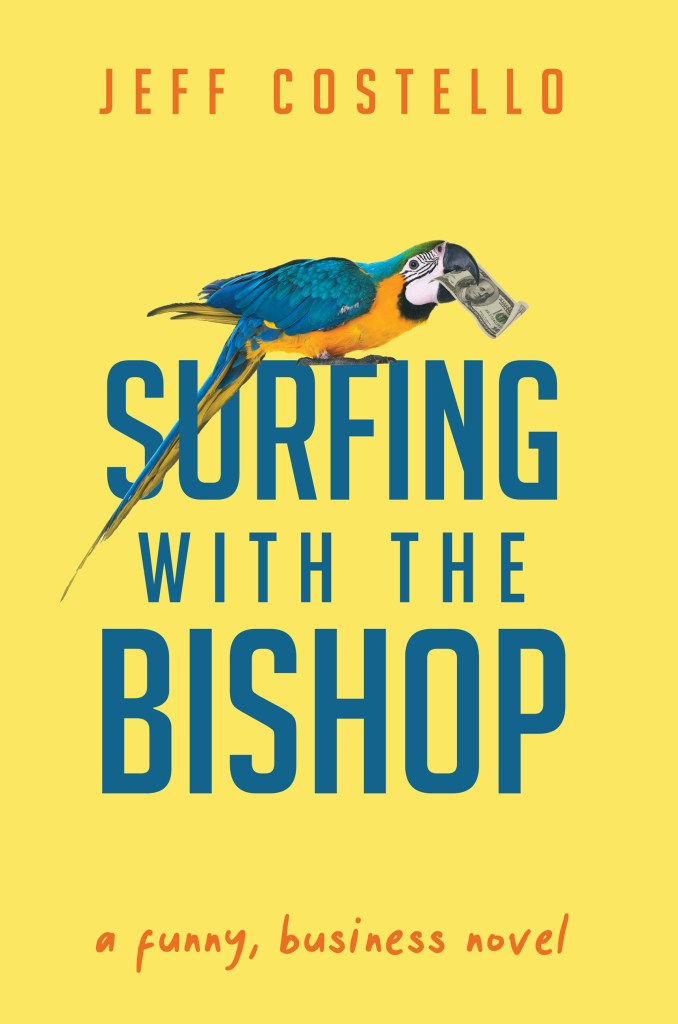
A man must find it within himself to save the company he’s poured his life into after his boss and mentor passes away, and his children begin the process of selling off the business in author Jeff Costello’s “Surfing with the Bishop: A Funny Business Novel”.
Advertisements
The Synopsis
“A hilariously fun read loaded with relatable characters and laugh-out-loud moments that’s so damn entertaining, you’ll wish you worked with these people. Buckle up for a white-knuckle ride that will remind you of the best companies you’ve ever worked for and the worst.”
Tim Shiner, Entrepreneur and author of 50 Things They Didn’t Teach You in School!
Business owners die, heirs sell, and companies disappear. It happens all the time. But, when Grayson Quinn’s mentor Big Bill passes away – and his daughters quickly decide to sell off their father’s legacy – the burden of saving the company and the livelihood of so many others falls to Grayson.
To succeed, he must accomplish the seemingly impossible. It will take all of Grayson’s ingenuity to overcome insanely bad marketing, negotiate without money, and outwit obnoxious competitors who want to buy the company and steal his business, not necessarily in that order.
Hidden motives drive critical decisions, as Grayson is caught in the middle with little understanding of anyone’s true intentions. Business as usual is his directive to anyone who will listen, but there’s nothing usual about the final days of Martlet Visionary Products.
The Review
The author did a marvelous job of creating a unique reading experience that focuses on high-stakes business operations while also crafting memorable characters that readers will feel invested in. The amount of detail the author poured into the characters was amazing to see, as the business world felt alive and vibrant in the author’s novel, as did the businessmen and women who brought this company to life. The way the author infused humor and wit into the character’s interactions within this office setting and the issues protagonist Grayson faced were well-rounded and entertaining to see unfold.
Yet it was the tone and world-building the author did that really made this novel come alive. It is such a unique story as it really hones in onto the business theme and had detailed accounts of how the business side of things ran, elevating the characters and their own struggles as the story went on. Layering this into a story of loss and overcoming insurmountable odds, along with the theme of legacy, made this story really shine brightly.
The Verdict
A memorable, original, and highly creative read, author Jeff Costello’s “Surfing with the Bishop” is a must-read contemporary fiction novel. The funny interactions between the characters within this business world and the layered world and character growth the author introduced will definitely have readers enthralled, making this a brilliant feat of storytelling. If you haven’t yet, be sure to grab your copy today!
Rating: 10/10
Advertisements
About the Author
Jeff Costello served as a senior sales executive for 30-plus years, driving billions of dollars of revenue from emerging technology markets. He’s led worldwide sales teams that supported partners in over 100 different countries and participated in numerous company acquisitions. Having entertained customers for decades, he’s often boasted that he has, “fed more people than Mother Teresa, or at the very least, served better wine.” Jeff lives in the Dallas/Fort Worth area with his wife, Trina, and their dogs, Bentley and Bo.
I received a free copy of this book in exchange for a fair and honest review. All opinions are my own.
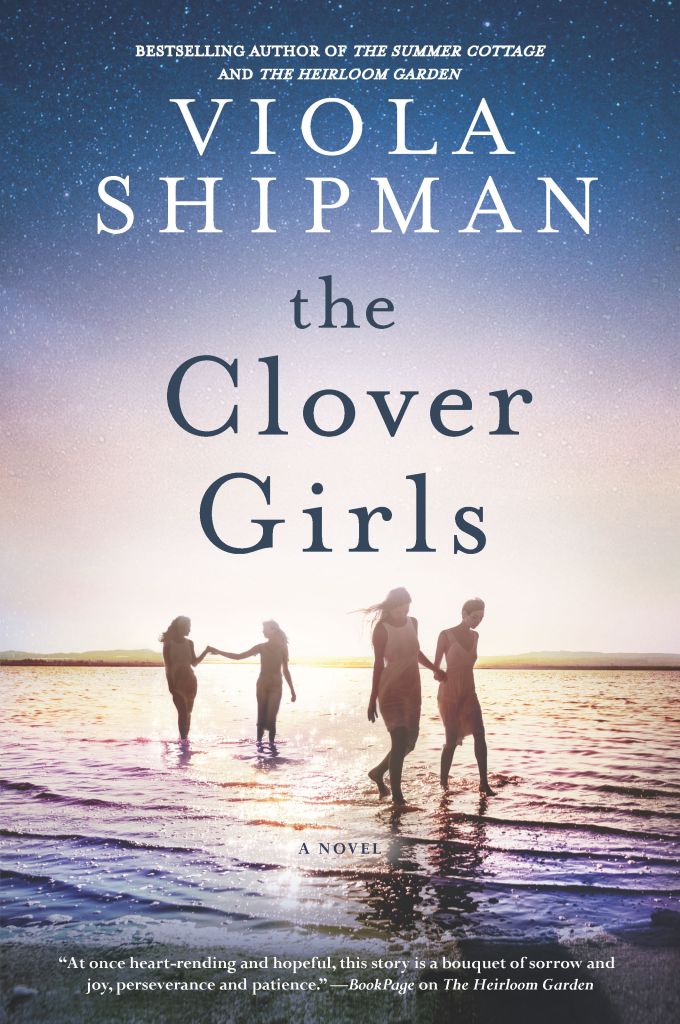
Three friends from their youths must reunite when their fourth friend dying of cancer summons them to the summer camp they spent their youth in, and must find the dreams they left behind as they face the challenges of their own lives in author Viola Shipman’s “The Clover Girls”.
Advertisements
The Synopsis
As comforting and familiar as a favorite sweater, Viola Shipman’s novels never fail to deliver a heartfelt story of friendship and familty, encapsulating summer memories in every page. Fans of Dorthea Benton Frank and Nancy Thayer will love this new story about three childhood friends approaching middle age, determined to rediscover the dreams that made them special as campers in 1985.
Elizabeth, Veronica, Rachel and Emily met at Camp Birchwood as girls in 1985, where they called themselves The Clover Girls (after their cabin name). The years following that magical summer pulled them in very different directions and, now approaching middle age, the women are facing new challenges: the inevitable physical changes that come with aging, feeling invisible to society, disinterested husbands, surley teens, and losing their sense of self.
Then, Elizabeth, Veronica and Rachel each receive a letter from Emily – she has cancer and, knowing it’s terminal, reaches out to the girls who were her best friends once upon a time and implores them to reunite at Camp Birchwood to scatter her ashes. When the three meet at the property for the first time in what feels like a lifetime, another letter from Emily awaits, explaining that she has purchased the abandoned camp, and now it belongs to them – at Emily’s urging, they must spend a week together remembering the dreams they’d put aside, and find a way to become the women they always swore they’d grow up to be. Through flashbacks to their youthful summer, we see the four friends then and now, rebuilding their lives, flipping a middle finger to society’s disdain for aging women, and with a renewed purpose to find themselves again.
The Review
Such an incredible and emotional story, author Viola Shipman has crafted a truly beautiful and heartbreaking story of lost friendship, loss, and regaining that which has been lost in our lives. The multiple POV of these characters really brings a sense of wholeness and driven narratives to their story.
So often in life friends drift away, becoming busy with their growing lives and diverging paths that take them away from one another. Yet less often is the events that bring us back together again. This narrative does a fantastic job of exploring the uncharted path towards unification with the people who made us feel like ourselves again.
The setting and imagery of the narrative felt alive and become a character all on their own. I love the flashbacks and letters from the early days of the Clover Girls that really captured the essence of the 80’s style era that part of the narrative took place in, and the pacing really helped with the friend’s journey to not only find themselves but to find the friendship that brought them so much happiness and joy.
The Verdict
A mesmerizing, emotionally driven, and engaging read, author Viola Shipman’s The Clover Girls is the perfect summer read for those who love women’s fiction and tales of friendship and the bonds we share with others. The author takes the readers on such an emotional journey and showcases how the painful reality of loss can sometimes bring and heal those who have been lost to each other back together again. If you haven’t yet, be sure to grab your copy today!
Advertisements
About the Author
Viola Shipman is the pen name for Wade Rouse, a popular, award-winning memoirist. Rouse chose his grandmother’s name, Viola Shipman, to honor the woman whose heirlooms and family stories inspire his writing. Rouse is the author of The Summer Cottage, as well as The Charm Bracelet and The Hope Chest which have been translated into more than a dozen languages and become international bestsellers. He lives in Saugatuck, Michigan and Palm Springs, California, and has written for People, Coastal Living, Good Housekeeping, and Taste of Home, along with other publications, and is a contributor to All Things Considered.
Fizzy water (cherry, lime, watermelon, mixed berry)
Chips (lentil, quinoa, kale, beet)
Cereal (Kashi, steel-cut oats, NO GMOs! VERY IMPORTANT!)
Whatever happened to one kind of milk from a cow, one kind of water from a faucet and one kind of chip from a potato?
My teenage children are seated on opposite ends of the massive, modern, original Milo Baughman circular sofa that David and I ordered for our new midcentury house in Los Angeles. Ashley and Tyler are juggling drinks while pecking at their cells, and it takes every fiber of my soul not to come unglued. This is the most expensive piece of furniture I have ever purchased in my life. More expensive even than my first two years of college tuition plus my first car, a red Reliant K-car that would stall at stoplights.
I still don’t know what the K stood for, I think. Krappy?
That was a time, long ago, when that type of negative thought would never have entered my mind, when the K would have stood only for Konfident, Kool or Kick-Ass. But that was a different world, another time, another life and place.
Another me.
Another V.
I steady my pen at the top of a pad of paper emblazoned with the logo of my husband’s architectural firm, David Berzini & Associates.
Los Angeles is the latest stop for us. My family has hopscotched the world more than a military brat as David’s architectural career has exploded. He is now one of the world’s preeminent architects. David studied under and worked with some of the most famous midcentury modern architects—Albert Frey, William Krisel, Donald Wexler—and has now taken over their mantles, especially as the appreciation for and popularity of midcentury modern architecture has grown. Now he is working on a stunning new public library in LA that will be his legacy.
I glance up from my pad. A selection of magazines—Architectural Digest, Vogue, W—are artfully strewn across a brutalist coffee table. The beautiful models stare back at me.
That was my legacy.
“Mom, can I get something to eat?”
This is now my legacy.
I glance at my children. Everything old has come back en vogue. Ashley is wearing the same sort of high-waisted jeans that I once wore and modeled in the ’80s, and Tyler’s hair—razored high by a barber and slicked back into a big black pompadour—looks a lot like a style I sported for a Robert Palmer video when every woman wanted to look like a Nagel woman.
Yes, everything has made a comeback.
Except me.
I look at my list.
And carbs.
My kids, like my husband, have never met a Pop-Tart, a box of Cap’n Crunch, a Jeno’s Pizza Roll or a Ding Dong. My entire family resembles long-limbed ponies, ready to race. I grew up when the foundation of a food pyramid was a Twinkie.
I again put pen to paper, and in my own secret code I write the letter L above the first letter of my husband’s name. If someone happened to glance at the paper, they would simply think I had been doodling. But I know what “LD” means, and it will remind me once I get to the store.
Little Debbies.
You know, I actually hide these around our new home, which isn’t easy since the entire space is so sleek and minimal, and hiding space is at a premium. It took a lot of effort, but I, too, used to be as sleek and minimal as this house, as angular and arresting as its architecture. Anything out of place in our butterfly-roofed home located in the Bird Streets high above Sunset Strip—where the streets are named after orioles and nightingales, and Hollywood stars reside—is conspicuous.
Even now, on yet another perfect day in LA, where the sunshine makes everything look lazily beautiful and dipped in glitter, I can see a layer of dust on the terrazzo floors. Although a maid comes twice a week, the dust, smog and ash from nonstop fires in LA—carried by hot, dry Santa Ana winds—coat everything. And David notices everything.
Swiffers, I write on the pad, before outlining “LD” with my pen.
David hates that I have gained weight. He is embarrassed I have gained weight.
Or is just my imagination? Am I the one who is embarrassed by who I’ve become?
David never says anything to me, but he attends more and more galas alone, saying I need to watch the kids even though they no longer need a babysitter and that it’s better for their stability if one parent is with them. But I know the truth.
What did he expect would happen to my body after two children and endless moves? What did he expect would happen after losing my career, identity and self-esteem? It’s so ironic, because I’m not angry at him or my life. I’m just…
“Why don’t you just put all of that in the notes on your phone?”
“Or just ask the refrigerator to remember?”
“Yeah, Mom,” my kids say at the same time.
I look over at them. They have my beauty and David’s drive. Ash and Ty lift their eyes from their phones just long enough to roll their eyes at me, in that way that teens do, the way teens always have, in that there-couldn’t-be-a-more-lame-uncool-human-in-the-world-than-you-Mom way. And it’s always followed by “the sigh.”
“I like to do it this way,” I say.
“NO ONE writes anything anymore,” Ashley says.
“NO ONE, Mom!” Tyler echoes.
“Cursive is dead, Mom,” Ashley says. “Get with the times.”
I stare at my children. They are often the sweetest kids in the world, but every so often their evil twins emerge, the ones with forked tongues and acerbic words.
Did they get that from me? Or their father? Or is it just the way kids are today?
The sun shifts, and the reflection of water from the pool dances on the white walls, making it look as if we are living in an aquarium. I glance down the long hallway where the pool is reflecting, the place David has allowed me to have my only “clutter”: a corridor of old photos, a room of heirlooms.
My life flashes before me: our family in front of the Rockefeller Center Christmas tree in New York at the holidays, eating colorful French macarons at a café in Paris, lying out on Barcelona’s beaches, and fishing with my parents at their summer cottage on Lake Michigan. And then, in the ultimate juxtaposition, there is an old photo of me, teenage me, in a bikini at Lake Birchwood hanging directly next to an old Sports Illustrated cover of me. In it, I am posing by the ocean where I met David. I am crouched on the beach like a tiger ready to pounce. That was my signature pose, you know, the one I invented that all the other models stole, the Tiger Pose.
I was one of the one-name girls back then: Madonna, Iman, Cher, V. All I needed was a single letter to identify myself. Now V has Vanished. I have one name.
“Mom!”
“Lunch. Please!”
My eyes wander back to our pool. I would be mortified to wear a bikini today. I am not what most people would deem overweight. But I have a paunch, my thighs are jellied and my chin is starting to have a best friend. It was that photo in all of the gossip magazines a year or so ago that did it to me. Paparazzi shot me downing an ice cream cone while putting gas in my car. I had shuttled the kids around all day in 110-degree heat, and I was wearing a billowy caftan. I looked bigger than my SUV. And the headlines:
Voluminous!
V has Vanished Inside This Woman!
If you saw me in person, you’d likely say I’m a narcissist or being way too hard on myself, but it’s as hard to hide fifteen pounds in LA as it is to hide an extra throw pillow in this house. I get Botox and fillers and do all the things I can to maintain my looks, but I am terrified to go to the gym here. I am mortified to look for a dress in a city where a size two is considered obese. The gossip rags are just waiting for me to move.
My eyes wander back to the photos.
I no longer have an identity.
I no longer have friends.
“Earth to Mom? Can you make me some lunch?” Tyler looks at me. “Then I need to go to Justin’s.”
“And you have to drive me to Lily’s at four, remember?”
I shudder. A two-mile drive in LA takes two hours.
“Mom?”
Ashley looks at me.
There is a way that your children and husband look at you—or rather don’t look at you at a certain point in your life—not to mention kids in the street, young women shopping, men in restaurants, David’s colleagues, happy families in the grocery.
They look through you. Like you’re a window.
It’s as if women over forty were never young, smart, fashionable, cool…were never like them, never had hopes, dreams and acres of life ahead of them.
What is with American society today?
Why, when women reach a “certain age,” do we become ghosts? Strike that. That’s not an accurate analogy: that would imply that we actually invoke a mood, a scare, a feeling of some sort. That we have a personality. I could once hold up a bag of potato chips, eat one, lick my fingers and sell a million bags of junk food for a company. Now I’m not even memorable enough to be a ghost. This model has become a prop. A piece of furniture. Not like the stylish one my kids are stretched out on, but the reliable, sturdy, ever-present, department store kind, devoid of any depth or substance, one without feeling, attractiveness or sexuality. I am just here. Like the air. Necessary to survive, but something no one sees or notices.
I used to be noticed. I used to be seen. Desired. Admired. Wanted.
I was the ringleader of friends, the one who called the shots. Now, I am Uber driver, Shipt delivery, human Roomba and in-home Grubhub, products I once would have sold rather than used.
I take a deep breath and note a few more grocery items on my antiquated written list and stand to make my kids lunch.
They are teen health nuts, already obsessed with every bite they consume. Does it have GMOs? What is the protein-to-carb differential?
Did I do this to them? I don’t think so.
Even as a model, I ate pizza, but that’s back in the day when a curve was sexy and a bikini needed to be filled out. I pull out some spicy tuna sushi rolls I picked up at Gelson’s and arrange them on a platter. I wash and chop some berries and place them in a bowl. I watch my kids fill their plates. Ashley is a cheerleader and wannabe actress, and Tyler is a skateboarding, creative techy applying to UCLA to study film and directing. Ashley wants to go to Northwestern to major in drama. They will both be going to specialty camps later this summer, Ashley for cheerleading and acting, Tyler for filmmaking and to boost his SAT scores. My eyes drift back to my photo wall, and I smile. They will not, however, spend their days simply having fun, singing camp songs, engaging in color wars, shooting archery, splashing in a cold lake, roasting marshmallows and making friends. A kid’s life today, especially here in LA, is a competition, and the competition starts early.
There is a rustling noise outside, and Ashley tosses her plate onto the sofa and rushes to the door. In LA, even the postal workers are hot, literally and figuratively, and our mailman looks like Zac Efron. She returns a few seconds later, fanning herself dramatically with the mail.
“You’re going to be a great actress,” I say with a laugh. Ashley starts to toss the mail onto the counter, but I stop her. “Leave the mail in the organizer for your dad.”
Yes, even the mail has its own home in our home.
“Hey, you got a letter,” she says.
“Who writes letters anymore?” Tyler asks.
“Old people,” Ashley says. The two laugh.
I take a seat at the original Saarinen tulip table and study the envelope. There is no return address. I feel the envelope. It’s bulky. I open it and begin to read a handwritten letter:
Dear V:
How are you? I’m sorry it’s been a while since we’ve talked. You’ve been busy, I’ve been busy. Remember when we were just a bunk away? We could lean our heads over the side and share our darkest secrets. Those were the good ol’ days, weren’t they? When we were innocent. When we were as tight as the clover that grew together in the patch that wound to the lake.
How long has it been since you talked to Rach and Liz? Over 30 years? I guess that first four-leaf clover I found wasn’t so lucky after all, was it? Oh, you and Rach have had such success, but are you happy, V? Deep down? Achingly happy? I don’t believe in my heart that you are. I don’t think Rach and Liz are either. How do I know? Friend’s intuition.
I used to hate myself for telling everyone what happened our last summer together. It was like dominoes falling after that, one secret after the next revealed, the facade of our friendship ripped apart, just like tearing the fourth leaf off that clover I still have pressed in my scrapbook. But I hate secrets. They only tear us apart. Keep us from becoming who we need to become. The dark keeps things from growing. The light is what creates the clover.
Out the cabin door went all of our luck, and then—leaf by leaf—our faith in each other, followed by any hope we might have had in our friendship and, finally, any love that remained was replaced by hatred, then a dull ache, and then nothing at all. That’s the worst thing, isn’t it, V? To feel nothing at all?
Much of my life has been filled with regret, and that’s just an awful way to live. I’m trying to make amends for that before it’s too late. I’m trying to be the friend I should have been. I was once the glue that held us all together. Then I was scissors that tore us all apart. Aren’t friends supposed to be there for one another, no matter what? You weren’t just beautiful, V, you were confident, so funny and full of life. More than anything, you radiated light, like the lake at sunset. And that’s how I will always remember you.
I’ve sent similar letters to Rach and Liz. I stayed in touch with Liz…and Rach…well, you know Rach. For some reason, you all forgave me, but not each other. I guess because I was just an innocent bystander to all the hurt. My only remaining hope is that you will all forgive one another at some point, because you changed my life and you changed each other’s lives. And I know that you all need one another now more than ever. We found each other for a reason. We need to find each other again.
Let me get to the point, dear V. Just picture me leaning my head over the bunk and telling you my deepest secret.
By the time you receive this, I’ll be dead…
My hand begins to shake, which releases the contents still remaining in the envelope. A pressed four-leaf clover and a few old Polaroid pictures scatter onto the tabletop. Without warning, I groan.
“Are you okay, Mom?” Tyler asks without looking back.
“Who’s that from?” Ashley asks, still staring at her phone.
“A friend,” I manage to mumble.
“Cool,” Ashley says. “You need friends. You don’t have any except for that one girl from camp.” She stops. “Emily, right?”
The photos lying on the marble tabletop are of the four of us at camp, laughing, singing, holding hands. We are so, so young, and I wonder what happened to the girls we used to be. I stare at a photo of Em and me lying under a camp blanket in the same bunk. That’s when I realize the photo is sitting on top of something. I move the picture and smile.
A friendship pin stares at me, E-V-E-R shining in a sea of green beads.
I look up, and water is reflecting through the clerestory windows of our home, and suddenly every one of those little openings is like a scrapbook to my life, and I can see it flash—at camp and after—in front of me in bursts of light.
Why did I betray my friends?
Why did I give up my identity so easily?
Why am I richer than I ever dreamed and yet feel so empty and lost?
Oh, Em.
I blink, my eyes blur, and that’s when I realize it’s not the pool reflecting in the windows, it’s my own tears. I’m crying. And I cannot stop.
Suddenly, I stand, throw open the patio doors and jump into the pool, screaming as I sink. I look up, and my children are yelling.
“Mom! Are you okay?”
I wave at them, and their bodies relax.
“I’m fine,” I lie when I come to the surface. “I’m sorry. I didn’t mean to scare you.”
They look at each other and shrug, before heading back inside.
At least, I think, they finally see me.
I take a deep breath and go down once more. Underwater, I can hear my heart drum loudly in my ears. It’s drumming in such perfect rhythm that I know immediately the tune my soul is playing. I can hear it as if it were just yesterday.
I received a free copy of this book in exchange for a fair and honest review. All opinions are my own.
Three women struggling in their lives take the opportunity of a lifetime by heading off on a road trip like no other in author Sarah Morgan’s “The Summer Seekers”.
Advertisements
The Synopsis
Get swept into a summer of sunshine, soul-searching and shameless matchmaking with this delightfully bighearted road-trip adventure by USA TODAY bestselling author Sarah Morgan!
Kathleen is eighty years old. After she has a run-in with an intruder, her daughter wants her to move into a residential home. But she’s not having any of it. What she craves—what she needs—is adventure.
Liza is drowning in the daily stress of family life. The last thing she needs is her mother jetting off on a wild holiday, making Liza long for a solo summer of her own.
Martha is having a quarter-life crisis. Unemployed, unloved and uninspired, she just can’t get her life together. But she knows something has to change.
When Martha sees Kathleen’s advertisement for a driver and companion to share an epic road trip across America with, she decides this job might be the answer to her prayers. She’s not the world’s best driver, but anything has to be better than living with her parents. And traveling with a stranger? No problem. Anyway, how much trouble can one eighty-year-old woman be?
As these women embark on the journey of a lifetime, they all discover it’s never too late to start over…
The Review
This was a terrific and engaging women’s fiction story. The use of three protagonists, each from a different generation with their own worries and stress, really added much more engagement and emotional struggle to the story. The characters just jumped off the page, adding some personal relation to me as I recently had my grandmother pass a couple of years ago, and the years leading up to that did add some worry and stress to our lives as she was very dear to our hearts, so the worry and stress Liza is feeling is something that I can easily relate to.
However, it is the bond and connection these women share amongst themselves as well as the emotional journey of finding themselves and who they really are, that make this novel shine so brightly. The blend of adventure and heartbreak as the story progresses really draws the reader in, and the adventure along Route 66 really added an extra level of imagery as the trip is so iconic and dreamed of by so many.
The Verdict
An expertly crafted, eventful, and entertaining yet emotionally driven narrative, author Sarah Morgan’s “The Summer Seekers” is a must-read novel for the summer. A beautiful story that draws on the strengths and well-rounded personalities of these strong protagonists, this novel promises to draw readers in from the start and speaks to a wide array of readers as a whole. If you haven’t yet, be sure to grab your copy today!
Advertisements
About the Author
USA Today bestselling author Sarah Morgan writes hot, happy, contemporary romance and women’s fiction, and her trademark humor and sensuality have gained her fans across the globe. Described as “a magician with words” by RT Book Reviews, she has sold more than eleven million copies of her books. She was nominated three years in succession for the prestigious RITA® Award from the Romance Writers of America and won the award three times: once in 2012 for Doukakis’s Apprentice, in 2013 for A Night of No Return and in 2017 for Miracle on 5th Avenue. She also won the RT Reviewers’ Choice Award in 2012 and has made numerous appearances in their Top Pick slot. As a child, Sarah dreamed of being a writer, and although she took a few interesting detours along the way, she is now living that dream. Sarah lives near London, England, with her husband and children, and when she isn’t reading or writing, she loves being outdoors, preferably on vacation so she can forget the house needs tidying.
It was the cup of milk that saved her. That and the salty bacon she’d fried for her supper many hours earlier, which had left her mouth dry.
If she hadn’t been thirsty—if she’d still been upstairs, sleeping on the ridiculously expensive mattress that had been her eightieth birthday gift to herself—she wouldn’t have been alerted to danger.
As it was, she’d been standing in front of the fridge, the milk carton in one hand and the cup in the other, when she’d heard a loud thump. The noise was out of place here in the leafy darkness of the English countryside, where the only sounds should have been the hoot of an owl and the occasional bleat of a sheep.
She put the glass down and turned her head, trying to locate the sound. The back door. Had she forgotten to lock it again?
The moon sent a ghostly gleam across the kitchen and she was grateful she hadn’t felt the need to turn the light on. That gave her some advantage, surely?
She put the milk back and closed the fridge door quietly, sure now that she was not alone in the house.
Moments earlier she’d been asleep. Not deeply asleep—that rarely happened these days—but drifting along on a tide of dreams. If someone had told her younger self that she’d still be dreaming and enjoying her adventures when she was eighty she would have been less afraid of aging. And it was impossible to forget that she was aging.
People said she was wonderful for her age, but most of the time she didn’t feel wonderful. The answers to her beloved crosswords floated just out of range. Names and faces refused to align at the right moment. She struggled to remember what she’d done the day before, although if she took herself back twenty years or more her mind was clear. And then there were the physical changes—her eyesight and hearing were still good, thankfully, but her joints hurt and her bones ached. Bending to feed the cat was a challenge. Climbing the stairs required more effort than she would have liked and was always undertaken with one hand on the rail just in case.
She’d never been the sort to live in a just in case sort of way.
Her daughter, Liza, wanted her to wear an alarm. One of those medical alert systems, with a button you could press in an emergency, but Kathleen refused. In her youth she’d traveled the world, before it was remotely fashionable to do so. She’d sacrificed safety for adventure without a second thought. Most days now she felt like a different person.
Losing friends didn’t help. One by one they fell by the wayside, taking with them shared memories of the past. A small part of her vanished with each loss. It had taken decades for her to understand that loneliness wasn’t a lack of people in your life, but a lack of people who knew and understood you.
She fought fiercely to retain some version of her old self—which was why she’d resisted Liza’s pleas that she remove the rug from the living room floor, stop using a step ladder to retrieve books from the highest shelves and leave a light on at night. Each compromise was another layer shaved from her independence, and losing her independence was her biggest fear.
Kathleen had always been the rebel in the family, and she was still the rebel—although she wasn’t sure that rebels were supposed to have shaking hands and a pounding heart.
She heard the sound of heavy footsteps. Someone was searching the house. For what, exactly? What treasures did they hope to find? And why weren’t they trying to at least disguise their presence?
Having resolutely ignored all suggestions that she might be vulnerable, she was now forced to acknowledge the possibility. Perhaps she shouldn’t have been so stubborn. How long would it have taken from pressing the alert button to the cavalry arriving?
In reality, the cavalry was Finn Cool, who lived three fields away. Finn was a musician, and he’d bought the property precisely because there were no immediate neighbors. His antics caused mutterings in the village. He had rowdy parties late into the night, attended by glamorous people from London who terrorized the locals by driving their flashy sports cars too fast down the narrow lanes. Someone had started a petition in the post office to ban the parties. There had been talk of drugs, and half-naked women, and it had all sounded like so much fun that Kathleen had been tempted to invite herself over. Rather that than a dull women’s group, where you were expected to bake and knit and swap recipes for banana bread.
Finn would be of no use to her in this moment of crisis. In all probability he’d either be in his studio, wearing headphones, or he’d be drunk. Either way, he wasn’t going to hear a cry for help.
Calling the police would mean walking through the kitchen and across the hall to the living room, where the phone was kept and she didn’t want to reveal her presence. Her family had bought her a mobile phone, but it was still in its box, unused. Her adventurous spirit didn’t extend to technology. She didn’t like the idea of a nameless faceless person tracking her every move.
There was another thump, louder this time, and Kathleen pressed her hand to her chest. She could feel the rapid pounding of her heart. At least it was still working. She should probably be grateful for that.
When she’d complained about wanting a little more adventure, this wasn’t what she’d had in mind. What could she do? She had no button to press, no phone with which to call for help, so she was going to have to handle this herself.
She could already hear Liza’s voice in her head: Mum, I warned you!
If she survived, she’d never hear the last of it.
Fear was replaced by anger. Because of this intruder she’d be branded Old and Vulnerable and forced to spend the rest of her days in a single room with minders who would cut up her food, speak in overly loud voices and help her to the bathroom. Life as she knew it would be over.
That was not going to happen.
She’d rather die at the hands of an intruder. At least her obituary would be interesting.
Better still, she would stay alive and prove herself capable of independent living.
She glanced quickly around the kitchen for a suitable weapon and spied the heavy black skillet she’d used to fry the bacon earlier.
She lifted it silently, gripping the handle tightly as she walked to the door that led from the kitchen to the hall. The tiles were cool under her feet—which, fortunately, were bare. No sound. Nothing to give her away. She had the advantage.
She could do this. Hadn’t she once fought off a mugger in the backstreets of Paris? True, she’d been a great deal younger then, but this time she had the advantage of surprise.
How many of them were there?
More than one would give her trouble.
Was it a professional job? Surely no professional would be this loud and clumsy. If it was kids hoping to steal her TV, they were in for a disappointment. Her grandchildren had been trying to persuade her to buy a “smart” TV, but why would she need such a thing? She was perfectly happy with the IQ of her current machine, thank you very much. Technology already made her feel foolish most of the time. She didn’t need it to be any smarter than it already was.
Perhaps they wouldn’t come into the kitchen. She could stay hidden away until they’d taken what they wanted and left.
They’d never know she was here.
They’d—
A floorboard squeaked close by. There wasn’t a crack or a creak in this house that she didn’t know. Someone was right outside the door.
Her knees turned liquid.
Oh Kathleen, Kathleen.
She closed both hands tightly round the handle of the skillet.
Why hadn’t she gone to self-defense classes instead of senior yoga? What use was the downward dog when what you needed was a guard dog?
A shadow moved into the room, and without allowing herself to think about what she was about to do she lifted the skillet and brought it down hard, the force of the blow driven by the weight of the object as much as her own strength. There was a thud and a vibration as it connected with his head.
“I’m so sorry—I mean—” Why was she apologizing? Ridiculous!
The man threw up an arm as he fell, a reflex action, and the movement sent the skillet back into Kathleen’s own head. Pain almost blinded her and she prepared herself to end her days right here, thus giving her daughter the opportunity to be right, when there was a loud thump and the man crumpled to the floor. There was a crack as his head hit the tiles.
Kathleen froze. Was that it, or was he suddenly going to spring to his feet and murder her?
No. Against all odds, she was still standing while her prowler lay inert at her feet. The smell of alcohol rose, and Kathleen wrinkled her nose.
Drunk.
Her heart was racing so fast she was worried that any moment now it might trip over itself and give up.
She held tightly to the skillet.
Did he have an accomplice?
She held her breath, braced for someone else to come racing through the door to investigate the noise, but there was only silence.
Gingerly she stepped toward the door and poked her head into the hall. It was empty.
It seemed the man had been alone.
Finally she risked a look at him.
He was lying still at her feet, big, bulky and dressed all in black. The mud on the edges of his trousers suggested he’d come across the fields at the back of the house. She couldn’t make out his features because he’d landed face-first, but blood oozed from a wound on his head and darkened her kitchen floor.
Feeling a little dizzy, Kathleen pressed her hand to her throbbing head.
What now? Was one supposed to administer first aid when one was the cause of the injury? Was that helpful or hypocritical? Or was he past first aid and every other type of aid?
She nudged his body with her bare foot, but there was no movement.
Had she killed him?
The enormity of it shook her.
If he was dead, then she was a murderer.
When Liza had expressed a desire to see her mother safely housed somewhere she could easily visit, presumably she hadn’t been thinking of prison.
Who was he? Did he have family? What had been his intention when he’d forcibly entered her home? Kathleen put the skillet down and forced her shaky limbs to carry her to the living room. Something tickled her cheek. Blood. Hers.
She picked up the phone and for the first time in her life dialed the emergency services.
Underneath the panic and the shock there was something that felt a lot like pride. It was a relief to discover she wasn’t as weak and defenseless as everyone seemed to think.
When a woman answered, Kathleen spoke clearly and without hesitation.
“There’s a body in my kitchen,” she said. “I assume you’ll want to come and remove it.”