
I received a free copy of this book in exchange for a fair and honest review. All opinions are my own.
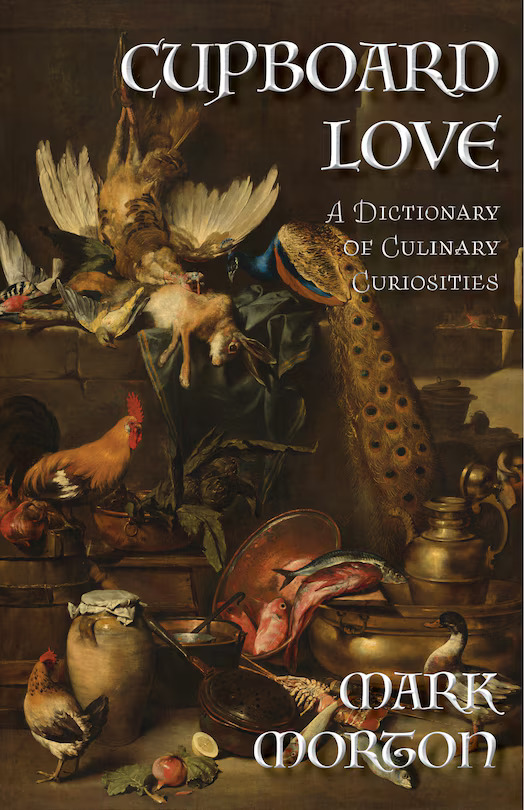
Author Mark Morton releases the third edition of his beloved book of culinary terms and their history in the book “Cupboard Love: A Dictionary of Culinary Curiosities.”
The Synopsis
“A whimsical, side-splitting, erudite, and sometimes cheeky book.” – The Globe and Mail

From everyday foods to exotic dishes, from the herbs and spices of medieval England to the cooking implements of the modern kitchen, Cupboard Love is a sumptuous feast that explores the fascinating stories behind familiar and not-so-familiar gastronomic terms.
Who knew that the word “pomegranate” is related to the word “grenade”? That “baguette” is a cousin of “bacteria”? That “soufflé” comes from the same root as “flatulence”? Who knew that “vermicelli” is Italian for “little worms,” that “avocado” comes from an Aztec word meaning “testicle,” or that “catillation” denotes the unseemly licking of plates?
Originally published in 1996 and revised and expanded in 2004, and now available again for the first time in two decades in this new edition, Cupboard Love was one of three books nominated for a 1996 Julia Child Cookbook Award in the Food Reference/Technical Category (Calphalon Award), and was included in The Globe and Mail’s list of “required reading” notable books for 1997.
Addictively readable, it takes us on a journey across cultures and history to arrive at the explanations behind some of our favorite culinary words and phrases, answering along the way those questions we’ve always had about food but were afraid to ask the cook.
The Review
This was such a fun and fascinating reference book. The author did an incredible job of exuding passion and a wealth of knowledge on the page, showcasing a wide range of terminology and the depth of research that the author poured into the book. The range of topics related to food was great to see as well, as the author not only touched upon certain types of cuisine but different events related to food as well, such as the term “groaning”, which refers to a period in the English countryside when a woman was going through the birthing process, and those in attendance would be given groaning boards to eat food from.
When it comes to reference books, one factor that always stands out to me as a reader is how much I’m left wanting to return to the book for guidance or knowledge. The author’s engaging and unique writing style keeps me invested in this book as a reference for culinary history and the world at large. The relevance for readers of European and American descent is also felt, with a profound amount of knowledge in this type of culinary terminology featured in the book.
The Verdict
Thought-provoking, engaging, and memorable, author Mark Morton’s “Cupboard Love” is a must-read reference book. The book elevates culinary history to all-new levels, making this feel like more than just a dictionary or trivia book, but a genuine appreciation for the world of food and the evolution of how people view cooking and food preparation as a whole. If you haven’t yet, be sure to grab your copy today!
Rating: 10/10
About the Author

I grew up with a bunch of brothers and sisters on a small farm in the south-east corner of Saskatchewan, a bleak, flat, sublime landscape that continues to define my identity and sensibilities. I was never interested in farming —and my parents knew I would likely lose a limb trying to do it—so I went to university. And then I went some more. And then some more. Eventually, I completed a PhD in sixteenth-century literature from the University of Toronto. I taught for a while in the south of France, and then for twelve years at the University of Winnipeg, in Manitoba. I really enjoyed teaching.
While I was in Winnipeg, I also started doing writing and broadcasting for CBC radio, first for a regional show and then for a national show called Definitely Not the Opera. My “gig” was talking about the intersections of language and culture. Eventually, I broadcast more than a hundred columns. Also while in Winnipeg, I co-founded the Winnipeg International Writers Festival, and wrote four nonfiction books, and more than fifty columns for Gastronomica: A Journal of Food and Culture published by the University of California Press.
Best of all, while in Winnipeg I met my wife (I mean she wasn’t my wife yet, but she became that😊). She—Melanie Cameron—is also a writer, having published two award-winning books.
We moved to Kitchener-Waterloo, Ontario, where I started working at the Centre for Teaching Excellence at the University of Waterloo. Melanie and I then adopted two older children—Brandon and Laika—and then, a few years later, two more—Rukhsana and Matthew. Not surprisingly, our writing screeched to a halt while we devoted ourselves to raising our children (and our four dogs—dogs have always been integral to our family!). All of our kids are now are in their twenties and are doing well.
After our kids grew up, I started writing again, but I shifted to fiction. That’s when I wrote The Headmasters, which was published by Shadowpaw Press. I’ve also completed another novel and have started writing a third one.

 Mark Morton is the author of The End: Closing Words for a Millennium (winner of the Alexander Isbister Award for nonfiction); The Lover’s Tongue: A Merry Romp Through the Language of Love and Sex (republished in the UK as Dirty Words), and Cooking with Shakespeare. He’s also the author of more than fifty columns for Gastronomica: The Journal of Food and Culture (University of California Press) and has written and broadcast more than a hundred columns about language and culture for CBC Radio. His young adult science fiction novel The Headmasters came out from Shadowpaw Press in early 2024.