I received a free copy of this book in exchange for a fair and honest review. All opinions are my own.
A woman must learn not only to survive but thrive in the aftermath of trauma and a haunting past in author Sienna Ross’s “Not Here Anymore.”
Advertisements
The Synopsis
Not Here Anymore tells the compelling, emotional journey of Katherine, a woman who escapes a violent past, only to realize that unresolved trauma will continue to haunt her. After enduring toxic relationships, she embarks on a journey across several countries in search of healing from trauma and a new life. As she confronts her deepest fears, Katherine discovers that survival is not just about running; it’s about empowerment, rebuilding and self-discovery.
Through heartbreak, loss and life-altering challenges, including the tragic death of a loved one and the painful reality of a miscarriage, Katherine must navigate the scars of her past. Yet, even in the face of overwhelming grief, she learns that true emotional resilience isn’t just about surviving; it’s about finding the strength to thrive. This gripping story isn’t only about escaping abuse; it’s about the inspiration to heal and create a new future, no matter the darkness that comes from previous wounds.
Not Here Anymore is a deeply moving and authentic women’s fiction novel that captures the heartache of domestic abuse and the strength it takes to rebuild a life. Set against the backdrop of various cultures like Belgium, Italy, Cuba this domestic thriller offers an international perspective, bringing an emotional depth to the story. The journey Katherine undertakes is as much about survival as it is about discovering the power within herself to move beyond the pain.
Key Features:
A powerful, emotional journey of a woman escaping a toxic relationship.
Themes of survival, empowerment and resilience are the heart of the story.
Set in international locations, adding depth and a cinematic quality to the narrative.
Inspiration for women a must-read for anyone seeking strength after hardship.
An emotional rollercoaster, blending psychological thriller with personal growth.
This psychological thriller combines raw emotion with suspense, making it a page turner that’s both engaging and impactful. Readers will find inspiration in Katherine’s transformation and her relentless pursuit of a life defined by empowerment rather than fear. It’s a story that resonates with anyone who has faced life’s challenges, reminding us all that healing from trauma is possible and happiness is still within reach.
Perfect for fans of:
Survival thrillers
Contemporary women’s fiction
Psychological suspense
Domestic thrillers
Inspiring stories of resilience and renewal
The Review
This was a compelling domestic thriller meets suspense novel. The harrowing experiences and tension that the author layered into each chapter of this novel were chilling and heartbreaking, yet interspersed with glimpses of hope and resilience. The powerful imagery and honest, authentic dialogue between the characters keep the readers engaged as the story progresses.
The heart of this novel was in the character development, especially for the protagonist, Katherine. The realities and struggles of domestic violence and stalking that so many women have to face in this world are not only expertly woven into this story, but they also bring a haunting reality to the narrative. Yet, the themes of strength through survival and transformation were beautifully executed. Despite loss and struggle, the way this protagonist picked herself up time and again made this a memorable read.
The Verdict
Haunting, compelling, and engaging, author Sienna Ross’s “Not Here Anymore” is a must-read domestic thriller meets suspense narrative. The twists and turns that this story takes, the emotional weight of grief, loss, and empowerment, are explored. The shocking cliffhanger finale will leave readers eager for another installment featuring this endearing and moving protagonist. If you haven’t yet, be sure to grab your copy today!
Rating: 10/10
Advertisements
About the Author
Welcome – I’m Sienna Ross, author of bold stories that follow people through love, loss, escape, and reinvention.
My writing blends raw truth with atmospheric storytelling — from violent pasts to distant cities, from painful goodbyes to unexpected strength.
I come from very humble beginnings, yet I started working at 17 and built my path through success in sales, team building, and leadership. As a licensed life coach, I have supported many people in overcoming obstacles and stepping into their true potential. My book carries the same mission: to remind readers that no matter the hardships, we all have the power to rise and create a life of strength and purpose
If you believe that stories can heal, challenge, and empower — you’re in the right place.
Through my work, I help individuals overcome challenges, build resilience, and find the courage to move forward even when life feels unbearable. With a rare combination of business insight and human empathy, I bring authenticity, depth, and inspiration to my writing.
My book reflects this mission—it is more than just a story; it is a powerful reminder that no matter how dark the past, it is always possible to rebuild, heal, and create a meaningful future.
I received a free copy of this book in exchange for a fair and honest review. All opinions are my own.
A closeted Syrian refuge helping other refuges cross over into Greece finds his life on the line when both ISIS and the CIA approach him about using his skills for their own needs, and his growing feelings for two men put his secrets within reach of those who would see him killed in author Timothy Jay Smith’s “Istanbul Crossing”.
Advertisements
The Synopsis
In this coming-of-age literary thriller, Ahdaf, a gay Syrian refugee, after watching his cousin executed by ISIS for being homosexual, flees to Istanbul for safety.
Ahdaf’s reputation as a people smuggler has put him in danger once more. A Syrian refugee himself, Ahdaf earns a meager living in Istanbul helping others make the crossing to Greece – a perilous line of work, but no less so than what he would face if the truth of his sexuality were discovered by ISIS.
Yet when the CIA and ISIS approach him about transporting high-profile individuals and serving as a double agent for their causes, Ahdaf ’s life is thrown into turmoil. And when his feelings for one of his clients come to light and as another possible relationship grows, the decision is taken out of his hands. Now a new choice lays before him, between two men and two different futures – if Ahdaf will live to see either of them. Istanbul Crossing is a story of adversity, love, and the courage of an ordinary man who must brave impossible situations in order to survive.
The Review
What a compelling, tense, and emotional read. The author does a remarkable job of building a engaging cast of characters that drive the narrative forward while also allowing the realities of the conflicts in the Middle East and the impact it has on innocent people to have the spotlight. The heavy atmosphere and the tension brought to the narrative allowed the stress and emotion that the protagonist felt throughout the story to be more widely felt by the reader.
The heart of this narrative, though, was in the protagonist’s personal development and struggles. Life as a member of the LGBTQ+ community is tough enough in places like the United States, but in the Middle East, hiding oneself from the world is a means of survival, and the author highlights how dangerous and deadly living out in the open can be for people in countries where homosexuality is a crime punishable by death. The pain and heartbreak that come with living in this reality, along with the humanitarian and trafficking conditions found there thanks to the war being fought, put a special spotlight on these real-world problems.
The Verdict
Author Timothy Jay Smith’s “Istanbul Crossing” is a must-read domestic and political espionage thriller that is thought-provoking, haunting, and emotionally investing. The themes of LGBTQ+ life and the refugee crisis in the Middle East made this story stand out, and the tragic yet hopeful tones found in the book’s ending will stay with readers long after the book ends. If you haven’t yet, be sure to grab your copy today!
Rating: 10/10
Advertisements
About the Author
Raised crisscrossing America pulling a small green trailer behind the family car, Timothy Jay Smith developed a ceaseless wanderlust that has taken him around the world many times. En route, he’s found the characters that people his work. Polish cops and Greek fishermen, mercenaries and arms dealers, child prostitutes and wannabe terrorists, Indian Chiefs and Indian tailors: he’s hung with them all in an unparalleled international career that saw him smuggle banned plays from behind the Iron Curtain, maneuver through Occupied Territories, represent the U.S. at the highest levels of foreign governments, and stowaway aboard a ‘devil’s barge’ for a three-day crossing from Cape Verde that landed him in an African jail.
Tim brings the same energy to his writing that he brought to a distinguished career, and as a result, he has won top honors for his novels, screenplays and stage plays in numerous prestigious competitions. Fire on the Island (to be released by Arcade Publishing in July 2020) won the Gold Medal in the 2017 Faulkner-Wisdom Competition for the Novel, and his screenplay adaptation of it was named Best Indie Script by WriteMovies. Another novel, The Fourth Courier, set in Poland, published in 2019 also by Arcade Publishing, received tremendous reviews and is currently competing in many competitions. Previously, he won the Paris Prize for Fiction (now the Paris Literary Prize) for his novel, A Vision of Angels. Kirkus Reviews called Cooper’s Promise “literary dynamite” and selected it as one of the Best Books of 2012.
Tim was nominated for the 2018 Pushcart Prize. He’s an avid theater-goer and playwright himself. His stage play, How High the Moon, a gay love story set in Nazi-occupied Warsaw, won the prestigious Stanley Drama Award. He is the founder of the Smith Prize for Political Theater.
I received a free copy of this book in exchange for a fair and honest review. All opinions are my own.
A woman finds herself trapped in a hellish marriage and must find a way to escape in author Barbara Harrison’s “Get Out Now!”
Advertisements
The Synopsis
Beautiful, naïve Amber Light, falls in love with a tortured artist named Cade Raine. From the first moment she meets him, she is absolutely smitten. Not only is he incredibly handsome, but also successful and wealthy.
They marry soon after. Without realising it, suddenly, Amber’s entire world revolves around this one man, who isolates her from family and friends then overtly turns against her. He does this subtly at first, allowing Amber to believe that everything which goes wrong in their relationship, is her fault. That is, until she begins to uncover the truth about her husband’s dark side.
Throughout a turbulent marriage of ten years, there are many twist and turns along Amber’s journey with Cade. She eventually understands that she needs to get out of her sham of a marriage. The problem is that she knows Cade won’t allow her to leave, so she must craft a fool-proof plan to escape.
The Review
This was such a heart-wrenching and chilling read. The author does an incredible job of bringing the reader into the brutal reality that so many women find themselves forced to endure, thanks to predatory men. The suspense and horror of the events that led Amber to finally leave her husband, as well as the terror that comes with fighting for survival, were all equally felt thanks to the author’s fantastic use of imagery and atmosphere in her writing, allowing the reader to feel immersed in this story.
The character dynamics and powerful themes are well done in this story. The realistic nature of both Amber and Cade as characters and the cycle of violence and forgiveness shown throughout their marriage hit close to home for far too many readers. Yet, the realistic nature of the characters’ relationship and the beats of hope throughout the story as she fights to escape this relationship will stay with readers long after the book ends.
Get Your Style Stix by using my Link! Click on this picture to get yours today!
The Verdict
Heartbreaking, tragic, yet engaging author Barbara Harrison’s “Get Out Now!” It is a must-read psychological suspense tale, and domestic thriller readers won’t be able to put it down. The reader will instantly connect emotionally to Amber’s plight, and the reality of this story will hopefully shed new light on this horrifying situation so many have to endure. If you haven’t yet, be sure to grab your copy today!
Rating: 10/10
Advertisements
About the Author
Barbara Harrison is a woman who loves telling stories. She was an avid reader as a teenager, whose interest in the world of imagination was first stirred by the written word. Barbara started with writing scripts for plays and poetry. This love for words, then extended into a passion for acting and bringing the written word to life. As a hopeless romantic, she mostly enjoyed reading books about true love and finding a soulmate. As she grew into womanhood, the young Barbara began to realise that sadly, the love stories depicted in Mills and Boon novels, were far removed from real life. In 1988 she married her late husband, Russel Harrison, and they raised two children together. After many marital ups and downs and twelve years of marriage, Russel moved to Florida, USA. This was a huge shock to Barbara and their children, who had no desire to relocate overseas. For a period of fourteen years. Barbara lived a life of split family on two continents, travelling between America and South Africa.
Tragically, in August 2012, after a mole biopsy on his arm, Russel received news that it had become a melanoma. He recovered well from the surgery to remove the cancer, however, it had spread, and in April 2014 was considered to be stage four and therefore terminal. Both returned to South Africa in July 2014, where Russ received treatment and they could be with family and friends during that dreadful time. On 1 October 2015, their twenty-seventh wedding anniversary, Russel passed away, leaving Barbara a grieving widow. Barbara began to slowly move forward again, and as she looked back to take stock of her life, she began to realise that she had spent most of her married life, living her husband’s dream. Although she thoroughly enjoyed being a wife and mother, there had been no ambition, other than the love of acting many years ago, to follow a career. At the age of fifty, encouraged by two of her friends, Barbara began to write again. Her first couple of endeavours were in the non-fiction world and she did not attempt to publish. One of her friends suggested that she try her hand at writing novels. Another friend greatly believed in her ability to write and constantly encouraged her to keep going, ultimately birthing the book you now hold in your hands.
I received a free copy of this book in exchange for a fair and honest review. All opinions are my own.
A wife desperate to find her missing husband searches for clues to his location, unaware her neighbors may have been the last to see or hear from him in author Mary Kubica’s “Just the Nicest Couple”.
Advertisements
The Synopsis
A husband’s disappearance links two couples in this twisty thriller from New York Times bestselling author Mary Kubica
Jake Hayes is missing. This much is certain. At first, his wife, Nina, thinks he is blowing off steam at a friend’s house after their heated fight the night before. But then a day goes by. Two days. Five. And Jake is still nowhere to be found.
Lily Scott, Nina’s friend and coworker, thinks she may have been the last to see Jake before he went missing. After Lily confesses everything to her husband, Christian, the two decide that nobody can find out what happened leading up to Jake’s disappearance, especially not Nina. But Nina is out there looking for her husband, and she won’t stop until the truth is discovered.
The Review
This was a gripping and captivating domestic thriller. The author does an incredible job of layering this story with intrigue from the beginning, from Lily’s shocked demeanor and her husband’s desperation to protect her to Nina’s fear and determination to find answers to all her questions. The pacing of the novel was incredible as it allowed the mystery to unravel slowly and keep the reader engaged with the narrative as the motivations and suspects in this case grow larger and larger.
Character development was the heart of this narrative, as each of the four main characters in this narrative held a depth to them that captivated readers from the start. The use of both Christian and Nina’s perspectives for the majority of the story allowed both of their unique viewpoints and shocking revelations to hold their own weight in the story, and the mystery surrounding those they love and what they are capable of to grow until the explosive final chapters.
The Verdict
Memorable, shocking, and entertaining, author Mary Kubica’s “Just the Nicest Couple” is a must-read domestic thriller of 2023. The twists and turns in the narrative and the shocking revelations that come to light in the disappearance of Jake Hayes will keep fans of the genre hanging onto the author’s every word. The adrenaline-fueled suspense read will stay with readers and connect both psychologically and emotionally. If you haven’t yet, be sure to grab your copy today!
Rating: 10/10
Advertisements
About the Author
Mary Kubica is a New York Times bestselling author of thrillers including The Good Girl, The Other Mrs., and Local Woman Missing. Her books have been translated into over thirty languages and have sold over two million copies worldwide. She’s been described as “a helluva storyteller” (Kirkus) and “a writer of vice-like control” (Chicago Tribune), and her novels have been praised as “hypnotic” (People) and “illuminating” (L.A. Times). She lives outside of Chicago with her husband and children.
I gasp and stagger backward. My hand goes to my mouth, bear- ing down.
My brain screams at me to run. Run.
I can’t at first. Shock and fear hold me captive. They keep me from moving, like a ship that’s dropped anchor. I’m moored to this spot, my eyes gaping in disbelief. My breath quickens and I feel the flailing of my heartbeat in my neck, my throat and in my ears.
Run, my brain screams at me. Go. Fucking run.
There is movement on the ground before me. The sound that comes with it is something heathen and raging, and some part of me knows that if I don’t go now, I may never leave this place alive.
I turn away. It’s instantaneous. One minute I’m unmoving and the next I’m moving so fast that the world comes at me in vague shapes and colors, streaks of brown and blue and green. I barely feel the movement of my legs and my feet as I run. I don’t feel the impact of my shoes colliding with the earth, moving quickly across it. I don’t look back, though I want more than anything to steal a look to know that I’m alone. That I’m not being followed. But I don’t look. It’s too risky. Looking back would cost precious seconds that I don’t know that I have. If I do, those seconds could be my last.
Sounds come, but I’m so disoriented that I don’t know where they come from. Is it only my pulse, the rush of blood in my ears?
Or is someone there?
I feel something tangible against my hair and then my spine. My back arches. I jerk away, pitching forward, landing hard on my hands and knees.
The world stops moving.
I have only two thoughts in that moment: staying alive, and that this isn’t the way it was supposed to happen.
Christian
Lily is sitting on the leather chair in the family room when I come in. Her back is to me. I see her from behind, just her long brown hair spilling down the back of the chair. She stares toward the TV on the opposite wall, but the TV is off. It’s just a black box, and in it, I see a murky reflection of Lily on the screen, though I can’t tell if her eyes are open or shut.
“Hey,” I say, coming in through the garage door, closing it quietly and stepping out of my shoes. I set my phone and keys on the counter, and then ask, “How was your day?”
It’s getting dark in the house. Out the window, the sun is about to set. Lily hasn’t bothered with the lights, and so the in- side of the house is colorless and gray. We face east. Any pretty sunset is the other way. You can’t see it from here, if there even is one to see.
Lily says nothing back. She must have fallen asleep, sitting upright in the chair. It wouldn’t be the first time. She’s been extremely tired lately. The pregnancy is getting the best of her, not to mention that she’s on her feet teaching all day. These two things in combination exhaust her. It used to be that Lily would be in the kitchen, cooking dinner when I got home, but these last few weeks, she comes home from work ready to drop. I don’t mind that she’s not cooking. I’ve never been the kind of person to need a home-cooked meal after work, but that’s the way Lily was raised. Her mother did it for her father, and so she thinks she should do it for me. She’s been apologetic that she hasn’t had it in her to cook dinner, but she’s been queasy, too, and the last thing she needs to be doing is cooking for me. I called from the car and ordered takeout already; it will be here any minute.
I step quietly into the family room. I come around to the other side of Lily to face her. Lily isn’t asleep like I thought. Her eyes are open but her expression is blank. Her skin looks gray, washed-out like the room, and I blame the poor lighting.
Lily’s head turns. She looks up at me as if in slow motion.
“Hey,” I say again, gently, smiling. “You okay? Did I wake you?”
I flip on a side table light, and she winces from the bright- ness of it, her eyes taking time to adjust. I apologize for it, realizing that her pale face had nothing to do with the lack of light.
In the warmth of the lamp’s glow, I see that Lily’s hair is wet. She wears maroon-colored joggers and a sweatshirt. She’s showered and changed since coming home, which is more than she usually does. Usually she falls flat on the couch and doesn’t leave until it’s time to go to bed.
I drop to my knees in front of her. I reach forward and run a hand the length of her hair. “You look exhausted, babe. Do you want to just go to bed? I can help you up. Takeout should be here soon. I’ll bring it up to the room for you when it gets here.”
Lily blinks three times, as if to clear the fog. She finds her voice. It’s husky at first, dry, like after a day of shouting at a football game, which is not that different than a day of teach- ing rowdy high school kids math. “No,” she says, shaking her head, “I’m fine. Just tired. It was a long day.”
“You sure? I wouldn’t mind dinner in bed myself.” I had a long day too, but it doesn’t seem right to compare them when only one of us has another human growing inside of them.
“That sounds messy,” she says.
“I promise I’ll be neat.”
Lily smiles and my heart melts. I love it when she smiles at me. “When are you ever neat?”
“Never,” I say, feeling better if she can still poke fun at me.
I’ve done my research on pregnancy and childbirth. I’ve read that the fatigue women feel during the first trimester is maybe the most tired they’ll feel in their whole lives. Growing a human is exhausting. Caring for one is too, but we’re not there yet.
“You need anything?” I ask, and she shakes her head.
Takeout comes. I convince Lily to come sit on the couch with me, where we both fit. We watch TV and, as we do, I ask her about her day and she asks me about mine. She’s quieter than usual tonight. I do most of the talking. I’m a market research analyst, while Lily teaches high school algebra. We met in college over of our shared love of math. When we tell people that, it makes them laugh. We’re math nerds.
When it’s time for bed, Lily goes up to the room before me. From downstairs, I hear the sink run as she washes up. I clean up from dinner. I throw the takeout containers in the trash. There is a package waiting on the front porch. I step outside to get it, where the night is dark, though the sky is clear. It must be a new moon.
Lily is standing at the top of the stairs when I come back in. She’s there in the upstairs hall, standing in the dark, backlit by the bedroom light. Gone are the maroon sweats she wore ear- lier. She has on my flannel shirt now. Her legs are bare, one foot balanced on the other. Her hair is pulled back, her face still wet from washing it.
“Don’t forget to lock the door,” she says down over the rail- ing, patting her face dry with a towel.
I wouldn’t have forgotten to lock the door. I never do. It’s not like Lily to remind me. I turn away from her, making sure the storm door is shut and locked, and then I push the front door closed and lock the dead bolt too.
Our house sits on a large lot. It’s old on the outside, but has a completely revamped, modern interior. It boasts things like a wraparound porch, beamed ceilings, a brick fireplace—which Lily fell in love with the first time she laid eyes on the house, and so I knew I couldn’t say no despite the price—as well as the more modern amenities of a subzero fridge, stainless steel appliances, heated floors and a large soaker tub that I was more enthusiastic about. The house is aesthetically pleasing to say the least, with an enormous amount of curb appeal. It practically broke the bank to buy, but felt worth it at the time, even if it meant being poor for a while.
In the backyard, the river runs along the far edge of the prop- erty, bound by a public hiking and biking trail. We were worried about a lack of privacy when we first moved in, because of the trail. The trail brought pedestrians to us. Strangers. People just passing by. For most of the year, it’s not a problem. The leaves on the trees provide plenty of privacy. It’s only when they fall that we’re more exposed, but the views of the river are worth it for that small sacrifice.
“Done,” I tell her about the locks, and she asks then if I set the alarm. We’ve lived here years and hardly ever set the alarm. I’m taken aback that she would ask.
“Is everything okay?” I ask.
Lily says, “Yes, fine.” She says that we have an alarm. We pay for it. We might as well use it. She isn’t wrong—it’s just that she’s never wanted to before.
I set the alarm. I make my way around the first floor, turning off lights. It takes a minute. When I’m done, I climb the stairs for the bedroom. Lily has the lights off in the room now. She stands at the window in the dark, with her back to the door.
She’s splitting the blinds apart with her fingers and is looking out into the dark night.
I come quietly into the room. I sidle up behind Lily, setting my hand on the small of her back and asking, “What are you looking at?” as I lean forward to set my chin on her shoulder, to see what she sees.
Suddenly Lily reels back, away from the window. She drops the blinds. They clamor shut. I’ve scared her. Instinctively, her hands rise up in self-defense, as if to strike me.
I pull back, ducking before I get hit. “Whoa there, Rocky,” I say, reaching for her arms.
Lily’s hands and arms remain motionless, suspended in air.
“Shit, sorry,” she says, knowing how close she came to im- pact. The realization startles us both.
“What was that?” I ask as I gently lower Lily’s arms. Lily isn’t usually so jumpy. I’ve never seen that kind of reaction from her.
She says, “I didn’t know it was you.”
“Who did you think it was?” I ask, as a joke. She and I are the only ones here.
Lily doesn’t answer directly. Instead she says, “I didn’t hear you come up the stairs. I thought you were still downstairs.”
That doesn’t explain it.
“What are you looking at?” I ask again, gazing past her for the window.
“I thought I heard something outside,” she says.
“Like what?”
She says that she doesn’t know. Just something. We stand, quiet, listening. It’s silent at first, but then I hear the voices of kids rising up from somewhere outside. They’re laughing, and I know there are teenagers clowning around on the trail again. It wouldn’t be the first time. They never do anything too bad, though we’ve found cigarette butts and empty bottles of booze. I don’t get mad about it. I was a stupid teenager once. I did worse.
I go to the bed. I pull the blankets back. “It’s just dumb kids,
Lily. There’s nothing to be afraid of. Come to bed,” I say, but, even as she turns away from the window and slips under the sheets with me, I sense Lily’s hesitation. She’s not so sure.
Excerpted from Just the Nicest Couple @ 2023 by Mary Kyrychenko, used with permission by Park Row Books.
I received a free copy of this book in exchange for a fair and honest review. All opinions are my own.
A woman fearing her husband may be cheating, she turns to a friend who lost her son the year before, and together they hope to catch the husband in the act. However, this plan turns down a dark and deadly road as more secrets are unearthed that neither of them could have imagined in author Seraphina Nova Glass’s “On a Quiet Street”.
Advertisements
The Synopsis
A simple arrangement. A web of deceit with shocking consequences.
Welcome to Brighton Hills: an exclusive, gated community set against the stunning backdrop of the Oregon coast. Home to doctors, lawyers, judges–all the most upstanding members of society. Nothing ever goes wrong here. Right?
Cora’s husband, Finn, is a cheater. She knows it; she just needs to prove it. She’s tired of being the nagging, suspicious wife who analyzes her husband’s every move. She needs to catch him in the act. And what better way to do that than to set him up for a fall?
Paige has nothing to lose. After she lost her only child in a hit-and-run last year, her life fell apart: her marriage has imploded, she finds herself screaming at baristas and mail carriers, and she’s so convinced Caleb’s death wasn’t an accident that she’s secretly spying on all everyone in Brighton Hills so she can find the murderer. So it’s easy for her to entrap Finn and prove what kind of man he really is.
But Paige and Cora are about to discover far more than a cheating husband. What starts as a little agreement between friends sets into motion a series of events neither of them could have ever predicted, and that exposes the deep fault lines in Brighton Hills. Especially concerning their mysterious new neighbor, Georgia, a beautiful recluse who has deep, dark secrets of her own…
The Review
The author continues to do a phenomenal job of pushing the domestic thriller genre to its limits and beyond in the best way possible! The world-building and character growth early on in the book did a great job of layering the mystery of both the fidelity of Cora’s marriage to her husband and the circumstances of Paige’s son and his untimely demise. The shocking twists and turns that this small community takes on, as well as the secrets that these households harbor, really add both an engaging plotline and yet an eerily realistic touch to the narrative, as the shocking developments are not necessarily out of the realm of possibility in this day and age, making this even more of a haunting read.
For, as a longtime fan of mystery reads, the suspense aspect of this mystery thriller and the theme that it explores were the biggest draws for me. The exploration of this multi-layered mystery and how each character’s struggles early on in the novel inadvertently stack up against one another’s until all three protagonists and narrators of this novel find themselves coming together. The theme of toxic masculinity and how it impacts marriages and relationships was a major theme throughout the novel. Often seen in our world, men will go to extreme lengths to be dismissive of women, mansplain to women things they already have an understanding of, and manipulate the women in their lives to fulfill their own personal needs. This toxic behavior is explored in several of the characters’ lives, and the shocking twists that toxicity takes add to the depth of character development and the mystery that unravels as a result of those developments.
The Verdict
Haunting, shocking, and entertaining, author Seraphina Nova Glass’s “On A Quiet Street” is a must-read novel of 2022 and one of the top domestic thrillers of the year. The chilling twists this narrative takes and the emotional pull of these characters’ struggles will have readers on the edge of their seats as the climactic second half of this novel takes off! This is one of the best authors to come through in this genre in years and I cannot wait to read more of her work. If you haven’t yet, be sure to grab your copy today!
Rating: 10/10
Advertisements
About the Author
Seraphina Nova Glass is a professor and playwright-in-residence at the University of Texas, Arlington, where she teaches film studies and playwriting. She holds an MFA in playwriting from Smith College, and she’s also a screenwriter and award-winning playwright. Seraphina has traveled the world using theatre and film as a teaching tool, living in South Africa, Guam and Kenya as a volunteer teacher, AIDS relief worker, and documentary filmmaker.
Paige stands, watering her marigolds in the front yard and marvels at how ugly they are. The sweet-potato-orange flowers remind her of a couch from the 1970s, and she suddenly hates them. She crouches down, ready to rip them from their roots, wondering why she ever planted such an ugly thing next to her pristine Russian sage, and then the memory steals her breath. The church Mother’s Day picnic when Caleb was in the sixth grade. Some moron had let the potato salad sit too long in the sun, and Caleb got food poisoning. All the kids got to pick a flower plant to give to their moms, and even though Caleb was puking mayonnaise, he insisted on going over to pick his flower to give her. He was so proud to hand it to her in its little plastic pot, and she said they’d plant it in the yard and they’d always have his special marigolds to look at. How could she have forgotten?
She feels tears rise in her throat but swallows them down. Her dachshund, Christopher, waddles over and noses her arm: he always senses when she’s going to cry, which is almost all the time since Caleb died. She kisses his head and looks at her now-beautiful marigolds. She’s interrupted by the kid who de-livers the newspaper as he rides his bike into the cul-de-sac and tosses a rolled-up paper, hitting little Christopher on his back.
“Are you a fucking psychopath?” Paige screams, jumping to her feet and hurling the paper back at the kid, which hits him in the head and knocks him off his bike.
“What the hell is wrong with you, lady?” he yells back, scrambling to gather himself and pick up his bike.
“What’s wrong with me? You tried to kill my dog. Why don’t you watch what the fuck you’re doing?”
His face contorts, and he tries to pedal away, but Paige grabs the garden hose and sprays him down until he’s out of reach. “Little monster!” she yells after him.
Thirty minutes later, the police ring her doorbell, but Paige doesn’t answer. She sits in the back garden, drinking coffee out of a lopsided clay mug with the word Mom carved into it by little fingers. She strokes Christopher’s head and examines the ivy climbing up the brick of the garage and wonders if it’s bad for the foundation. When she hears the ring again, she hollers at them.
“I’m not getting up for you people. If you need to talk to me, I’m back here.” She enjoys making them squeeze around the side of the house and hopes they rub up against the poi-son oak on their way.
“Morning, Mrs. Moretti,” one of the officers says. It’s the girl cop, Hernandez. Then the white guy chimes in. She hates him. Miller. Of course they sent Miller with his creepy mustache. He looks more like a child molester than a cop, she thinks. How does anyone take him seriously?
“We received a complaint,” he says.
“Oh, ya did, did ya? You guys actually looking into cases these days? Actually following up on shit?” Paige says, still petting the dog and not looking at them.
“You assaulted a fifteen-year-old? Come on.”
“Oh, I did no such thing,” she snaps.
Hernandez sits across from Paige. “You wanna tell us what d id happen, then?”
“Are you planning on arresting me if I don’t?” she asks, and the two officers give each other a silent look she can’t read.
“His parents don’t want to press charges so…”
Paige doesn’t say anything. They don’t have to tell her it’s because they pity her.
“But, Paige,” Miller says, “we can’t keep coming out here for this sort of thing.”
“Good,” Paige says firmly. “Maybe it will free you up to do your real job and find out who killed my son.” Hernandez stands.
“Again, you know we aren’t the detectives on the—” But before Hernandez can finish, Paige interrupts, not wanting to hear the excuses.
“And maybe go charge the idiot kid for trying to kill my dog. How about that?”
Paige stands and goes inside, not waiting for a response. She hears them mumble something to one another and make their way out. She can’t restrain herself or force herself to be kind. She used to be kind, but now, it’s as though her brain has been rewired. Defensiveness inhabits the place where empathy used to live. The uniforms of the cops trigger her, too; it reminds her of that night, the red, flashing lights a nightmarish strobe from a movie scene. A horror movie, not real life. It can’t be her real life. She still can’t accept that.
The uniforms spoke, saying condescending things, pulling her away, calling her ma’am, and asking stupid questions. Now, when she sees them, it brings up regrets. She doesn’t know why this happens, but the uniforms bring her back to that night, and it makes her long for the chance to do all the things she never did with Caleb and mourn over the times they did have. It forces fragments of memories to materialize, like when he was six, he wanted a My Little Pony named Star Prancer. It was pink with purple flowers in its mane, and she didn’t let him have it because she thought she was protecting him from being made fun of at school. Now, the memory fills her with self-reproach.
She tries not to think about the time she fell asleep on the couch watching Rugrats with him when he was just a toddler and woke up to his screaming because he’d fallen off the couch and hit his head on the coffee table. He was okay, but it could have been worse. He could have put his finger in an outlet, pushed on the window screen and fallen to his death from the second floor, drunk the bleach under the sink! When this memory comes, she has to quickly stand up and busy herself, push out a heavy breath, and shake off the shame it brings. He could have died from her negligence that afternoon. She never told Grant. She told Cora once, who said every parent has a moment like that, it’s life. People fall asleep. But Paige has never forgiven herself. She loved Caleb more than life, and now the doubt and little moments of regret push into her thoughts and render her miserable and anxious all the time.
She didn’t stay home like Cora, she practically lived at the restaurant. She ran it for years. Caleb grew up doing his homework in the kitchen break room and helping wipe down tables and hand out menus. He seemed to love it. He didn’t watch TV all afternoon after school, he talked to new people, learned skills. But did she only tell herself that to alleviate the guilt? Would he have thrived more if he had had a more nor mal day-to-day? When he clung to her leg that first day of preschool, should she have forced him to go? Should he have let him change his college major so many times? Had he been happy? Had she done right by him?
And why was there a gun at the scene? Was he in trouble, and she didn’t know? Did he have friends she didn’t know about? He’d told her everything, she thought. They were close. Weren’t they?
As she approaches the kitchen window to put her mug down, she sees Grant pulling up outside. She can see him shaking his head at the sight of the cops before he even gets out of the car.
He doesn’t mention the police when he comes in. He silently pours himself a cup of coffee and finds Paige back out in the garden, where she has scurried to upon seeing him. He hands her a copy of the Times after removing the crossword puzzle for himself and then peers at it over his glasses.
He doesn’t speak until Christopher comes to greet him, and then he says, “Who wants a pocket cookie?” and takes a small dog biscuit from his shirt pocket and smiles down at little Christopher, who devours it.
This is how it’s been for the many months since Grant and Paige suffered insurmountable loss. It might be possible to get through it to the other side, but maybe not together, Paige said to Grant one night after one of many arguments about how they should cope. Grant wanted to sit in his old, leather recliner in the downstairs family room and stare into the wood-burning fireplace, Christopher at his feet, drinking a scotch and absorbing the quiet and stillness.
Paige, on the other hand, wanted to scream at everyone she met. She wanted to abuse the police for not finding who was responsible for the hit-and-run. She wanted to spend her days posting flyers offering a reward to anyone with information, even though she knew only eight percent of hit-and-runs are ever solved. When the world didn’t respond the way she needed, she stopped helping run the small restaurant they owned so she could just hole up at home and shout at Jeopardy! and paper boys. She needed to take up space and be loud. They each couldn’t stand how the other was mourning, so finally, Grant moved into the small apartment above their little Italian place, Moretti’s, and gave Paige the space she needed to take up.
Now—almost a year since the tragic day—Grant still comes over every Sunday to make sure the take-out boxes are picked up and the trash is taken out, that she’s taking care of herself and the house isn’t falling apart. And to kiss her on the cheek before he leaves and tell her he loves her. He doesn’t make observations or suggestions, just benign comments about the recent news headlines or the new baked mostaccioli special at the restaurant.
She sees him spot the pair of binoculars on the small table next to her Adirondack chair. She doesn’t need to lie and say she’s bird-watching or some nonsense. He knows she thinks one of the neighbors killed her son. She’s sure of it. It’s a gated community, and very few people come in and out who don’t live here. Especially that late at night. The entrance camera was conveniently disabled that night, so that makes her think it wasn’t an accident but planned. There was a gun next to Caleb’s body, but it wasn’t fired, and there was no gunshot wound. Something was very wrong with this scenario, and if the po-lice won’t prove homicide, she’s going to uncover which of her bastard neighbors had a motive.
She has repeated all of this to Grant a thousand times, and he used to implore her to try to focus on work or take a vacation—anything but obsess—and to warn her that she was destroying her health and their relationship, but he stopped responding to this sort of conspiracy-theory talk months ago.
“What’s the latest?” is all he asks, looking away from the binoculars and back to his crossword. She gives a dismissive wave of her hand, a sort of I know you don’t really want to hear about it gesture. Then, after a few moments, she says, “Danny Howell at 6758. He hasn’t driven his Mercedes in months.” She gives Grant a triumphant look, but he doesn’t appear to be following.
“Okay,” he says, filling in the word ostrich.
“So I broke into his garage to see what the deal was, and there’s a dent in his bumper.”
“You broke in?” he asks, concerned. She knows the How-ells have five vehicles, and the dent could be from a myriad of causes over the last year, but she won’t let it go.
“Yes, and it’s a good thing I did. I’m gonna go back and take photos. See if the police can tell if it looks like he might have hit a person.” She knows there is a sad desperation in her voice as she works herself up. “You think they can tell that? Like if the dent were a pole from a drive-through, they could see paint or the scratches or something, right? I bet they can tell.”
“It’s worth a shot,” he says, and she knows what he wants to say, also knows he won’t waste words telling her not to break into the garage a second time for photos. He changes the subject.
“I’m looking for someone to help out at the restaurant a few days a week—mostly just a piano player for the dinner crowd—but I could use a little bookkeeping and scheduling, too,” he says, and Paige knows it’s a soft attempt to distract her, but she doesn’t bite.
“Oh, well, good luck. I hope you find someone,” she says, and they stare off into the backyard trees.
“The ivy is looking robust,” he comments after a few minutes of silence.
“You think it’s hurting the foundation?” she asks.
“Nah,” he says, and he reaches over and places his hand over hers on the arm of her chair for a few moments before getting up to go. On his way out, he kisses her on the cheek, tells her he loves her. Then he loads the dishwasher and takes out the trash before heading to his car. She watches him reluctantly leaving, knowing that he wishes he could stay, that things were different.
When Paige hears the sound of Grant’s motor fade as he turns out of the front gate, she imagines herself calling him on his cell and telling him to come back and pick her up, that she’ll come to Moretti’s with him and do all the scheduling and books, that she’ll learn to play the piano just so she can make him happy. And, after all the patrons leave for the night, they’ll share bottles of Chianti on checkered tablecloths in a dimly lit back booth. They’ll eat linguini and clams and have a Lady and the Tramp moment, and they will be happy again.
Paige does not do this. She goes into the living room and closes the drapes Grant opened, blocking out the sunlight, then she crawls under a bunched-up duvet on the couch that smells like sour milk, and she begs for sleep.
I received a free copy of this book in exchange for a fair and honest review. All opinions are my own.
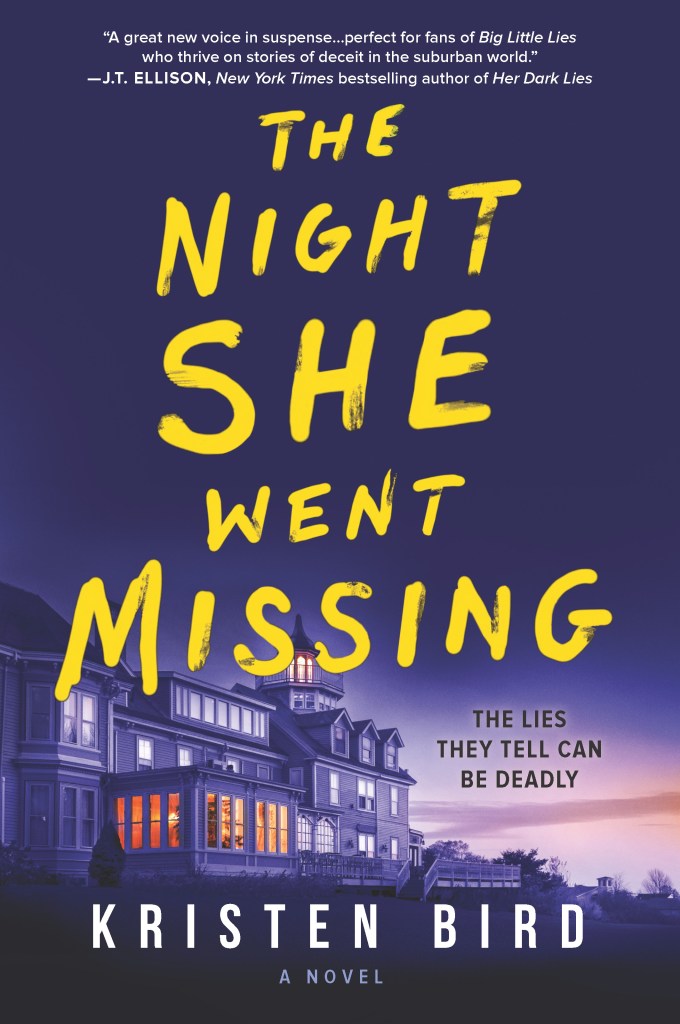
Three mothers and friends-turned-frenemies must work together to solve what happened to a local high school girl after she is found unconscious months after her disappearance after the police are unable to move forward in the investigation in author Kristen Bird’s domestic thriller, “The Night She Went Missing”.
Advertisements
The Synopsis
Months after she disappeared, a high school senior is found floating in the town’s harbor, alive but unconscious. Where has Emily been, and how did she get into the water? In Kristen Bird’s “gripping” (Publishers Weekly) debut The Night She Went Missing, three friends-to-frenemies mothers in a close-knit, wealthy Texas community decide to investigate after the police hit a dead end. While each woman has secrets to protect, they’ll all be forced to look at their own children – or each other’s – to uncover the truth.
With the relentless pacing and complex female characters of Big Little Lies and an expertly crafted small town setting, The Night She Went Missing introduces Kristen Bird as a new force in the world of domestic suspense. Her novel goes well beyond that, exploring complex questions about mothers and daughters, loss, and the line between taking chances and living dangerously.
The Review
What an adrenaline-fueled thriller! The pulse-pounding narrative really infuses a sense of mystery and suspense into the character arcs and dialogue as each chapter peels back the layers of the story and the character’s pasts as well. The author found amazing notes of dread and spine-chilling terror as the actions of the mothers, their children, and their community begin to unfold.
What really stood out to me was the character arc. A great way of differentiating a domestic suspense thriller from your average murder mystery type of thriller is the intimate community setting and character development that can be found within. The author really captured that voice and tone in the novel, and these protagonists were crucial to that vibe, as these mothers balanced the struggles of parenting and their own identities with the actions of their children and other members of the community.
The Verdict
A striking, engaging, and haunting read, author Kristen Bird’s debut novel “The Night She Went Missing” is a must-read domestic suspense thriller and a brilliant first novel in the author’s career. With a shocking series of twists and turns, the narrative will keep readers invested in diving down the rabbit hole that is this small-town mystery and the final revelation will have readers spinning as one of the protagonists has their world turned upside down. If you haven’t yet, be sure to grab your copy today!
Rating: 10/10
Advertisements
About the Author
Kristen Bird lives outside of Houston, Texas with her husband and three daughters. She earned her bachelor’s degree in music and mass media before completing a master’s in literature. She teaches high school English and writes with a cup of coffee in hand. In her free time, she likes to visit parks with her three daughters, watch quirky films with her husband and attempt to keep pace with her rescue lab-mixes. THE NIGHT SHE WENT MISSING is her debut novel.
Here is an Excerpt from Kristen Bird’s The Night She Went Missing
EMILY
They find me faceup in the murky water of the harbor on the day of my funeral. Or memorial service. Whatever. It’s not like there’s much difference. Dead is dead.
Except I’m not. I. Am. Not. Dead. I would pinch myself if I could move.
“Can you hear me? Hey, what’s your name? Can you open your eyes?”
My eyes are as dense and heavy as basalt. Basalt: rich in iron and magnesium, Mr. Schwartz penned on the board during our volcanic rock unit in eighth grade. I fight to come out of the emptiness that has held me for the past…the past what? Hours? Days? Weeks?
I attempt to whisper my name even though my eyelids remain anchored. Emily. That’s right. Emily. I can’t remember the last time I voiced those three syllables.
“Pull her up.”
Hands yank at me, jerking me from the arms of the water. Two hands wander up my body—over my feet, my legs, the arch of my hips, my arms, onto my neck, stopping at my forehead. This touch is not like the familiar plying of the boy I love, so fiery that it almost stings. This touch is necessary, cold, perfunctory. Perfunctory, Mrs. Abbot, my sophomore English teacher had pronounced for us students as we learned the word for the first time. P-E-R-F-U—
The voice cuts in. “Tell them we have a girl, a teenager. No broken bones as far as I can tell but looks like she’s been out here for hours. Unconscious, but breathing on her own.” His voice muff les as he turns his head. “I think she might be Emily.”
Suddenly, a brilliant choir of tenors and baritones and basses burst forth. “The Emily?”
Emily. Yes, that’s me. What a comforting thing to hear one’s name spoken by those who can point the way home. I breathe in gratitude and descend into the lightness of sleep before a hand touches my cheek again.
“You awake, Emily?”
The swooshing of the waves calls to me, a reminder that the song of the deep is steady despite all the new sounds: The bustle of work boots, the hum of the boat waiting to churn to life and set out across the open sea.
“Your mama’s been looking for you, Ms. Emily. You gave us all a fright. You hear me?” The man seems to sense that I can hear his words while my body remains frozen despite the warmth of the water and the sun overhead. “You’re gonna be okay, sweetheart. Yes, ma’am, you’re gonna make it just fine. Got a daughter about your age, and I woulda been worried sick if my girl had gone missing for weeks on end. Your mama sure is gonna be happy.”
A nasally voice now. “Where you think she’s been all this time? Turned into a mermaid?” The boy chuckles.
“Hush, Beau.”
The man’s hand touches my forehead, his fingers sandpapery with callouses. “Now, sweetheart, if you can open your eyes for a sec, I can introduce you properly to the crew. We’re getting you help as fast as we can, but you can go ahead and open them eyes before all the medics arrive. They’d be good and relieved to see you looking around.”
I try. Oh, how I want to f licker them open, but my head aches and oblivion pulls harder. The siren call of the void is too tempting to resist.
I received a free copy of this book in exchange for a fair and honest review. All opinions are my own.
A young woman dealing with the loss of her father runs into her childhood nanny, and hoping to reconnect with a lost parental figure, begins to build a friendship with the woman. Yet not all is as it seems, and soon the tale of the nanny takes this woman down some dark and twisting roads in author Flora Collins’s novel, “Nanny Dearest”.
The Synopsis
Compulsively readable domestic suspense, perfect for fans of THE TURN OF THE KEY and THE PERFECT NANNY, about a woman who takes comfort in reconnecting with her childhood nanny after her father’s death, until she starts to uncover dark secrets the nanny has been holding for twenty years.
Set in New York city and upstate New York, NANNY DEAREST is the story of twenty-five year-old Sue Keller, a young woman reeling from the recent death of her father, a particularly painful loss given that Sue’s mother died of cancer when she was only three. At just this moment of vulnerability comes Anneliese Whitaker, Sue’s former nanny from her childhood days in upstate New York.
Sue, craving connection and mothering, is only too eager to welcome Annie back into her life; but as they become inseparable once again, Sue begins to uncover the truth about Annie’s unsettling time in the Keller house all those years ago, particularly the manner of her departure – or dismissal. At the same time, she begins to grow increasingly alarmed for the safety of the two new charges currently in Annie’s care.
Told in alternating points of views, switching between Annie in the mid-90s and Sue in the present day, this is a taut novel of suspense with a shocking ending.
Advertisements
The Review
What a shocking and engaging story! The author did such a great job of taking the time to build up these characters and their history together. The alternating chapters between the past as Annie settled into life as a nanny, to Suzy’s present-day struggles to find a connection to the parents she lost too soon, did an amazing job of peeling back the layers of this dark and haunting domestic drama, as secrets are revealed and relationships are changed forever.
What stood out to me was just how strongly the author covered parenthood, loss, and the grieving process. In particular, the focus on motherhood and the impact that things like loss can have on a mother’s relationship with their children and vice-versa was so fascinating to watch unfold. The exploration of loss really covered most of the main characters in this thriller and showed how that kind of pain could impact people in so many different ways, from internal struggles to chaotic and scary external experiences that impact everyone around them.
The Verdict
A brilliant, thought-provoking, and highly entertaining thriller, author Flora Collins’s “Nanny Dearest” is a must-read novel of 2021. The haunting way the author explores the importance of relationships and bonds formed in childhood and the lengths some people will go to in order to regain something lost so long ago was eloquently written into the fabric of this narrative, and the shocking final pages will keep readers hanging on the author’s every word. If you haven’t yet, be sure to grab your copy today!
Rating: 10/10
Advertisements
About the Author
Flora Collins was born and raised in New York City and has never left, except for a four-year stint at Vassar College. When she’s not writing, she can be found watching reality shows that were canceled after one season or attempting to eat soft-serve ice cream in bed (sometimes simultaneously). Nanny Dearest is her first novel, and draws upon personal experiences from her own family history.
“I WOULD RECOGNIZE THOSE bangs anywhere,” she says, clutching her large faux-leather bag, pink nails pinching the synthetic hide. I can see the laugh lines beneath her glasses’ rims. I swallow, my tongue darting between my back molars, bracing myself.
“They stuck, I guess.” I laugh lightly, a meek trickle that escapes from my lips before I can stop it. She smiles again, this time with teeth, and I see how her front two overlap, barely discernible. But she’s standing so close that it’s hard not to notice.
“You live around here now?” She stopped me in front of a church and behind us the congregation trickles out, chatting among themselves. A child wails for lunch. The sun beats down hard and yellow, speckling the sidewalk. I raise my hand like a visor, even though I feel the weight of my oversized sunglasses, heavy on the bridge of my nose.
“Yep. Moved down to Alphabet City after college,” I answer. She nods, pushing a wisp of red hair behind her ear.
She is letting the sun in, the pupils of her green eyes shrinking with the effort.
“You don’t remember me, do you?” It’s a statement, not a question, one that she says confidently, as if it’s a sign of character that she is easily forgettable, that fading into my brain’s recesses is some kind of compliment.
The church group disperses and I step away to let a family by.
“I’m sorry. I don’t.” And then, even though she is secure in her stance, amused perhaps by my social transgression, I fumble for some excuse. “Forgive me. I-I’m not good with faces.”
She laughs, then—a long, exhilarating sound, like a wind chime. “I don’t blame you. I think you were about three feet tall the last time you saw me.” She reaches out a hand, dainty and freckled. “I’m Anneliese. Anneliese Whittaker. I was your nanny.” Her hand remains in the air for a moment, outstretched, like the bare limb of a winter tree, before I take it.
“Sue. Sue Keller.” But of course she knows who I am. She says she was my nanny.
“I used to babysit you when you lived upstate.” I flinch, unintentionally. She knew my mother. “How’s your dad? He always wanted to move back up there later in life.”
I bite the inside of my cheek, savoring the tenderized spot there, made bloody by my anxious jaw. “He passed last year. Car accident.”
Anneliese puts a hand to her mouth, her eyes widening behind the glasses. “Oh honey, I’m so sorry. You must miss him a lot, don’t you? He was your whole world back when I knew you.”
I offer her a smile. “Yes, well, aren’t most little girls that way with their fathers?”
The child is still screaming for lunch. His mother is speaking to another woman, the three of them the only people left in front of the church.
“Yes, well, I guess that’s true. You and your dad had a special bond, though.” She gazes at me then, her face full of compassion, those green eyes penetrative.
And we’re silent, for a beat too long. So I find myself shuffling, moving around her. “I actually have to meet a friend.” I check my wrist though I’m not wearing a watch. “But it was funny running into you.” I give her what I hope is an apologetic smile, backing away from her, toward the curb.
She stops me, one of those tiny hands on my wrist, almost tugging at my sleeve like a child. “Wait. I’d love to see you again.” She digs around in her purse. I catch sight of a book, earbuds, some capped pens, a grimy-looking ChapStick. She takes out a receipt, uncaps a pen, and leans the paper against the church’s stone masonry, scrawling her number. The figures are dainty, like her hands.
“I’m sorry to keep you waiting. Tell your friend a crazy lady stopped and demanded you spend time with her.” She laughs again, that wind chime chortle, and I pocket the receipt.
“Nice to see you again!” I call, making the traffic light just in time. When I cross the street and turn, she’s gone, consumed by the hordes, no sign of that red hair glinting in the sunlight.
“And you stopped? I would’ve kept on walking. No time for nutso people like that,” Beth says through the phone as I pace my studio, absentmindedly throwing trash away, smoothing out the creases in my bedspread, my phone nestled between my shoulder and ear. I set it down and put her on speaker. I have the urge, suddenly, to rearrange the furniture in this miniscule apartment. To move the bed to the other side of the room, away from the window, from the noise of the street.
“She knew my name, Beth. She called out ‘Sue.’ I wasn’t going to ignore that.” Outside, a siren wails and I pull down the shade.
“That’s why you always wear headphones. So you have an excuse not to deal with those kinds of people.” Beth smacks her gum, the noise ricocheting through the tinny speaker.
“So you really don’t remember if I had a nanny called Anneliese?” I crumple up the wax paper from my bagel, letting it drift to the floor. The old family photo albums from that period are in storage, buried deep inside the disorganized cardboard boxes I hired movers to collect when I cleaned out Dad’s apartment.
“Dude, we met when we were five. I don’t think I knew my own mom’s name back then. I certainly wouldn’t remember who your babysitter was.” I close my eyes and massage my temples, my usual insomnia-inflicted headache edging toward a dull throb. I don’t remember a long-term nanny. I never had any babysitters growing up, just my dad.
I hear Beth say something to her girlfriend, a bark, and I walk away from the phone for a minute with a twinge of annoyance that she’s not giving me her undivided attention.
I think of Anneliese’s face, those teeth, the green eyes. The hair. And.
And.
I am running in a field with her, in the yard behind the house upstate. The garden is giant. Huge sunflowers, hedges high enough to block the sun. Beneath me, the grass is lush, dewy, tickling my bare feet. And the sky is white, hot and blazing. And she is behind me, shrieking, her freckled arm outstretched, a paintbrush in her hand tinged blue.
And I feel its slick bristles on my back and I fall, stumble. But I am laughing. And she is, too, her orange hair like a halo, eclipsing the sun.
I open my eyes.
“Anyway, I’m having some people over next weekend. I know you hate parties these days but you’re so cooped up all the time in that apartment. I swear it’ll be fun…” Beth squawks on, her voice shrill through the speaker.
“I remember her.”
Beth pauses mid-ramble. “What?”
“I remember her. Anneliese. The woman who stopped me today. She’s not nuts. I remember her.”
There’s a heavy silence on the other end. “Are you sure? You just said you didn’t.” Beth’s voice has lowered an octave, as if she’s whispering. Which I know is for my benefit, so her girlfriend won’t hear.
I tighten my hand into a fist. “I’m serious. She was my nanny. We used to play this game with paint.”
Beth sighs. “Still weird to me. You’re not thinking about calling her or anything like that, right?” But I’m already reaching into the garbage bag I use as a hamper, sifting through it for the sweats I wore earlier today. I take out the receipt, smoothing it out against my knee. It’s for shampoo, coconut Herbal Essences, and I can smell it on her, as if it’s 1996 and I am on the floor of my blue-carpeted bedroom and she is swinging her princess hair to and fro as we play Candy Land, the smell even more enticing than how I imagined Queen Frostine’s scent.
Tears prick my eyelids.
“I want to see her.” It comes out sounding infantile, testy even. And I hear Beth breathing, willing herself not to lash out.
“Okay. Okay, Suzy. Just meet in public and bring some pepper spray. Remember, she stopped you in the street. She really could be anyone, even if she did babysit you a thousand years ago.” I hear her put another piece of gum in her mouth, the wrapper like static.
“I know. She’s just a nice middle-aged woman. And maybe she has some cool things to say about my parents.” I know that will get Beth off my back. Any mention of my parents gets anyone off my back.
I hear her breath as she blows a bubble, the snap of the gum sticking to her lip. “I’m just trying to be a good friend. Don’t fault me for it.” Her voice has lowered again. “I’ve said this before and I’ll say it again: you’ve been spending way too much time alone. It’s not like you and I can tell it’s getting to you. It would get to me.” But my finger is already hovering over the End Call button, eager to get Beth off the line.
“I appreciate it. But for real, now I have work to do. I’ll text you.” She spends one more minute reminding me to come to her party next weekend and I promise I will, even though we both know I won’t, and I hang up first, still fingering that crumpled receipt, studying the perfectly shaped eights in the handwritten phone number, each the same height, the same size.
Outside, a dog barks. And I bark back, loud and sharp, laughing at myself, my apartment easing into darkness as the sun sets.
I received a free copy of this book in exchange for a fair and honest review. All opinions are my own.
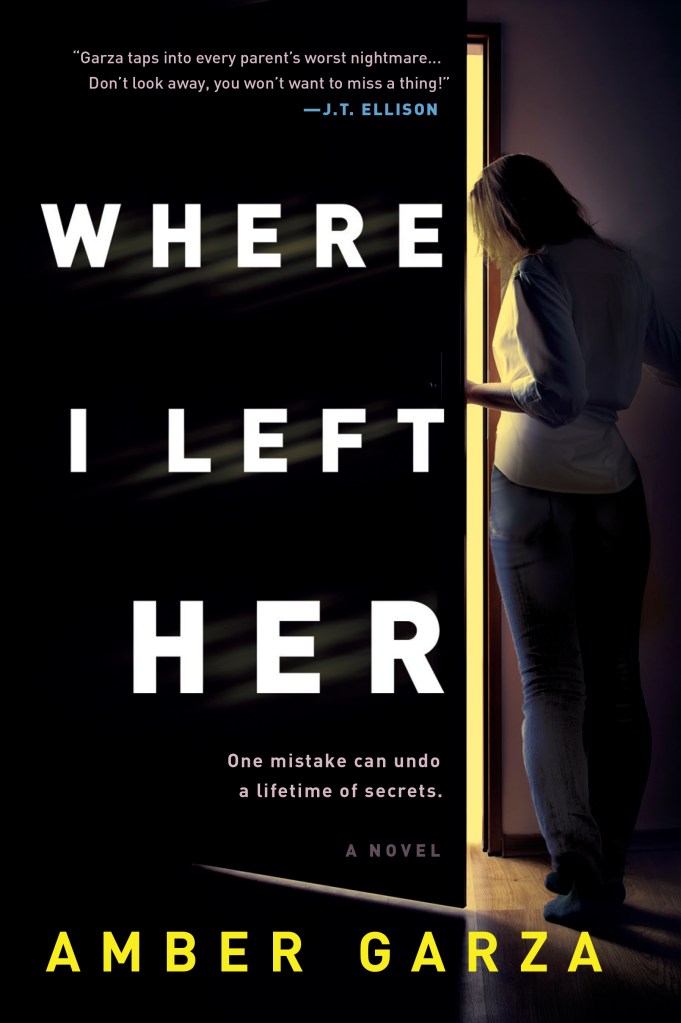
A mother realizes her worst fears as her teenage daughter disappears, and a trail of secrets and lies forces her to question everything she thought she knew about her child in author Amber Garza’s “Where I Left Her”.
Advertisements
The Synopsis
From the author of WHEN I WAS YOU comes a spine-tingling new thriller about a mother’s worst nightmare come true, when she goes to pick up her daughter from a sleepover, and she’s nowhere to be found.
Whitney had some misgivings when she dropped her increasingly moody teenage daughter off for a sleepover last night. She’s never met the friend’s parents, and usually she’d go in, but Amelia clearly wasn’t going to let something so humiliating happen, so instead she waved to her daughter before pulling away from the cute little house with the rosebushes in front.
But when she goes back to get her, an elderly couple answers the door–Amelia and her friend are nowhere to be found, and this couple swears she’s at the wrong house. As Whitney searches for Amelia, she uncovers a trail of secrets and lies her daughter has told her–from Finsta accounts to rumors of a secret relationship. Does she really even know this girl she’s raised, and can she find her before it’s too late?
The Review
What a truly gripping and engaging thriller! I was hooked from the book’s first pages, and the pacing and atmosphere that the author created were both entertaining and haunting all at once. Straight out of the gate readers are shown evidence that this young woman was living a very different life than her mother ever knew, and each revelation is like a nail in her coffin as the danger feels closer and closer. Yet in an instant, the author finds ways of taking readers in directions they never saw coming, until the momentous final moments of this book.
The characters themselves were what kept the mystery and narrative so brilliant in their delivery. The changing POVs from chapter to chapter was brilliant, and the revelation of the various characters behind those POVs will turn the novel’s plot on its head. The dynamic and struggles between mother and daughter are the core and heart of this story, highlighting the delicate balance and emotional connection that mothers make with their children and the hardships that arise when children become teenagers.
The Verdict
A brilliantly written, emotional, and shocking summer thriller, author Amber Garza’s “Where I Left Her” is a must-read novel of 2021, and definitely a contender for best thriller of the year! A heartbreaking and heart-pounding journey of a mother who must learn her daughter’s secrets and come to terms with her own past in order to find her child and bring her home, this novel will keep readers on the edge of their seats long past the final pages. If you haven’t yet, be sure to grab your copy today!
Rating: 10/10
Advertisements
About the Author
Amber Garza has had a passion for the written word since she was a child making books out of notebook paper and staples. Her hobbies include reading and singing. Coffee and wine are her drinks of choice (not necessarily in that order). She writes while blaring music, and talks about her characters like they’re real people. She lives with her husband and two kids in Folsom, California.
Here is an Exclusive Excerpt from “Where I Left Her”
1
FRIDAY, 5:00 P.M.
DROP-OFF
WHITNEY WANTED TO get rid of her daughter.
How awful is that?
Not forever, of course, but for the night. She was weary of the sixteen-year-old attitude. The rolling of eyes, stomping of feet, the judging glances and biting remarks.
That’s why she wasn’t paying as much attention as she should’ve been when dropping Amelia off at Lauren’s. Her mind was back in their apartment, her butt planted on the couch, bare feet propped on the table, a pint of ice cream in her lap.
“The destination is on your right.” She turned the steering wheel, following the instructions given by the disembodied voice of the GPS in her daughter’s phone. Amelia held it up, giving the illusion that her palm was talking. The house in front of them was nondescript. A tract home, painted tan with beige trim, a cream door, two large windows overlooking the narrow front walkway. The only thing that set it apart from the others was the row of rosebushes lining the left perimeter of the yard, scarlet red petals and thorny, jagged stems.
Whitney pulled her car over, tires hugging the curb.
Amelia hopped out the minute her mother’s foot pressed down on the brakes, as if she was desperate to be free of her.
“You sure this is her house?” Whitney asked.
Amelia shrugged, glancing down at her phone and then back up. “This is the address she gave me.” Her tone was impatient, irritated. That’s how she’d been lately. Distant and moody. Everything her mom said and did annoyed her.
Originally, she’d planned to walk Amelia up to the front door and meet Lauren’s mom. But on the way over here, Amelia had begged her not to do that, pointing out that she was no longer a little girl.
As much as Whitney hated to admit it, she could see her point. Amelia was sixteen. As soon as she finished her driver’s training and passed her test, she’d be driving on her own and then Whitney wouldn’t even have the option of dropping her off at her friend’s. It was time she learned to let go, loosen the death grip a little.
Instead of following her daughter, Whitney stayed inside the car, watching through the smudged glass of the passenger-side window. Amelia’s dark hair swished down her spine as she sped to the front door. When she reached it, she readjusted the blue overnight bag that was secured on her shoulder while lifting her other hand to knock.
Lauren appeared in the doorway, flashing a smile at Amelia. She wore a pink headband that made her look much younger than seventeen. Amelia peered over her shoulder before stepping forward, her lips curling at the corners as she threw her mom another wave. It was the largest grin Whitney had gotten in days, and she welcomed it, grabbed hold of it and then gave it back.
After watching them both disappear inside, Whitney pulled away from the curb. Without even looking in the rearview mirror, she sped toward her night of freedom, dreaming of a couch to herself and a movie Amelia couldn’t make fun of.
SATURDAY, 10:00 A.M.
SEVENTEEN HOURS AFTER DROP-OFF
Whitney had been up for hours, and still hadn’t heard from Amelia. Last night was restful. Quiet. Peaceful. All the things Whitney had wanted it to be. Much needed. But this morning she was suffering from a serious case of mom guilt. She missed her daughter. Was anxious for her to come home, attitude and all. Unlocking her phone, she shot her a quick text: Ready for me to pick you up?
Even after several minutes, no response came. Not that she was shocked. When Amelia had friends over, they stayed up all night giggling and talking. No matter how many times Whitney would remind them to keep it down, within minutes their muffled voices would return, drifting through the adjoining bedroom wall. Most likely, she’d done the same at Lauren’s and they were both still asleep.
The house smelled like Saturday morning—coffee, creamer, maple syrup.
French toast had been a weekend tradition for years. When Amelia was little, she’d wake up early and bound into her mom’s bedroom, eager for breakfast. But lately it seemed Whitney ate alone more often than not. Even when Amelia was home, there was no guarantee she’d join her. Amelia lived in her room, earbuds perpetually plugged in her ears, as if she’d grown another extremity. Still, Whitney couldn’t bring herself to stop the tradition altogether. The French toast would get eaten, even if it took a couple of days. Whitney didn’t mind leftovers, anyway. Not that she had many this morning. She’d gone for an extra-long jog and had been ravenous.
After cleaning up the kitchen, Whitney went back into her phone and clicked on the Snapchat app. Amelia may have been quiet around the house lately, but she had no problem sharing her life with the rest of the world. Whitney expected to be greeted by smiling selfies of her and Lauren, maybe some photos of the food they were eating, proof to all the other teenagers on social media that they were having a blast on their Friday night together. But nothing had been posted on her story in the last twenty-four hours.
With slick fingertips, Whitney closed out of Snapchat and checked Instagram. Nothing there either. A chill brushed over her neck, causing the hairs to stand on end. She shook the feeling away with an abrupt jerk of her head. Whitney had always been like this. Anxious. A worrier, especially when it came to Amelia. Perpetually thinking the worst. Amelia hated it. So had her ex-husband. It was one of the many things they fought about. And it was probably one of many reasons why Dan had ended up marrying that sunny, smiling, high-pitched preschool teacher. If Whitney had to take a guess, she’d say there were no skeletons in Miss Karen’s closet. No past indiscretions she was afraid of coming to light. No monsters from her past lurking around the corner.
No secret buried inside, so deep the roots had become invisible.
When Dan married Karen, Whitney remembered thinking how he had succeeded in finding someone completely opposite from her, just like he said he would. It didn’t take him long either. He’d met Karen less than a year after they’d split up. He and Karen were friends for a while, and then dated for several years before marrying.
That was how he always defended it.
We were friends first.
We took it slow.
But that was never the point. He should have made Amelia his priority. Whitney hadn’t dated at all while Amelia was growing up—she’d only started within the last couple of years. Once Amelia hit high school and started having a life of her own, Whitney figured it was time she did too.
Leaning against the counter, she stared out the kitchen window. There wasn’t a view. The window overlooked the apartment across the way. A man stood in his kitchen, his back to Whitney as he drank coffee. His build vaguely reminded Whitney of Jay, and it made her smile.
Going into her last text thread with him, she typed, I miss you.
Then she bit her lip. Too forward? Too soon?
They’d been dating for a couple of months, and he’d only been on an overnight business trip. He was returning later today. She didn’t want to come on too strong.
Backspace. Delete. She tried again: Hope your trip was good.
Too formal?
Whitney paused, thinking.
Why am I making this so hard?
She really liked Jay. That was the problem. He was the first guy in a long time she felt hopeful about. Usually by month two of dating someone, the red flags popped up and her interest waned. That hadn’t happened yet with Jay.
Turns out, she didn’t need to stress over what to text. Jay beat her to it.
Boarding the plane now. Will call you when I’m back, he texted.
Sounds good, she responded.
It was 10:30. There were a million things on the agenda today and waiting around for Amelia wasn’t one of them.
After hitting the grocery store and Target, Whitney swung by Lauren’s, using the memory of how they’d gotten there yesterday as her guide. It was a little tricky, since she hadn’t paid enough attention to Amelia’s directions yesterday, but after a few minutes of circling the neighborhood, she came upon a familiar street and turned on it. A couple of houses in, she recognized the rosebushes.
It had been well over an hour since she’d sent the last text to Amelia. Although there hadn’t been any response yet, Whitney was sure she was up by now. Probably hoping to buy more time with her friend.
Whitney had gotten Amelia a bag of gummy worms. She pulled it out of one of the grocery bags. It crinkled as she set it on the passenger seat. Amelia probably wouldn’t even eat them. Certainly, they didn’t fit within the parameters of her latest diet, but, still, Whitney couldn’t resist. Whitney’s habit of picking up treats at the store had started back when Amelia was a toddler, when she’d surprised her with a bag of cookies one afternoon when picking her up from preschool. Whitney would never forget how wide Amelia’s eyes got, how broad her smile became as she clutched the little bag. A lot of things may have changed between them over the past few years, but Whitney didn’t want that to be one of them.
After getting out of the car, she slipped the key ring around her finger and walked up the front walkway, flip-flops slapping on the pavement. It was a warm, spring day. Kids played outside a few houses down. A lawnmower kicked on. A couple rode their bikes past, bright neon helmets bouncing up and down like beach balls bobbing in the waves. Amelia used to love to ride bikes. For a while, it had been a weekend tradition. Whitney couldn’t remember the last time they’d hit the trails together, but she made a note to ask her about it. Most likely her answer would be a big resounding no, coupled with the same cringey, horrified look she had whenever Whitney suggested they hang out. Still, it was worth a shot. Sometimes Amelia surprised her with a yes, reminding Whitney of the girl she used to be before the teenage monster took over.
When Whitney reached the door, she lifted her hand to knock the same way she’d watched Amelia do the day before. A minute passed and no one answered. That funny feeling returned, but she shoved it down, feeling silly.
She knocked again, this time so hard it stung her knuckles. The girls were probably listening to music or something. Or maybe they were in the backyard. It was a nice day. Ears perked, she listened for the sound of her daughter’s voice or of music playing inside. Hearing neither of those, she frowned.
Finally, Whitney caught the hint of footsteps inside.
The door creaked open, an older woman peering out, eyebrows raised. She looked to be in her late sixties, maybe early seventies.
Whitney was taken aback. She’d never met Lauren’s mom, but there was no way this was her. Maybe Lauren’s grandparents lived with them. Recently, Whitney had watched a news report about how the cost of living had gone up, causing multigenerational homes to become a growing trend. And Lauren had mentioned that her parents were divorced. Whitney knew firsthand how financially taxing it was to raise a child alone.
“Hi, I’m Whitney. Amelia’s mom.” Smiling, Whitney jutted out her hand.
But the elderly woman just stared at it, not saying a word. She glanced over her shoulder where a man around her same age stood. He furrowed his brows and stepped forward. Whitney’s body tensed.
Maybe she’s got dementia or Alzheimer’s or something. Whitney caught the old man’s eyes. “Hi, I’m Amelia’s mom. She spent the night here.”
“Nope. Not here.” Shaking his head, he came closer. “You must have the wrong house. They all kinda look the same in this neighborhood.”
Whitney glanced around. Hadn’t she thought the same thing yesterday? She must’ve turned down the wrong street or something.
Face warming, she backed away from the door. “I’m so sorry to have bothered you.”
“No bother at all,” the man said, and the woman offered a kind smile.
Whitney turned on her heels and made her way back to the car. She turned on the ignition and pulled away from the curb. The couple had already disappeared inside. Whitney drove to the main street and turned right. When she came up on another street, she turned onto it. The man was right. There were lots of houses that looked like theirs. She pulled up in front of one, scanning the yard.
Nope. No roses.
That’s what had set the other house apart. The one she dropped Amelia off at.
She moved farther down the street, carefully looking to the right and to the left, searching for a one-story house, roses lining the perimeter. Coming up empty, she swung the car around. Maybe her mistake had been turning right at the main street.
Backtracking, this time Whitney turned left.
This street was almost identical to the other two she’d just been down. Same tract homes. Manicured lawns. Shuttered windows. A sea of tan paint and beige trim. The odd red door or colorful lawn art. But, again, no roses. At least, not in the correct spot.
Turning onto another street, she finally found it. The simple house. The roses lining the side.
After parking in front, she leaped out and hurried to the front door. It was answered after only a couple of knocks.
She gasped, taking in the elderly man standing in the doorway. The same one she’d just spoken to a few moments ago.
Oh, my God.
She’d ended up right back where she’d started. As she backed away from the door, apologizing profusely, she took in the shuttered windows, the manicured lawn, the roses lining the perimeter of the yard. Peering back at her car, she envisioned Amelia in the front seat holding her phone, the voice of the GPS speaking in her palm.
There was almost no doubt in Whitney’s mind—this was where she’d left her.