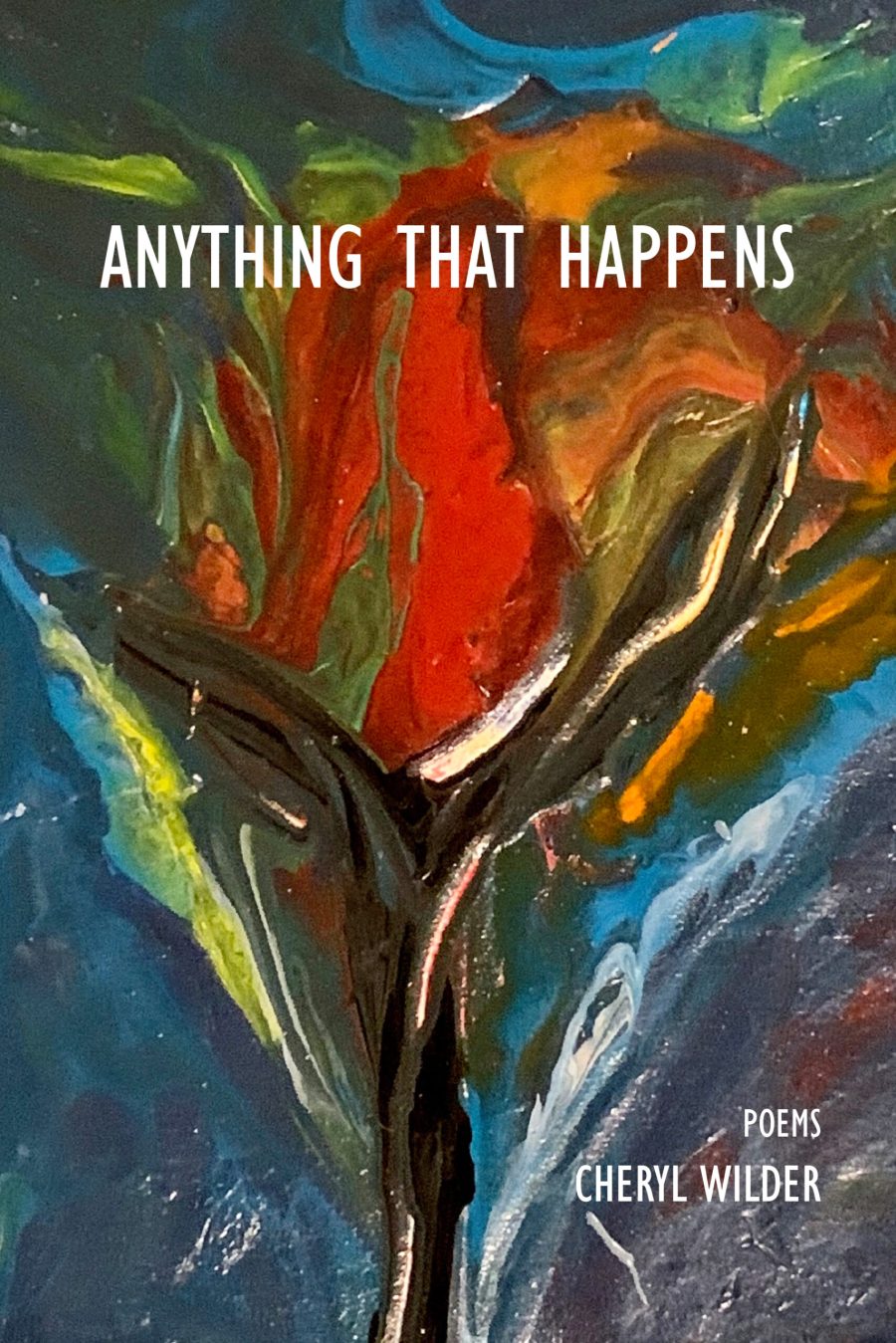
Iโm not sure who said it, but thereโs an adage that goes something like: A first book is the one the author needed to write. This statement is true for me, though not for all the themes found in my first book, Anything That Happens. Hm. That may not be accurate. Let me begin again.
I came to writing through a side door. At the end of my senior year in high school, my English teacher pulled me aside, a stack of my creative assignments in his hand, and urged me to keep writing. โIf you enjoy doing this, keep doing it,โ Mr. Langford said, making me look up and into his eyes so I could see his serious face. He knew I was an adrift teenager about to be released into the world. I imagine him crossing his fingers as he gave me the โlife raftโ that is poetry.
My poetry has always been personal, tied to the exploration of emotion. I believe itโs a response to the practical, non-communicative environment where I grew up. The stack of papers Mr. Langford held were poems about friendship and trust, my mom making a new home with her husband-to-be, my fatherโs absence, and me coming to terms with โฆ my future?
Since I had little direction, and I enjoyed writing, I took Mr. Langfordโs advice. But, I didnโt know how to live like a writer. And I believed โexperienceโ would make me a writer. (Obviously, I wasnโt paying attention in class when we talked about Emily Dickensonโs life.)
So, when I moved from California to North Carolina at nineteen years old, I was embarking on โlife.โ I uprooted, hoping for new, enlightening experiences. Nine months later, the eventโa car crashโI would eventually need to write happened.
The irony is that after the crash, I couldnโt write. Then, I wouldnโt write, not seriously. Not for years. I believed it was wrong to make a good thing from my bad act. And since I wanted to become a poet, I kept myself from it, accepting my due punishment.
The thing about needs is they donโt disappear. Whether I wanted to believe it or not, I was a poet, and a poet needs to write poetry. Thereโs no escaping it. (Oh, thank goodness.)
I first gave myself permission to write about the crash in a fiction class. I had returned to college at twenty-seven years old and majored in creative writing. Fiction provided me the distance I needed to write the details of the night, from my friendโs phone call to being handcuffed and put into a police car. In the โstory,โ the crash was happening to someone else.
That first step was monumental: I was in the writerโs chair.
Two years later, during my last poetry workshop before graduation, I wrote my first poem about the crash, the original version of the โSlippedโ series thatโs in the book. It was the story I wrote in fiction, but this time, I was once again in the driverโs seat. Placing myself there gave me a better vantage point to tell the story, and not only the drinking too much and car wrapped around a pole story. The pieces of the story only I knew: the emotional and psychological impact.
The crash was the story I needed to tell. โEmotional and psychological impactโ is the inherent slice of all the stories I tell, like when I tried to understand my fatherโs choices compared to my motherโs back in high school.
The main narrative of Anything That Happens is the car crash and its aftermath. But there is also the death of my mother, the birth of my first son, struggles of parenthood, and underneath it all, ever-present shame. Thereโs no doubt the car crash heightened my interest in how one action can affect someone else. When I wrote about the relationship with my parents and how I felt about becoming a mother, I did so through the lens of cause and effectโthe impact of choosing what not to do weighing as heavily as choosing what to do.
The impact of writing the story I needed to write is just coming to fruition. The book is only two months old. My desire to write hasnโt lessened. Now, I get to work on what I want to write. I donโt know what that looks like yet. Sure, I have ideas and dreams. Okay, I even have projects I kept putting to the side while I finished the needed-to-be-told story. But thatโs the โworkโ of being a writer, and Iโll get to it. For now, Iโm still living the piece Iโm most interested in, the emotional and psychological impact of having told the story I needed to tell.
Advertisements
About the Author
Cheryl Wilder is the author of Anything That Happens, a Tom Lombardo Poetry Selection (Press 53, 2021), a collection that examines how to reconcile a past grave mistake and a future that stretches into one long second chance. Her chapbook, What Binds Us (Finishing Line Press, 2017), explores the frailty and necessity of human connection.
A founder and editor ofย Waterwheel Review, Cheryl earned her BFA from the University of North Carolina at Wilmington and her MFA from Vermont College of Fine Arts.
โPotentially the difference between a blockbuster and a flop, kid!โ Hollywood answered, chewing on a cigar and pouring two fingers of scotch.
In all seriousness, it is unfortunately true that more than a few cinematic gems have been buried by their lackluster titles. A good title, by contrast, can get someone to click on a trailer, read a two-sentence description that can clinch the deal, or fill a theater seat on the power of the curiosity it has inspired alone.
At the very least, a good title gets a moviegoer to ask, โtell me moreโโฆ and a really good title gets a moviegoer to say, โOkay, show me.โ
And this is why Blake Snyder emphasizes in Save the Cat! โ his methodology that revolutionized the language of storytelling โ that you are not tasked with simply coming up with a title for your movie.
Youโre tasked with giving your movie a killer title.
Itโs a mission so importantโso absolutely paramountโthat we hammer it home in great detail in the โCracking the Beat Sheetโ online course. We also offer an arsenal of tips and pointers because, after all, imagine pouring your heart and soul into writing a story for the ages, pulling every string to get it into the hands of a decision-maker (or at least an intern) at a production company or major studio, only to have them look at the title, and with a โmeh,โ toss it onto the โmaybe laterโ (maybe never) pile.
Tragedy! One that would ruffle even Shakespeareโsโฆ ruffles! So letโs prevent it!
โLegally Blondโ
โThe Good, the Bad, and the Uglyโ
โFight Clubโ
We all know a good title when we read one. But what makes a title good?
Years ago, Blake offered us an important clue to cracking that case. He pointed out that โa good title must say what it is! and yet give us a fresh, intriguing invitation to your party that gives us a hint of the type and tone of the festivities weโre about to attend. And thatโs some tight writing right there.โ
So as you can seeโand as many of us have had the displeasure of experiencingโitโs no easy task, nor is it a small one. And to prove that itโs a task on which even the biggest films may stumble and fall, allow me to share the example we use in the Save the Cat! โCracking the Beat Sheetโ course:
In 2014, Tom Cruise starred in a movie called Edge of Tomorrow, which was phenomenal by both audience and criticsโ accounts with a 90% fresh rating on Rotten Tomatoes. The premise was basically Groundhogโs Day in the middle of an alien invasion. A man with no combat experience is forced to relive the same day over and over again until he can figure out how to thwart a devastating extraterrestrial attack.
The problem was, none of the excitement of that premise was hinted at or captured with the title โEdge of Tomorrow,โ slick as it sounded. And one of the most vocal lamenters of the titleโs failure was Doug Liman, the filmโs director. He openly blamed this title, which was forced on the film, for the movieโs disappointing box office returns.
โI ended up having to call the person (the Warner Bros. executive) and apologize for pointing out that they were wrong,โ he said. โAnd they started titling it the title I always thought it should have, which is Live Die Repeat. But they tiptoed around it, and when we make the sequel, itโll be permanently titled Live Die Repeat. The sequel will be Live Die Repeat and Repeat.โ
Guess what? Thatโs a title that says what the movie is.
Hopefully, youโre now fully convinced that a title matters a great deal, and youโre mentally running the โSay What It Isโ test on your current script titles.
And if you still only find yourself on the edge of inspiration, weโve packed our online course with wisdom and tricks to tip you over.
Happy writing! Or shall we sayโฆ live, write, repeat!
Advertisements
BIO:
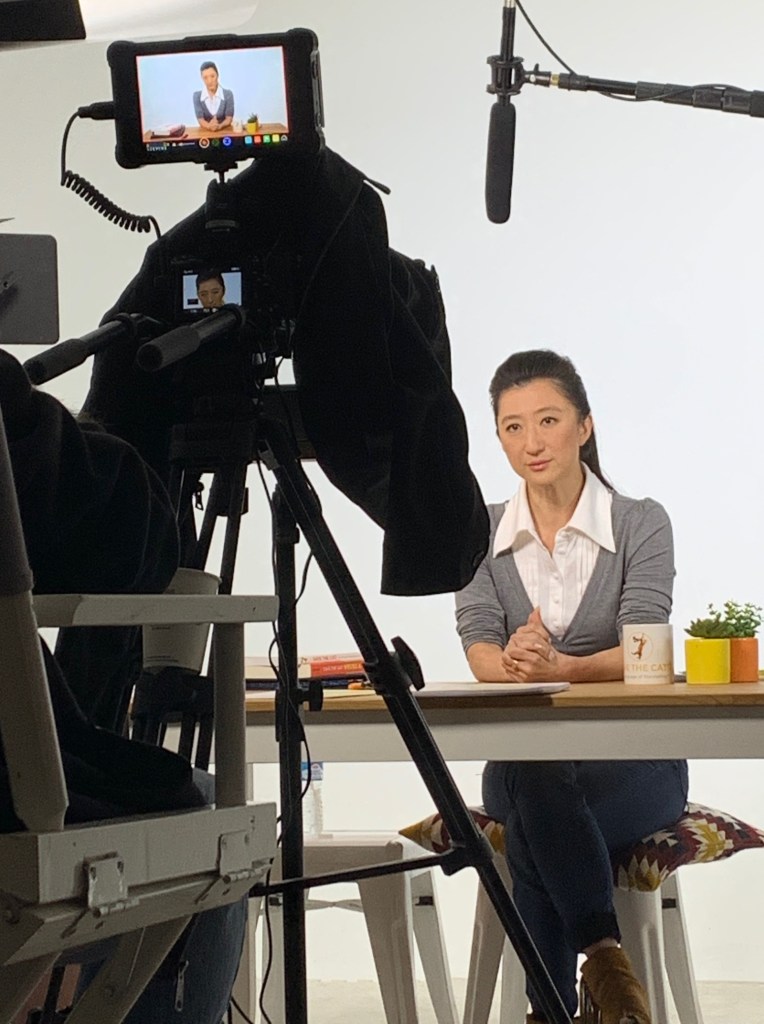
Jennifer Zhang is a screenwriter and filmmaker who wrote, produced and sold her award-winning debut feature “The Evil Inside” shortly after working with Blake Snyder and adopting Save the Cat! storytelling principles in her screenwriting. She is the instructor featured in the โCracking the Beat Sheetโ online course, and has most recently garnered early festival buzz for her feature-length independent thriller “Charon” which has picked up multiple official selections and โBest Writerโ nominations.
About Save the Cat!
Save the Cat!ยฎ is the bestselling story methodology introduced by screenwriter Blake Snyder in 2005 with his first book, Save the Cat!. Snyderโs acclaimed ideas, methods, and software have provided thousands of writers with the resources they need to develop their screenplays and novels.
Save the Cat!โs
WOW! WOMEN ON WRITING TOUROFCracking the Beat Sheet
&
Story Development Cards
Tour Begins February 22nd
First, what is Save the Cat!ยฎ?
Save the Cat! provides writers the resources they need to develop their screenplays and novels based on a series of best-selling books, primarily written by Blake Snyder (1957- 2009). Blakeโs method is based on 10 distinctive genres and his 15 story beats (the Blake Snyder Beat Sheet). Our books, workshops, story structure software, apps, and story coaching teach you everything you need to unlock the fundamentals and mechanics of plot and character transformation.
About the Save the Cat! Cracking the Beat Sheet Online Course
This course is designed for writers to turn their idea into a movie or novel. This learn-at-your-own-pace online class helps you develop the 15 key โbeatsโ or โplot pointsโ of your story. Strung together, in the right order, these 15 beats make up the blueprint to a successful screenplay or novel.
You’ll Turn an Idea into a Story by Learning to…
โข Create a solid beat sheet that will serve as the road map, and โbackboneโ of your story
โข Identify and know the key components of your story genre โข Learn the clichรฉs of your genre so that you can break them like an artist
โข Plot your heroโs journey and โtransformationโ โข Troubleshoot your story idea for viability
โข Write a compelling logline or elevator pitch
This Course Is for Those Who…
โข Want to troubleshoot an existing story
โข Have so many great ideas and struggle to choose “the one”
โข Are ready to write but not sure how to start
โข Are determined to finish a half-written story
โข Want to learn
This Course Includesโฆ
โข Over 3 hours and 17 minutes of original video production
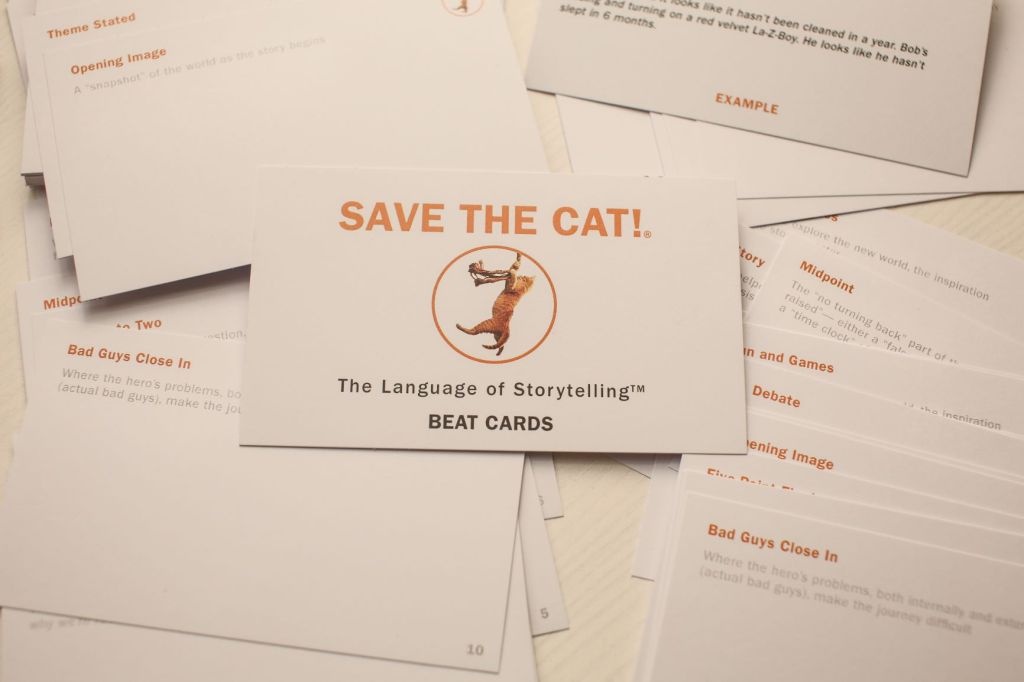
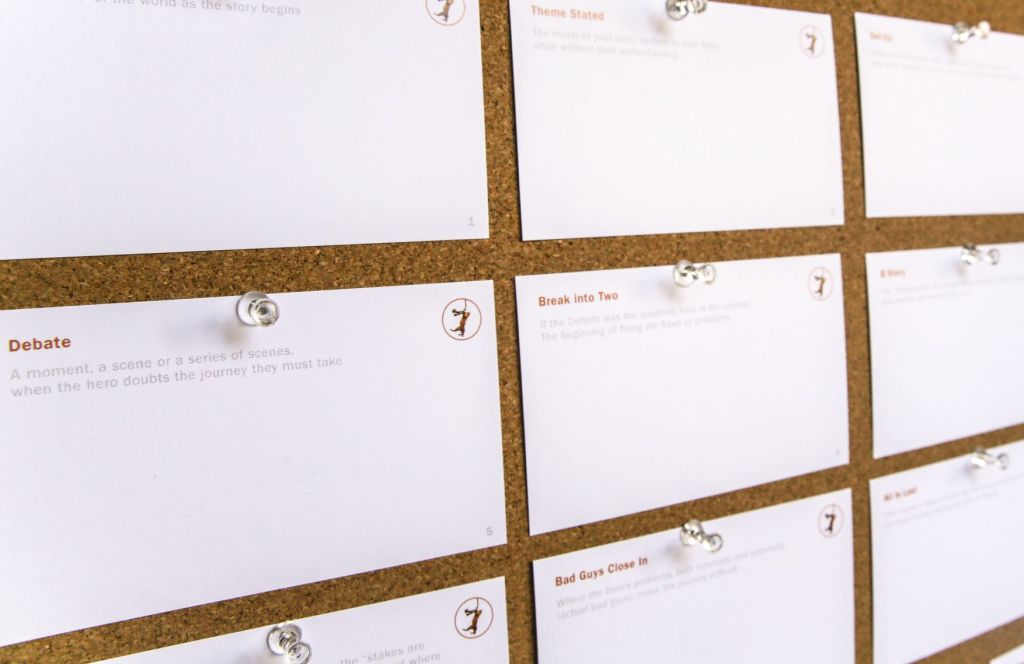
Introducing Save the Cat!ยฎStory Cards, consisting of Save the Cat! Beat Cards and Save the Cat! Scene Cards, all designed to outline and develop your story.
Save the Cat! Beat Cards
Crack your story from the โOpening Imageโ to the โFinal Image.โ Save the Cat!ยฎ Beat Cards provide writers with the 15 key plot points to map out your script or novel. Every set contains 15 individual index cards with helpful explanations of each beat to form the foundation of your story.
Save the Cat! Scene Cards
Every scene of your story needs to communicate โplace,โ โbasic action,โ โemotional transformation,โ and โoutcome.โ The Save the Cat!ยฎ Scene Cards help writers nail the purpose of every scene. Each set of cards contains 40 color-coded cards broken down by act, with 10 extra cards because we know youโll need them.
What goes better in the morning than a muffin? Grab your coffee and join us today over at our blog, where we launch another blog tour for Save the Cat! We talk about their online course and their story cards, interview the Save the Cat team, and host a special giveaway you don’t want to miss.
Guest writer, Stephanie Anne, reviews the Save the Cat! Cracking the Beat Sheet course and Save the Cat! Story Cards on Nicole’s blog World of My Imagination.
I ran a small press for seven years and published 13 books, including three New York Times Bestsellers, three Hoffer Award Winners, and a book that was optioned for a film. We averaged 6,000 copies sold of each titleโincluding two titles that sold more than 20,000 copies each.ย
To put that in perspective: the average U.S. nonfiction book sells fewer than 250 copies per year and fewer than 2,000 copies in its lifetime. The average author-published book sells 250-300 copies in its lifetime. Sales of 5,000 copies of a book is considered respectable by a Big Five publisher, and a โhome runโ by a small publisher.
We achieved success without traditional distribution and on a shoestring budget. And one of the keys to our success was using e-newsletters and websites that promote books.
There are dozens of book promotion newsletters (more than 100 by some counts), and I used many of them as a publisher. Earlier this year, after having used these newsletters for many years in my marketing efforts and after having done extensive market research on the industry, Kathleen Meyer and I launched LitNuts, an e-newsletter to bring the โBest of the Indiesโ to booklovers.
Today, I want to give you a quick overview of the industry, and tell you why readers should take a closer look at book promotion newsletters and why authors and publishers should include them in their marketing plans. Iโll also tell you why we decided to launch LitNuts despite the crowded playing field.
Advertisements
The Book e-Newsletter Industry
You are probably familiar with some book promotion e-newsletters. Some of the more prominent ones are BookBub, Bargain Booksy and eReader News Today. And for every large one, there are many other smaller ones like Book Basset, the Choosy BookWorm and the Frugal eReader. Beyond industry giant BookBub, there is a group that would best be described as mid-sized family-run businesses, and then there are a bunch that are produced by individuals.
They all follow a similar business model in that the e-newsletters are free to subscribers, and authors and publishers pay to have their books featured in the e-newsletter. The cost to be featured ranges from as low as $10 (even less in some cases) to several hundreds or even thousands of dollars (in the case of BookBub).
The newsletters are great for readers. In addition to being free, the newsletters mostly focus on bargains, and everybody loves a bargain.
The only problems from the readerโs perspective are 1) the focus on bargains means a limited universeโnot every great book is $2.99 or less, and 2) uneven quality because the only requirement for most newsletters is paymentโthey are not looking at quality, which means thereโs a more-than-middling possibility that the 99 cent โbargainโ you just downloaded isnโt worth the time you spent to download it, let alone read it.
There are additional problems from the perspective of the author or publisher, including convoluted promotion โpackages,โ tiered pricing structures, and a maze of sometimes complicated order forms.
Despite the problems, newsletters are a great way for readers to โdiscoverโ books, and a great way for authors and publishers to get their books out there for โdiscovery.โ But obviously, thereโs room for improvement. Thatโs why Kathleen and I started LitNuts: we felt we could do some things a little differentโand ideally, better.
What Makes LitNuts Different?
One thing that makes LitNuts different is our focus on indie books. No other newsletter has this focus. While the Big Five publishers (Penguin Random House, Hachette Livre, HarperCollins, Macmillan Publishers, and Simon & Schuster) and their ~250 imprints focus on million-dollar deals and the next big bestseller, indie publishers are nurturing new authors and emphasizing quality and innovation over profits. In addition, books from independent, university, small and micro presses have been professionally edited and designed, ensuring a level of quality. (Note: We will also feature author-published works that rise to that same level of quality and meet our standards.)
Another thing that makes LitNuts different is that while other newsletters focus on bargains, LitNuts features books at all price points, including lots of new releases and award winners. In addition, we feature collections of short stories, essays and poetryโforms of writing that most newsletters exclude simply because collections donโt usually sell as well as book-length works.
Finally, weโve made things easier for authors and publishers: no convoluted โpackagesโ to analyze…no tiered pricing…no waiting to see if the date an author wants for a book promotion is available. Itโs a very affordable $25 to be featured in LitNuts, and our simple order form allows you to select the date of your book promotion.
Submitting Books to Promotional Newsletters/Websites
Another thing that can be complicated from the author/publisher perspective is coordinating promotions. A lot of times, an author or publisher is planning a sale and will want to schedule multiple promotions in conjunction with the sale. You can do it yourself, but if you want to run multiple promotions at the same time, be prepared to spend lots of hours at the computer filling out order forms.
There are some economical services that will handle submission to multiple book promotion newsletters and websites if you are giving away free, promotional copies of an e-book:
Taranko1 on Fiverr: Will submit free e-books to multiple promotion services for as little as $5.
Author Marketing Club: No charge, but they donโt submit for you. Instead, they have consolidated on one page links that take you directly to the order forms of multiple promotion services. You still have to submit the books yourself, but having all of the order forms in one place will save you time.
That said, when it comes to submitting books that are on sale for $0.99 or more, youโre pretty much on your own. Which is fineโฆyou can do it! It just takes time. But I will tell you about a service that I recently came across called Book Rank, which has two options: 1) โWe Build Itโ Promotion Services, in which they select the book promotion newsletters/websites for you, and 2) โBuild Your Ownโ Promotional Services, in which you tell them which venues you want to use.
Iโve not used Book Rank, and the โWe Build Itโ prices are not cheap. But the โBuild Your Ownโ service looks pretty reasonable. Itโs $50 plus 6.9% of the total cost of the sites you want to submit to. You can choose from 33 book promotion newsletters/sites (soon to be 34 when they add LitNuts), and your cost will be $50 + the total cost of doing a promotion with each newsletter/website + 6.9%. Thatโs not a bad deal. But you need to know which ones to use.
And then, of course, thereโs BookBub. BookBub is expensive, but it gets results. The catch is that you have to apply to be featured in their newsletterโand they are very selective. They only accept 10-15% of the books that are submitted to them. Some of that has to do with price; BookBub requires that โyour book must be discounted to at least 50% off the predominant recent priceโ and โyour book cannot have been offered for a better price in the recent past.โ In other words, you essentially need to price your book at the lowest price in its history to have it included in BookBub.
BookBub looks at everything else, too: book cover, professional reviews, online reader reviews, awards, etc. BookBub doesnโt give a number, but I tell people youโd better have at least 25 reader reviews averaging 4 stars or better on Amazon or Goodreads before submitting to BookBub (some say 50 reader reviews averaging 4.5 stars).
If you think your book will qualify, submit it to BookBub. Prices range from as little as $113 (to promote a free e-book to a very small audience) to as much as $4,000 (to promote an e-book that costs more than $3 to a large audience). The average price to promote a 99 cent e-book is currently $600. Thatโs a lotโbut you will sell hundreds, if not thousands, of e-books as a result of doing a promotion with Bookbub.
Conclusion
Book promotion newsletters are a dynamic component of the overall book industry. They are a boon to readers, bringing you a wide selection of books to consider for your next read. And they are a boon to authors and publishers, and should be part of any marketing plan. But as with all things, proceed with caution. Readers need to be wary of the disproportionate focus on โbargainsโ that may not be bargains at all, and authors and publishers need to do their homework on which newsletters actually get results and which ones are just taking your money.
Ideally, book promotion newsletters bring readers and authors togetherโฆproviding readers with more choices, and authors and publishers with an economical way to share new titles. And ideally, the book promotions will generate enough sales to at least pay for themselves. But even if an author or publisher just breaks even on a promotion, I think you can regard that as a โwin.โ You got your book into the hands of more readers, which should lead to more online reader reviews (worth their weight in gold) and more word-of-mouth marketing (the Holy Grail of book publishing).
Advertisements
About LitNuts
For Readers
So, LitNuts brings you books of short stories, essays, or poetry that many other newsletters refuse to include (because collections donโt sell as well as novels). LitNuts also features new releases and award-winning books that other newsletters exclude because of price. (Many newsletters feature ONLY ebooks priced at $2.99 or less, which is fine โ but not all great books are $2.99 or less!).
For authors, you’ll be happy to hear that LitNuts founders Mike OโMary and Kathleen Meyer handled publishing and marketing for an indie press for more than 10 years. This is important because that means they understand the challenge of getting your books in front of readers.
For Authors
LitNuts is an affordable vehicle that focuses on indie books and has engaged subscribers. Their goal is to help authors increase their bookโs sales rank with online retailers, generate more reader reviews, and create positive word-of-mouth.
Toward that end, they are building a subscriber base of booklovers who want to hear from indie presses. And we are focused on keeping things simple and flexible for authors. They offer a flat price of $25, so itโs simple. No tiered pricing or convoluted advertising offers to analyze.
At the same time, they give authors the flexibility to advertise short story, essay and poetry collections, to link to your website so book lovers can purchase directly from you, and to set the price of your e-book according to your needs.
About LitNut and owners Kathleen Meyer and her father, Mike O’Mary:
LitNuts is a woman-owned, family-run business founded by Kathleen Meyer and her father, Mike O’Mary, who share a love of literature and reading. Kathleen is an avid reader with 10 years of marketing experience, including with Dream of Things, a small press founded by Mike in 2009. During its 10 year history, Dream of Things published three New York Times Bestsellers, three winners of the Hoffer Award, and one book that has been optioned for a film. Kathleen and Mike drew upon their experience of publishing and marketing books on a shoestring budget to create LitNuts, in the hope of helping other indie presses achieve success.
Authors and readers, visit LitNuts.com to sign up for their newsletter, where you can hear about incredible books from indie publishers that you wouldn’t hear about anywhere else.
What goes better in the morning than a muffin? Join us WOW’s blog The Muffin as we celebrate the launch of LitNuts.com. Follow along the tour for excellent guest posts written by the owners, reader their interview with us, and enter a giveaway.
November 7th @ Michelle Cornish Visit Michelle Cornish’s blog today and you can read a guest post about a closer look inside the world of publishing. https://www.michellecornish.com/blog
November 10th @ Books, Beans and Botany Blogger Ashley Hubbard shares LitNut’s experiences with some of their favorite authors. A fun guest post you don’t want to miss! https://booksbeansandbotany.com/
November 11th @ Literary Quicksand
Jolissa will be interviewing the LitNuts founders, and discussing everything you’ll want to know about this amazing new bookish newsletter.
November 23rd @ The Frugalista Mom Join Rozelyn as she shares LitNuts’ guest post with some excellent book recommendations you’ll add to your reading list. https://thefrugalistamom.com
November 24th @ Editor 911
Join Margo as she features the LitNuts guest post about how to launch your book on a shoestring budget.
I suppose itโs arguable that everything Iโve ever read about the era in which the Second Son Chronicles are set has, in some way, influenced the creation of the narratives. After all, thereโs a certain amount of osmosis that happens with every book we enjoy. But within that broad-brush landscape, some highlights do stand out (in no particular order).
Alison Weirโs non-fiction has been a rich source of details about life in Medieval and Renaissance times. Regardless of the specific subject, her books describe in great depth what daily life was like during these periods โ itโs an immersive experience, and the osmosis factor helped me to create the world of the Chronicles.
I also found inspiration in Ken Follettโs Kingsbridge series, particularly The Pillars of the Earth and World Without End. Follettโs detailed depiction of the building of the great Gothic cathedrals got me thinking about architecture, engineering, and building from Roman times through the Renaissance and led to the inclusion of some building projects in my own books. His narrative of the inventive ways that those outside mainstream medicine of the day began to understand the nature of the spread of infection and the importance of hygiene and other methods for containing it helped inspire my own exploration of how people dealt with disease over six hundred years ago.
Whether itโs in the shield wall with Uhtred of Bebbanburg or in the fields of Agincourt with Henry V, Bernard Cornwell doesnโt shy away from the gritty and brutal realism of the battlefields of long ago. My battle scenes pale by comparison to Cornwellโs ability to bring the sights and sounds and stench and fear and blood-lust of medieval war to life. But I happily acknowledge my debt to him for showing how to make my battles more realistic than they might otherwise have been.
While the time period is much earlier than that of my stories, Jack Whyteโs re-imagining of the Arthurian legends in his Camulod Chronicles influenced a number of decisions I made for my own series. Whyte postulates a world that might have existed in post-Roman Britain and an entirely realistic history that could, in the absence of any surviving written record, have been the basis for the legends. So what does this have to do with the Second Son Chronicles?
My stories are set at the dawn of the Renaissance, a time when so much is well-known about the characters and events of northern Europe. Asking readers to accept that an entirely different set of royalty, nobility, and events could have existed seemed like too great a suspension of disbelief. But if Whyte could create an entirely imagined history, why couldnโt I create an imagined setting for my own narrative? If readers notice some similarities to northern Europe, then perhaps that only adds to the flavor of the world where my characters play out their lives.
I hope you enjoy reading the Second Son Chronicles as much as Iโve enjoyed bringing the stories to life.
Advertisements
Book Summary
At the dawn of the Renaissance, Alfred – the eponymous second son – must discover the special destiny foreseen for him by his grandfather. Now, the unthinkable has happened: Alfredโs brother is king. And it isnโt long before everyoneโs worst fears are realized. Traditional allegiances are shattered under a style of rule unknown since the grand bargain that formed the kingdom was struck over two hundred years ago. These will be the most dangerous years of Alfredโs life, forcing him to re-examine his duty to personal honor and to the kingdom, while the threats posed by his brother constantly remind him of his fatherโs final words of advice. What choices will he have to make to try to protect the things he holds most dear?
Print Length: 234 Pages
Genre: Historical Fiction
Publisher: Black Rose Writing
ASIN: B08563V87C
ISBN-10: 1684334810
ISBN-13: 9781684334810
Pestilence is available to purchase as a print copy and as an e-book at Amazon.com and Barnes and Noble. Be sure to add this to your GoodReads reading list too!
Advertisements
About the Author, Pamela Taylor
Pamela Taylor brings her love of history to the art of storytelling in the Second Son Chronicles. An avid reader of historical fact and fiction, she finds the past offers rich sources for character, ambiance, and plot that allow readers to escape into a world totally unlike their daily lives. She shares her home with two Corgis who frequently reminder her that a dog walk is the best way to find inspiration for that next chapter.
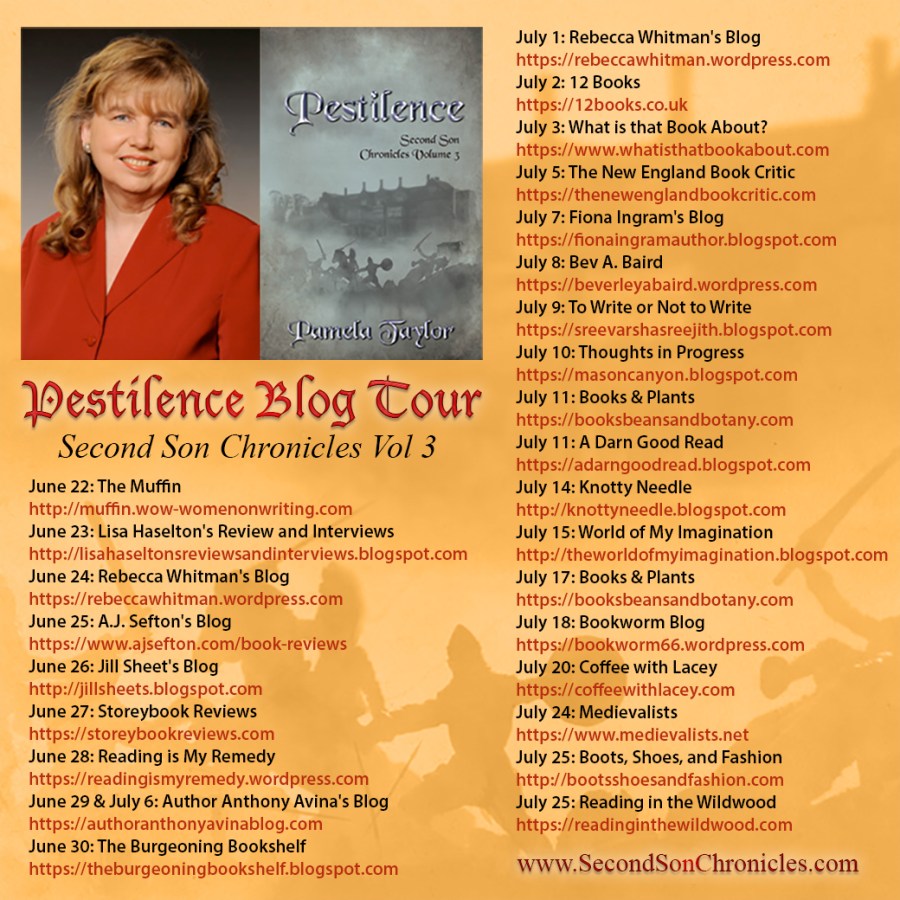
What goes better in the morning than a muffin? Join us as we celebrate the launch of Pamela Taylor’s blog tour for her book Pestilence. You can read an interview with the author and enter to win the first three books in her series “The Second Son Chronicles.”
Visit Rebecca’s blog today and you can read Pamela Taylor’s guest post discussing the allegory (themes) embedded in the narrative of Pestilence specifically and the Chronicles generally.
Visit Veronica’s blog today and you can read a guest post by Pamela Taylor about the trap of linguistic anachronism โ getting the language and word usage right for historical narratives.
I am honored to share with you a fantastic guest blog post from author and poet Elizabeth Hazen, as part of the wonderful blog tour for “Girls Like Us”.
Advertisements
For Christmas, which seems like three lifetimes ago, my parents gave my husband a book of interesting words from around the world*. An engineer who has a soft spot for spoonerisms, puns, and wordplay in every form, he found instant delight in this book. Did you know that Germans have a word for the weight we gain from stress-eating? Kummerspeck. Or that the Scots have a word for that awkward pause when youโve forgotten the name of the person youโre introducing? Tartle. Among my favorites are the whimsical Swedish smultronstรคlle, a place of wild strawberries; the romantic Italian dormiveglia, the space between sleeping and waking; and the essential Japanese tsundoku, that pile of unread books on my bedside table that grows with each passing month.
Needless to say, I took that book of words from my husband, adding one more to my stack.
Getting through my tsundoku โ or at least managing it โ is one of my goals for this summer. I am a teacher, and the summer brings with it the beautiful freedom of longer days and fewer responsibilities, but the lack of structure โironically, frustratingly, and inevitably โ invites bad habits and a gradual decline into despair over the time I fear I am wasting. As a result, I know I need to impose some kind of schedule โ a routine that will keep me on track. Part of that routine, I have decided, will include reading more poetry.
One of the lessons I most love to teach to my seventh-grade students involves defining poetry. We examine a range of definitions โ the top of our heads being blown off, the best words in the best order, language at its most distilled and most powerful. We can debate the specifics, note our preferences, but that words are the poetโs medium is indisputable. Imperfect, delicious, malleable, living, breathing words. It is my love of words that I always return to during the darkest moments, and boy are these days dark.
In a review of my recent collection, Girls Like Us, Nandini Bhattacharya defines the poem as โineffable interrogator, ethicist and chronicler of human history.โ Indeed, I certainly have found more accuracy and truth in poems than in the newspaper, more solace in poems than in meditation or exercise, more freedom in poems than in the endless walks I take to escape the confines of quarantine. As when I was in the thick of adolescent depression, poems come to rescue me, to remind me that the legacy of human sadness and loss and pain is infinite, but so is our legacy of resilience and power and change.
Perhaps poems allow us to do what the Dutch call uitwaaien: โto take a break and walk away from the demands of life to clear oneโs head.โ Or maybe life demands poems, and it is precisely in these moments of trauma and fear and violence that we must dive in head-first. Whatever they do, I am grateful for them. Here are several recent collections by women that I highly recommend. Each, in its own way, has given me what the Icelandic call radljรณst: enough light to find my way.
Difficult Fruit by Lauren K. Alleyne, Peepal Tree, 2014
Thrust by Heather Derr-Smith, Persea Books, 2017
American Samizdat by Jehanne Dubrow, Diode Editions, 2019
The Miracles by Amy Lemmon, C&R Press, 2018
Voyage of the Sable Venus by Robin Coste Lewis, Knopf, 2016
Code by Charlotte Pence, Black Lawrence Press, 2020
How to Exterminate the Black Woman by Monica Prince, [Pank Books], 2019
American Lyric Trilogy by Claudia Rankine, Graywolf, 2004, 2014, 2020
The State Sheโs In by Lesley Wheeler, Tinderbox Editions, 2020
*The book of words I refer to is Other Wordly: Words Both Strange and Lovely from Around the World by Yee-Lum Yak with illustrations by Kelsey Garrity-Riley
Elizabeth Hazen is a poet, essayist, and teacher. A Maryland native, she came of age in a suburb of Washington, D.C. in the pre-internet, grunge-tinted 1990s, when women were riding the third wave of feminism and fighting the accompanying backlash. She began writing poems when she was in middle school, after a kind-hearted librarian handed her Lawrence Ferlinghettiโs A Coney Island of the Mind. She has been reading and writing poems ever since.
Hazenโs work explores issues of addiction, mental health, and sexual trauma, as well as the restorative power of love and forgiveness. Her poems have appeared in Best American Poetry, American Literary Review, Shenandoah, Southwest Review, The Threepenny Review, The Normal School, and other journals. Alan Squire Publishing released her first book, Chaos Theories, in 2016. Girls Like Us is her second collection. She lives in Baltimore with her family.
Most of us have heard that walking is good for our bodies: walking can reduce our risk of high blood pressure, high cholesterol, dementia, diabetes, several types of cancer, and more. Some of us have heard that walking is good for our brains: walking can help improve our decision-making, boost our executive function, and fuel our creativity. And many of us have heard that walking is good for our emotional well-being: walking can boost our mood and can be a valuable tool in the battle against depression.
But what about loneliness? Can walking help there too?
We believe so. A study my company undertook last year revealed that women who regularly walk with their friends are 2.5 times less likely to feel lonely often.
Why is it that walking together is so powerful?
First, we are social beings and we are wired to crave — and enjoy — shared experiences. Researchers believe this comes directly from our biological need to belong: our ancestors were a whole lot safer walking in the woods with their tribe than they were walking the woods by themselves.
Second, our hormones help. Walking increases levels of oxytocin — a hormone that heightens our connections with others. So when you walk with a friend, your biology helps foster a deeper, more meaningful connection. And yes, oxytocin is the same hormone that is released during childbirth and nursing, which makes sense because it encourages us to bond with our babies.
Third, extensive research shows that our brains process differently when we are walking. Because only part of our brain is occupied with putting one foot in front of the other, the rest of our brain is free to roam, to think more deeply. More importantly, when we are walking together, we can comfortably take the moments of quiet to process and give ourselves the chance to think, and connect, more deeply.
Finally, because conversations tend to flow more easily and because walking together provides an activity — and one that takes place away from home — it is far more comfortable to invite a new friend for a walk than to invite them to your home. Indeed, many mom friendships have been formed from the question โDo you want to take a walk after school drop off?โ
In short, walking together can be an incredibly powerful antidote to loneliness. It provides the perfect environment for conversation and connection. It offers time and space, free of distractions. It gives us the increased pleasure that comes from sharing an experience. It delivers a blast of oxytocin that encourages us to connect with one another. And it provides an easy way to begin to connect with a new friend.
Advertisements
About the Author
Joyce Shulman, founder and CEO of 99 Walks and Macaroni Kid reaches millions of moms each month with hyper-local and national e-newsletters and websites, social media content, video and her Weekly Walk podcast. Having created a one-of-a-kind digital platform, she connects families to the wonders of their own communities and inspires women to chase their dreams and crush their goals.
Her most recent endeavor, 99 Walks, is on a mission to combat loneliness and improve fitness through the simple act of encouraging moms to walk together. Her mission? Nothing short of getting a million women walking.
Throughout her two decades as an entrepreneur, Joyce has guided SAHMs, teachers and even MBAs to success. Joyce shares how moms need to โtake care of mama bearโ and avoid the โmartyr mom syndrome.โ Her experience in business and leading mompreneurs makes her a coveted speaker where she shares tactics for beating burnout, fueling creativity, goal crushing, how walking can fuel productivity and performance, and more.
Joyce received her Bachelorโs in Business Management from the University of Maryland and her Juris Doctor, Cum Laude, from St. Johnโs University School of Law. After law school, she spent more than a dozen years as a New York City lawyer where her practice focused on complex commercial litigation.
A self-confessed idea junkie, in 1998, Joyce abandoned law firm life to liberate her entrepreneurial spirit and focus on the things that are most important to her: family, community and empowering women to chase their dreams.
What goes better in the morning than a muffin? Grab your coffee and join us in celebrating the launch of Joyce Shulmanโs book Walk Your Way to Better. You can read an interview with the author and enter to win a copy of the book.
Stop by Lisaโs blog again today where you can read a guest post by author Joyce Shulman where she talks about why do women need to take care of themselves. A timely post in this day and age!
Stop by Terriโs blog today and read her review of Joyce Shulmanโs book Walk Your Way to Better. You can also read a guest post written by the author about the power of yet.
As we tread through the New Year, we find some, if not all, of our resolutions falling by the wayside. However, one doesnโt have to wait till December 31st and the rush of holiday feels and stress to decide to make changes. Any day is a good day to take care of yourself, and one of the best things you can do is introduce some self-care into your life.
With self-care becoming a growing topic I want to be clear about what itโs not. It isnโt a license to make unhealthy choices or shirk responsibility. Itโs not about spending sprees or throwing around money you donโt have. In a world full of consequences, the last thing it should encourage is a bucket full of regrets when you must face the music from your choices.
Our world is ever -spinning and growing, and ever rushing us from one moment to the next. Self-care is about the pause where you allow yourself to smell the roses, as it were. Where the must crucial aspect is an honest internal dialogue. Taking a few moments to quietly address and asses your needs whether they are emotional, physical or mental. Once you figure out what you are in need of to achieve balance you then select an activity to improve that.
Advertisements
So here are some simple things you can do every day to both provide yourself with care as well as opening up dialogue within yourself, so it becomes second nature.
GET MORE SLEEP. Countless studies show that the majority of us are not getting enough sleep. We probably all know better sleep equals better mood, but did you know it also helps prevent weight gain, improves memory, hand eye coordination as well as strengthen your heart? It truly is one of the best things you can give yourself and will help you in making the most of your day. It will make the good days sweeter and provide the strength to get through the bad ones. Yes, despite what many other articles will tell you bad days are sure to be par for the course. Thereโs no amount of self-help, positive perspective or vitamins that can guarantee a great day every day.
LEAVE YOUR PHONE OFF FOR 1 HOUR. You may wonder how this even applies to self-care. Well, it does, on two levels. Studies show us time and time again that all this technology, social media, and unbound access to more information than any human could every use has a definite downside. It impacts our self-esteem, self-worth, stress levels, concentration, as well as wear down our ability to read most nonverbal cues. Another benefit is this routine time disconnected allows you to reconnect to yourself. You will hear and grow that inner voice that is telling you what it needs. You can spend an hour when you wake up without your phone, or at least an hour before bed. Use this time to read, journal, or even day dream.
TAKE 10-15 MINUTES OUTSIDE. Remember when you were younger and your best days were spent outside, with friends having adventures? Maybe you were on your bikes till the sun went down, or ended the day sitting on a porch with a cold drink or frozen treat. Whatever the case may be, and probably without you realizing it, your mind and body reaped the rewards of the fresh air and the sun shinning on your face. However, the world of adulting leaves us very little time to kick off our shoes and walk through the grass. Endless errands, appointments and responsibilities keep us in our cars, offices, or other building. before we get up to do it all again tomorrow. So, carve out just 10 minutes each day to find your way outside. To feel the sun on your face, the breeze on your skin and the smells that surround you as you take a deep breath.
SAY NO. I canโt say this enough, we spread ourselves too thin. We may have the best of intentions, but we do. Women more so then men feel the inner conflict of guilt that leads them to agree to things they donโt have the time, funds, or plain interest in doing. We mostly do this to prevent hurt feelings or guilt. Thereโs only one way I can say this, and thatโs bluntly. No matter who they are, no matter what you may have to offerโฆ. they can make it without you. Your involvement alone is not enough to make or break any personโs event or favor. They will get by without you, you need you for every moment of your life. Say yes when you can, or when you want to, but say no when you canโt. Every single time, no matter the reason.
DO YOU. This is the part thatโs different for everyone, but every single day you need to do one thing solely for your own personal joy. It doesnโt matter how many people depend on you, whether itโs at work or home. From children to coworkers there will always be someone you have to make time for. If you are willing to give it to them then thereโs no reason to keep it from yourself. It may be getting yourself your favorite treat on your way to work, taking control of the playlist for your commute and singing out loud, or giving yourself a small upgrade when youโre at the store. It can also be the big things once in a while. Like making up a bucket list, spending a day off going on an adventure, buying that outfit youโve been eyeing, or having a date night once a week at a new restaurant
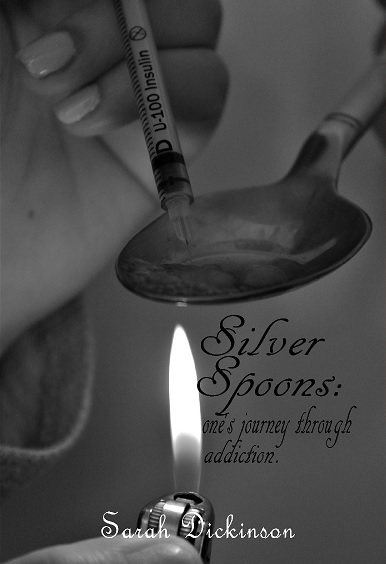
I like to tell people that the end of my 30โs marked major changes for me. I became a mother young, and wife even younger. I lived my life for everyone else. My children, husband, parents, friends and any person in between. Then I got in over my head with a person who meant the world to me. Unfortunately, they also suffered from addiction and I found myself being called upon for favor after. The experience of those years led to two major moments. The moment I changed my perspective about almost everything in my life, and the moment I decided to share my story. I learned how to listen to myself. To figure out who I am, what I want and what I need. I also learned how to take all that love, focus, and support I gave to almost everyone and to finally start giving it to myself as well. When I decided to share my story, I spent almost two years writing my novel. Silver Spoons: Oneโs Journey through Addiction. Despite how many or few copies I may sell Iโve already reaped the benefits of writing it. I saw a dream come to life in finishing a novel, pride at accomplishing something not everyone can do, and peace. I found peace with hearing people tell me their stories. We sadly live in a world where everyone knows an addict or someone who loves an addict.
With all of these experiences and while I have your attention. I would love nothing more than everyone reading this to take care of themselves. Love yourself, nurture yourself, and craft your own stories. I promise you, youโll never regret that choice
Advertisements
Book Summary
Silver Spoons: One’s Journey Through Addiction takes an intimate and raw look at the current face of addiction and recovery. Talking about the current opioid epidemic, we follow a young couple while one of them goes through the recovery process. Told through letters, we get an understanding of their relationship as it struggles through his addiction and resulting recovery. From detox, rehab, sober living and the 12 steps of A.A, you get a raw and honest look at the effects of addiction and how they affect relationships.
AUTHOR NOTE: There is explicit and graphic content.
Print Length: 380 Pages
Genre: Women’s Fiction
Publisher: Independently Published
ISBN-13: 978-1717868947
ISBN-10: 1717868940
Silver Spoons: One’s Journey Through Addiction is now available to purchase at Amazon.com.
About the Author, Sarah Dickinson
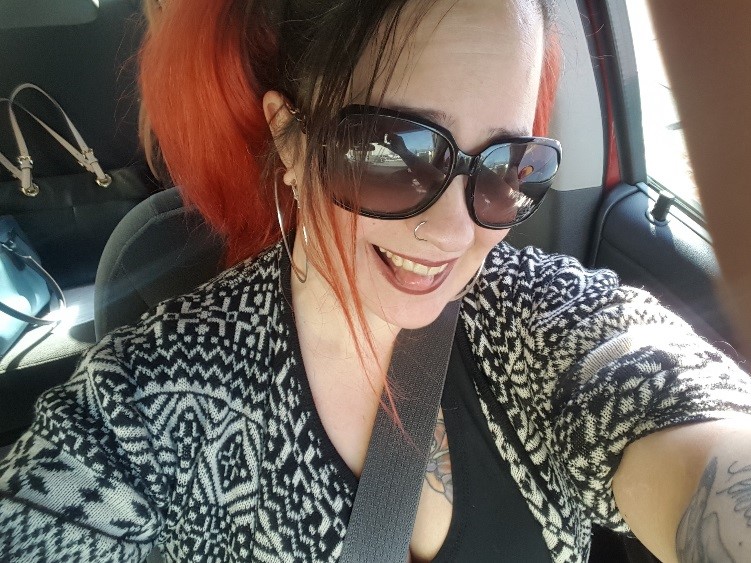
Sarah Dickinson is a lifelong resident in beautiful upstate New York. Mother of two amazing daughters and three equally awesome rescue dogs, she is the author of Silver Spoons: One’s Journey Through Addiction. She currently attends college and is in the midst of switching careers. When she isn’t doing it all, she reads comic books, blogs, and takes weekend getaways.
What goes better in the morning than a muffin? Visit our blog today and you can read an interview with the author of Silver Spoons: One’s Journey Through Addiction and also enter to win a copy of the book!
Visit Anthony’s blog again where you can read a guest post by author Sarah Dickinson. Make sure you check out her easy self-care tips to add to your daily routine.
Make sure you visit Francesca’s blog today and read her review of Sarah Dickinson’s book Silver Spoons: One’s Journey Through Addiction. You can also read an interview with the author!
Visit Rozelyn’s blog today and you can read her review of the book Silver Spoons: One’s Journey Through Addiction by Sarah Dickinson. Also, win a copy for yourself too!
Hello everyone. Today I am happy to share with you this special spotlight on the novel Georgia Stories on My Mind by author Jackie Rod. First, here is a little bit about the book itself.
Advertisements
Book Summary
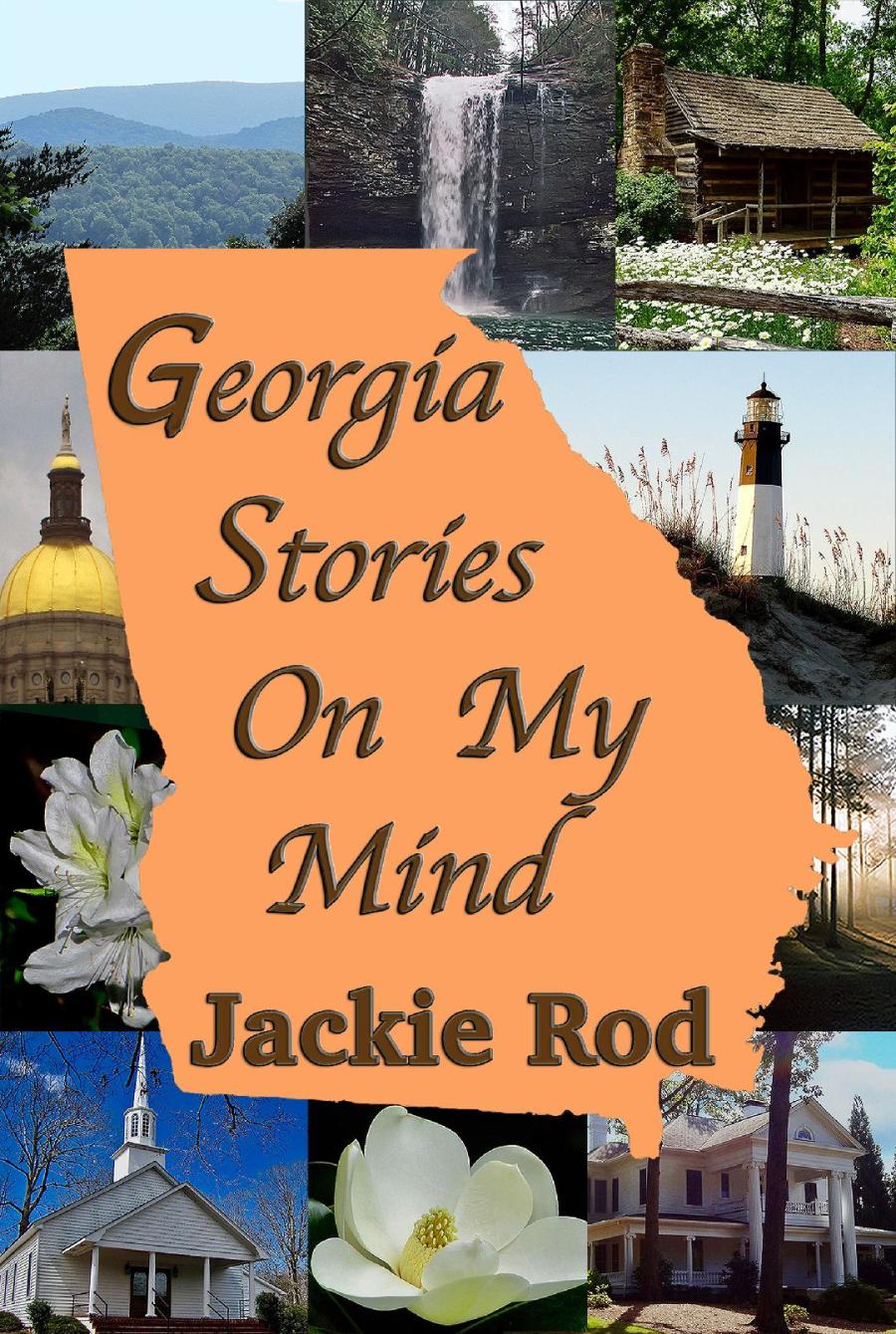
Come visit Georgia within these pages as you read heartwarming stories shaped by local traditions and legends. The characters live life to the fullest through joys and hardships. Inhale the essence of Georgiaโs revitalized small town squares while eating hand- scooped ice cream on a park bench. Each town has its own magic. Sometimes the most real things in life are things we cannot see but those that deeply touch us, as the folks in these tales learn. Share smiles and shed tears as you travel the curving road of life with these Georgia characters. Are you ready for an unforgettable experience of hope, faith, trust, reconciliation, and love?
Print Length: 259 Pages
Genre: Short Story Anthologies
Publisher: Touch Not the Cat Books
ASIN: B07FXVRZGG
Georgia Stories on My Mind is available to purchase on Amazon.com.
About the Author, Jackie Rod
โA good book transports me to another time and place. It lets me feel the sensation of heroes and heroinesโ dark loneliness, deep passion, a fatherโs pride and a motherโs grief.โ Jackie Rod is a fiction writer, loving wife of a legal beagle, and mother of three children who has blessed her with seven fantastic grandchildren. After Jackie retired from teaching, her love of words and stories led her to begin writing fiction. Reading and traveling enrich her life and she jumps at the opportunity to teach a workshop or attend a writing conference. She belongs to five writing chapters/groups. Jackieโs work can be found in twelve published books on Amazon, in several Metro Atlanta libraries, and independent bookstores.
And now, I am happy to share with you all a wonderful guest post from the author herself, Jackie Rod.
Advertisements
Family and Friends
Faith, family, friends and purposeful work are the blessings of life. Today we will focus on family and friends, major components of our lives. They can bring us our greatest joys and our greatest sorrows. Usually it falls somewhere in between. We tend to apply our values and viewpoints to our family and friends, even if their perspectives may not be in line with ours.
Most of the time we identify with friends who hold similar values. In times of trouble we can turn to them for solace and comfort. In times of triumph we celebrate together.
Family members, on the other hand, may have viewpoints diametrically opposed to ours. Often arguments can last for years and affect participation at holiday gatherings and other family events. Some people had rather miss an event than have to deal with their anger and feelings of hostility toward others.
Over the years the actual differences of opinion may be forgotten, but the hard feelings remain and are never addressed. Folks can be stubborn. Of course, these same things might hold true for friends and neighbors with whom you disagree. We could write them off and discontinue any relationship rather than address the issue and try to work it out.
Some people are toxic and need to be eliminated from our circles so that our zin is not out of balance. Perhaps a good therapist would offer techniques and strategies for us to get over our hurt feelings and anxiety.
In the end, we all get on with our lives and make allowances for those we love and overlook the failings of best friends, at least the ones we continue to talk to.
Addressing the misunderstandings can begin a process of healing. Put away the pettiness. Forgiveness is a powerful force.
Remember the joy you receive each day from a wonderful family and friends. Notice the light in their eyes when you flash your beautiful smile. Stay bonded, stay thankful, and stay blessed.
— Blog Tour Dates
Today @ The Muffin
What goes better in the morning than a muffin? Grab your coffee and join us as we celebrate the launch of Jackie Rod’s blog tour of her book Georgia Stories on My Mind. You can read an interview with the author and win a copy of the book.
Visit Lori’s blog today and read author Jackie Rod’s guest post about editing. You can also enter to win a copy of her book Georgia Stories on My Mind.
Visit Ashley’s blog today and you can read Jackie Rod’s guest post about how time is limited and precious. Plus, you can enter to win a copy of the book!
Stop by Margo’s blog where you can read Jackie Rod’s guest post about being a cheerleader for others. You can also win a copy of the book Georgia Stories on My Mind. Don’t miss it!
Stop by Rozelyn’s blog today and you can read her review of Jackie Rod’s book Georgia Stories on My Mind. You can also enter to win a copy of the book!
Stop by Anjanette’s blog again and you can read an interview with author Jackie Rod and read the author’s guest post featuring writing tips. Don’t miss!
As part of the amazing new Women on Writing Blog Tour for author Barbara Barth’s novel “The Unfaithful Widow Ten Years Later”, I am honored to shared this guest blog post from the author today on writing anthologies. I hope you all will enjoy this as much as I did.
Advertisements
I wish I planned better. Iโve always jumped right in doing something without much thought to it. The idea I can do this always crosses my mind first and then I ask myself, what was I thinking? Publishing anthologies (now I have done two with a third on its way early 2020) has been a learning process for me. Iโm delighted to say you can teach an old dog new tricks and Iโve made progress in the planning department.
The first two anthologies A Cup of Christmas (2014) and A Cup of Love (Valentineโs 2018) were beasts to conquer in a short timeframe. I contacted writers I knew, sent guidelines for stories and formatting. I didnโt want to hinder anyoneโs style, so I was open to memoir, fiction, recipes, and poetry. Some great things came in, some not so great. Some of the best writers sent in first drafts, not finished projects. Iโm not an editor for punctuation, Iโm more about continuity. The good news, many flushed out their stories, and for those that didnโt, well I did my own haphazard editing. The anthologies were to benefit a charity, First Book that does wonderful things for children in need with reading and learning materials. The writers pulled together and both anthologies, last-minute ideas, were completed in six weeks each. An awesome task but we got it done. I also have a wonderful book designer, my sister, who knows how to knock it out of the park with a fabulous looking product. Those two anthologies were eBooks only.
I joked, if I ever do this again, Iโd call it A Cup of Cyanide. I was over all the work Iโd brought on myself with the others, and you get my drift with the cyanide! Never crack a joke like that with a group of writers. They loved the title, and so a third anthology is in the works. A bit of murder and mayhem. This time itโs being done differently. Itโs our Walton Writers project. Weโre taking our time. The group members will design the cover and interior, edit the stories, and learn the book formatting process. Itโs the focus of our monthly meetings. This anthology is a grand way for everyone to be involved, make the decisions, and ultimately have a book (both paper and eBook) that is their product. Our non-profit this time is The Monroe-Walton Center for the Arts, where we meet each month. We plan to have a big launch party at the Art Center when we finish.
The bottom line, itโs all been great. The writers (from never published to award-winning) gave freely and quickly to the first two anthologies. Writers giving back. I love that. And the excitement of our writing group for the new anthology is infectious. I learn something new myself at every meeting, because itโs all a learning process, to be better writers.
ย ย ย ย ย ย So, if you think you want to publish an anthology and donโt know how, I didnโt either. Donโt let that stop you.ย
Advertisements
The Unfaithful Widow Ten Years Later
Tour Begins November 11th
Book Summary
Picking up where The Unfaithful Widow ended, Ten Years Later continues the authorโs journey from widow to a slightly askew woman. A memoir written with warmth and candor on being single again, aging, and finding a creative path surrounded by dogs, friends, laughter, and a bit of craziness. Barbara Barth shares stories on the adventures that followed her first year alone as she moved headfirst into a new life, listening to her heart, sometimes not so wisely, but always full speed ahead. Join her on the ride of her life, from owning an antique shop to moving to a Victorian cottage outside of Atlanta, and all the follies in between. Going into the next decade with six dogs by her side, the author proves you are only as old as you feel, and happiness begins with a grateful heart. A funny and engaging memoir for anyone who wants to be their own superhero facing lifeโs good and bad moments.
Print Length: 374 pages
Genre: Memoir
Publisher: Amazon Digital Services, LLC
ASIN: B07YBNHXZG
The Unfaithful widow Ten Years Later is available in print and as an ebook at Amazon.com
About the Author, Barbara Barth
Author, blogger, sometimes antique dealer, dog hoarder, bedazzled by life. Widowed ten years ago, Barth writes about finding a creative path back to happiness. Her recent move to a 1906 historic cottage brought many surprises, including discovering the MonroeโWalton Center for the Arts where she started the monthly Walton Writers group and is on the MWCA Board as Literary Arts Chair. Barth is a contributor to Walton Living Magazine and a former blogger for The Balancing Act, Lifetime Televisionโs morning show for women. Currently she lives with six dogs, rescue dogs that rescued her.
What goes better in the morning than a muffin? Grab your coffee and join us in celebrating the launch of Barbara Barth’s new book The Unfaithful Widow Ten Years Later. You can read an interview with the author and enter to win a copy of the book.
Stop by Lori’s blog today where you can read her interview with Barbara Barth and read her review of Barbara’s book The Unfaithful Widow Ten Years Later.
Be sure to stop by Deirdra’s blog today and check out her spotlight of the book The Unfaithful Widow Ten Years Later and enter to win a copy of the book!
Stop by the blog Women’s Writing Circle and you can read a guest post by Barbara Barth about adopting dogs while all her friends are having grandkids. Don’t miss this one!