In the Throes by Mathias B. Freese Review

I received a free copy of this book in exchange for a fair and honest review. All opinions are my own.

A creature that is the first of its kind discovers self-awareness and a passion for art in author Mathias B. Freese’s “In the Throes”.

Advertisements

The Synopsis

In the Throes explores the awakening of intelligence and the coming into awareness of an evolutionary mishap on a forbidding apocalyptic planet.

The story follows eponymic Gruff, the first linguistic/metaphysical awakener of his species, as he navigates identity, mentation, and ontology in relation to the Gruff’s natural prey: humankind.

Combining the writings of Freud and the spiritual truths of Krishnamurti, author Mathias B. Freese depicts the Gruff as an evolutionary dark creature—disfigured, maimed, instinct-driven, and grotesque—until he attains self-awareness and transforms into a self of artistic expression and wisdom.

As the title suggests, the reader identifies with self-struggle as it surges toward awakening and is moved by the apotheosis that closes the book. The nuanced theme: each one of us is an artist if only we take our selves in hand and construct a life of artistic expression. The closing chapters sing to us of Isak Dinesen’s observation that an artist is never poor.

A metaphor of the evolutionary self, In the Throes is a time-processed journey into awareness—our destiny as a species.

Shop Finejewelers.com's Gift Finder Today & Be Ready for Every Holiday and Birthday Celebration!

The Review

This was one of the most thought-provoking and philosophical sci-fi novels I’ve enjoyed reading. The rich blend of world-building, mythology, and philosophy allows the reader to get lost in this distant world. The story’s natural progression evenly matched the development of Gruff both as a character and as a specimen of his kind, exploring the development of sentient creatures overall in an entertaining yet thoughtful way.

Yet, it was Gruff’s evolution that stood out in this novel. Gruff’s way of thinking, the philosophical debate of instinct versus free will, and his awareness of himself and others around him made this story come to life on the page. The natural drive to create and be expressive was a fascinating approach to mankind’s creative voice, and how artists of one kind or another often dwell within us all spoke to the reader as they delved further and further into the story.

Converse All-Star Sneakers

The Verdict

Remarkable, thoughtful, and engaging author Mathias B. Freese’s “In the Throes” is a must-read sci-fi and philosophy novel. The vivid imagery of this harsh landscape and alien world, mixed with the detailed look at Gruff and his species as a whole and the inner evolution that speaks to mankind’s evolution on Earth, helps illustrate how even the most lumbering, bestial creature can have the heart of a poet or storytelling waiting to be uncovered over time. If you haven’t yet, be sure to grab your copy today!

Rating: 10/10

Advertisements

About the Author

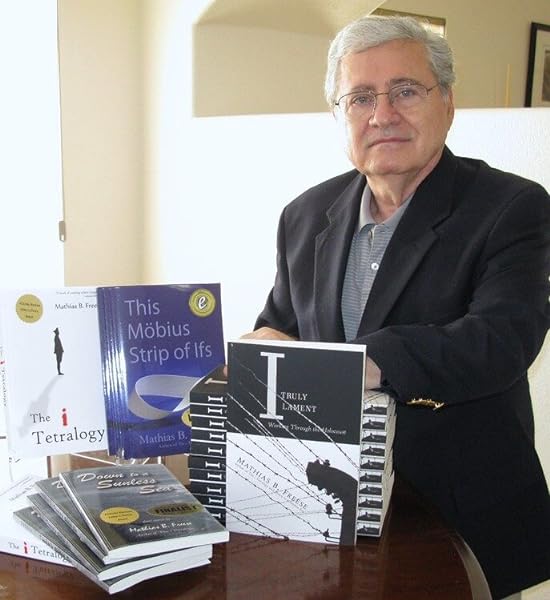
MATHIAS B. FREESE is a writer, teacher, and psychotherapist who has authored eight books. After his first novel, ‘The i Tetralogy’ on the Holocaust, his second work, ‘I Truly Lament: Working Through the Holocaust’, won the Beverly Hills Book Award, Reader’s Favorite Book Award, and was a finalist in the Indie Excellence Book Awards, the Paris Book Festival, and the Amsterdam Book Festival. In 2016 ‘Tesserae: A Memoir of Two Summers’, his first memoir, received seven awards. The following year his second memoir appeared, ‘And Then I Am Gone’.

https://www.mathiasbfreese.com
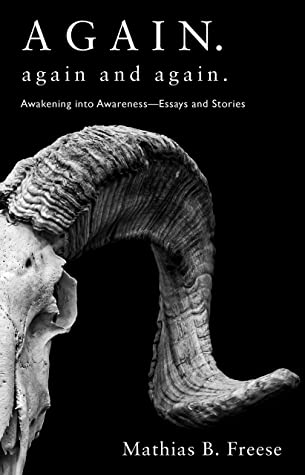
Again. Again and Again: Awakening into Awareness – Essays and Stories by Mathias B. Freese Review

I received a free copy of this book in exchange for a fair and honest review. All opinions are my own. 

Author Mathias B. Freese takes readers deep into his mind and life through a series of personal essays and third-person stories in his book, “Again. Again and Again: Awakening Into Awareness – Essays and Stories”.

Advertisements

The Synopsis

Having once been a psychotherapist who’s never hesitated to turn the therapeutical gun barrel toward himself, Mathias B. Freese ramps up his radical reflexivity in this latest work, from confessional first-person narration to third-person “stories” starring “characters” named Matt. (This genre could be called meta-Matt.) “I write to know perhaps something about who I am,” Freese writes. “I write to arrive at some awareness, however dim, about self or other, for when I have that fleeting moment of awareness, I feel at one — true.” Truly, Again. Again and Again. is a song of himself.

Rocker Billy Idol proves to be an unlikely but apt echoer here: “When there’s nothing to lose and there’s nothing to prove, well, I’m dancing with myself.” As a one-man show, Freese puts the “dance” in “abundance,” stressing an author’s singularity, the innerness of writing, the sharing — rather than the proselytizing — purpose of artistic expression. In other words, as Freese says, “a book is one person’s awareness as he or she sees it.”

More than a few times, Freese had implied that Again. Again and Again. would probably be his swan song, his “final stirrings,” his ultimate testament. How laughable, considering both his prolificacy and “urge and urge and urge” (as Whitman would gush). Sure enough, the author is no longer so sure that he’s expressed enough, and it seems that yet another stirring idea spurs him to create again. Again and…

The Review

This was an incredibly profound and thought-provoking read. The author found the perfect balance between his 1st personal perspective essays and the more 3rd person short narratives that each highlighted an important theme or idea that the author presented. One line that immediately stuck out to me was one in which the author speaks of a friend of his who said literature always featured love and death, but in reflecting on that notion the author realized that his friend forgot time itself. This was so profound, as the author delves in one page into the heart of not only literature but life itself, for what is love and death without the time it takes to achieve both? 

The thing that stood out to me as a reader immediately was the author’s writing style. Whether he was writing a short story about man’s awareness of the universe around him or a personal essay on the pursuit of greatness and how the journey is far more often beautiful than the completed end as a whole, the author always wrote as if he were having a personal conversation with the reader. This very intimate and thoughtful approach to this style of writing was so well-conceived that I was on the edge of my seat the entire reading, mesmerized by the author’s words and the passion for which he wrote.

The Verdict

Heartfelt, engaging, and thoughtful in its approach, author Mathis B. Freese’s “Again. Again and Again” is a must-read book of short stories and essays on life’s most existential questions. The honesty and enlightening way the author weaves together a collection of writing that is both inspiring and philosophical really highlights the author’s sense of teaching and writing, making this one book readers will not want to put down. If you haven’t yet, be sure to grab your copy today!

Rating: 10/10

Advertisements

About the Author

MATHIAS B. FREESE is a writer, teacher, and psychotherapist who has authored eight books. His I Truly Lament: Working Through the Holocaust won the Beverly Hills Book Award, Reader’s Favorite Book Award, and was a finalist in the Indie Excellence Book Awards, the Paris Book Festival, and the Amsterdam Book Festival. In 2016, Tesserae: A Memoir of Two Summers, his first memoir, received seven awards. The following year his second memoir appeared, And Then I Am Gone.

https://www.mathiasbfreese.com/

https://www.amazon.com/gp/product/B09VYC477V/ref=x_gr_w_glide_sin?caller=Goodreads&callerLink=https%3A%2F%2Fwww.goodreads.com%2Fbook%2Fshow%2F60686562-again-again-and-again&tag=x_gr_w_glide_sin-20

Nina’s Memento Mori by Mathias B. Freese Review

I received a free copy of this book in exchange for a fair and honest review. All opinions are my own. 

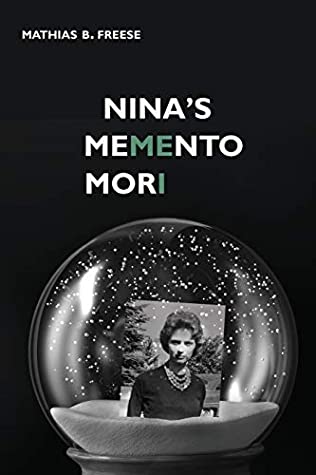
An author puts his life into perspective through the lens of his late wife as he deals with the grief of her passing in author Mathias B. Freese’s “Nina’s Memento Mori”. 

Advertisements

The Synopsis

Near the end of Nabokov’s Lolita, Humbert makes an honest admission: “[A]nd it struck me…that I simply did not know a thing about my darling’s mind.” That line sums up the isolate game of memorializing a deceased loved one, which is the basic tension in Nina’s Memento Mori, an elegy to Mathias Freese’s lost wife. The profound responsibility of answering the question “Who was Nina?” is left to the lone memoirist:

I can say or write anything I want about her…There is much writerly power in that. I am the executor of her probate in all things now. She is mine now in ways she could not be when alive. I am the steward of her memory.

Freese ends up analyzing himself, putting the “me” in “memento” and the “i” in “mori,” thanks to ever-giving Nina posthumously providing a therapeutic mirror or “Rosebud,” which Freese appropriates from Citizen Kane. But Freese mourns more over the burden of existence than over its loss. Appropriately, for Kane is not about the symbolic sled as much as it’s about the cumulative snow that buries it.

The Review

Once again Mathias beautifully illustrates the literary genius that he is while also delving into one of the most difficult concepts of life as a whole, and that is the loss of a loved one. The author has crafted a beautiful, tragic and heartfelt dedication to his late wife, not only showcasing her own life but viewing himself through her eyes. 

Touching on the stages grief takes us all through, from the regrets of things not said or done to the memories that keep our loved ones in our hearts and more, the author has shown that memories are one of the many ways that we as people honor and keep the life of those who are no longer here alive. 

The Verdict

A must-read book filled with beautifully artistic writing and an emotional journey many of us can identify with, “Nina’s Memento Mori” by Mathias B. Freese is a one of a kind dedicated to the author’s late wife. The book’s emotional core and the author’s feelings for his late wife are felt throughout, and his honest and no-holds-bar approach to the subject makes for an honest and gripping look into the life of both the author and his late wife. A very identifiable read, be sure to grab your copies today! 

Rating: 10/10

Advertisements

About the Author

MATHIAS B. FREESE is a writer, teacher, and psychotherapist who has authored eight books. After his first novel, ‘The i Tetralogy’ on the Holocaust, his second work, ‘I Truly Lament: Working Through the Holocaust’, won the Beverly Hills Book Award, Reader’s Favorite Book Award, and was a finalist in the Indie Excellence Book Awards, the Paris Book Festival, and the Amsterdam Book Festival. In 2016 ‘Tesserae: A Memoir of Two Summers’, his first memoir, received seven awards. The following year his second memoir appeared, ‘And Then I Am Gone’.

Interview with Mathias B. Freese

1) Tell us a little bit about yourself. How did you get into writing?

Never begin a sentence with “well.” [a writer should break rules.]Well, writing, for me, was characterological. It was a consequence of a repressed and depressed childhood and adulthood. It was the spume of a discontented and directionless youth, of misspent energies and unclear goals. It was the product of an outer directed self. Aimless, un-fathered and un-mothered, I was benign neglect incarnate. There is much truth in the adage that we grow old too soon and smart too late.

2) What inspired you to write your book?

All of my books are not inspired; they are made from moving trends in my own personal reflections. When my thoughts founder upon a reef, I take the wreckage and begin to make order from disorder. A writer shapes experience. This book is a second memoir; the first was youth and young adulthood, lunacy, foolishness and recklessness; a land of mischief and misbehavior. The second memoir is more reflective, an older man’s thoughts, hopefully wiser, perhaps not; we are all fools until the day we die.

3) What theme or message do you hope readers will take away from your book?

In my memoir I carry on an imaginary conversation with Thoreau; however, he says nothing as I speak to him about the issues of my life. I keep Thoreau silent, for the questions I ask and the answers I get are solely of my own creation. The latent message of this literary conceit is awareness, or the awakening of intelligence, to cite Krishnamurti. Thoreau, as I see him, was consumed by the meaning of experience, of how to live an aware existence. In many ways he was a scold, hectoring us, berating us, pushing and shoving us into assessing what we are doing as human lives from moment to moment. I have been obsessed, if that is the word, with understanding who I am, and how to deal with existence since a young man. And so my affinity for Thoreau. This is an old man’s memoir filled with a young man’s ardor and exuberance.

4) What drew you into this particular genre?

I am free. [“I hope for nothing. I fear nothing. I am free.”—Kazantzakis] I took an arrow from my quiver and it read memoir and I tried this genre free of whatever memoirs are supposed to be.

5) If you could sit down with any character in your book, what would you ask them and why?

All the characters in my stories and essays and novel and memoirs emanate from me., at the very least are projections of myself. The essential questions I ask are ones of meaning, intention and purpose in life. In the last essay of my memoir I ask all the questions I have ever asked of myself to an imaginary Thoreau. I would hope the reader attaches his kite to mine and sets flight.

6) What social media site has been the most helpful in developing your readership?

I am not interested in my readership. I have deconditioned myself from that. I have no interest in twitter and all the rest. I try to get my books reviewed or seen without going nuts over it. I write for my pleasure, to divine who I am. I write for no one else. To write for others is a kind of emptiness, or outer-directedness. Who said I had to have readers? Who said I have to be read? What is it I want is all that matters. I sell a smattering of books and engage a few people in literary discussion such as this piece, but that is all. I march to a different drummer.

7) What advice would you give to aspiring or just starting authors out there?

Advice is generally used or secondhand; use it sparingly. It must always be questioned. With that caveat, I’ll say the following. Constantly reference yourself; look up quaquaversal which appears in my memoir. It is the source from which other things emanate. Trust yourself. Techniques can be learned and schools can teach that; but since you are the last of your kind, and no one will be like you ever again, it’s best to discover all you can about yourself through mentors, philosophers, therapists and most importantly the awakening of intelligence. Continually decondition yourself of state, religion and authorities of any kind. When you are free, your writing will be a song.

8) What does the future hold in store for you? Any new books/projects on the horizon?

I may have written my last book. I am not sure. I hear fragments in my mind that may turn out to be stories. To wit, “It is here. Oh my…Oh my….” Strikes me ominously. I’ll see. I have no future. I have the moment, so why waste time on a future tense.


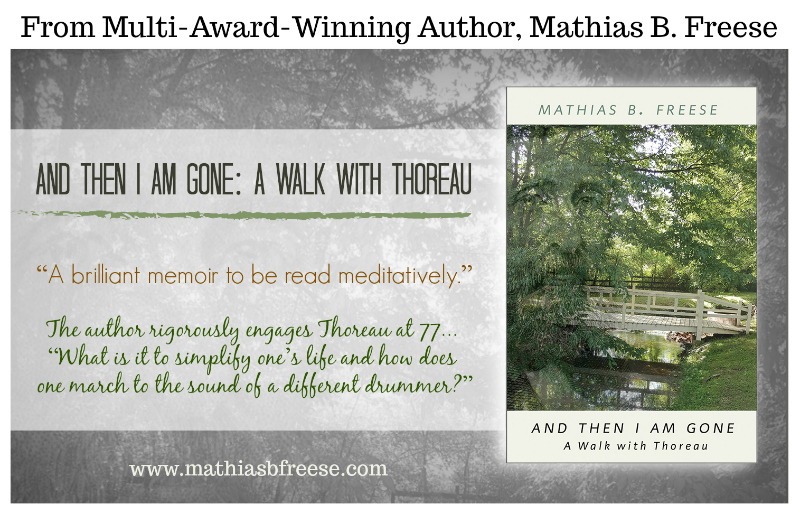
And Then I Am Gone: A Walk with Thoreau tells the Story of a New York City
man who becomes an Alabama man. Despite his radical migration to simpler
living and a late-life marriage to a saint of sorts, his persistent pet anxieties and
unanswerable questions follow him. Mathias Freese wants his retreat from the
societal “it” to be a brave safari for the self rather than cowardly avoidance, so
who better to guide him but Henry David Thoreau, the self-aware philosopher
who retreated to Walden Pond “to live deliberately” and cease “the hurry and
waste of life”? In this memoir, Freese wishes to share how and why he came to
Harvest, Alabama (both literally and figuratively), to impart his existential
impressions and concerns, and to leave his mark before he is gone.

Book Awards:
• The i Tetralogy: Allbooks Review Editor’s Choice Award 2007
• Down to a Sunless Sea: National Indie Excellence finalist Book Awards 2007 &
• Allbooks Reviews Editor’s Choice Award 2007.
• This Mobius Strip of Ifs: National Indie (Winner) Book Awards, 2012 & Global
Ebook Award finalist, 2012.
• I Truly Lament: Working Through the Holocaust: Finalist in the 2012 Leapfrog Press
Fiction Contest out of 424 submissions, Beverly Hills Book Awards, Winner;
• Readers’ Favorites, Five Stars; Indie Excellence Book Awards, Finalist; Readers’
• Favorite, Book Award Winner – Bronze medal
• Tesserae: A Memoir of Two Summers: 2016 Los Angeles Book Festival Honorable
Mention, Great Northwest Book Festival Winner in Biography/Autobiography
• Category, Runner-up in General Non-Fiction Category in the San Francisco Book
Festival, Winner for General Non-Fiction in The Beach Book Festival & Runner-Up
in General Non-Fiction in the Paris Book Festival


MATHIAS B. FREESE
is a multi-published,
award-winning author,
writer, teacher and
psychotherapist.

And Then I Am Gone teaser small

And Then I’m Gone: A Walk With Thoreau by Mathias B. Freese Review

I received a free copy of this book in exchange for a fair and honest review. All opinions are my own.

One of the most thought provoking memoirs in recent years challenges readers to examine not only the world around them but how they are living their lives in author Mathias B. Freese’s novel And Then I Am Gone: A Walk With Thoreau. Here’s the full synopsis:

And Then I Am Gone: A Walk with Thoreau tells the story of a New York City man who becomes an Alabama man. Despite his radical migration to simpler living and a late-life marriage to a saint of sorts, his persistent pet anxieties and unanswerable questions follow him. Mathias Freese wants his retreat from the societal “it” to be a brave safari for the self rather than cowardly avoidance, so who better to guide him but Henry David Thoreau, the self-aware philosopher who retreated to Walden Pond “to live deliberately” and cease “the hurry and waste of life”? In this memoir, Freese wishes to share how and why he came to Harvest, Alabama (both literally and figuratively), to impart his existential impressions and concerns, and to leave his mark before he is gone.


This was one of the most unique and creative memoirs I’ve read in recent years. The story of the author’s journey in his later years in life allow us as readers to take the time to appreciate not only our own lives, but challenges us to think critically and take the time to find meaning in our lives. It does a marvelous job of using past life experiences, history, humor and classic pop culture references to contemplate the current state of our world. From the rise of Donald Trump as the United States President and what it says about the mentality of the nation as a whole to the hours spent on subjects like religion and life views that end up dividing us when there’s no need for it, this book is a perfect read for anyone looking to find meaning and purpose.

Written almost like a diary entry or an actual conversation between the author and the philospher Henry David Thoreau himself, this story exudes insight, psychology and honesty. It shows the power of hope in tumultous times, while also showing the history of the world and the threat of being doomed to repeat it in our modern times. It’s as much a reflection on our society as it is on himself, and despite the title’s ominous overtones, this story is not one of loss and hopelessness but one of learning from our own pasts and finding the will to reflect on our lives and come to terms with it. It’s a story of love, loss and life itself, and deserves to be read. If you haven’t yet, be sure to pick up your copies of And Then I Am Gone: A Walk With Thoreau by Mathias B. Freese today!

Rating: 10/10


About the Author

Mathias B. Freese is a writer, teacher, and psychotherapist who has authored six books. His I Truly Lament: Working Through the Holocaust won the Beverly Hills Book Awards and the Reader’s Favorite Book Award, and it was a finalist in the Indie Excellence Book Awards, the Paris Book Festival, and the Amsterdam Book Festival. In 2016 Tesserae: A Memoir of Two Summers, his first memoir, received seven awards.