I received a free copy of this book in exchange for a fair and honest review. All opinions are my own.
If you’ve ever wanted a new solution to bug infestations that won’t cost an arm and a leg and will also help you understand the insects infesting your home, then look no further than author Tess Watson’s novel “Little Buggers!: How to Identify, Treat and Prevent Insect Infestation”.
The Synopsis
Got unwelcome houseguests of the teeny tiny variety running around like they own the place? Not every insect infestation requires a call to a pest-control company. Little Buggers! offers facts, figures and pictures along with practical guidance on how to evict them on your own and when to call in the pros. It also includes preventive measures to keep them from ever returning… or ever beginning.
The Review
This was a well written, thoroughly researched and quick read that will fully help home owners and people in general to understand the insects that commonly infest a home and how to properly work to rid them from your home without hiring an exterminator to come out and do it themselves. The author diligently goes through the various insects that may find themselves calling your home their nest, from ants and fleas to spiders and wasps.
What really stood out as a guide book and how-to style book was the depth of detail the author presented on each insect. While most would only think to look for the quickest and easiest way to get rid of the bug, the author details the insects carefully to help the average homeowner gain an understanding of these creatures, the benefits they provide the outside of a person’s home and how to remove the infestation to keep and maintain that balance from the outside of a person’s home to the inside.
The Verdict
Although a quick read, the author hits the reader with precision and a straight to the point voice that commands the readers attention. The author even details the various chemicals that can be used on a person’s home, what goes into these chemicals and how they will affect the home and the insects in general, making for a very thorough read. If you are looking for a way to not only rid yourself of an insect infestation but understand the nature of the bugs who have crawled their way into your home, then grab your copy of “Little Buggers!: How to Identify, Treat and Prevent Insect Infestation” by Tess Watson today!
1) Tell us a little bit about yourself. How did you get into writing?
There came a time almost twenty years ago that I felt I had actually been quite fortunate to have had so many experiences already during my lifetime that I wanted to share. I had invented and patented some laser technology which could, if introduced deep inside the human body, remove even potentially lethal obstructions, as in clots in small blood vessels and otherwise. I had practiced medicine and surgery around the world. And more.
I focused first on a few of those and wrote short articles about some of them. Mirage in the Desert was about my period of living and working in the Persian Gulf. Here Today, Gone Tomorrow had to do with some of the tragic losses in my life when I lost loved ones under the most painful of circumstances. Something From Nothing was about the strange process of inventing with all of its uncertainty– somehow, one day, coming to believe you actually had stumbled upon something new and potentially important or valuable. Monster in the Midst was about the tragedy of living with a loving spouse who is turned into a human monster by the emergence of violent, psychotic bipolar disorder. But then I felt there was more I could say and at the time, to me, the most efficient way to do that was using free verse. That lead to my anthology of some 88 poems I wrote over the course of about one year. In 2018, finally, I decided to write At the Point of a Knife, a narrative that encompassed a lot of the above in just one book.
2) What inspired you to write your book?
At the Point of a Knife is also the story of a lot of things that can go very wrong, with the backdrop of a lot of others which are very right. I was certain that there are so many people who struggle with living with severe untreated mental illness, even if that manifests itself in a partner or someone else very close. It is tragic in its destruction, and with the stigmas about such things which run so strongly in society, there must be better ways. First, though, something cried out for this tragic type of circumstance to be called out and exposed. Somehow society needs to not only recognize the enormous destruction that these severe mental illnesses cause to it, not only to the affected individuals directly, but it needs to open channels for proactively identifying these ill people who desperately need help, and force them to get it! The costs of not doing so are far too great. Mental hospitals hardly exist any longer in the U.S., but if the stigmas are removed, their benefits are great and the costs of not having them are extreme. Having these facilities is half the battle. Forcing their use in extreme situations is the rest- proactively, not after people die and lives and livelihoods are ruined.
After my experience with losing fabulous children who were so horribly abused by their other, alienating parent, ruining our family and my relationship with them and theirs with me, I came to realize that there were many such circumstances, albeit with differing degrees of adverse impact. In the 90s when my children were so severely alienated and abused, Parental Alienation Syndrome (PAS) was still being broadly challenged in society, in essence a cover up of an enormous problem which destroys families. Since, through the hard work of many dedicated mental health, medical, social work, justice and other professionals, that has changed to a signficant extent, although the battle still rages in society about PAS. But it turns out, quite conclusively so unfortunately, that if courts don’t both enforce custody and visitation by and with the non- alienating, normal parent and restrict and severely control the visitations with the alienating one, the problem will not only not be solved, it will become permanent. When the abused, alienated children grew up, they retain that ‘blind spot’ in their brains inculcated by the abuse, and they can not re- form relationships with the non- alienating parent. Again, as with severe mental illness, ignoring the problem is horribly destructive and futile, and proactivity, by society, in all such cases is imperative. This is one situation for judicial pro- activity.
My problems, as described in At the Point of a Knife, also included how horribly one rogue judge was able to piggyback on his own sordid past to wield power from the bench which made a mockery of justice. While he turned a blind eye to the above mentioned severe problems squarely before him, the system let him carry on his own psychopathic brand of jurisprudence unabated, while he slashed and burned everything in his sight. Not satisfied with allowing a potential murderer to run loose, a beautiful family to be destroyed, he persisted in destroying a thriving start- up international business involving life- saving technology, a professional career and sought for as long as he could to put in jail his chosen victim. For the judicial system to hide behind veils of opacity, while according no recourse in reality even in situations of gross abuses of power by a few who clearly have no business having been given the trust placed in them, is simply a wrong crying out for change. Juries of peers sit on crucial cases, both civil and criminal, in American jurisprudence. There is no reason that peers, ordinary citizens, can not sit in courtrooms so that when the obvious, gross abuse of power and justice does occur, they are there to see it and have the authority to make those few perpetrators of these quasi- judicial horrors disappear into the oblivion they deserve. Anyone sitting in that Virginia judge’s courtroom would have likely recognized in short order that he was an outlier who did not belong in that position. There were lawyers sitting in the gallery at times, unrelated to these cases, who said as much openly– but they had no power to act. No one deserves that kind of immunity from exhibiting even a minimum level of responsibility in society which places trust in their hands, or the impugnity to openly scorn that society while abjuring that trust.
Large companies are also given huge sway in our society. Perhaps even like big government itself, they become too big to control. Unrestrained, they continue to get bigger and more powerful yet. But since there are, alas, too many flaws in societies, manifested by the underlying flaws in the individuals of which they are comprised. Somehow the society must rein in not only the sickest individuals before they can harm themselves and others, they must control those who abuse their powerful positions for their own gain and to the detriment of so many others. My small, but very successful start- up hi- tech company was robbed blind by a few in power in some large companies that knew they could just steal our patented technology and probably never have to pay for it. By virtue of bonuses, stock options and the like, sometimes well deserved, othertimes not at all, those individuals could steal from us, not pay royalties and get away with millions. Their companies benefitted financially as well, but inventing is thwarted and society several disadvantaged when the incentive to invent is stifled, particularly when that is done totally illegally. We had fought for the international patents and we even managed to enforce them in courts. But the losers in all of that simply went on to lie and cheat about their royalty- bearing revenues, having little to fear. If, in the end, after almost endless litigation all over the world, we would win, time and again, they might have to pay, but no more really than what they owed in the first place. That is not justice, it favors the greedy and the rich and discourages the honest and the inventive among us in this type of situation. Patent cheating is theft and that is a crime, and societies should extend that type of control to patent infringement and to wanton breaches of patent royalty license agreements. Those crooked executives who are in it only for their own aggrandizement and care not a wit about who might benefit from new and better technology, including in the life sciences, or even if they ever do, should risk being put in jail for patent crimes. That might put some control in place on what, now, is their unfettered rampage over smaller inventors whose technology represents, collectively, the way forward for societies and stimulates the growth that they all need to stay healthy. Furthermore, the companies that steal this technology, if found guilty of same in the courts, should pay treble, not just once for their crimes and defalcations, and that might get the proper attention of their shareholder- owners who are all too happy now to put their crooked managers in place and look the other way from their foibles.
My story, told in At the Point of a Knife, from my experiences, points to a lot of grotesque wrongs that exist quite openly today and which reap huge destruction on our society because they are not realized and even less addressed in meaningful ways. It is death, injury, mental abuse and the collective pain and ravages of corruption, negligence and distrust. That is what inspired my writing this book.
3) What drew you into the field of developing new technologies and inventions as mentioned in your novel?
My entrance into the field of innovation, via the basic medical science investigations and inventions ultimately happened by accident. My late inventive partner asked me a seemingly simple question, having to do with laser energy, something I used in my clinical practice therapeutically, but the answers were anything but obvious. We discovered that no one else seemed to know those answers either. We experimented, with the laser energy, applying it in the laboratory to human and animal tissues, and we observed what happened. Eventually, quite literally, we stumbled upon a way to control that laser energy which produced the desired results we sought, but avoided the damaging ones which had thwarted prior efforts. We defined what we had done and that lead to patents being written, then prosecuted before patent offices around the world. As is often the case with innovation, it was happenstance. In this case, things went well.
4) What is the biggest obstacle facing the legal field in regards to mental health and those afflicted from it (not to mention the families of those individuals)?
How to make societies more attentive to and focussed on real problems is very difficult. The problems are complex and there are always seemingly forces of evil which miltate to take advantage of those problems rather than to ameliorate them. It is in the end about the people. If they want and can take responsibility, then that is hopeful. But when and if they won’t, they are doomed. Abdicating that responsibility is often disastrous, whether to those powerful in business or to those in even any branch of government too. After all, they are all made up of people, sometimes even the same people. Blindly trusting all justice makes that justice blind. When something is fundamentally wrong, someone has to be both motivated to, but also empowered to be able to do something about it. Letting a judge like the rogue described in At the Point of a Knife to act unempeded is disastrous. Letting a violent mentally ill individual, untreated, reak havoc on those nearest to her, and indirectly even those not so close, is calamitous. Similarly letting those in high authority in private industry trade on their enormous advantages unchecked is extremely dangerous. I believe we all need a much stronger fundamental level of responsibility and personal integrity, or else we are doomed. Society can not determine for any of us specifically what those things look like better than we individually can by deep personal searching within. Education is crucial, since the more each of us knows, the better chance we have.
5) What social media site has been the most helpful in developing your readership?
The lessons I perceive from my own extensive experiences which are chronicled to some extent in At the Point of a Knife, and in my other writings, are varied and cut a broad swath through society. I have been very fortunate to have seen so much of that over many years. It is, now, difficult to point to any social media which directly speaks to a lot of that. Probably the answer may be that a lot of social media speaks to a little of what I write about and very little current social media speaks to a lot of it.
6) What advice would you give to aspiring or just starting authors out there?
People sometimes seem to say that writing a memoir or a narrative non- fictional story is cathartic. Actually, I am not sure that is so because it is so painful to do, and the pain persists. It is also a sacrifice, as such, but one I felt compelled to undertake in these ways, manifested by the written words. Also, as before so often in my life, whether in Medicine or in inventing life- saving laser technologies, in trying to be a loving parent and spouse and son, I like to believe I cared enough to make the effort, to face the problem and to react to it, this time in words rather than in deeds. Given how popular writing seems to be, that must be, in general, a good thing.
There are, of course, many genres of books, of stories, as there is variety in life itself. I seem to be inspired by what I have seen and felt. One can only encourage that sort of thing in others.
7) What does the future hold in store for you? Any new books/projects on the horizon?
For me it is important to continue to confront challenges, which is, to live. I continue to try to find what seems best, and to act on that as best I can. I continue to learn since that, too, should never end. I always want to find what motivates me most, and to act on that as much as I can. I continue to be inspired by those around me most, who I love. I continue to seek justice, even all too often in all too mediocre courts. But I continue to seek harmony, compromise and peace. I continue to try to support technology, inventiveness and innovation since, alas, it seems to me we continue to need those things. I continue to tell tales, and to write, as I am doing now.
Kenneth R. Fox is the inventor of a great deal of laser medical technology and the patentee of many international patents. Dr. Fox has practiced Medicine in six countries on four continents and has lectured in many others. He has taught both Medicine and Business at several universities in a number of different countries. He is the author of many peer- reviewed medical and scientific articles, quite a few published poems and several short articles, mostly related to various aspects of health, but all based on his personal experiences over many years, as is At the Point of a Knife.
I received a free copy of this book in exchange for a fair and honest review. All opinions are my own.
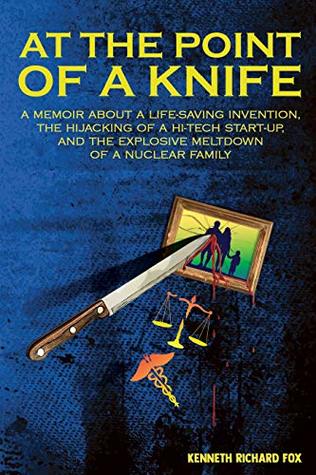
Readers are given a glimpse into the tragic reality of a faulty mental health system that fosters and allows those suffering form the most severe cases to be untreated, and a man’s struggle to fight a losing battle against an unprecedented legal fight like no other in author Kenneth Richard Fox’s “At the Point of a Knife”.
The Synopsis
A memoir about a life-saving invention, the hijacking of a hi-tech start- up, and the explosive meltdown of a nuclear family
At the Point of a Knife is a real life thriller about a doctor who invents life-saving laser technology, his wife’s destructive inheritance and the legal conspiracy to steal his successful hi-tech start-up. Dr. Kenneth Fox fights off predatory companies as he battles globally for his company’s rights. But he ignores the threats to his family. By day, he has a successful career. By night, he lives with an increasingly mentally ill spouse. Although she is physically abusive with him and their son, Fox is emotionally co-dependent. At the same time, he is helping his dying mother and his chronically ill father.
There is an attempted murder. After this explosive nuclear family meltdown, Fox learns of his wife’s secret fortune including several homes. He also discovers the true story about her dead father: a hereditary bipolar disorder and the scandal that drove her family from her childhood home. In a final twist of fate, manic depression, money and judicial corruption intersect. Fox’s company is wrested away in a plot that includes a crooked lawyer and a corrupt judge who owes his career to his former partner in crime.
Dr. Kenneth Fox is a physician and surgeon, an inventor of patented medical laser technology and a medicine and business professor.
The Review
This was a powerful non-fiction read that people will have a hard time putting down. The story was clear and concisely written, showcasing a multitude of incidents that contributed to the deterioration of a family, the personal and business losses of a man and the gross injustices that often plague our society.
The author’s in-depth study of the law practices in relation to medical field lawsuits and divorce proceedings which favor one person over the other really brought the harm endured through this man’s life to the forefront. Each chapter has the reader shaking their head, unable to believe that one man would be forced to endure such hardships.
More than that however, the novel allows readers to see the grave injustice that comes with failing to treat those suffering with mental illnesses, and how the taboo of suffering from such a disease or the inaccurate assumptions about mental illness often lead to a lack of diagnosis or care for such individuals, who if given proper treatment and care could avoid the unfortunate damage and suffering endured by both the patient and those closest to them, in this instance the author himself.
The Verdict
Although a short read, this was a powerful and great read that fans of law cases, medical practices and the struggles of mental health will thoroughly enjoy. A whirlwind case that will get readers emotions stirring, this was a heart-pounding story that draws the reader in and gets them invested immensely, so be sure to grab your copy of “At the Point of a Knife” by Kenneth Richard Fox today!
Rating: 10/10
About the Author
Kenneth R. Fox is the inventor of a great deal of laser medical technology and the patentee of many international patents. Dr. Fox has practiced Medicine in six countries on four continents and has lectured in many others. He has taught both Medicine and Business at several universities in a number of different countries. He is the author of many peer- reviewed medical and scientific articles, quite a few published poems and several short articles, mostly related to various aspects of health, but all based on his personal experiences over many years, as is At the Point of a Knife.
I received a free copy of this book in exchange for a fair and honest review. All opinions are my own.
An in depth look into the world of mental health care and the ways in which it can be improved take center stage in Author Lynn Nanos novel Breakdown.
The Synopsis
When hospitals release seriously mentally ill patients too soon without outpatient follow-up, the patients can end up homeless, jailed, harming others, or even dead. When patients are deemed suitable for inpatient care, they can languish for weeks in hospital emergency departments before placements become available. Meanwhile, patients who fake the need for care are smoothly and swiftly moved to inpatient settings.
Breakdown opens a dialogue with anyone interested in improving the system of care for the seriously mentally ill population. This book helps to answer questions such as:
Is inpatient care too inaccessible to those who need it most?
Do mental health professionals discriminate against mentally ill patients?
Are more stringent measures needed to ensure that patients take their medication?
Is borderline personality disorder too serious to be classified as just a personality disorder?
Using vignettes based on real interactions with patients, their families, police officers, and other mental health providers, Lynn Nanos shares her passion for helping this population. With more than twenty years of professional experience in the mental health field, her deep interest in helping people who don’t know how to request help is evident to readers.
A woman travels from Maine to Massachusetts because she was ordered by her voice, a spirit called “Crystal,” to make the trip.
A foul-smelling and oddly dressed man strolls barefooted into the office, unable to stop talking.
A man delivers insects to his neighbors’ homes to minimize the effects of poisonous toxins that he says exist in their homes.
Breakdown uses objective and dramatic accounts from the psychiatric trenches to appeal for simple and common-sense solutions to reform our dysfunctional system. This book will benefit anyone interested in seeing a glimpse of the broken mental health system way beyond the classroom. It can guide legislative officials, family members, mental health professionals, and law enforcement officers toward a better understanding of the system.
The Review
As someone who has advocated for mental health awareness and seeks to improve and see the mental health education and rehabilitation of this world improve, this was a book that spoke volumes to me. The author does a spectacular job of presenting the struggles and heartbreak of the profession. From the book’s opening pages readers are shown the levels of illness and sad state of affairs for both the patients and the doctors attempting to treat them.
What really stuck out to me reading this novel was how the author wrote it all out in a methodical and precise tone of voice, and yet was still written in a way that the average reader, someone who isn’t an expert in the field of mental health, will be able to understand and empathize with. Each chapter elevates the struggle by showing not only individual cases the author worked, but the journey to fight for the rights for all mentally ill patients to seek help or get help they need. The details given by the author and the statistics laid out for the mandates for mental health by state showcase a lack of cohesive treatment plans and emphasizes the need to expand and grow the mental health profession in this nation and the world at large.
The Verdict
A well written, powerful and heartbreaking non-fiction read that everyone should try for themselves. Breakdown by Lynn Nanos is a detailed and meticulous book that gives readers the inside look into a very under appreciated field, and novels like this are the steps needed to take the United States and the world forward into the mental health profession for both patients and care providers alike. Be sure to grab your copy today!
Rating: 10/10
Part of taking care of one’s mental health and overall health in their daily relationships has to be seeking advice from counselors or those well versed in the hardships of any relationship. If you are looking for such advice, visit our friends at Regain to learn more by following this link https://www.regain.us/advice/ .
About the Author
Lynn Nanos is a Licensed Independent Clinical Social Worker in her twelfth year as a full-time mobile emergency psychiatric clinician in Massachusetts. After graduating from Columbia University with a Master of Science in Social Work, she worked as an inpatient psychiatric social worker for approximately seven years. She is an active member of the National Shattering Silence Coalition that advocates for the seriously mentally ill population. She serves on its Interdepartmental Serious Mental Illness Coordinating Committee committee and co-chairs its Blog committee.
I received a free copy of this book in exchange for a fair and honest review. All opinions are my own.
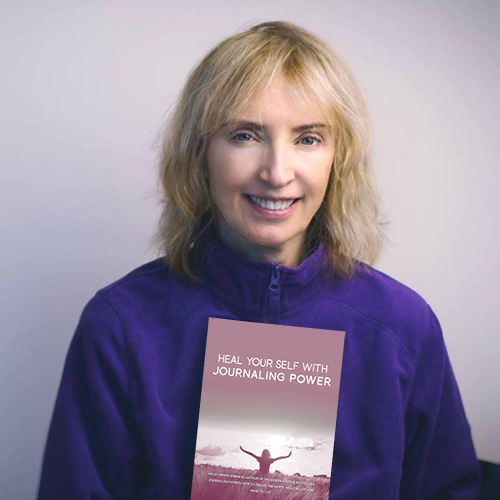
The therapeutic nature and power of journaling is fully explored in author Mari L. McCarthy’s novel “Heal Yourself with Journaling Power”.
The Synopsis
Heal Yourself with Journaling Power reveals the inner strength and grace that comes through the proven therapeutic power of expressive writing.
You’ll discover the life-changing magic of journaling through moving personal stories told by just a few of the thousands of people who have tapped into this highly-effective way to heal, grow, and transform your life
This is a quick yet detailed read that fully explores the process and progress of journaling as a form of therapy. The author’s experiences with health concerns allowed her to explore journaling in a whole new light, and in the course of this book has showcased the ways the journaling power has helped with her health, her business and various aspects of her life in general.
From releasing stress and tensions through journaling about whatever creates those stresses, to improving relationships by writing down whatever disagreements you may share with someone and boosting memory by using cognitive recall which hardwires information into one’s brain more readily, this novel covers a wide array of topics that will help anyone seeking a new form of therapy to deal with physical, mental or emotional struggles or seeks to improve areas of one’s life.
The Verdict
This book gives a great guide on how to utilize and better use journaling to help with various aspects of your life in new and exciting ways. It allows the reader to reconsider or look at different things in life through a new lens. From using journaling as an alternate to therapists by allowing the journal writer to be 100% honest with themselves to how journaling can help anyone going through a struggle to make a major comeback, this is a novel few are going to want to miss out on, so be sure to grab your copy of Mari L. McCarthy’s novel “Heal Yourself with Journaling Power” today!
Mari McCarthy’s latest, Heal Your Self with Journaling Power, represents the voice of a warm friend who not only talks the talk but also has lived first-hand the transforming power of writing. Packed with focused, fun prompts to jump-start the journaling process, this book is a motivation and an uplift! I especially enjoy the stress-bucket exercise. Not to be missed.”
–Melanie Faith, educator and author of In a Flash and Poetry Power,
In a world of ever-present scary news, stress, and technology that distracts us from genuine human encounters, Mari McCarthy invites us to do something both simple and radical: pause daily to encounter our own souls. And she not only tells us to just do it, she shows us how with her own life story, the stories of others, and her many ideas about how to maximize the transformative power of journaling time.
— Kevin Anderson, Ph.D., Author of Now is Where God Lives: A Year of Nested Meditations to Delight the Mind and Awaken the Soul and The Inconceivable Surprise of Living: Sustaining Wisdom for Spiritual Beings Trying to Be Human.
The most important lesson illustrated in Heal Your Self with Journaling Power is that anyone can enhance their health and wellbeing through the therapeutic power of expressive writing. This is the definitive book that shows you how. So just grab a pen and a pad of paper and do it!
Mari L. McCarthy is the Self-Transformation Guide and Founder/Chief Inspiration Officer of CreateWriteNow.com. She is also author of the international-bestselling, award-winning book Journaling Power: How to Create the Happy, Healthy Life You Want to Live.
Mari began journaling to relieve the debilitating effects of multiple sclerosis (MS) over 20 years ago. Through journaling, Mari was able to ditch her prescription drugs and mitigate most of her MS symptoms. Now she teaches people throughout the world how to heal, grow, and transform their lives through the holistic power of therapeutic journaling.
She lives in a gorgeous beachfront home in Boston, where she has the freedom, flexibility, and physical ability to indulge in all her passions, which include singing and recording her own albums.
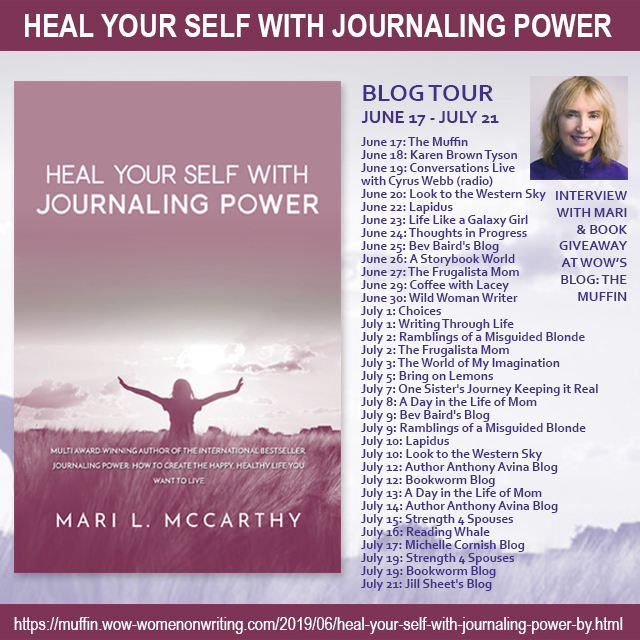
— Blog Tour Dates
June 17th @ The Muffin
What goes better in the morning than a muffin? Stop by Women on Writing’s blog The Muffin and read an interview with author Mari McCarthy and win a copy of her book Heal Your Self with Journaling Power.
Visit Lapidus, words for well-being association, where you can read Francesca’s review of Mari McCarthy’s eye-opening book Heal Your Self with Journaling Power.
Do you love the energy in National Novel Writing Month (NaNoWriMo)? Well, if you do, you will not want to miss today’s post at the blog Thoughts in Progress where Mari McCarthy shares her tips on how to recreate the magic of NaNoWriMo in any month.
Be sure to stop by Amber’s blog and read her interview with author Mari McCarthy and also enter to win a copy of the book Heal Your Self with Journaling Power.
If you are in need of a new book in your life, make sure to stop by Lindsey’s blog today where you can read her review of Mari McCarthy’s new book Heal Your Self with Journaling Power.
Make lemons into lemonade today when you visit Crystal’s blog today and read her thoughts about Mari McCarthy’s new book Heal Your Self with Journaling Power.
Want to inspire your kids to journal? Visit Ashley’s blog today and read Mari McCarthy’s guest post featuring imaginative journaling activities to do with kids.
Visit Anjanette’s blog today where you can read her interview with author Mari McCarthy and also be sure to check out Mari McCarthy’s guest post about journaling power for emotional health.
Make sure your day today includes visiting Ashley’s blog where you can read her thoughts about Mari McCarthy’s life-changing book Heal Your Self with Journaling Power.
Do you procrastinate too much? Well, visit Anthony Avina’s blog again today where you can read Mari McCarthy’s guest post on how to use your favorite types of procrastination to your advantage.
Stop by Michelle’s blog where she reviews Mari McCarthy’s book Heal Your Self with Journaling Power. You can also check out her interview with Mari and find out more about the author!
Do you love journaling? Well if so, you will want to visit Wendi’s blog where she shares her thoughts about Mari McCarthy’s powerful book Heal Your Self with Journaling Power.
Visit Jill’s blog today where you can read Mari McCarthy’s blog post about overcoming writer’s block. Don’t miss this if you are struggling with staying inspired!
Have you ever wanted to start therapy but didn’t know how much it would cost you? Look no further as my friends at BetterHelp show you how much it would cost to get a counselor and seek therapy.
How many times have you asked yourself: “Why does my business seem so hard? Why am I struggling, when other women make it look so easy?”
I understand, because once upon a time, I was you. But that’s not where I am any more.
What changed? I did.
When I started to pay more attention to the spiritual nature of my business and trusting my intuition, remarkable things unfolded. By focusing energetically on five critical areas of my business, I began to experience rapid growth. And so my principles of ENERGETIC SELLING AND MARKETING were born.
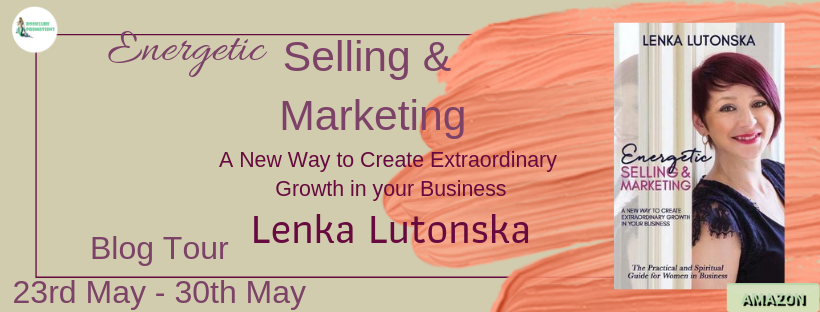
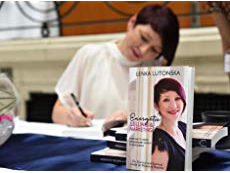
In ENERGETIC SELLING AND MARKETING, International Business & Mindset Strategist Lenka Lutonska shares the powerful principles that she has developed over many years of coaching clients to exceptional business growth. Born from her experience that tactics and strategies alone will not create extraordinary results in business, she inspires entrepreneurs to take a deeper, more energetic approach. When the two are are integrated, not only are mindset and communication techniques improved, but sales and marketing strategies become transformed, resulting in the greatest and fastest growth possible.
Results have often been nothing short of miraculous – women increasing their fees five times and selling with greater ease than ever before; women booking themselves solid with their ideal high-end clients; women turning their annual income into their monthly income; and women doubling, tripling or even quadrupling their sales revenues within several months.
With a foreword by CEO Penny Power, OBE, this book is an essential read for any entrepreneur who wants to open their minds to the possibility of extraordinary growth and create lasting and aligned business success.
Lenka Lutonska is an International Coach, Speaker & Master NLP trainer. She came to the UK from her native Slovakia aged just 19, where she found work in McDonalds. After having worked her way up to become an award-winning manager, she used the world-class sales training sheąd received to set up her own business. Despite its significant growth, it was all lost overnight, when she was betrayed by her business partner.
Faced with starting all over again, but this time with a young family to support, she knew she had to take a different, more courageous and heart-centred approach. The result is her very successful coaching consultancy, whose success far outstrips anything else she had achieved prior to developing her principles of energetic selling.
She now uses her strategic business experience, her NLP and psychology training and her intuition and spirituality to take clients to multiple 6- and 7-figure revenues that not only transform their businesses but change their lives.
GRAB YOUR COPY FROM
KNOW ABOUT THE AUTHOR
<br />
Lenka Lutonska is an internationally renowned Business and Mindset Strategist for female entrepreneurs, Speaker & Master NLP trainer. She came to the UK from her native Slovakia aged just 19, where she found work in McDonald’s. After having worked her way up to become an award-winning manager, and studying counseling, NLP, psychotherapy, and hypnotherapy, she set up her own training and coaching consultancy. Despite its significant growth, it was all lost overnight, when she was betrayed by her business partner.
Faced with starting all over again, but this time with a young family to support, she knew she had to take a different, more courageous and heart-centered approach. The result is her very successful coaching consultancy, whose success far outstrips anything else she had achieved prior to developing her principles of energetic selling.
She now uses her strategic business experience, her NLP training, and her intuition and spirituality to take clients – women entrepreneurs from over 30 countries around the globe – to multiple 6- and 7-figure revenues that not only transform their businesses but change their lives.
Meet the Author
This Blog Tour is bought to you by
<!– start InLinkz script –>
document.write(”);
<!– end InLinkz script –>
<br />
Energetic Selling & Marketing
by Lenka Lutonska
Name of the book: Energetic Selling & Marketing
Introduced by: Lenka Lutonska
Genre: Self Help
Release Date: 22nd March 2019
Excerpt
To my surprise, she wasn’t excited about my generous and affordable coaching offer. ‘I’ll think about it,’ were her exact words. Several days later, she emailed to say she had decided not to go ahead at this time. Ouch!
About a year later, she approached me again. This time, I proposed a coaching package at eight times the fee I had quoted previously. She pulled out her credit card and paid in full, and we entered a thriving coaching relationship. This is a real example of two sales conversations, one year apart, with very different outcomes! Exactly the same client; exactly the same needs; exactly the same coaching offer; except priced very differently. What had changed? What made the difference? I had changed and, more precisely, my energy had changed. When she had approached me the first time, I was in a place of scarcity. I was trying to rebuild my once-successful business.
At that time, as far as I was concerned, any client was a blessing. I started each sales conversation hoping that I would get it right this time. When I spoke to the same woman a year later, I was no longer functioning like that. I no longer held sales conversations with clients hoping and praying that it would work out this time. I no longer tried to prove to my potential clients that I would be the best coach they could hire. Hoping, praying, proving … you would think you can keep these things secret. After all, we think these things in our heads, and no one can hear those thoughts, right? Well, not so fast. Any form of insecurity affects your personal energy field; and your potential client will pick up on this energy, whether they are consciously aware of it or not.
GRAB YOUR COPY FROM
KNOW ABOUT THE AUTHOR
<br />
Lenka Lutonska is an internationally renowned Business and Mindset Strategist for female entrepreneurs, Speaker & Master NLP trainer. She came to the UK from her native Slovakia aged just 19, where she found work in McDonald’s. After having worked her way up to become an award-winning manager, and studying counseling, NLP, psychotherapy, and hypnotherapy, she set up her own training and coaching consultancy. Despite its significant growth, it was all lost overnight, when she was betrayed by her business partner.
Faced with starting all over again, but this time with a young family to support, she knew she had to take a different, more courageous and heart-centered approach. The result is her very successful coaching consultancy, whose success far outstrips anything else she had achieved prior to developing her principles of energetic selling.
She now uses her strategic business experience, her NLP training, and her intuition and spirituality to take clients – women entrepreneurs from over 30 countries around the globe – to multiple 6- and 7-figure revenues that not only transform their businesses but change their lives.
Meet the Author
This Blog Tour is bought to you by
<!– start InLinkz script –>
document.write(”);
<!– end InLinkz script –>
<br />
Energetic Selling & Marketing
by Lenka Lutonska
Name of the book: Energetic Selling & Marketing
Introduced by: Lenka Lutonska
Genre: Self Help
Release Date: 22nd March 2019
KNOW ABOUT THE AUTHOR
Q. 1 What was your inspiration for writing this book?
My own journey of building a successful business, losing it abruptly and having difficulties rebuilding it again. I found that traditional marketing and selling methods didn’t work by themselves as I was missing the confidence that every successful entrepreneur should have. Once I started to tap into my spiritual nature and apply spiritual principles into my business, it started to bloom and grow rapidly. I have taught hundreds of women these principles, often with extraordinary results – some women doubling, tripling, even quadrupling their sales revenues within months, sometimes even weeks. I write about these priniciples and how to apply them in the book.
Q.2 What is the biggest challenge a seller faces nowadays?
“I’d love to work with you but I can’t afford you” is one of the most common challenges women face when selling. In Energetic Selling and Marketing, I describe how words alone are often not enough to break this pattern or overcome this challenge successfully and how by adopting a new attitude about what selling means can dramatically transform the outcome of sales conversations.
Q.3 Can you share an instance where you turned a challenge into an opportunity?
After I had lost my first business and was trying to get my second business to work, I went to get some cash out at the ATM to buy dinner for my family, only to find that I had just £7.30 left in my bank account. I was hugely embarrassed by this. I was an apparently successful businesswoman yet, I couldn’t afford to put dinner on the table for my family. That day, I ran home and called everyone I could think of for the whole day and made £1800. From that day on, I started to sell daily and stopped avoiding this important activity rather than shying away from it.
Q.4 What is your advice to new marketers?
Develop and learn to trust your intuition – it is your most powerful coach on the planet – and get the support you deserve from mentors to any other kind of support you need in your business and life.
Q. 5 What are you working on next?
Before I dive into writing another book, I am working on getting Energetic Selling and Marketing into the hands of as many people as possible because it has the ability to completely transform their businesses and their lives.
Lenka Lutonska is an internationally renowned Business and Mindset Strategist for female entrepreneurs, Speaker & Master NLP trainer. She came to the UK from her native Slovakia aged just 19, where she found work in McDonald’s. After having worked her way up to become an award-winning manager, and studying counseling, NLP, psychotherapy, and hypnotherapy, she set up her own training and coaching consultancy. Despite its significant growth, it was all lost overnight, when she was betrayed by her business partner.
Faced with starting all over again, but this time with a young family to support, she knew she had to take a different, more courageous and heart-centered approach. The result is her very successful coaching consultancy, whose success far outstrips anything else she had achieved prior to developing her principles of energetic selling.
She now uses her strategic business experience, her NLP training, and her intuition and spirituality to take clients – women entrepreneurs from over 30 countries around the globe – to multiple 6- and 7-figure revenues that not only transform their businesses but change their lives.
1) Tell us a little bit about yourself. How did you get into writing and your overall profession?
I was born in Venice (Italy) and precisely in Murano, the island of the glass-blowers. I had a classical education and studied Latin and Ancient Greek literatures but I specialized in Anthropology and did a lot of fieldwork from 1973 to 2013 in sub-Saharan African countries (Burkina Faso, Ghana, Guinea, Ivory Coast, Kenya, Mali, Mauritania, Somalia, Uganda, Zambia, Zimbabwe); in my long experience I was struck by the amount of physical work that women carry out all over the world while reproducing the human society delivering and raising children. I taught 36 years in the Universities and wrote 14 books (of which 4 in English and 1 in French), and more than one hundred papers published in collective books or in international journals (of which 16 in English and 8 in French).
I was inspired by the need to show that if mankind succeeded in dominating the planet, this is due to women who lent their time to men. The occasional source of inspiration was David Graeber’s book “Debt: the last 5000 years” that ignores the role of women during the previous 50,000 years.
3) What message do you hope readers will take away from your book?
I hope readers will appreciate my effort to explain how humans (Homo sapiens) succeeded in history thanks to the work of women, and hope they will grasp that human success was not due simply to the technological progress, but to an intelligent and efficient mode of articulating of the two main labour forces (male hunting and female gathering) during the 99% of their life on earth.
4) What drew you into this particular subject?
In 1993 I was engaged in an analysis of the foraging (hunting-gathering) economies and discovered that the work of the gathering women was everywhere less time-consuming and energetically more productive than the work of the hunting men. My analysis was concerning only the contemporary and marginalized foraging societies. My exercise was aimed at finding out the conditions by which human societies enter into a transition from a purely foraging economy to an economy based on agricultural production (cultivation and breeding). At that time, I published a book in Italian on this subject.
5) You go over in great detail many examples and historical references to make your argument, but in your opinion and for readers looking to delve into your book, what is one of the single biggest pieces of evidence or events in our world’s history to you that women are responsible for many of the advancements of human history?
The time women allowed men to enjoy in order to let them spend the necessary time for dealing with the complex tasks of hunting. This is the most ancient and the most surprising form of financement. Therefore, I agree with the statement that “women financed male dominance”.
6) With so much of our society built upon a male dominant perspective, why do you think women have such a hard time earning the respect and recognition for their contributions to society?
Failing to acknowledge the role of women, and still trying to keep them in a subordinate status, not to speak about frequent violence against women, is a crime against humanity. Nonetheless, in many countries or regions women are often accomplices with cultural trends that are against their complete equality, which makes it difficult the fight of women even in the most developed countries.
7) What advice would you give to aspiring or just starting authors or researchers out there?
I hope that the best suggestion is to speak always words of truth in support of humanity.
8) What does the future hold in store for you? Any new books/projects on the horizon?
Probably a couple of books are in preparation on my desk: one on my experience as anthropologist, and another one on my birthplace and its history.
Mariano Pavanello taught Social Anthropology and Africanistics in the Universities of Pisa and Rome “La Sapienza”, where he was Head of the Department of History, Cultures, and Religions. His extensive experience among the Nzema of Ghana was his main ethnological fieldwork that he concluded with the creation of the “Kwame Nkrumah Museum of the Nzema Culture and History” in the premises of the eighteenth-century Fort Apollonia in Beyin, Ghana. He has published a number of books, including Sistemi umani (1992), Le società acquisitive e i fondamenti razionali dello scambio (1993), Il formicaleone e la rana (2000), Perspectives on African Witchcraft (2017), and La papaye empoisonnée. Essais sur la société Akan des Nzema (2017).
1) Tell us a little bit about yourself. At what point did you decide to pursue writing about your field of study?
I started my career as a process development engineer in the semiconductor manufacturing industry, designing better ways to connect computer chips to circuit boards. As an engineer, I gravitated toward writing the articles for publication in trade magazines and the reports for projects. I began my writing career with Advanced Packaging Magazine, a publication in which I had published contributed articles. My current business, JLFG Communications, focuses on writing technical marketing content for corporate websites, but I still occasionally write articles for trade and business magazines. It’s nice to keep a toe in journalism and not only write anonymous content.
2) What inspired you to write your book?
My initial inspiration was a desire to shift my client base toward companies involved in sustainable manufacturing and renewable energy. I figured that writing a book on the topic would give me credibility that would help me get a foot in the door. Clients I’ve been working with for years will trust me with projects outside my proven fields of expertise, but potential clients often want to see experience writing for their specific industry.
As I delved into the research, my fascination with the subject matter and interactions with the enthusiastic business professionals I interviewed inspired me to continue. I knew that I needed to get this book out into the world.
3) What do you hope readers will take away from your book above all else?
I want readers to understand that the challenges of reducing waste in manufacturing are complex, but many smart business leaders are developing creative solutions and progress is being made. We shouldn’t be complacent, but neither should we be discouraged. I want readers to commit to at least one action at work or at home that allows them to be part of the solution.
4) What drew you into this particular field of study?
I’ve been fascinated by engineered materials ever since I took an introductory materials science course in college, but I didn’t always consider the environmental impact of all the amazing materials that engineers were inventing. In recent years, I’ve thought more about these issues and the responsibility of manufacturers to their employees, customers, and the communities in which they operate. The more I learned about companies embracing the triple bottom line—profit, people, planet—the more I became convinced that I should write a book focused on the materials aspect of sustainability.
5) What is the number one thing you would recommend for a manufacturing company just starting out in their business?
Fledgling manufacturing companies contemplating the shift from prototypes to volume production face many hurdles. I urge them to consider the environmental footprint of their manufacturing process when evaluating their entire supply chain. If they want to be eco-friendly, that needs to extend to every component or ingredient in their products, every vendor they choose, where they manufacture their products, and how they ship products to customers. Making smart decisions up front can save money in the long run and build trust with customers.
6) What social media site has been the most helpful in developing your readership?
I’ve gotten traction with both Facebook and LinkedIn. I made my book launch an event on Facebook and invited all my local Seattle-area friends. My multiple posts about the book got the attention of many friends in the San Francisco Bay Area, where I lived for 20 years, and many of them are now on my mailing list. When my LinkedIn contacts shared my post about the book launch, it expanded my reach to hundreds of people I’ve never met. In the long run, I believe that LinkedIn will be more helpful in reaching a business audience.
7) What advice would you give to aspiring or just starting authors out there?
Join a writing group that meets in person, in addition to participating in online groups. Writing is a solitary activity, but just being in the company of other writers can inspire you to achieve your goals. For nonfiction authors, the Nonfiction Authors Association has a wealth of information on its website, including links to its weekly teleseminars, plus chapters in many cities that hold monthly meetings. Whether you’re wondering what type of editing your book will need or trying to decide between submitting a proposal to agents or self-publishing, experienced authors can help point you in the right direction.
8) What does the future hold in store for you? Any new books/projects on the horizon?
In the short term, I’m focused on marketing Material Value. Simply writing a book that people want to read isn’t enough. It’s an author’s responsibility to let potential readers know that the book exists. I am, however, gathering ideas for my next book. It will also address materials and sustainability but focused on the textile and fashion industries. A surprisingly large number of companies are producing fabrics made from recycled plastic water bottles.
Julia L F Goldstein holds a PhD in materials science and started her career as an engineer before migrating to journalism in 2001. She now writes white papers and other technical marketing content for companies manufacturing a wide variety of products. Julia is active in her local writing community and leads the Seattle chapter of the Nonfiction Authors Association. When she’s not writing, she enjoys playing flute and piccolo and participating in triathlons.
I received a free copy of this book in exchange for a fair and honest review. All opinions are my own.
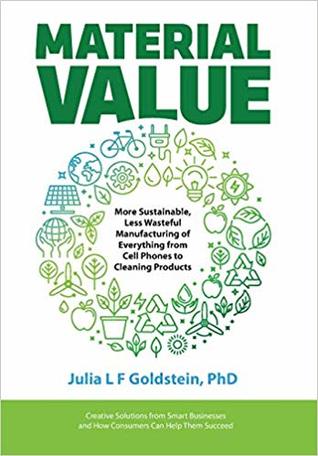
An in-depth study of how materials like plastic and metals are not only made, but how businesses can use new knowledge to extract these materials without any damage being done to human life and the environment as a whole take center stage in author Julia Goldstein’s book, “Material Value: More Sustainable, Less Wasteful Manufacturing of Everything from Cell Phones to Cleaning Products”. Here is the synopsis.
The Synopsis
Have you wondered why gold is so expensive or why so little plastic packaging is recycled?This highly readable book with a unique perspective on environmental sustainability answers these questions and more.
Readers will learn:
How metals and plastics are made and what happens when they are recycled The challenges that manufacturers face when trying to make their facilities and products less toxic and less wasteful How manufacturers can extract the value of materials while doing less damage to human health and the environment The role of individuals, agencies, and governments in improving the use and reuse of materials How regulations can stifle or promote innovation How smart companies are embracing the triple bottom line–profit, people, planet–to yield creative solutions that make manufacturing safer and less wasteful Why some big corporations painted as evildoers deserve a second look. How reporting standards are making it easier to get a full picture of a company’s environmental footprint The author explains concepts clearly and concisely through compelling examples and personal stories. Hear the journeys of:
A business owner recycling scrap from airplane manufacturing A former geologist running a chain of donut shops Two entrepreneurs committed to improving e-waste processing An executive promoting social and environmental responsibility at a major electronics company A chemist developing safer cleaning products Consultants helping businesses embrace practices that save resources and money Other business professionals devoted to making the world a better place Concerned citizens with or without a background in manufacturing or business will find surprising answers to the questions facing companies as they work toward making better use and reuse of materials. Readers will come away with a new awareness of the steps they can take to help the business world succeed in making manufacturing more sustainable and less wasteful.
The Review
Not only is this nonfiction title informative and descriptive, but relates the knowledge of this specific field in a relatable way that is not difficult to understand, which is something that truly stands out from other textbook style novels. Using her expertise in the field and study of materials science, the author uses a mixture of personal anecdote, first hand accounts and detailed examples to drive the points she is making home.
From challenging the differences between companies who care about the environment and those who only worry about the perceived image of “sustainability”, to theories and visions of a specific plastic that in theory could capture carbon emissions, and in that same theory envisioning a field of trees made of this material in an effort to reduce the carbon in our environment, the author explores the ins and outs of the field in great detail, and gives both business owners, others in the field and interested readers a chance to really see what it takes to make a more sustainable and less wasteful manufacturing society as a whole.
The Verdict
This is a must read for anyone interested in materials science and the more sustainable way to maintain a business in manufacturing. It’s through, intelligent and relatable all at once, and gives new and fresh insights into how to make our world safer yet retain a high end manufacturing business all at once. From studying how materials are made and the different elements of the periodic table that are required for said materials, to the safe practices that could be implemented to keep people and the environment safe, to mining operations of material and how various countries and their specific working conditions due to war, this novel explores it all. If you haven’t yet, be sure to grab your copy of “Material Value: More Sustainable, Less Wasteful Manufacturing of Everything from Cell Phones to Cleaning Products” by Julia Goldstein today.
Rating: 10/10
About the Author
Julia L F Goldstein holds a PhD in materials science and started her career as an engineer before migrating to journalism in 2001. She now writes white papers and other technical marketing content for companies manufacturing a wide variety of products. Julia is active in her local writing community and leads the Seattle chapter of the Nonfiction Authors Association. When she’s not writing, she enjoys playing flute and piccolo and participating in triathlons.