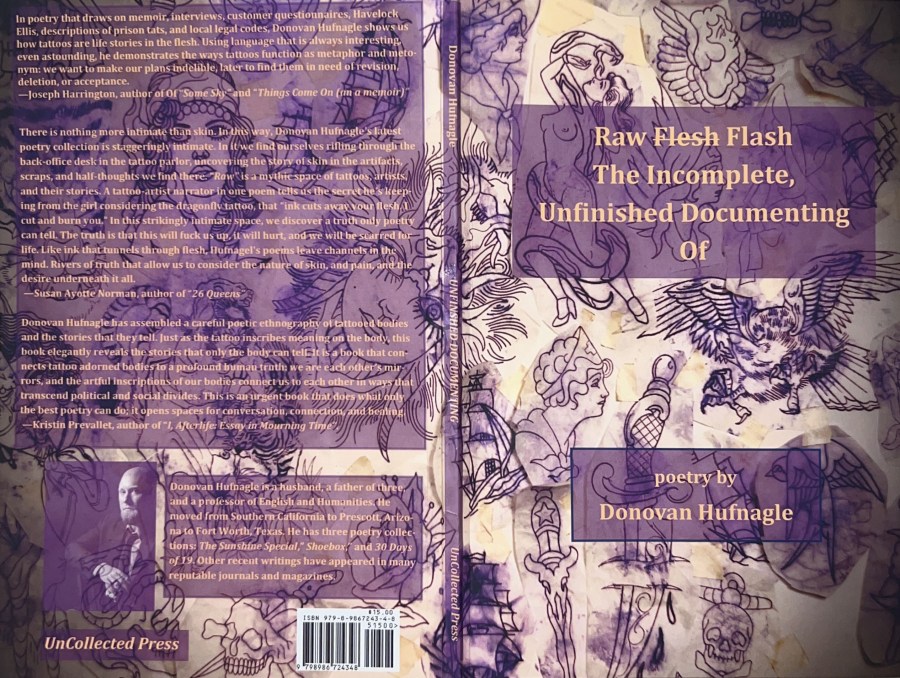
Raw Flesh Flash: The Incomplete, Unfinished Documenting Of by Donovan Hufnagle Review

I received a free copy of this book in exchange for a fair and honest review. All opinions are my own. 

Author and poet Donovan Hufnagle shares a collection of poetry that delves into the meanings and stories behind the tattoos that adorn our bodies within his book, “Raw Flesh Flash: The Incomplete, Unfinished Documenting of”.

Advertisements

The Synopsis

Raw Flesh Flash: The Incomplete, Unfinished Documenting Of is “a careful poetic ethnography of tattooed bodies and the stories that they tell. Just as the tattoo inscribes meaning on the body, this book elegantly reveals the stories that only the body can tell. It is a book that connects tattoo-adorned bodies to a profound human truth: we are each other’s mirrors, and the artful inscriptions of our bodies connect us to each other in ways that transcend political and social divides.” Kristen Prevallet

The Review

This was such an artful and passionate collection of poems. The author does an incredible job of utilizing imagery and atmosphere in each poem to convey the tone and theme that each poem and passage is meant to. The way each story within the poems seems to tie into the deeper meaning behind not only the tattoos that people get, but the people behind the needle who curate these works of art onto a person’s body and the tattooing process as a whole made this so compelling to get lost in.

While not someone who has gotten a tattoo before, I have many family members who have, and not only have I always wanted one myself but the art behind tattoos and the meaning behind them have always moved me. The creativity, the passion, and the emotional connection for some make these tattoos feel alive, and the way this experience harkens back throughout history, even to the ancient Viking culture, was profound to lose yourself in when reading up on the subject. This is the same magic and wonder the author’s work tackles, as each poem not only tells the story of average, ordinary people, but the stories of love and loss and everything in-between that their tattoos tell of, and the sense of wonderment that overcomes you when looking upon these works of art, as well as both the good and bad emotions that come with the experience, making this a compelling collection to get lost in.

The Verdict

Memorable, heartfelt, and engaging, author Donovan Hufnagle’s “Raw Flesh Flash: The Incomplete, Unfinished Documenting Of” is a must-read collection of poetry. The almost rhythmic delivery of each poem and the artistry that went into the delivery of the poem’s imagery was profound and captivating, making this one collection you will pick up time and time again. If you haven’t yet, be sure to grab your copy today!

Rating: 10/10

Advertisements

About the Author

Donovan Hufnagle is a husband, a father of three, and a professor of English and Humanities. He moved from Southern California to Prescott, Arizona to Fort Worth, Texas. His new poetry collection, Raw Flesh Flash: The Incomplete, Unfinished Of, is a poetic scrapbook of interviews, poetry, and documents about the universal narrative of tattoos. 

He also has three other poetry collections: The Sunshine Special, a “part personal narrative, epic poem, and historical artifact;” Shoebox, an epistolary, poetic narrative about Juliana’s “past and present, love and lack, in language that startles;” and 30 Days of 19, inverted Haiku poems juxtaposed to Trump tweets, capturing the first thirty days of the Covid 19 quarantine. 

Other recent writings have appeared in The Closed Eye Open, Tempered Runes Press, Solum Literary Press, Poetry Box, Beyond Words, Wingless Dreamer, Subprimal Poetry Art, Americana Popular Culture Magazine, Shufpoetry, Kitty Litter Press, Carbon Culture, Amarillo Bay, Borderlands, Tattoo Highway, The New York Quarterly, Rougarou, and others.

http://www.donovanhufnagle.com/

https://a.co/etNpctS

Guest Blog Post from Author Donovan Hufnagle, author of “Raw Flesh Flash: The Incomplete, Unfinished Of”

Publishing is just another trial as part of the writer’s journey. When we cross the threshold from the known world into the unknown world, answering the call to adventure, entering OZ, Wonderland, the Athenian Forest…into our dreamworld, “somewhere over the rainbow,” we follow the yellow brick road, follow gold bricks in the form of words to counter the white space on the page and, perhaps, in our life. The perfect word(s). This word and not that word. We pass through the abyss, reach the Emerald City, and eventually come back home. But before we can reach the city, earn our gift, tap our heels together, and share it with the known world, the trial of publishing confronts us. 

Publishing is not the end of the journey nor is it a gift. When my first book, Sunshine Special, was published, I thought the world would change. It didn’t. I did, however, reach a revelation…publishing isn’t the key to a magical door that opens a garden of poppies and avenues. When my current book, Raw Flesh Flash: The Incomplete, Unfinished Documenting Of, won a publishing contest and was published by Uncollected Press, I understood that the work had just begun. And I think understanding is crucial. Writers, especially poets, should understand that there may be many times we hear the word NO. It feels personal. It’s not. But when you write and write, edit, and write some more then finally build the strength to submit your work, placing your work on display for someone to just cut it open until it bleeds seems pretty damn personal to me. And, simultaneously, impersonal, since most of the time you receive a cookie cutter rejection from the publisher like they didn’t even bother to read it. 

Advertisements

On a side note, if you receive a personalized rejection, cherish it. 

Understand that publishing is a business like any other business and your success as a writer is not dependent on publishing. I just received a rejection through Submittable just the other day for one of my poems. I place it in a folder titled “submissions,” forget it and move on. Publishing is not an enemy; it is just a necessary hurdle along the way. 

My advice, then, is to keep writing, and one day you may become published (if that is what you are striving for).  It will feel good. It will be exciting. Someone out there appreciating your work as much as you do. Your hard work will finally be on display for others. You can stop plucking rose petals, wondering if they love you or if they love you not (maybe). Also, understand that the journey is not over. You will need to work just as hard for the next thing, to conquer the next trial. 

It took a long time for me to truly think about publishing—decades. As a younger poet, I wasn’t that interested in publishing. I would submit a poem here or there. But it wasn’t until I crafted my art to a point where I wanted, no, felt like I needed to share it with more than my wife that publishing seemed like the next logical step. So, I put my stuff out there. Scary and exciting. I received rejections. Dejected. I received acceptances. Elated. Some won contests. Some still have never seen the light of day. 

I am at a place, now, in my writing career that I know my talents, I know my successes, and they don’t depend on those publications. But it sure does feel nice. My writings are like my tattoos, on public display for all that I encounter, simultaneously, holding a personal meaning no one else will ever know, unless you ask. Every writer’s journey is unique; some trials along the way may come easy, some may never be conquered, but know the real gift is that you wrote something, you created new, you crafted art for a world where the “dreams that you dare to dream really do come true.”

Advertisements

About the Book

Donovan Hufnagle has assembled a careful poetic ethnography of tattooed bodies and the stories that they tell. Just as the tattoo inscribes meaning on the body, this book elegantly reveals the stories that only the body can tell. It is a book that connects tattoo adorned bodies to a profound human truth: we are each other’s mirrors, and the artful inscriptions of our bodies connect us to each other in ways that transcend political and social divides. This is an urgent book that does what only the best poetry can do; it opens spaces for conversation, connection, and healing.-Kristin Prevallet, author of “I, Afterlife: Essay in Mourning Time”.

Advertisements

About the Author

Donovan Hufnagle is a husband, a father of three, and a professor of English and Humanities. He moved from Southern California to Prescott, Arizona to Fort Worth, Texas. His new poetry collection, Raw Flesh Flash: The Incomplete, Unfinished Of, is a poetic scrapbook of interviews, poetry, and documents about the universal narrative of tattoos. 

He also has three other poetry collections: The Sunshine Special, a “part personal narrative, epic poem, and historical artifact;” Shoebox, an epistolary, poetic narrative about Juliana’s “past and present, love and lack, in language that startles;” and 30 Days of 19, inverted Haiku poems juxtaposed to Trump tweets, capturing the first thirty days of the Covid 19 quarantine. 

Other recent writings have appeared in The Closed Eye Open, Tempered Runes Press, Solum Literary Press, Poetry Box, Beyond Words, Wingless Dreamer, Subprimal Poetry Art, Americana Popular Culture Magazine, Shufpoetry, Kitty Litter Press, Carbon Culture, Amarillo Bay, Borderlands, Tattoo Highway, The New York Quarterly, Rougarou, and others.
http://www.donovanhufnagle.com/

Flare, Corona (American Poets Continuum Series Book 201) by Jeannie Hall Gailey Review

I received a free copy of this book in exchange for a fair and honest review. All opinions are my own.

Author and poet Jeannie Hall Gailey share a rich collection of poems that showcase our ability to prevail and persevere through illness and natural disaster in the book “Flare, Corona”. 

Advertisements

The Synopsis

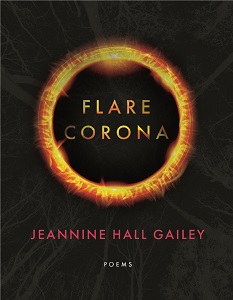
Against a constellation of solar weather events and evolving pandemic, Jeannine Hall Gailey’s Flare, Corona paints a self-portrait of the layered ways that we prevail and persevere through illness and natural disaster.

Gailey deftly juxtaposes odd solar and weather events with the medical disasters occurring inside her own brain and body— we follow her through a false-alarm terminal cancer diagnosis, a real diagnosis of MS, and finally the onset of the coronavirus pandemic. The solar flare and corona of an eclipse becomes the neural lesions in her own personal “flare,” which she probes with both honesty and humor. While the collection features harbingers of calamity, visitations of wolves, blood moons, apocalypses, and plagues, at the center of it all are the poet’s attempts to navigate a fraught medical system, dealing with a series of challenging medical revelations, some of which are mirages and others that are all too real. 

In Flare, Corona, Jeannine Hall Gailey is incandescent and tender-hearted, gracefully insistent on teaching us all of the ways that we can live, all of the ways in which we can refuse to do anything but to brilliantly and stubbornly survive.

The Review

I was absolutely moved and captivated by the heart and passion that the author relays her story of health battles and the pandemic. The use of story-driven, sci-fi, and dystopian genre writing styles to illustrate the author’s personal story was so remarkable and thrilling to see come to life on the page, and the humor and wit that underscores these apocalyptic-style poems made this a thrilling collection.

To me, the heart of this collection resides in the themes and imagery that the author utilizes in her work. The juxtaposition of the decay and darkness that surrounds humanity with the life and love that brings the light back into our lives was so remarkably moving, and the imagery that connects a brain scan to astronomical, and solar movements were both thought-provoking and heartfelt in its delivery.

The Verdict

Memorable, moving, and insightful, author Jeannie Hall Gailey’s “Flare, Corona” is a must-read collection of poems that speak to both the perils of health crisis and the hope that humanity draws from in times of need. The scope of the poems themselves and the creativity that they spark, and the imagery that the author’s poems bring to life made this a truly wonderful read. If you haven’t yet, be sure to grab your copy today!

Rating: 10/10

Advertisements

About the Author

Jeannine Hall Gailey is a writer with MS who served as the second Poet Laureate of Redmond, Washington. She is the author of five books of poetry: Becoming the Villainess, She Returns to the Floating World, Unexplained Fevers, The Robot Scientist’s Daughter, Field Guide to the End of the World, the winner of the Moon City Press Book Award and the SFPA’s Elgin Award, and upcoming in 2023, Flare, Corona from BOA Editions. She also wrote a non-fiction book called PR for Poets to help poets trying to promote their books. Her poems have been featured on NPR’s The Writer’s Almanac and on Verse Daily; two were included in 2007’s The Year’s Best Fantasy and Horror. She was awarded a 2007 and 2011 Dorothy Sargent Rosenberg Prize for Poetry and a 2007 Washington State Artist Trust GAP grant. Her poems have appeared in American Poetry Review, Poetry, and Ploughshares.

https://webbish6.com/

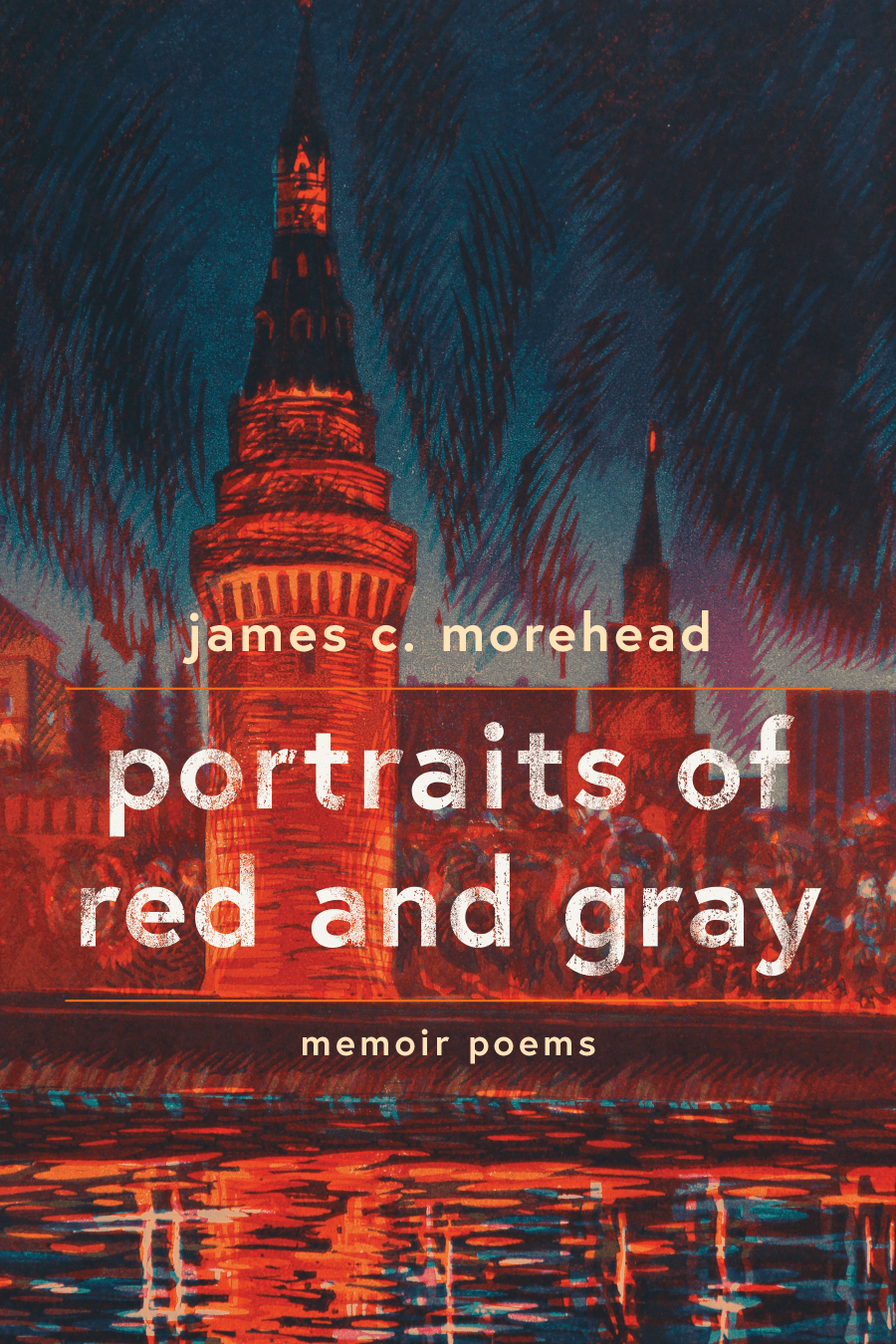
portraits of red and gray: memoir poems by James Morehead Review

I received a free copy of this book in exchange for a fair and honest review. All opinions are my own.

Author and poet James Morehead take readers on a journey from childhood to adulthood, from Soviet Union era-Russia to the Canadian wilderness, Wyoming, and beyond in his book “portraits of red and gray: memoir poems”.

Advertisements

The Synopsis

Take an unforgettable journey from the Cold War USSR to Savery, Wyoming, from the mountains of Tuscany to the peak of Yosemite’s Half Dome, from the Canadian wilderness to the beaches of Normandy. James Morehead’s (Poet Laureate – Dublin, California) acclaimed collection is built around a series of memoir poems that takes readers into pre-perestroika Soviet Union through the eyes of a teenager, from Moscow to Tbilisi to Leningrad (and many stops in-between). The striking cover, designed by Zoe Norvell, is based on a 1982 lithograph by Igor Prilutsky.

BookBaby's Complete Self-Publishing Package includes eBooks, Printed Books and more - everything you need for your book launch!

The Review

This was such a moving and beautiful collection of poetry. The author does a remarkable job of using profound imagery that feels both relatable and memorable at the same time, and the varied pacing of each poem speaks to the uniqueness of the memories that make up the subject of each poem, speaking to a specific moment in the author’s life that added to their growth as a person.

To me, the author’s work really worked for the balance in the surface-level themes of life experiences in specific places with the deeper meaning of love itself. Each poem spoke not only to the location of the author’s experience, but the person that they spent that memory with, whether it was the boating trip with his father, watching his Italian grandmother-in-law bake, and so on and so forth. The details that went into each poem spoke to the experience and things around the author that resonated with the person he was with, speaking to the insightful nature of his experiences, even when the person he resonated with was his younger self.

ABN Banner

The Verdict

Memorable, thoughtful, and engaging, author James Morehead’s “portraits of red and gray: memoir poems” is a must-read collection of poetry. The emotional and moving connection the reader makes to the author’s experiences blends well with the imagery and vividness of each poem, making this a wonderful read. If you haven’t yet, be sure to grab your copy today!

Rating: 10/10

Advertisements

About the Author

James Morehead is Poet Laureate of Dublin, CA. portraits of red and gray is his second collection, and he hosts the Viewless Wings Poetry Podcast. James’ poem “tethered” was transformed into an award-winning animated short film, “gallery” was set to music for baritone and piano, and his poems have appeared in numerous publications. He is currently based in the San Francisco Bay Area.

Blog Tour Schedule:

April 18: the bookworm (review)

April 27: A Bookish Way of Life (review)

May 6: Anthony Avina’s blog (review)

May 9: The Book Lover’s Boudoir (review)

May 11: Impressions in Ink (review)

May 15: Review Tales by Jeyran Main (interview)

May 23: CelticLady’s Reviews (guest post)

May 25: Books Parlour (review)

May 29: True Book Addict (review)

https://jamesmorehead.com/

If the Sky Won’t Have Me by Anne Leigh Parrish Review

I received a free copy of this book in exchange for a fair and honest review. All opinions are my own.

Author Anne Leigh Parrish follows up on her acclaimed debut poetry collection with a sequel that delves into what it means to be alive in this complex world of ours in the book “If the Sky Won’t Have Me”. 

Advertisements

The Synopsis

The poems in If The Sky Won’t Have Me weave a brilliant tapestry of the human condition, focusing on nature, the female experience, family drama, aging, politics, and regret. Images of water feature strongly, as do rebirth and regeneration, both physical and spiritual. A perfect sequel to the author’s debut collection, the moon won’t be dared, these poems expand and deepen our understanding of what it means to be alive in a complex world.

BookBaby's Complete Self-Publishing Package includes eBooks, Printed Books and more - everything you need for your book launch!

The Review

This was the perfect collection of poems and simple yet empowering artwork. The author does an incredible job of capturing the imagination and the emotion that poems are meant to evoke, and the way each poem is able to really impact the author in a specific way allowed the song-like quality of each poem’s structure to really become melodic in nature.

To me, the heart of the book rested in the reliance on nature and morality as both conversation starters and imagery. The emotion and sparks of insight that each of these poems stirs within the reader help to elevate the almost narrative approach to the poems themselves. For instance, my favorite poem in this collection for me was “Like a Shade of Dawn”, and the way this spoke to me about the desire for change, for leaving behind the past and embracing the coming of the dawn was powerfully felt and utilized the nature motif expertly.

ABN Banner

The Verdict

Moving, passionately written, and engaging, author Anne Leigh Parrish’s “If the Sky Won’t Have Me” is a must-read poetry collection. The heart and thoughtfulness of each poem will speak to the quiet yet contemplative voice within us all, the empowering way the book speaks to women in particular, and the need to look at how people embrace life in this modern world of ours through the use of nature and morality will really stay with the reader long after the book ends. If you haven’t yet, be sure to grab your copy today!

Rating: 10/10

Advertisements

About the Author

Anne Leigh Parrish is the author of nine previously published books: A Winter Night (Unsolicited Press 2021); What Nell Dreams, a novella & stories (Unsolicited Press, 2020); Maggie’s Ruse, a novel, (Unsolicited Press, 2017); The Amendment, a novel (Unsolicited Press, 2017); Women Within, a novel (Black Rose Writing, 2017); By the Wayside, stories (Unsolicited Press, 2017); What Is Found, What Is Lost, a novel (She Writes Press, 2014); Our Love Could Light The World, stories (She Writes Press, 2013); and All The Roads That Lead From Home, stories (Press 53, 2011). Visit her website.

Our Wolves by Luanne Castle Review

I received a free copy of this book in exchange for a fair and honest review. All opinions are my own.

The classic tale of Little Red Riding Hood gets a new take when poetry and perspective shine a light on Red and those she interacted with on that fateful night in author and poet Luanne Castle’s “Our Wolves”.

Advertisements

The Synopsis

In Our Wolves, poet Luanne Castle navigates the timeless story of “Little Red Riding Hood” in a compelling collection of sharp, memorable poetry. Familiar tales are ageless for a reason. Their magic is that they can easily be transformed to explore subjects of abuse, danger, sexuality, self-sufficiency, and interpersonal relationships in a way that makes these challenging topics palatable to readers. Trying to find the reasoning behind Red’s traumatic adventure, as well as using it to comment on contemporary events, Castle creates taut narratives and sympathetic monologues to show how the story shapeshifts with the teller. Here, we hear from the wolf, the huntsman/woodcutter, Grandmother, townspeople, and Red herself. Not just a victimized or innocent child, Castle’s Red also appears in wiser (and sometimes older) incarnations that are knowing, rebellious, resilient, and clever. This technique subverts stereotypical conventions and shows that Red’s story “is not so very different from yours / and yours and yours and yours and yours.” Filled with atmospheric power, dynamic portrayals, and bright imagery, Our Wolves will haunt you long after you’ve returned from its woods.

Christine Butterworth-McDermott, author of The Spellbook of Fruit & Flowers

In this recasting of the Little Red Riding Hood tale, Luanne Castle’s wolves are not the wolves skulking in our imaginations. Her poems challenge our senses, bounce from view to view, shifting their focal points. Grandmothers and red-coat-wearing girls may or may not bear guilt. Indeed, Granny may be the Wolf. Or the Wolf may be a father, pulling down panties to slap bare skin. The story is told “to search / for who, not why. It’s all about blame.” Which is, of course, only one truth lurking within this fable. The poems in Our Wolves burrow under your skin and into your flesh. They don’t let go, no matter how you scratch; they’re unsettling, magical. Relentless. Unforgettable.

Robert Okaji, author of Buddha’s Not Talking

Bookbaby.com helps independent authors bring their creative vision to the marketplace. Sell eBooks online in the biggest retail stores.

“Perhaps you were wrong.” In these imaginative and evocative poems, expectations are subverted, and flat, centuries-old characters are brought to life in both amusing and startling ways. Castle tells the old story of Red Riding Hood from new angles and perspectives, creating a multitude of responses from the reader, eliciting from us everything from moments of cringing to laughter. Most interestingly, Castle subverts the predictable and achieves complexity by using an unlikely combination of forms and mixed modes–from the more traditional lineated lyric and narrative poems to the unexpected Haibun and Abecedarian, using every technique available to create this lively and memorable book. These poems invite us to confront what we take for granted and then let loose our own inner wolf to bite in and savor them all–one well-crafted word at a time.

Kimberly K. Williams, author of Sometimes a Woman and Still Lives

ABN Banner

The Review

This was a memorable and heartfelt collection of poems. The author does an incredible job of finding the right balance of storytelling through the poems themselves to tell this reimagining of such an iconic fairytale and highlighted the rich themes found within the poems with powerful imagery and insightful tones that kept the reader grounded in the magical reality they were weaving together. 

The heart of the author’s work rested in the moving themes the poems played with and the folklore that the author drew upon to weave this tale. The poems hit upon things like identity, staying true to oneself, honesty, and overcoming our fears in life, and the way the author was able to write these poems in a way in which the audience was able to see themselves in one form or another through these varied perspectives was memorable, to say the least. The way in which the reader is treated to the perspective of the Wolf, Grandma, and of course Red herself allowed for readers to connect more with the major players of this tale and the struggles each and every one of them held onto until the bitter end. 

The Verdict

Heartfelt, memorable, and captivating, author Luanne Castle’s “Our Wolves” is a masterful and engaging poem collection. The imagery and atmosphere that each pome conjures up and the rich dynamics each perspective brings to the narrative of Red Riding Hood made this a truly thoughtful and relatable collection that readers won’t soon forget. If you haven’t yet, be sure to grab your copy today!

Rating: 10/10

Advertisements

About the Author

Luanne Castle lives in Arizona, next to a wash that wildlife use as a thoroughfare. She has published two full-length poetry collections, Rooted and Winged (Finishing Line Press 2022) and Doll God (Aldrich/Kelsay 2015), which won the New Mexico-Arizona Book Award for Poetry. Kin Types (Finishing Line Press 2017), a chapbook of poetry and flash nonfiction, was a finalist for the Eric Hoffer Award. Our Wolves (Alien Buddha Press 2023) is her second chapbook. Luanne’s Pushcart and Best of the Net-nominated poetry and prose have appeared in Copper Nickel, American Journal of Poetry, Pleiades, River Teeth, TAB, Verse Daily, Saranac Review, and other journals.

Luanne blogs at Writer Site and The Family Kalamazoo.

Guest Blog Post: WHY A JOURNALIST WROTE A MEMOIR – ACROSS CONTINENTS by Ira Mathur

In writing this memoir, I combined my two loves, journalism and creative writing.

The journalist’s task is to find the dark corners of the world of injustice and sadness and illuminate them. The bigger job is to be the watchdog of democracies, to ensure there are checks and balances in governance on behalf of the people.

If there is one thing it taught me is that humans are essentially the same. Everyone is looking for a way to survive the dark days of our mortality and the trials of being human, whether they are gangsters who end up getting shot at 20 and buried with gold chains down to their stomachs; or priests who have lived ascetic lives; or indeed, families around the commonwealth navigating the damage of Empire.

Advertisements

It was with this understanding that I began to write a memoir.

As an immigrant to Tobago, where my parents moved when I was a child, and later to Trinidad, I felt the past was being cut away from me.

My son was born, and I had begun forgetting words in Urdu and Hindi. As an immigrant to Trinidad, I started feeling the past was being cut away from me. I wrote it to remember the past and understand the present of the glittering islands of Trinidad and Tobago, where my parents moved when I was a child. 

As I wrote about my experience as a journalist, somebody who chronicles the events that shape a country, I realised that my past was not unique. My grandmother told me how my ancestor was brought from Uzbekistan to put down the mutiny in India in 1856. As a recruited member of the British Army, he was forced to shoot his fellow Muslims, something he regretted till he died. I began making connections. It was also the story of colonial islands in the new world, where people were stripped of language. The narrative continued with my parents travelling to Trinidad and Tobago, which also has a complicated history of colonisation by the French Spanish and English. That interested me – how the personal can be so political, how the unravelling of one family living under decades of colonialism can echo a crumbling empire.

The overall theme of the crumbling Empire is relevant, especially now; after the death of Queen Elizabeth 11, we can see how similar post-colonial worlds are. The history of brutality was identical. In India, we grew up with stories of the Jallianwala Bagh massacre in Amritsar Puja when General Dyer ordered the British 

Indian Army to open fire on over a thousand unarmed, nonviolent protestors, Churchill’s active role in perpetuating the Bengal famine, or the signs my mother remembers in exclusive clubs that read “No Dogs or Indians” and the sly inroads of the East India Company. In Trinidad, as in much of South America, there is the brutal history of slavery, indentureship and genocide of millions of native Indians. In India from 1765 to 1938. the British got an estimated 45 trillion U.S. dollars’ worth of goods like textiles, rice, iron, and timbre, not to mention jewels from the Raj, which are housed in 

British museums today. Similarly, Caribbean islands like ours were looted for sugar and cocoa. It’s a shared history of exploitation.

 When my grandmother left India to join our family in Trinidad, she told me stories about a vanished India of the British Raj. She told me of generations of women born into Muslim Indian princely families of Bhopal and Savanur. I had to infer the calamity upon her life when my mother broke hundreds of years of tradition and understand why my grandmother disinherited my mother for marrying a Hindu army officer.

There were unanswered questions. I wondered why my grandmother ended up alone and penniless despite all her privileges- born a princess into Indian royalty, beauty, and musical talent. 

As I wrote the story, the puzzle came together. I began to understand how patterns are created in how we treat our daughters and how that damages the people we love. At my grandmother’s funeral, I was aware of how incongruous this was, a woman born in colonial India dying in the new world so far from everything she grew up with and knew. It was a way of bringing tother the old and new worlds and introducing the question of how and why this happened. How did a princess of the Raj die in Trinidad? 

Advertisements

The colonial idea that subjugation, cruelty and even corporal punishment can be justified for the greater good filtered down to how people in colonies viewed their children.– how neglect, abandonment or abuse is passed on to their daughters and that pattern is continued. 

Migration is also a very personal issue. At the funeral of the late Queen Elizabeth, dozens of security guards were of South Asian origin. According to an Indian Ministry of External Affairs report, 32 million Non-Resident Indians live outside India, overseas Indians comprise the world’s largest overseas diaspora, and over 2.4 million Indians migrate overseas yearly. Our family was just one in this ocean of movement. So the themes aren’t heavy, but 

illustrates how politics always becomes personal and affects families.  

When I wrote it, I did not expect it to resonate with so many people across continents. Michael Portillo for Times Radio was moved by the story of Poppet, the child in the book. Anita Rani of Times Radio was moved by the story of migration. The Observer found it was reminiscent of the times of the Raj in India, which has connected India and Britain for generations.

Advertisements

About the Author

Ira Mathur is the author of Love The Dark Days – a Peepal Tree published a memoir on the emotional ruins of Empire on three generations of women set in Trinidad, St Lucia, India and the U.K., bookended with a weekend with Derek Walcott. Love The Dark Days was selected as a UK Guardian Best Book of the Year 2022 ( Memoir and Biography)

Mathur is an Indian-born Trinidadian multimedia journalist and columnist with a body of writing that includes over 800 columns over 20 years. (www.irasroom.org) She was longlisted for the 2021 Bath Novel Award for Touching Dr Simone. (Out in 2023)

Mathur studied creative writing in London with The University of East Anglia/Guardian & the Faber Academy with Gillian Slovo, Maggie Gee, and James Scudamore. In 2019 Mathur was longlisted for the Johnson and Amoy Achong Caribbean Writers Prize. She holds degrees in literature, law and journalism. 

Purchase on Amazon U.K.: https://www.amazon.co.uk/Love-Dark-Days-Ira-Mathur/dp/1845235355#detailBullets_feature_div

Purchase on Amazon U.S.: https://amzn.to/3YaoVmH

Damnation and Cotton Candy by Alan S. Kessler Review

I received a free copy of this book in exchange for a fair and honest review. All opinions are my own.

Author and poet Alan S. Kessler take readers on a journey of beauty and melancholy in his book “Damnation and Cotton Candy”.

Advertisements

The Synopsis

A book of poetry from Alan S. Kessler, the award-winning author of the 2022 Eric Hoffer Finalist Ghost Dancer, and other books. These are poems best served with hot cocoa, melancholy, and a sharp knife.

The Review

This was such a profound and captivating collection of poetry. The author’s ability to weave macabre imagery and atmosphere into the poetry while offering commentary on life itself was so engaging for a reader to behold. The natural way the author is able to weave dark tones with profound emotions was truly inspiring to behold.

Yet to me, it was the way the imagery blended with the deep-seated themes of this narrative. From politics and warfare to hollow niceties between strangers and corporations as a whole, the message of finding hope is not in the materialism of our current world but in the philosophy and spirituality that exists just on the fringes of our society as a whole. 

The Verdict

Mesmerizing, haunting, and emotionally driven, author Alan S. Kessler’s “Damnation and Cotton Candy” is a must-read book of poetry. The imagery and atmosphere do a great job of portraying the capitalist machine of our world with the truly dark and macabre aspects of life, and readers will be hard-pressed to put this creative, artistic, and chilling book down. If you haven’t yet, be sure to grab your copy today!

Rating: 10/10

Advertisements

About the Author

Alan Kessler grew up in Columbus, Ohio. He says, “Childhood shapes us. Mine was, ironically, a gift. The sadism of my mother and the violence of my father, a murderer who died in prison, created within me a countervailing force, the ability to write empathetically about characters who, as Faulkner said, not merely endure but prevail.”

“Resilience isn’t an achievement, it exists as a matter of luck. I was lucky. I have a wonderful wife and four caring, intelligent children–even a dog,” according to Kessler. “I am blessed.”

https://www.alanskessler.com/

https://www.amazon.com/gp/product/B0B9NZV8NB/ref=x_gr_w_glide_sin?caller=Goodreads&callerLink=https%3A%2F%2Fwww.goodreads.com%2Fbook%2Fshow%2F61425691-damnation-and-cotton-candy%3Fac%3D1%26from_search%3Dtrue%26qid%3DozDQcx97Lh%26rank%3D1&tag=x_gr_w_glide_sin-20

Guest Post: Paw Prints by Tom Pearson

The creative process is mysterious. For me, it often consists of accumulation/distillation/accumulation, sifting ideas through different iterations and genres (art, poetry, performance). Micro-expressions of a central idea frequently become distinct projects and parts of a larger constellation of work. Along the way, much is gained, but also, sometimes, lost.

There are two stanzas from an early draft of Still, the Sky that aren’t found in the published work; although, traces of them remain. They were composed of an image that volunteered itself, left its mark, and vanished:

   After the first of seven was plucked for the

Feast, the others would set up camp

Around the twists and turns of the pathways,

            Chastity-in-residence,

   And they would plot to meet and spoil themselves,

To love the murder away, but they were kept

Apart, running from the gaze of the creature

            Whose shadow you cast.

   They would meet us from time to time,

Casual encounters, sometimes taking the time

To say what they thought, or how they felt,

            What their days had been.

   One even found a pet, an orange kitten

Who would disappear for days and then follow

As we made rounds, both intimate and mundane;

            She would outlive him.

The first two stanzas remain. The second two are gone, all that mentioned the unnamed victim and the kitten that survived. 

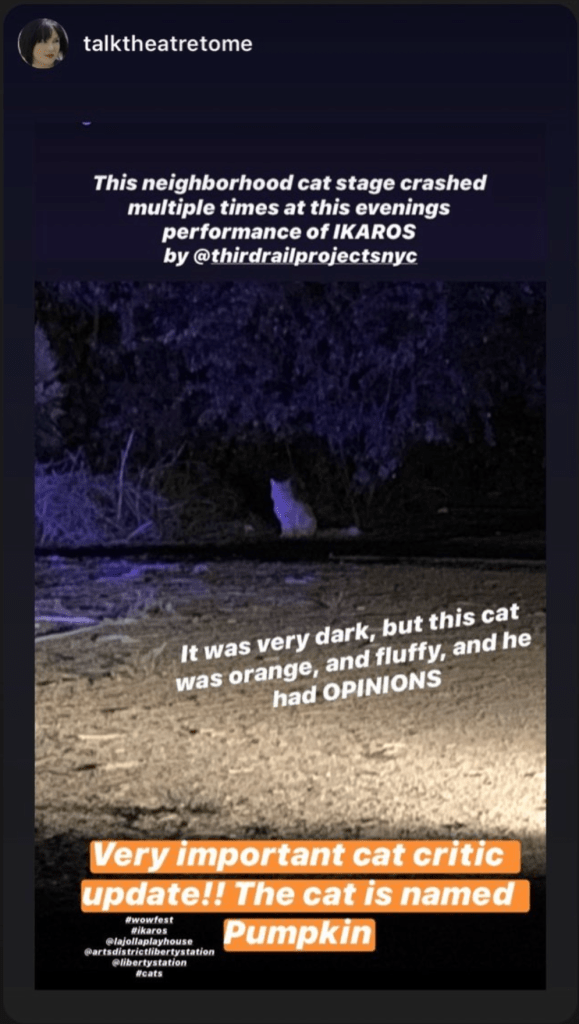
IG story post by @talktheatretome

Still, the Sky is the result of a long process of iterative works over the past few years, different expressions of the characters, themes, and ideas which had their genesis during a theater residency/fellowship in the spring of 2019 with the Bogliasco Foundation in Italy.

Advertisements
Courtesy of The Bogliasco Foundation; Photo by Laura Bianchi

Before I arrived to the residency, I received a commission from La Jolla Playhouse in California to create a site-specific work for their biennial Without Walls Festival, and so I already knew I would be working with themes of sky and sea, flight and nautical culture. My site in San Diego was a desert labyrinth just beyond the tarmac of the San Diego airport (beneath the flight path, divided by a narrow waterway) and on the grounds of Liberty Station, a formal naval training base. 

Pictured, Andrew Broaddus in Ikaros by Tom Pearson; Photo by Jim Carmody

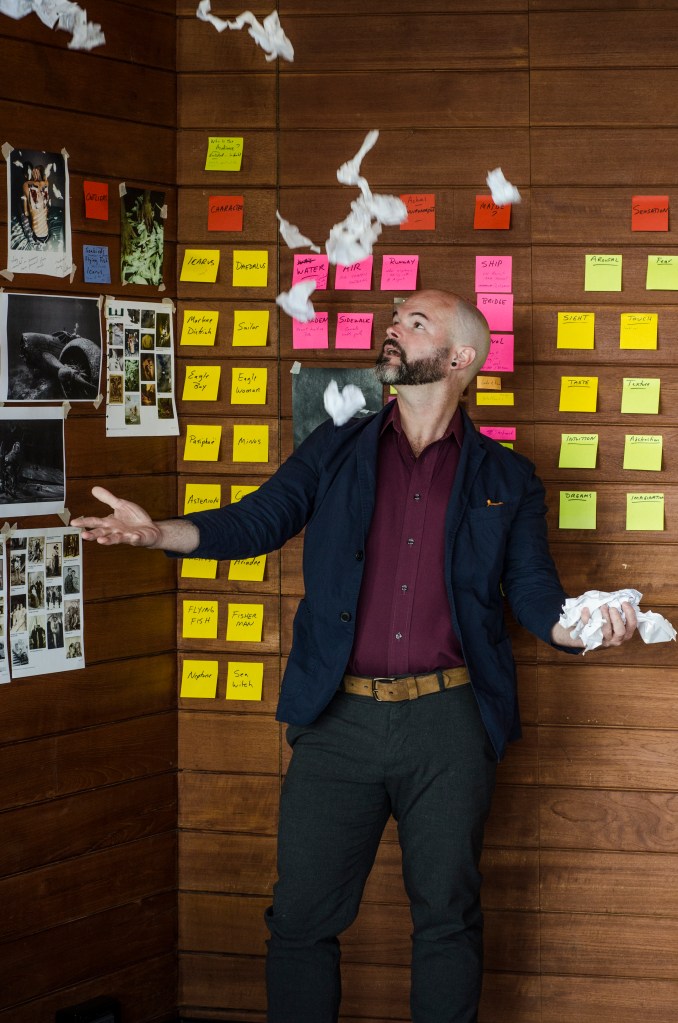
I also brought to the residency outtakes from The Sandpiper’s Spell (my first published volume) as another set of ideas. Most of the writings were coming-of-age themed or more recent explorations that didn’t have anywhere to go yet. In the first few weeks, I wrote something to bind them structurally and then put them aside for later—but as I began to storyboard ideas for the commission, filling up the walls with my Post-It Notes and columns of associations, I started to see a mythology unfolding through archetypes that would benefit from the specificity of personal experience.

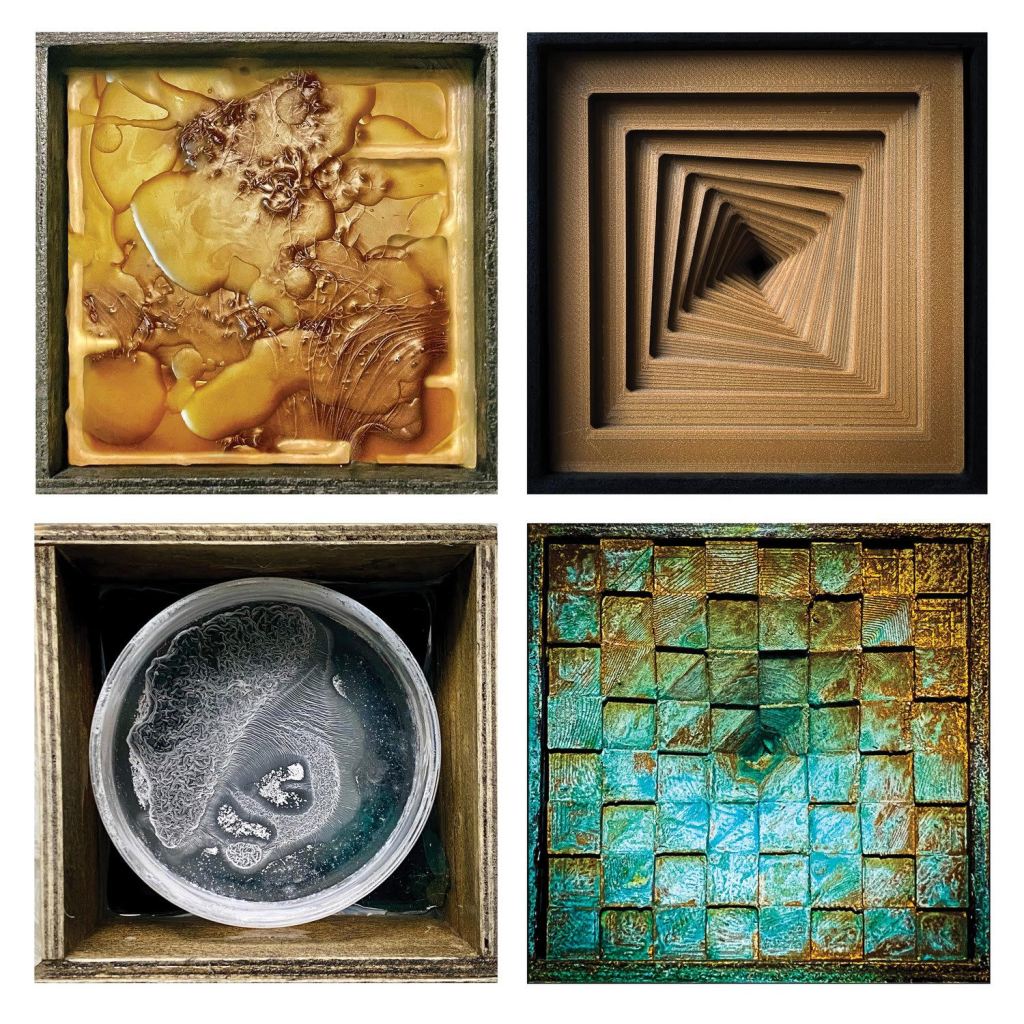
The next series of developments happened over summer, in New York, where I worked with performers. We experimented with choreography, film, and art to find the characters and describe the textures and themes, all in an exhibition at the Ace Hotel New York gallery. Then in October, we premiered the site-specific Ikaros in San Diego. After that, I continued to experiment with performance and material culture, mixing these with virtual reality. These explorations took me into early 2020 as I worked with students and faculty at the Olin College of Engineering where I was in-residence.

But then the pandemic hit, and we were sent into lock down. At that time, I circled back to revise the manuscript further, adding the artwork to the pages. At this stage, the three-dimensionality of the world revealed itself. The many previous micro-expressions of the project had rendered complex characters and rich environments—and reflecting upon the spaces in which I had worked, other elements emerged—for instance, the seagulls in Italy, nesting in the cliffs below my studio. Their mating rituals and fierce protection of their nests, their daily patterns, and the endlessness of sky and sea became dominant images of the main plot. And, in San Diego, an orange kitten also left her mark, shaping the timbre of a subplot.

Throughout the grounds of Liberty Station in San Diego, there was a population who made residence, whether temporarily passing through or on a more semi-permanent basis, in tents or lean-tos. As we were making Ikaros, we were careful not to displace, to be mindful, respectful, and in communication with the denizens of the space. Early on, one of the park residents came through rehearsals to chat with us about the work, the mythology, his observations of us in the site. He carried an orange kitten with him. Later, the kitten would come to rehearsals on her own and sometimes participate. 

There was a particular section with a long spindle of fabric which was unfurled to make the footprint of a labyrinth, and the kitten would stand threateningly at the edge of the rosemary bushes watching this giant ball of string, little shivers rippling along her spine—adding another layer of drama. 

We began to expect her. She started to show up consistently to rehearsals, but by the time we got to performance, she had gone elsewhere, only later to appear in another scene she’d never rehearsed, under full lights and in front of a paying audience. 

We rolled with it, but she stole the scene. She even got some social media coverage.

When the performances were finished, I went back to the poetry, and I took her image with me, writing her into the manuscript. In fact, I took the whole of the experience, the denizens of the space, the rosemary, the sounds, the smells, textures, animals, insects, birds, weather, and flight patterns all into consideration. The specificities of the lived experience were folded into the creative mix to further shape the world of the book.

By the time I arrived at a final draft, the overt mention of the kitten was gone, but her paw prints were all over it in subtle and invisible ways within the text and artwork (“a predator moving in right cycles, leaving us unharmed… treachery in the tall grass…”).

Reflecting later on The Sandpiper’s Spell, I realized the image of a pet outliving a companion was already a seed planted in the poem “Day Dreams.” The idea had carried forward, woven itself into the new work, then out again. Perhaps it will return and make more of itself in whatever I create next. 

I have begun to meditate on what these little threads mean over time, how a body of work forms from the scraps of previous work, how material moves forward and themes reiterate, or ideas sift and fold back together again to create specificity. It becomes a pattern for world building, one iteration at a time. It makes the work larger through the micro-expressions along the way—allowing for volunteer images that might invisibly imprint upon the eventual narrative. 

Little paw prints. 

Advertisements
Author Tom Pearson Reads Paw Prints

About the Author

Tom Pearson is an artist and poet who works in dance, theater, film, visual art, and multi-media. He is known for his original works for theater, including the long-running, off-Broadway immersive hits THEN SHE FELL and THE GRAND PARADISE and as a founder and co-artistic director of the New York City-based Third Rail Projects and Global Performance Studio.

He is the author of two books, THE SANDPIPER’S SPELL and STILL, THE SKY. More information available at his website and on social media at: tompearsonnyc.com and @tompearsonnyc.

https://tompearsonnyc.com/