I received a free copy of this book in exchange for a fair and honest review. All opinions are my own.
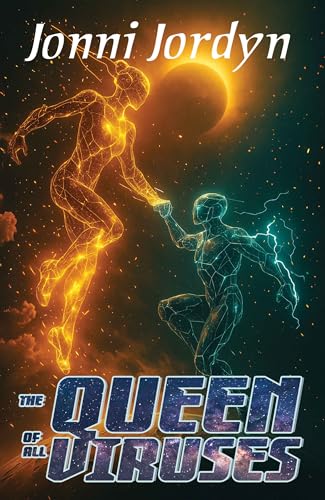
An act of protection turns into a struggle between two powerful AI entities in author Jonni Jordyn’s “The Queen of All Viruses”, the second book in the Mother of All Viruses series.
Advertisements
The Synopsis
The digital intelligence Odyssey returns to his homeworld to find all the biological lifeforms gone with a social structure designed to keep a few digital beings in power with most of the world under their control. They view his arrival as a threat and attack him. Even though he is invulnerable to their attack, one of them risks her life to protect him. When they turn their attack on her, he protects her, but she cleverly steals some of his technology until her ambition makes her a danger to him and a battle of epic proportions follows.
The Review
The author did an incredible job of expanding upon the world the first book introduced by exploring Odyssey’s home world and how society functions both in the past and present there. The exploration of machine mentality versus evolved AI, and whether it truly evolves or mirrors biological mannerisms, is such a treat to see play out on the page, and the way the author balanced this with the repercussions of Odyssey’s actions on Earth was so enthralling to read.
Yet, as a reader, what stood out to me was how the author developed two AI systems and their respective personalities enough to make them memorable characters in their own right. One of the hardest things for an author to ensure when writing is to create characters readers can relate to, root for, or root against, while connecting with them on some emotional level. Odyssey feels both futuristic and otherworldly, yet deeply profound and moving, and his story not only advances the world-building of this series but also deepens the strong themes it explores.
The Verdict
Entertaining, compelling, and thrilling, author Jonni Jordyn’s “The Queen of All Viruses” is a must-read sci-fi thriller-meets-adventure story. The imagery and atmosphere the author explores, and the dynamic character developments, help solidify the foundation that allows this profound insight into AI and the dangers and hopeful notes that reflect how we utilize AI in our own society to flourish, keeping the reader invested until the book’s shocking final chapter. If you haven’t yet, be sure to grab your copy today!
Rating: 10/10
Advertisements
About the Author
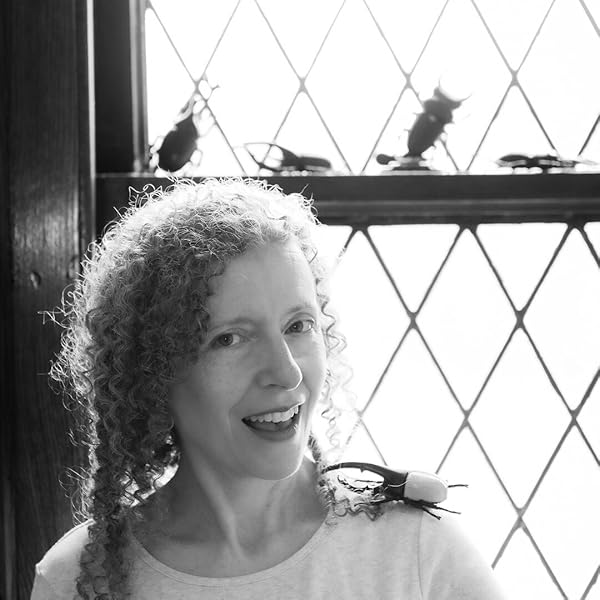
Jonni Jordyn, an award winning American author born in Oakland, Ca, started out playing music at age two, and moved on to singing and acting in grade school. High School introduced writing and film making followed by drawing and photography in college. In other words, she had a VERY LIBERAL arts education.
Jonni published some poetry and some india ink drawings in literary magazines while in college, won critical acclaim for her acting in a cabaret theater, but was faced with a decision to pick out the arts she wanted to pursue.
Of all the available opportunities, music and song writing won the first round when she found herself performing with legendary stars of the sixties and seventies.
Round two began years later, after leaving California for Arizona. It all started with a blank piece of paper and the question, “how can I possibly write more than eleven thousand words for a single story?” A valid question which was followed up a year later with, “How did I ever write 160,000 words?”
Now, the writing comes much easier, but still there are questions like, “How will I ever get all these ideas written down?” followed closely by, “How many times can I edit the same book?”
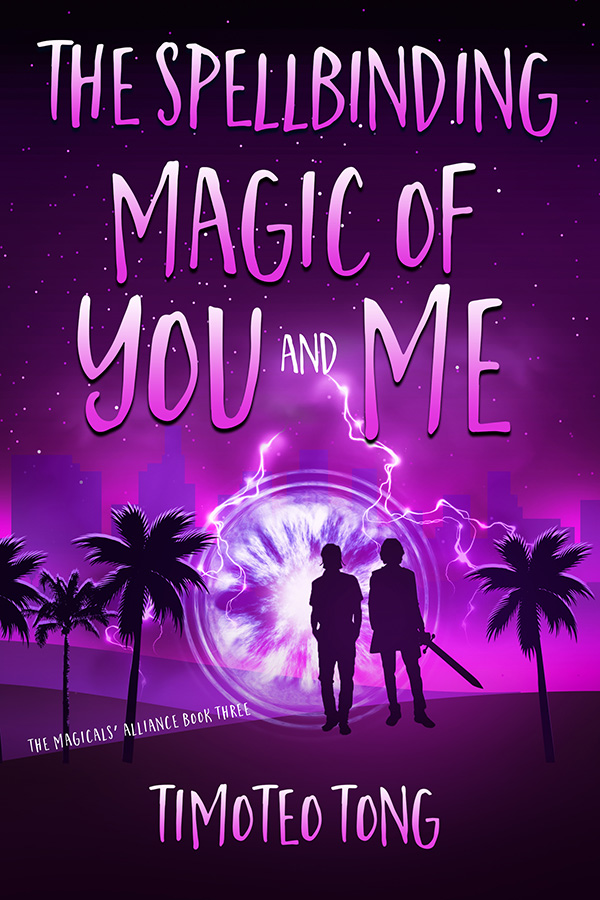
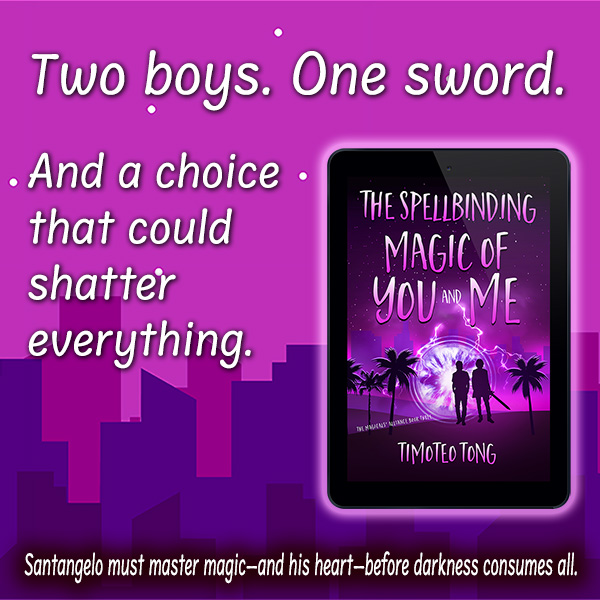
Timoteo Tong has a new fantasy/sci-fi book out, The Magicals Alliance book 3: The Spellbinding Magic of You and Me.
Magic, monsters, and a boy who never asked to be chosen.
Sixteen-year-old Santangelo Lo Geffo is drowning in grief. After his mother’s sudden death and his father’s emotional disappearance, he’s convinced the world has forgotten him—until his childhood best friend, Joshua “Neeky” Tang, shows up out of nowhere, charming, bold, and full of secrets. Their reunion reignites buried feelings and a bond stronger than fate.
But something darker stirs in the magical underworld known as the Gloom. A cursed sword has chosen Santangelo, and with it, the wrath of the ancient queen Máu Rabetica, who will stop at nothing to reclaim her power. With monsters closing in and war looming, Santangelo must train under the brutal God of War, survive attacks from rival covens, and navigate a tangled web of family secrets.
Worse, his heart’s a mess. He’s caught between his feelings for Neeky—the boy who’s always been there—and Daccio Scala, a flirtatious magical fighter who makes his pulse race. As the walls close in, a glam-pop sorceress with a hidden agenda sets her sights on Santangelo and the blade, forcing him to choose between destiny and desire… or risk losing both.
What if your wealthy, glamorous family was secretly saving the world?
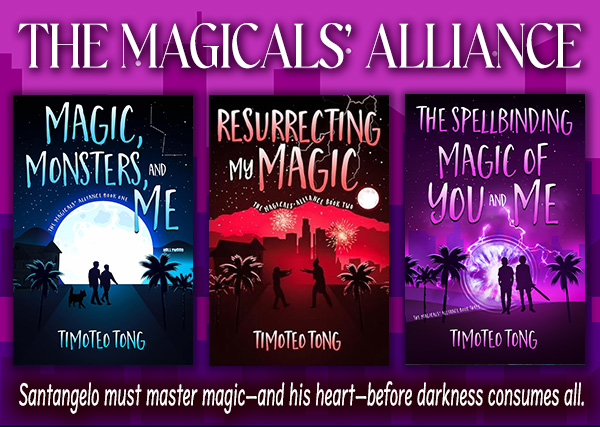
Welcome to the world of The Magicals Alliance, a spellbinding YA fantasy series that follows the powerful—and complicated—Delomary family. By day, they’re media moguls, philanthropists, and the faces of a global empire. But behind closed doors, they’re something much more dangerous: the last line of defense against monsters, magic, and total annihilation.
In a hidden war where Vampires, Werewolves, and dark forces threaten to tip the balance between worlds, the Delomarys stand at the center of it all—armed with secrets, ancient power, and a whole lot of emotional baggage.
Dive into a world of romance, rebellion, queer joy, and jaw-dropping magic as each book follows teens on the front lines of a battle that could destroy everything.
“Dammit, Bello!” Pops shouted from the front of the house.
I blinked awake. The drapes hung limp. The air in my room was warm and stale. My door stood open a crack. Che was gone.
“You have a visitor! Come downstairs—I’m making breakfast.”
I sat up, rubbed sleep from my eyes. The clock blinked 9:15. Pops was an early riser; I took after Mom and liked to sleep in.
“Coming!” I yelled back in Italian. I hated being woken before eleven.
I threw on a T-shirt and shorts, padded down the hall, and swung around the banister. At the bottom of the stairs, I froze. A shadow stood framed in the screen door to the verandah.
A tall boy with long black hair and glasses shifted from foot to foot, holding a cake like it might explode. He looked anxious and impossibly familiar.
“Open the door!” Pops barked. “Senlàpso!”
I opened the screen and stopped breathing. Joshua Tang—Josh—only not the kid I remembered. Taller now. Stronger. His smile hit me like a hammer.
“Santangelo!” he said. “Guess what? I just moved back to Burbank.”
We weren’t really friends anymore. So why was he acting like we were?
“Bello! Don’t be rude.” Pops’ voice snapped me awake.
“Oh. Hi, Josh.”
“Josh?” He tilted his head, eyes bright through his glasses. “That’s not my name.”
“Neeky,” he said.
The name clanged through me. I looked up—he towered over me now.
“Gosh,” he said, grinning, “you’re short. No growth spurt yet?”
“Yeah, well, you’re a giant.”
“Ah, yes,” Neeky said, blazing like midday sun, “that I am.”
“Come in. Let me take that cake.”
“Mom made it. It’s one of three things she can cook—scrambled eggs, soufflé, and carrot cake. Your favorite, Santy.” He handed it to Pops.
I stared. Three years gone, and suddenly he was here, filling our kitchen with noise and light.
“We moved back to the City of Angels,” Neeky said, sliding onto a stool while Pops poured juice. “Mom got a job at JPL.”
Pops’ eyebrows lifted. “Is that so? I didn’t know Susannah was a scientist.”
“She went back for her degree after… well, anyway. Now she’s a scientist.” Neeky bit into an apple like he’d never left.
He always made himself at home—shoes off, elbows out, comfortable like the world was his.
“That’s great, Josh,” I said automatically.
“Neeky, Mister Lo Geffo.” They shook hands like executives.
“Pops.”
Neeky turned to me. “Aren’t you going to sit?”
I climbed onto a stool across from him. Not too close. Not yet.
“I missed this place,” he said. “Always so homey. Our new house isn’t. Mom hates rugs and knick-knacks. Says they collect dust. She’s clueless.”
He talked like he’d been gone a day, not years. I wasn’t ready to pick up where we’d left off. Too much gnawed at me—things I couldn’t explain. Maybe he’d forgotten. That was like him. Pops and Neeky were both Leos: loud, sunny, terrible memories. I remembered everything—a curse.
“I’m taking Che for a run,” I muttered.
“We have a guest!” Pops shot me a glare sharp enough to petrify.
Neeky stood. “It’s fine, Pops. I have to help Mom decorate. She can’t do that alone.” He grinned, glowing like he carried his own weather. “Let’s hang out. I’m right across the street—the other old house on the block.”
He bounded down the porch steps, taking the golden light and jasmine air with him. Pops tucked the cake in the fridge. I called for Che.
“Time for a walk, Growlvara!”
Paws on wood, then Che trotted up, leash in his mouth. I knelt to rub his fur, grounding myself in his steady warmth.
Outside, a breeze stirred.
“Why did Josh move back?” I asked the air.
The wind ruffled my hair. “Neeky is his name.”
I frowned. “How do you know that?”
“I know everything.”
“You should be friends with him again,” it whispered.
“I don’t need friends. I have my cousins. And you. And Che.”
“Best friends are important,” the wind said. “Human friends.”
“I don’t want a best friend. It’s dangerous.”
“Why?”
“When you love someone, they leave.”
“Your mom didn’t leave you—not intentionally.”
“Shut up.”
“You held Neeky’s hand in kindergarten when he was scared. You were a good friend.”
And suddenly I was there again: first day of school. A small boy clung to his mother, sobbing. She left him, and he collapsed into the seat beside me, eyes red. I reached for his hand.
“You’ll be okay,” I’d said.
“You do?” he’d sniffled when I told him I liked building blocks too.
“Sure. I’ll hold your hand until you feel better.”
He had smiled through tears. “Best friends?”
“Sure,” I said.
Years later, under the olive trees, he kissed my cheek. I’d liked him back, though I had no words for it. Maybe that was why I ended things. Fear.
Now he was across the street again, and I felt a small, stupid happiness I didn’t want to admit.
Stop it, I told myself. I’m a loner. I don’t need friends. I have Che and Pops, even if Pops felt half-ghost most days.
Neeky paused on the sidewalk, looking back. Our eyes met, and the air stretched thin between us.
“Later?” he called.
My throat betrayed me. “Later.”
The wind laughed softly, and the house held its breath.
Author Bio
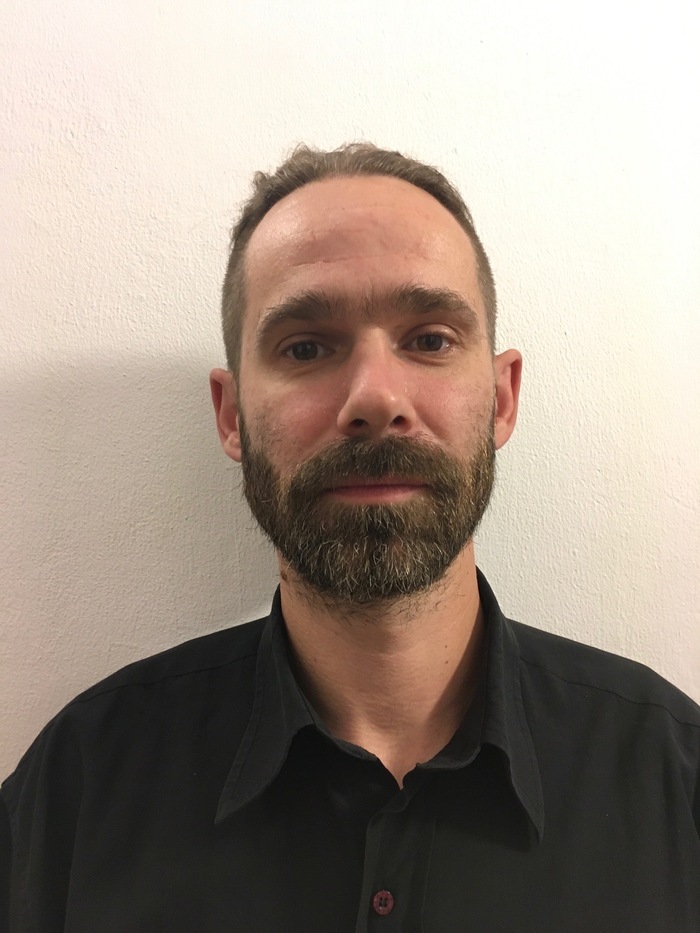
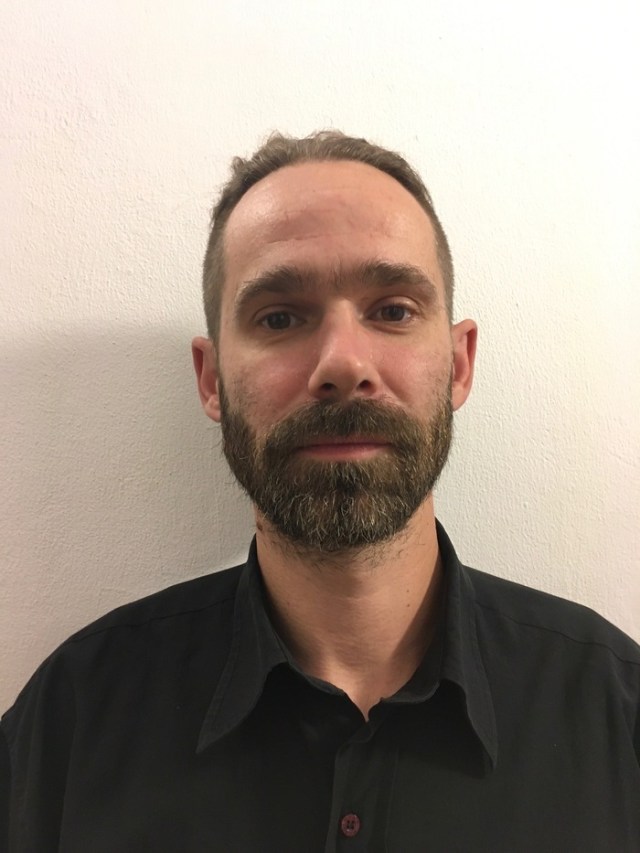
Timoteo Tong grew up in Burbank, CA, imagining epic battles against vampires and witches inside creaky old mansions—and hasn’t stopped dreaming since. He wrote his first book at age eight (a chaotic romance between a stuffed cocker spaniel and a duck) and never looked back. Inspired by the magic of L. Frank Baum, C.S. Lewis, and J.R.R. Tolkien, Timoteo now lives in San Francisco with his husband, where he writes stories full of queer magic, found family, and monsters that don’t play fair. When he’s not reading, writing, or daydreaming about flying, you can find him surrounded by houseplants, doing pushups between chapters, and always down for donuts.
By Timoteo Tong, Author of The Magicals Alliance Series
When most people picture Los Angeles, they think of Hollywood, palm trees, and endless sunshine. For me, though, Los Angeles has always shimmered with something more—something unseen, humming just beneath the pavement and echoing through the canyons. When I set out to write *The Magicals Alliance Series*, I wanted to take that “something more” and bring it to life.
Urban fantasy often asks: *What if magic exists right here, in the places we know best?* My answer was to build a universe where freeways double as ley lines, storm drains hide crypts of forgotten gods, and a drizzle of rain in the middle of summer might just signal divine intervention.
But why LA? Because it’s personal. I grew up wandering through Burbank, hiking in the Santa Monica Mountains, and staring out over the Griffith Observatory at the city lights. Those were the places where I daydreamed as a teen, and in my books, they become battlefields, sanctuaries, and portals to other realms. Every landmark holds a secret: MacArthur Park once turned to ink during a magical breach; the Sixth Street Bridge cracked open to reveal a curse-tree; and in *The Spellbinding Magic of You and Me*, Santangelo Lo Geffo finds himself running the very same streets I once did.
Blending real geography with fantasy lore means readers can feel grounded even as they encounter the impossible. It’s one thing to imagine a dragon’s den—but what if that den is hidden beneath downtown? What if your local park is also the site of a forgotten covenant? That interplay between the ordinary and extraordinary creates a world that feels alive, like magic could be hiding just around the corner.
Another key to my worldbuilding is history. *The Last Battle*, fought in Los Angeles 120 years before the events of the books, was my way of giving the city a magical “past life.” I asked myself: what if the clashes of gods and monsters weren’t just myths, but part of modern history erased from memory? That decision means LA isn’t just a backdrop—it’s a character with scars, secrets, and stories of its own.
Of course, worldbuilding is only half the story. It’s the *people* in this magical LA who bring it to life. Characters like Santangelo struggle not just against monsters, but against grief, identity, and the weight of expectation. To me, that’s what makes the magic believable: no matter how dazzling or terrifying, it’s always tied to human emotion. A golden sword forged on Mount Olympus isn’t just a weapon; it’s also a symbol of Santy’s courage, his mother’s love, and his destiny.
In the end, building magic into the real world is about wonder—but it’s also about connection. I want readers to finish my books and look at their own streets, parks, and neighborhoods differently. Maybe the shadows really do stretch too long at dusk. Maybe the rain is whispering secrets. Maybe, just maybe, there’s more to the world than what we see.
That’s the heart of *The Magicals Alliance Series*: ordinary teens navigating extraordinary magic in the places we know best. Because magic, like love and grief, isn’t something far away—it’s right here, waiting to be found.
Timoteo Tong is the author of The Magicals Alliance Series, a YA queer fantasy saga set in modern-day California. When not writing about magical battles and golden swords, Timoteo enjoys exploring local coffee shops, spending time with family, and dreaming up new ways to bring enchantment into everyday life.
1) Tell us a little bit about yourself. How did you get into writing?
I’ve always had the annoying habit of asking “why?” far too often, which usually results in either a headache or a story. Writing became my way of turning that endless curiosity — and occasional confusion — into something entertaining rather than just irritating to friends and family.
2) What inspired you to write your book?
The spark came from the idea that if planets could think, they might eventually get fed up with us treating them like clueless background props. Add a dash of dystopia, a sprinkle of absurdity, and a hefty nod to Douglas Adams, and suddenly I had a novel on my hands.
3) What theme or message do you hope readers will take away from your book?
That reality is often stranger, funnier, and more fragile than we think and questioning the system isn’t just allowed, it’s necessary. Also, never underestimate the comic value of an overworked, underappreciated bureaucrat. I hope readers will reflect on how our world is slowly ‘spoiling’ the entire plot before we even get to the ending. By that, I mean the dangerous amount of power handed to giant corporations and the not-so-charming, manipulative tendencies of AI. It worries me that some people are already treating it like a therapist — which is both hilarious and terrifying, and not in a good way.
4) What drew you into this particular genre?
I love the collision between the bleak seriousness of dystopian sci-fi and the irreverent humour of satire. When you mash them together, you get stories that can make readers laugh, cringe, and think all at the same time.
5) If you could sit down with any character in your book, what would you ask them and why?
Probably Mr. Smith, the man with the bear’s body. I’d ask: “How do you buy shirts?” Because let’s be honest, some mysteries are too big to leave unsolved.
6) What social media site has been the most helpful in developing your readership?
Goodreads has been great because it connects directly with readers who are already book-obsessed. Instagram is fun too—though I suspect most people are there for the cat photos, not my dystopian ramblings.
7) What advice would you give to aspiring or just starting authors out there?
Write the book you would love to read, not the one you think will sell. And finish it even if halfway through you’re convinced it’s terrible, because that’s usually the point where it starts to get interesting.
8) What does the future hold in store for you? Any new books/projects on the horizon?
Yes, my book is the beginning of a larger universe. I already have two more novels outlined, each diving deeper into the absurd machinery of our so-called “reality.” Whether the universe is ready for them is another question entirely.
Advertisements
Author Bio
Tamás Szikszai is a Hungarian author whose debut English-language novel, The Planet That Was Mistaken for a Fool, blends dystopian science fiction with sharp, satirical humour. Deeply inspired by George Orwell and Douglas Adams, Tamás aims to explore the absurdities of modern society while making readers laugh, think, and occasionally wonder if they’ve accidentally stepped on a Lego. When he’s not writing, he enjoys ska music, strange philosophical debates, and imagining planets with extreme opinions.
1) Tell us a little bit about yourself. How did you get into writing?
I was first introduced to writing in high-school when a friend an I started making radio plays for our English class. For our class finale, we made a movie in which I also acted, directed and spent time behind the camera. In college, I always took creative writing classes and had some poems published.
Advertisements
2) What inspired you to write your book?
The Diva of Mud Flats was inspired entirely by an idea I had for a character that was completely phony, yet actually attained some true notoriety, but couldn’t shake the false persona she created for herself. The other characters defined themselves as I created a story around her.
3) What theme or message do you hope readers will take away from your book?
I hope readers will come away from reading my book seeing how stereotypes don’t define a person and how abusing power will always carry consequences.
4) What drew you into this particular genre?
I have written a lot of genres, but this was my first venture into romcoms. I wanted to write a genre bending story that included scifi, westerns, comedy and romance.
Advertisements
5) If you could sit down with any character in your book, what would you ask them and why?
There are so many interesting and wacky characters in my book, that you could spend days interviewing them, but I might be tempted to sit down with Elizabeth, the diva’s personal manager, and the most normal person in the book. I would ask her how she can tolerate so much abuse from the diva. Answering this question was somewhat cathartic as I realized just how much she is me.
6) What social media site has been the most helpful in developing your readership?
I stopped branding myself on Twitter and have built a small following on tiktok. I have hired a publicist and need to work with her on my social media, but you can find me on tiktok @jonni_jordyn.
7) What advice would you give to aspiring or just starting authors out there?
I think it’s important for aspiring authors to recognize how creative they are. Natural creativity is very important for fiction, but other writers can still pursue a career in nonfiction. Still others may find their niche in editing and publishing. If you have that special spark, find your method, whether you are an outliner or a panster. Then learn how you like to polish it during revisions.
8) What does the future hold in store for you? Any new books/projects on the h (horizon?)
I am currently revising an upcoming novel that I hope to have out by the end of the year. It will be the third and final book of my Virus series. Following that, I think I’ll finish the last book of my grill series, which I think has eight chapters completed. Then, I have to write the last book of my magic series. So, I’m planning out to the end of 2026.
Advertisements
About the Author
Jonni Jordyn, an award winning American author born in Oakland, Ca, started out playing music at age two, and moved on to singing and acting in grade school. High School introduced writing and film making followed by drawing and photography in college. In other words, she had a VERY LIBERAL arts education.
Jonni published some poetry and some india ink drawings in literary magazines while in college, won critical acclaim for her acting in a cabaret theater, but was faced with a decision to pick out the arts she wanted to pursue.
Of all the available opportunities, music and song writing won the first round when she found herself performing with legendary stars of the sixties and seventies.
Round two began years later, after leaving California for Arizona. It all started with a blank piece of paper and the question, “how can I possibly write more than eleven thousand words for a single story?” A valid question which was followed up a year later with, “How did I ever write 160,000 words?”
Now, the writing comes much easier, but still there are questions like, “How will I ever get all these ideas written down?” followed closely by, “How many times can I edit the same book?”
I received a free copy of this book in exchange for a fair and honest review. All opinions are my own.
In Angel Monge’s The Time Codes, an archeologist discovers a history-altering secret and must decipher clues while outrunning dangerous forces.
The Synopsis
Discover The Time Codes, an enthralling historical thriller where ancient secrets, mystical artifacts, and conspiracy collide on the mysterious streets of Istanbul.
Michael Rothban, an archaeologist, makes a life-changing discovery in a forgotten library—a hidden manuscript linked to a legendary alchemist. What starts as a simple find quickly spirals into a dangerous quest, unlocking centuries-old secrets that could alter the course of history. Chased by powerful forces intent on keeping these secrets buried, Michael must decipher cryptic codes while staying one step ahead in a race against time.
As danger mounts and allies emerge from unexpected places, Michael’s journey will test his wits, courage, and heart. With a touch of romance and a sweeping narrative that blurs the lines between past and present, The Time Codes will keep you on the edge of your seat.
For fans of Dan Brown, historical mysteries, and thrillers packed with intrigue, The Time Codes is a must-read. Dive into a gripping adventure where every page brings you closer to uncovering a truth that could change everything.
Unlock the mystery today and join the adventure.
The Review
A genuinely compelling and captivating read. The author does an excellent job finding the perfect balance between historical fiction and science fiction thriller. The way the city of Istanbul and its history became its character in a sense more than just a setting allowed the reader to feel transported, engaged with the natural beauty and man-made iconic locals that helped elevate this narrative and engage in the rich imagery the author’s writing produced.
The book’s heart was in the character development and the narrative itself. Exploring alchemy and how advanced science could have played a role in ancient history and mythology was so consuming as the story progressed. Getting to explore the secret society known as Tempus and how they evolved was fun, and yet the emotional core of protagonist Michael and how he grows after suffering a significant loss and learning to love again made this a relatable and heartfelt story at its core.
The Verdict
Author Angel Monge’s “The Time Codes” is a must-read novel, a thrilling and expansive historical fiction meets sci-fi thriller. The shocking twists and turns, the open-ended mysteries, and the cliffhanger ending for some characters will have fans eager for more entries into this fascinating new series. If you haven’t yet, be sure to grab your copy today!
Rating: 10/10
About the Author
Angel Monge is a storyteller born amidst the rich coffee lands of Costa Rica. Having journeyed across the Americas, from the bustling streets of Toronto to the welcoming embrace of Santander, Colombia, he has soaked up a tapestry of cultures that infuse his writing. With “THE TIME CODES,” Angel weaves a thrilling adventure of mystery and discovery, marking his literary debut with a story that is as breath-holding as it is soul-warming. A lover of thrillers with a deep appreciation for narrative, Angel combines his passion for history with a talent for crafting tales that traverse the boundaries of time and space. In his personal life, he is devoted to his family as a husband and father of two boys and finds his strength and guidance in his Christian faith. With a voice as authentic as the lands that raised him, Angel Monge invites readers to dive into stories that promise not just entertainment but also a window into the mysteries that have captivated humankind throughout the ages.
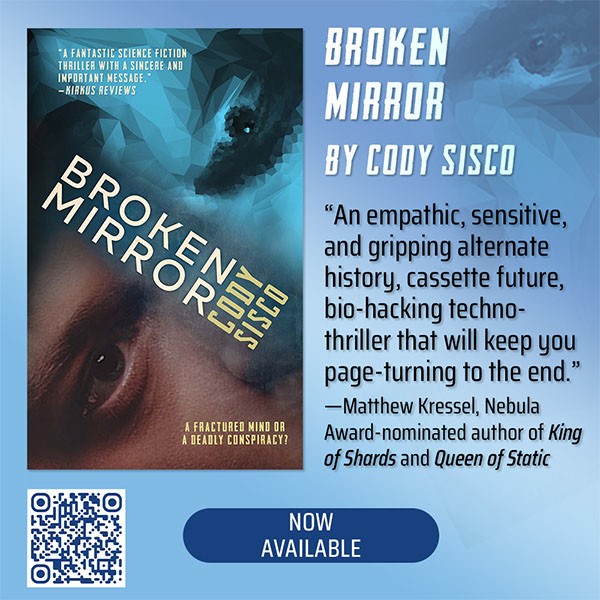
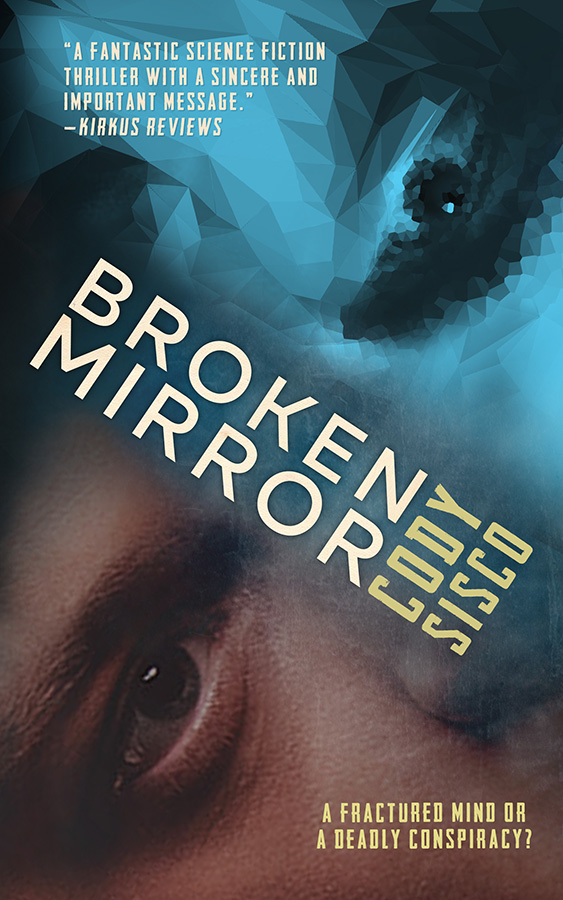
Cody Sisco has a new queer sci-fi mystery thriller out, Resonant Earth book one: Broken Mirror. And there’s a giveaway!
A fractured mind or a global conspiracy? Uncovering the truth can be hell when nobody believes you… and you can’t even trust yourself.
Broken Mirror is the first volume in a queer psychological science fiction saga that looks at the stigma of mental illness and the hellish distrust and alienation that goes with it.
Victor Eastmore knows someone killed his grandfather, the pioneering scientist Jefferson Eastmore. But Victor, diagnosed with mirror resonance syndrome, has been shunned by Semiautonomous California society. Nobody will believe a Broken Mirror. Now Victor must tread the line between sanity and reclassification—a fate that all but guarantees he’ll lose his freedom.
With its self-driving cars, global firearms ban, and a cure for cancer, the science fiction world of Broken Mirror may sound like a near future utopia, but on Resonant Earth, history has taken a few wrong turns. The American Union is a weak and fractious alliance of nations in decline. Europe manipulates its citizens through propaganda. And Asia is reeling from decades of war.
Determined to uncover the truth about Jefferson’s murder, pansexual Victor and his trans friend Elena set out on a road trip that takes them across the American Union from Semiautonomous California through the Organized Western States to the Republic of Texas. But Elena is holding something back, and Victor’s condition worsens.
Amid shifting geopolitical sands, Broken Mirrors like Victor find themselves at a cyberpunk crossroads: evolve or go extinct.
Warnings: violence, discrimination against characters with mental health challenges
A new universe, its vibrations, called to me, and I answered, ignorant of the harm in crossing over. —Victor Eastmore, Apology to Resonant Earth, (transmission date unknown)
Semiautonomous California 29 February 1991
It’s one thing to die quietly with things left unsaid among family members. It’s another thing to do what the great Jefferson Eastmore did with his secrecy and architecture of conspiracy: keep essential truths from Victor and put him on a collision course with an uncanny future.
Victor gazed across City Lake toward the tessellated foothills, where the elite families of Oakland and Bayshore kept their hedges trimmed and thorny. His grandfather’s sarcophagus was up there, surrounded by marble pillars and gold-gilt fencing shaped like twisted strands of DNA. A tidy and neat brick gravemound would never have sufficed, since at the end of his life, Jefferson was as grandiose as his cancer-curing career. The stones were plucked from the canals of New Venice, and a plaque listed the man’s many accomplishments. Not listed was his failed effort to cure Victor of mirror resonance syndrome.
Victor spun around to face the city skyline. The morning was bright and windy. The timefeed on his MeshBit indicated thirty minutes until his reclassification appointment. He could go and wait in the anteroom, but his anxious vibrations might shake the building to its foundations.
He took a breath. No going back. Before the sun reached its zenith that day, his path would materialize. If he were lucky, he could stay a Class Three: free but under close supervision. Or he could become a Class Two: under guard, imprisoned, at a rancho in the hinterlands. He whispered a cherished but inconsistently effective mantra to fight off brain blankness: The wise owl listens before asking who. Each episode of blanking out was one more step toward mirror resonance syndrome’s inevitable tragic end: becoming a comatose Class One, insensate, a forgotten ward of the government. The only unknown factor was how quickly the future would crash against him.
He trudged along the shoreline, tensing and relaxing his jaw, trying to distract himself. Glittering towers rose exultantly cityside. Squally breezes swooped out of a cloudless, azure sky and assaulted bulrushes, sedges, and cattails in the shallows where a grid of waterplots penned them in.
Granfa Jefferson had been poisoned. Victor knew it. He had proof. But his family didn’t believe him, and if he said any more about it, he would be locked away. Fair? No. Surprising? Not really. After all, his life was a farcical succession of tragedies. It wasn’t time to give up, though. Not while he had unanswered questions.
The palm trees encircling the lake rustled like cheerleaders shaking their pom-poms. The water rippled, creating countless sun flashes on the lake’s surface, and afterimages glowed and pulsed when he closed his eyes. The stench of goose shit turned his stomach.
He wedged the MeshBit’s detachable sonobulb in his ear, then called Elena. She answered right away. This was not the first time her promptness was suspicious.
“See?” she said. “When a friend calls, you should answer. Right away. Not never.”
“I know. I need your help,” he said. “My appointment is here. I’m having trouble.”
“Where are you?” she asked.
“City Lake. West shore.”
“I can’t get there in time.”
You were there for Granfa Jeff’s funeral. You showed up at my apartment whenever you wanted. Why can’t you be here now?
“Then talk to me,” Victor said. “Anything to keep my mind off my theories about Granfa Jeff.”
At the time, Victor had nothing close to the truth about Jefferson’s secret messages and plans for conspiracy and counter-conspiracy. He couldn’t have guessed his role in the proliferating conflagration that would transform every person on Resonant Earth and beyond. No one could have predicted the neuro-contagion that eventually radiated beyond the American Union of Nations, or the mind-machine hybridization that became humanity’s destiny, or the fact that crossing over to another world would become a possibility rather than paranoia. If Victor had guessed any of it, he might have failed his reclassification deliberately and shown up at the gates of a rancho to check himself in. All this was a lot to have piled onto a mentally unstable young adult.
“But you found radiation on the data egg,” Elena said. “I believe you. We’re going to figure this out.”
Author Bio
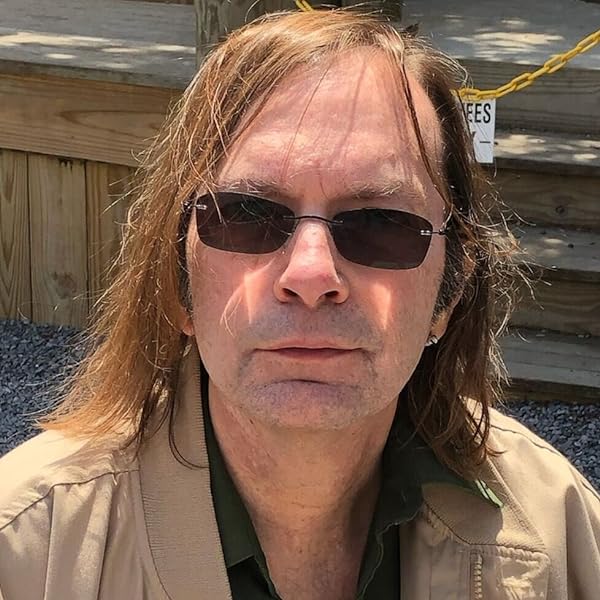
Cody Sisco is an author, editor, publisher, and literary community organizer. His LGBT psychological science fiction series includes two novels thus far, Broken Mirror and Tortured Echoes. He is a freelance editor specializing in genre-bending fiction and the acquisitions editor for RIZE Press. In 2017, he co-founded Made in L.A. Writers, an indie author co-op dedicated to the support and appreciation of independent authors. His startup, BookSwell, is a literary events and media production company dedicated to lifting up marginalized voices and connecting readers and writers in Southern California and beyond. He serves as a co-executive on the Board of Governors for the Editorial Freelancers Association, as the treasurer for the LGBTQ+ Editors Association, and as a board member at APLA Health.
In the world of Broken Mirror, cancer has been cured, civil rights for all citizens of the American Union of Nations are respected, and guns are strictly regulated everywhere. At first glance, I can see why you might think it’s a utopia. Indeed, librarians catalogued the book that way.
Cataloging is an interesting process. Publishers submit their data to wholesalers and retailers using standard categories. But librarians also have a say on how a book is categorized. It’s their expertise and their domain. So it was at first a surprise and then a delight, after the first edition of Broken Mirror was published in 2016 and I was looking up where the book was available at libraries across the country, when I discovered that it had been categorized under Utopias and Utopian Fiction, among other designations.
Fast forward to when I attended the American Library Association conference this year in San Diego. The convention center—the same one that hosts Comic Con—was filled with people who work with books in all kinds of ways. There were authors, publishers, artists, publicists, technologists, and of course librarians. The librarians who attended were looking for books to acquire but also for ideas and systems to help them run programs for their patrons, which vary from book collections and author talks to crafts, literacy courses, VR and technology hubs, and much more. In a way, libraries are the custodians of a utopian version of the future that is accessible, small-d democratic, and built on concepts of intellectual freedom, self-improvement, and community care.
However, I can understand how readers might have some qualms about calling my book a utopia. First, it’s too dark. Kirkus Reviews wrote that “the world and the characters work together to effectively form a cohesive story about how easy it is for society to classify a group of people as dangerous outsiders.” Juliana Caro reviewed the book for Reedsy and called it “a breathtaking, deeply dark alternate-history Earth with complex characters, layered worldbuilding, and twist after twist after twist.” Bleak, right?
The other problem with calling Broken Mirror a utopian book is that, when I try out the phrase, I get too many blank stares in response. Everyone is very clued in to what a dystopia is: the end of the world, things changing in unsettling ways, dark powers controlling things in secret. There are some elements of this in my book, but they’re balanced by those nice things like everyone enjoying civil rights.
The story is also definitely not about a false utopia, where things appear great on the surface, but danger lurks beneath the surface. The dangers in my book are part of the premise and they are front and center on purpose. We are familiar with false utopias through tropes introduced to the popular imagination by Twilight Zone, Star Trek, and many others, such as The Truman Show, Black Mirror, WandaVision, etc. But I’ve always been writing what I see as a realistic and balanced story about how our present could be if we made different choices throughout our history.
It’s important to note that a utopia is not a place where everything is perfect. It’s a thought experiment that imagines different structures and forces, sometimes hidden, sometimes plain as day, that shape society.
I’m coming to terms with the label of utopian fiction. Resonant Earth imagines an alternate history of Reconstruction after the U.S. Civil War being successful. In other words, formerly enslaved people gain full citizenship and civil rights. Women were a key part of the abolitionist movement, so I also imagined that they won the right to vote and full participation in civic life and the economy. Imagine if America could wake itself from all its awful, destructive, and painful -isms by the turn of the century (and by that I mean 1900). What kind of world would we live in today?
It’s very easy to become pessimistic about the future of humanity. Global conflict, biosphere degradation, the simply terrifying physics of climate change—who is going to save the world from such calamities? The answer is that each of us as individuals can come together to implement solutions. If I can’t live in utopia, at least I can write about one, live there in my imagination, and bring that creativity and resolve back into the real world.
I received a free copy of this book in exchange for a fair and honest review. All opinions are my own.
An alien species arrives on earth to prevent the human race from destroying themselves, but not everything is as it seems in author Alan M. Weber’s “A World Apart”.
Advertisements
The Synopsis
Existential Threats & Human Survival: A Cerebral Sci-Fi Epic Tackling Racism, War, Environmental Destruction and Societal Divisions.
Delve into the mind-bending universe of Alan M. Weber’s latest masterpiece, A World Apart. This gripping narrative takes readers on an emotional rollercoaster, exploring the depths of human existence and the looming threats that could lead to our extinction.
The story unfolds as mysterious entities, having observed our self-destructive tendencies through centuries of war, injustice, and environmental degradation, decide to intervene. They present humanity with a seven-point survival program. But is this a lifeline or a leash? Are these entities our saviors or colonizers? And what else have they brought with them? The answers to these questions form the crux of this riveting tale.
Weber, known for his thought-provoking works like The Mensch, What Kimi Discovered, Miens of Existence, and The Wedge, once again showcases his knack for crafting socially conscious narratives. His storytelling prowess shines through this science fiction epic, reminiscent of a novel-length version of The Twilight Zone.
A World Apart is not just a tale of survival; it’s a mirror reflecting our societal divisions. It’s a call to action against the existential threats we face – environmental degradation, racism, war, and the erosion of freedom and justice. It’s a commentary on the gun control debate and a plea for unity in a world torn apart by fear and hate.
This book is a must-read for science fiction enthusiasts and political thriller aficionados alike. Its speculative elements are sure to captivate the former, while its exploration of contemporary issues will resonate with the latter.
In A World Apart, Weber has created a world that is simultaneously familiar and alien, a world that forces us to confront the uncomfortable truths about our existence. It’s a world that asks us a simple yet profound question – must we save our Earth from them or from ourselves?
The Review
This was such an insightful and compelling sci-fi novel. The fast pacing of the narrative helped showcase the seriousness and urgency of the novel’s themes, and the character development helped reflect relatable individuals and drive the plot forward naturally. The tension that grows and the heavy atmosphere surrounding this book’s premise shows a depth of intrigue that keeps the reader engaged with these characters.
The heart of the story is in the prominent themes that are featured. Sometimes, to see a problem clearly, one must be willing to take a step back and get an outside perspective on the situation. The author takes this to an extreme yet shockingly necessary place, with an alien race showing the hostility and destructive nature of mankind throughout the centuries and the threat to both ourselves and the planet mankind is. The question of morality, survival, decency, and camaraderie come into play brilliantly here, and the back-and-forth struggle as those seeking change come against those who refuse to see a brighter future charges the action moving forward in this narrative.
The Verdict
Thought-provoking, shocking, and entertaining author Alan M. Weber’s “A World Apart” is a must-read sci-fi meets philosophy and political thriller novel. The realistic depictions of the divided political lines so many people reside in nowadays and the shocking twists in the narrative will keep readers on the edge of their seats and paying attention to the realities mirrored in this book from our world. If you haven’t yet, be sure to grab your copy today!
Rating: 10/10
Advertisements
About the Author
Alan M. Weber was born in the Bronx, NY, and now lives in Woodstock. Always a writer, he gave poetry readings around Manhattan’s Greenwich Village in his early twenties, engaged in political activism in college, and wrote extensively in his professional field of Education. Approaching his retirement from a field in which he had worked as a teacher, school administrator and professor of early childhood education, he began a second, long-delayed career as a novelist. He has authored seven books, two for children, five for adults, spanning themes of politics, meta-psychology and the power of love.
I received a free copy of this book in exchange for a fair and honest review. All opinions are my own.
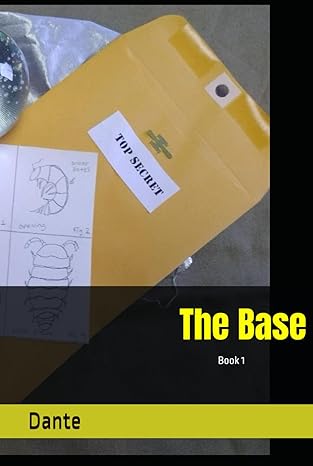
A secret military base doing cutting-edge research becomes the center of competition and deception as a new invention could either lead to a brighter future, or be mankind’s downfall in author Dante Terese’s “The Base”.
Advertisements
The Synopsis
The Base: From the most “Top Secret “military base in the country comes this tale of jealousy, deception, intrigue and triumph. The newest most sought-after military innovation “The Project” is about to be released, after many years of research by the military’s elite scientists. Unfortunately, there are many who seek to steal and intercept the invention for their own agenda.
Written from the inside of a place that few have ever seen with the most forbidding climate to keep outsiders away we follow our developers to the completion of their mission. Their success depends on a sacred trust and ethics while they live in conditions that would try even the strongest most resolute soul.
‘The Project” must succeed or we all will fail – and it will fall into the hands of the enemy.
Will they stay true when their spirits are put to the ultimate test?
Or will we all soon be controlled by the invention that was intended to keep us safe?
A very probable story with many valuable lessons about the competitive nature of cutting-edge research, the courage it takes to succeed both as a scientist while staying one step ahead of the spies and thieves that lurk everywhere.
“The Base” is a suspenseful, gripping story with many unforgettable characters. (It is the first book in a series)
The Review
This was such a compelling and engaging short sci-fi read. The author brilliantly takes readers into this narrative with a fresh perspective, giving a first-person account from the eyes of a young girl living with her family on a military base. The early establishment of her family dynamics, from her mother’s mystery at living in such an isolated space to her father’s understanding of nature and secretive work, helps establish a base to which the reader can easily relate to the characters in this novel.
The heart of this narrative is in the world-building, which allows both the imagery and scientific creations discussed in this book to feel vibrant and alive, thanks in part to the masterful use of imagery in the author’s writing. The Vector-1 experiment early on in the story, and the evolution that work takes on, mixed with the mystery and intrigue that comes with any military thriller as other entities try to gain the technology for themselves, make this a thrilling story to get lost in.
The Verdict
Fast-paced, suspenseful, and entertaining, author Dante Terese’s “The Base” is a wonderful sci-fi novel and a grand first entry into a new series. The twists and turns in the narrative and the honesty for which the protagonist speaks gave the mystery and world-building the solid foundation it needed for readers to get invested in. If you haven’t yet, be sure to grab your copy today!
Rating: 10/10
Advertisements
About the Author
Dante Terese is a dynamic new voice in fiction, blending deep themes with compelling narratives in her work. Her debut novel, Sex, Death, & Diane, celebrates the courage of those who dare to think independently and speak their truths, exploring the quiet power within each of us.
Her recent science fiction release, The Base, takes readers into the high-stakes world of military research, where ethical dilemmas and espionage intertwine in a suspenseful tale of innovation and integrity.
I received a free copy of this book in exchange for a fair and honest review. All opinions are my own.
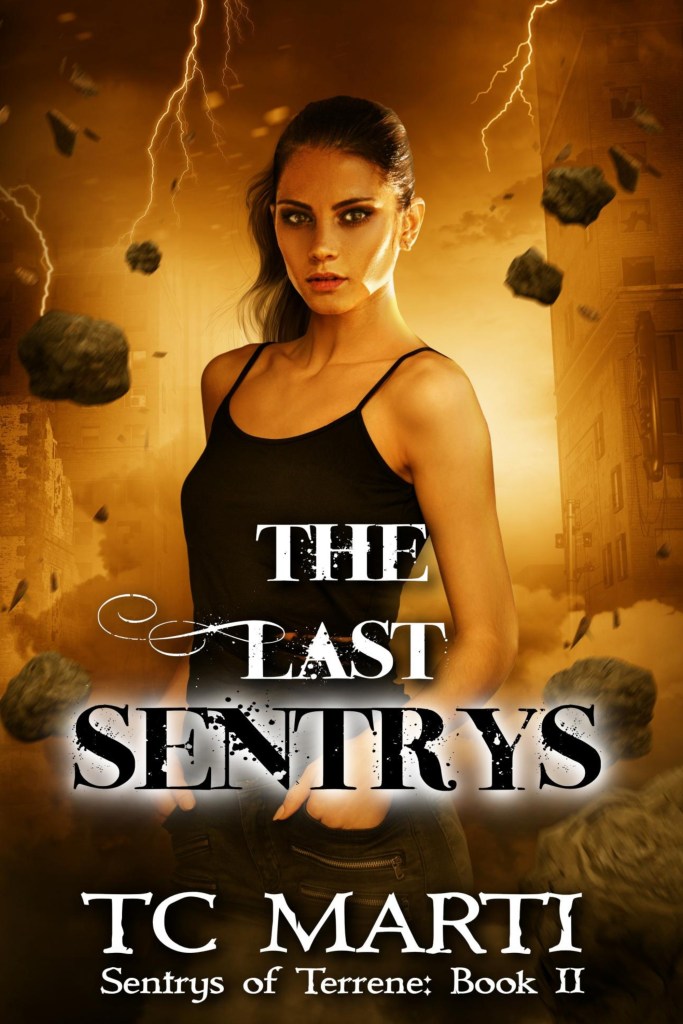
A young woman stands between her mentor’s legacy and her father’s evil plans as she must discover the true extent of her own power to save her world in author T.C. Marti’s “The Last Sentrys”, the second book in the Sentrys of Terrene series.
Advertisements
The Synopsis
A time of turmoil engulfs the Lost World of Terrene…
Sabre Kjaergaard stands at the heart of the conflict, torn between the legacy of her late mentors and the sinister designs of her biological father, a leader in the imperial Venn Order. With her powers evolving and the stakes higher than ever, she must seek the legendary Minch Ware, the last known Spirit Elysian Master, to unlock the secrets of her rare abilities to control both Earth and Spirit.
But the path is fraught with danger. As her father’s forces close in, the ultimate fate of Terrene hangs in the balance, with Sabre’s choices pivotal in an intensifying war that threatens to engulf their reality.
Join Sabre as she navigates through betrayal, love, and the trials of destiny. The battle to restore liberty is heating up, and every page in this post-apocalyptic dystopian science fantasy promises an adventure where only the strongest will survive.
The Review
This was a wonderfully written and compelling read. The author does a fantastic job of expanding upon the mythos and heart of the first novel and the overall series. The theme of legacy and identity runs through this novel beautifully, highlighting the need for balance and control in one’s life. The tension and atmosphere are perfectly on display throughout this book.
Yet, the character’s growth and action drew the reader into the narrative. The relationships that protagonist Sabre develops throughout the narrative, from her brother and the people she works with against her father to the growing romance in her life and the growing need to better herself to prevent her world from collapsing in on itself, gave the readers an honest look into the feelings and thoughts of this character so brilliantly.
The Verdict
Action-packed, thrilling, and entertaining author TC Marti’s “The Lat Sentrys” is a must-read and a grand entry into the Sentrys of Terrene series. This novel’s world-building and character development were outstanding, and the cliffhanger final scenes will keep readers hooked as they anticipate the next book in the series. If you haven’t yet, be sure to grab your copy today!
Rating: 10/10
Advertisements
About the Author
TC Marti has been an avid reader/writer for over three decades. He is the author of the Elementals Universe, a shared speculative fiction universe spanning multiple series. He is also a workout fanatic, and a fan of Arizona sports teams.