I received a free copy of this book in exchange for a fair and honest review. All opinions are my own.
Author K.S. Penn shares her harrowing story of breaking free from a cycle of violence and abuse and sheds a light on the rarely discussed cases of a child against parent abuse in her book, “The Evil I Own: My Son’s Prisoner”.
Advertisements
The Synopsis
A schoolgirl’s crush turns into a nightmare. Her fairy tale will not be coming true, and breaking free won’t be enough to stop the cycle of abuse.
The Evil I Own is a harrowing and brave story about family abuse. Partner abuse. Child abuse. Child-to-parent abuse.
This memoir recounts the painful and courageous story of Ellie, whose journey entails finding her way out of a life of violence and abuse. It will introduce a taboo-subject: Child-to-parent abuse, also known as child-to parent violence. It is one of the most under-reported and under-researched subsets of family violence. It is often ignored or misidentified. The effects of experiencing abuse from one’s child can be profound. Ongoing parent abuse has been found to impact on a parent’s and other family members’ physical and psychological health, with specific negative emotions such as fear, shame, humiliation, guilt and despair, and so they rarely seek help. There is stigma and disgrace around the concept that a child might choose to hurt a parent, and parents often attempt to ignore, placate, or surrender to these behaviours. It may include verbal abuse and name-calling, property damage (such as punching holes in the walls), financial abuse and the ultimate- physical abuse. Tragically, in some cases, even sexual abuse. Child-to-parent violence has been found to occur more commonly when the offending child has experienced violence perpetrated by a parent.
Ellie’s story will resonate with those who have lived with violence and educate others who may not understand how difficult it can be to leave an abusive situation. Sometimes life’s challenges and struggles can make you a stronger person. Perhaps Ellie was meant to survive and share her story. Perhaps in sharing, people see their own lives and stories more clearly.
Clearly written with insightful awareness and interspersed with messages of resolve and hope.
Recommended for readers 18+ due to scenes of graphic violence and sensitive issues.
The Review
This was such a heartbreaking yet engaging story. The author’s raw emotions and painstakingly vivid accounts of the years of mental, verbal, and physical abuse she suffered both at the hands of her husband and her child made this tale so tragic, and yet the author’s strength and courage in sharing her story help showcase the importance of speaking up against the cycle of violence so many people find themselves in throughout their lives.
The vivid details of the years the author experienced this tragedy did an important job of highlighting the patterns and signs that exist within these types of relationships. The balance the author struck with memoir-style storytelling and the harrowing accounts of abuse and the signs and symptoms associated with it made this story feel both well-rounded and vital to read. The thing people rarely ever look at when studying the life of a violent person is how their parents were affected, and how parents can be targets of abuse just as children or spouses can. The exploration of such a difficult subject was handled with honesty and courage on the author’s part, and this was reflected in the author’s superb writing.
The Verdict
Emotional, painful, yet vitally important, author K.S. Penn’s “The Evil I Own: My Son’s Prisoner” is a must-read memoir and nonfiction read. The heartfelt way the author wrote and the thought-provoking content of the author’s personal story is filled with tragedy, heartbreak, and shocking twists and turns that leave the final chapters with a shocking and gripping conclusion. The impact of abuse on both children and spouses is explored heavily throughout half of the book, and the impact is felt when the child becomes the abuser later on in the story, and the author’s fight to overcome both is one many readers can either identify with or root for, and we are grateful to see the author’s strength in every chapter of this book. if you haven’t yet, be sure to grab your copy today!
I received a free copy of this book in exchange for a fair and honest review. All opinions are my own.
A mysterious attack leads to a world changing event in author Lachlan Walter’s We Call It Monster. Here is the synopsis.
The Synopsis
One ordinary day, an enormous creature dragged itself out of the ocean and laid waste to a city. In the months and years that followed, more and more creatures appeared, until not a single country remained untouched. At first, people tried to fight them. In the end, all they could do was try and stay alive.
We Call It Monster is a story of forces beyond our control, of immense and impossible creatures that make plain how small we really are. It is the story of our fight for survival and our discovery of that which truly matters: community and compassion, love and family, hope and faith.
The Review
This is by far one of the most original and “human” stories set in a world filled with larger than life monsters. Bringing the large scale destruction of any Godzilla or King Kong style film and blending it in with the character development and connectivity of a film like Crash, the novel explores a sudden war with mysterious monsters that threatens to end the world as we know it. The author changed the formula up however by focusing not on the monster’s origins or larger than life battles, but instead the relationships and struggles of those affected by these events.
Each section of the novel focuses on specific years in this “war”, from the creatures emergence across the world to the economic struggles and loss of life felt by the people around the world. Each chapter focuses on a character introduced in the previous chapter, allowing readers to see how connected we all are to one another, and allowing us to see how the monster’s arrival affects everyone differently. The emotional impact of these creature’s destruction and the slow decline the planet faces brings a new focus on the monster genre, and creates a truly impactful story like no other.
The Verdict
A true must read novel of 2019, author Lachlan Walter has exceeded the expectations of the genre and created a narrative that is truly original. Exploring the affects the monsters have on our society, on the planet and the people left behind in their wake, the heart of this novel rests in it’s fantastic character development, and will leave readers on the edge of their seat as they witness the slow ride into the end of the world as we know it. If you haven’t yet, be sure to pick up your copy of We Call It Monster today!
Lachlan Walter is a writer, science-fiction critic and nursery-hand (the garden kind, not the baby kind), and is the author of two books: the deeply Australian post-apocalyptic tale The Rain Never Came, and the giant-monster story-cycle We Call It Monster. He also writes science fiction criticism for Aurealis magazine and reviews for the independent ‘weird music’ website Cyclic Defrost, his short fiction can be found floating around online, and he has completed a PhD that critically and creatively explored the relationship between Australian post-apocalyptic fiction and Australian notions of national identity.
He loves all things music-related, the Australian environment, overlooked genres and playing in the garden. He hopes that you’re having a nice day.
AN EXTRACT
The old man shuffled out to the balcony, dusted off an outdoor chair and
then made himself comfortable. The sky was a shade of blue that painters
only dream about; it was a beautiful sight. The old man drank it in,
leaning back in his chair. He sipped at his coffee and smoked a cigarette.
He was happy to wait as long as was necessary – he had all the time in
the world and he wasn’t going anywhere.
The monster finally appeared, a blurry smudge in the distance.
Slowly, but not as slowly as he would have thought, it grew both
closer and more distinct. The old man laughed out loud; it looked like
nothing more than a child’s drawing of something that might have been a
lobster or might have been a spider or might have been both, propped up
on flagpole-like legs that supported a wetly-shining carapace, a beaked
head, and a tail as long as a bus.
It was enormous and ridiculous in equal measure. The old man was
surprised to find that it failed to frighten him.
It drew closer to the city. It stopped suddenly and bit a great chunk
out of a stately old tree lining a boulevard. Chewing slowly and
methodically, it worked its way through the mass of wood and foliage
before throwing its head back and opening its mouth wide. Despite his
deafness, the old man felt the monster’s keening in his bones and in the
pit of his stomach.
He pulled his hearing aid from his pocket, turned it on then slipped it
in place.
The beast’s cry was low and mournful, more a melancholy bellow
than a ferocious roar. Thankfully, the klaxon-blare of the evacuation
alarms had stopped. The monster cried out again and it shook the old
man, both literally and metaphorically. The beast shifted its legs,
presumably adjusting its weight, and destroyed an office building in the
process.
Almost comically, it looked down at the destruction it had wrought
and seemed to shake its head.
It looked back up and cried out a third time, and then started walking
again. It seemed to meet the old man’s eye. Without breaking its gaze, the
old man took another sip of coffee before lighting another cigarette.
Slowly-slowly-slowly, the monster drew closer. You could almost see
a smile on the old man’s face.
A Q&A WITH THE AUTHOR
What is it about giant monsters that appeals to you?
Initially, it was a childish fascination with things being smashed. Let’s face it: Every little kid has thrown a tantrum for reasons they can’t explain, broken something and then experienced relief at the wordless release this brings. A giant monster barging through a city for no fathomable reason can reflect our own difficulties in articulating and making sense of our emotions at that age.
This fascination soon turned to awe and wonder at their scale and mystery, a reflection of the feelings inspired in me by my discovery of dinosaurs and cryptozoology (the study of creatures such as the Loch Ness Monster, Bigfoot, Yetis and the like). My love of dinosaurs is easy to explain – show me a kid who hasn’t at some point gone through a ‘dinosaur’ phase’ and I’ll eat my hat – while my love of cryptozoology was inspired by a book entitled Creatures From Elsewhere, which my parents gave me and which is actually still sitting on my bookshelf.
Beginning in my teenage years and continuing on into the present day, I’ve loved the metaphorical and symbolic potential that giant monsters possess, and the ways in which they can ‘stand in’ for so many different problems that seem beyond our control and almost impossible to deal with. Nuclear war, our negative impact on the environment, international terrorism, industrial pollution, climate change, the staggering number of displaced people around the world – giant monsters have represented them all.
Why did you decide to write about giant monsters?
As mentioned, I’ve always been fascinated by them. But I’ve also always been a voracious reader, and sometimes an obsessive one. I’ve been known to occasionally get my nerd on for a particular sub or micro-genre, looking up ‘similar title’ and ‘you might also like’ lists online when I should be doing better things with my time. But I still keep searching, because there can’t just be one example of Mystery Sub/Micro-genre X out there.
Giant monster fiction was one such obsession that carried me away, the timing of which coincided with the completion of my first book. I binged on literally anything I could find, looking for something that took giant monsters as seriously as some of the movies do, something that was more than just capital-A action. I found lots of fun, post-modern stuff out there – some of which could even be described as zany – but not much that approached giant monsters with a serious eye.
Looking for a new book to throw myself into writing – a book that I wanted to be distinctly different from my first book – I decided upon a piece of serious giant monster fiction. In other words, I decided to write the book that I wanted to read. Isn’t that what an author does?
Do you need to be a fan of giant monsters to appreciate We Call It Monster?
Nope, but it probably helps… In all seriousness, though – no, you don’t need to be a fan. My aim with We Call It Monster wasn’t only to write a serious piece of giant monster fiction because giant monsters have, historically, rarely been written about in such a way. Instead, I also wanted to write a piece of speculative fiction that does what all good speculative fiction should: Use the speculative element within to make us look at ourselves and our place in the world with fresh eyes.
Despite its title, We Call It Monster is more concerned with people than monsters. It isn’t a ‘wham-bam, shoot-em-up’ but instead a serious look at how we might react to forces beyond our control, and to forces that illuminate the precariousness of our position as world-conquerors sitting atop the food chain. And ultimately, it’s the story of what really matters: community and compassion, love and family and friendship, hope and faith. Anyone that appreciates such people-centric stories should find something within We Call It Monster that they can enjoy.
Why did you decide to write We Call It Monster as a story-cycle/novel-in-stories?
To me, one of reading’s biggest attractions has always been in my sense of engagement with the world being built on the page (a process even more absorbing when reading science fiction and speculative fiction). I think this enjoyment of engagement applies to most people. We all ‘see’ things in written worlds that the author didn’t actually write, even at the most mundane level: we populate a footpath with pedestrians, a street with cars.
A story-cycle/novel-in-stories can increase this sense of engagement to an incredibly strong degree, and their traditional structures allow writers to work magic. They can give us different perspectives on the same events, blocks of ‘missing time’ that exist between stories/chapters, events that are only alluded to rather than seen first-hand, a multiplicity of narrative “voices”, and so much more. But ‘missing time’ begs to be filled; events only alluded to tantalise us; we can’t know the truth when presented with different perspectives, or even if the truth exists. And so our minds do this work for us, conjuring up and giving life to parts of the story the writer has withheld.
The way story-cycles/novels-in-stories allow us to create the world right alongside the writer is a beautiful thing. However, the structures behind them aren’t just beautiful, but also incredibly practical. They can allow a story to cover a span of time longer than a regular person’s life; and help do away with the inevitable and repetitive ‘amazing coincidences’ that prop-up stories where one single character guides us through an incredible sequence of events covering an incredible amount of time; and enable a wider representation of voices from a wider variety of countries and cultures, without also falling back on the aforementioned trope of inevitable and repetitive ‘amazing coincidences’.
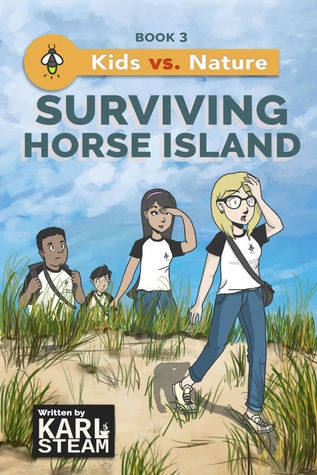
A refreshing change in scenery promises a day of fun for four middle school kids, but the reality of survival hits home in unexpected ways in author Karl Steam’s novel Surviving Horse Island, the third book in the Kids vs Nature series. Here’s the synopsis:
Josh and three of his classmates have proven they can survive a forest and a desert, but what about an island? Can they finish a third mission and make it home alive?
This third book takes an interesting turn, as for the first time the protagonist and the other kids caught in this endless web of survival missions the app brings them on find an environment that promises fun and adventure. The author does a great job of highlighting the beauty of the world, and also showing that beauty has to be respected and cared for, as untold dangers and survival skills are needed in the most beautiful of locations.
The growing character growth and blooming relationships between characters in the book promise a deeper and engaging story than ever before. The visuals do a great job once again of creating an even and free flowing story that both educates the reader and hooks them with relatable characters.
Overall this was a wonderful read that only makes readers crave more and more of the story. With the power of the app growing and the mystery of it’s development only becoming more shadowed, the third book in this series does a wonderful job of educating readers on survival on an island and how to fend for yourself in the wild, all while drawing the reader into a fast paced read that you won’t be able to put down. If you haven’t yet be sure to pick up your copy of Surviving Horse Island by Karl Steam today!
Check out my review of book one here and book two here.