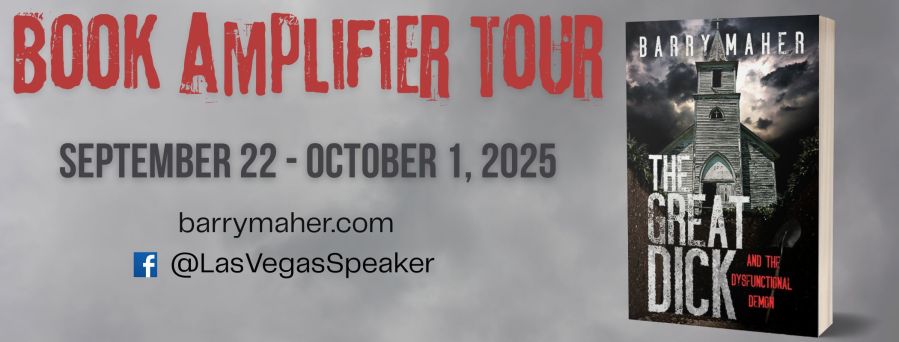
I listen to music when I write. This column for example is being created with the help of—or perhaps in spite of—a piece of music that seems to be an unfortunate blend of God Save the King and The Moldavan National Anthem. But creating my new supernatural thriller, The Great Dick: And The Dysfunctional Demon, a thriller that’s able to laugh at itself, (one reader called it “Horrifying and Delightful!”) required an even more horrifying type of music. Music like:
Dust by Fleetwood Mac
Fleetwood Mac? Aren’t they much too pop for horror? Actually Dust was from an early incarnation of Fleetwood Mac, with no hits and lots of drug problems, not the later version of the group with lots of hits and even more drug problems. The lyrics to Dust come from a 1909 poem by Rupert Brook, who was no bundle of sunshine.
“When your swift hair is quiet in death And through the lips corruption Thrust to still the labor of my breath”
Midnight Mile by the Rolling Stones.
This haunting tune about a mad day on the road “with a head full of snow,” gets me picturing Keith Richards as the guitar playing, coked-up, walking dead. Perhaps not a huge stretch.
I Put a Spell on You by Screaming Jay Hawkins. Writing about obsession?
Here’s Screaming Jay screaming that he doesn’t care if you don’t want him. It doesn’t matter to him at all. He’s still yours. A non-returnable gift that threatens to keep on giving. She’s Not There by the Zombies
This one doesn’t make my list for the name of the group, but for the mood the music evokes. And the lyrics do have a touch of the sinister. In this British song, a mysterious woman is causing untold suffering, Like the singer, we can only wonder about how much she lied, with no way of telling “how many people cried.” I know what you’re thinking. But the song was released in 1965, considerably before Maggie Thatcher ever became Prime Minister. No Bravery by James Blunt
I thought this guy wrote love songs, but this one features shallow graves, burning houses, the odor of death, and dying families. I listen to this, then write horror to cheer up.
Tie a Yellow Ribbon by Tony Orlando. Not a horror classic, just a horrible song. I can’t listen to it without dreaming of tying a yellow ribbon as tightly as possible around Tony Orlando’s neck. And I understand the reasoning of a homicidal demon.
Last and in so many ways least, Black Sabbath by Black Sabbath
Apparently, Satan, with eyes of fire, is coming after the singer. That might explain the vocal. I think this one is from the Black Sabbath album Blue Skies, Sunny Days and Lollypops, or it may be from Kittens, Puppies and Other Easy Meals. To quote a key phrase, “Please, God help me.”
Take a listen. The singing sounds like a weasel caught in a meat grinder. The question this little ditty raises is more theological than musical. Namely: why would a loving God allow something like this to exist? And to somehow be a hit? When I first heard it on my car radio, I thought my transmission was disintegrating, but it was only humanity’s musical taste.
Check out Barry Maher’s dark humor supernatural thriller, The Great Dick: And the Dysfunctional Demon, onAmazon. Contact him and/or sign up for his newsletter at www.barrymaher.com.
1) Tell us a little bit about yourself. How did you get into writing?
I’m Barry Maher and I may be the only horror novelist who’s ever appeared in the pages of Funeral Service Insider. In my misspent youth, my articles were featured in perhaps a hundred different publications and, in order to eat, I held nearly that many different jobs. Sometimes he lived on the beach. Not in a house on the beach. On the beach. With the sand and the seagulls.
Three hours into a truly excremental job—standing on a roof in the rain, holding the frayed cord of a toilet de-rooter—I thought I hit on a way for my writing to support me. I’d simply write a best-selling, critically-acclaimed novel. Think Sherlock Holmes meets Hamlet, if Ophelia was oversexed, homicidal and undead.
Surprisingly (to me anyway) that plot didn’t work out. But it got me to quit the rooter company. And eventually it led to my first novel, Legend. Which somehow—even I’m not sure—led to me telling my stories around the country and around the world, and to having an actual bank account. And ultimately toThe Great Dick: And the Homicidal Demon. Which led to me doing this interview with author Anthony Avina.
Advertisements
2) What inspired you to write your book?
I was speaking on an Asian cruise when I realized I could no longer figure out what the hands of the clock meant. The next day, during a presentation, I introduced the ship’s captain. Twenty minutes later I picked him out of the audience and asked him what he did for a living. (The uniform did look a tad familiar.) That same day, I gave up trying to understand foreign currency. Even American money was getting tricky. In Viet Nam, I handed a vendor two hundreds and a five for a $7.00 baseball cap. It was a very nice cap.
Back home, the first thing my doctor did was have me draw a clock face at ten to three. The second thing he did was take away my driver’s license. Then he sent me for an immediate MRI. The nurse there wouldn’t comment on the results, but when I asked where the restroom was, she said, “I can’t let you go in there alone.”
I explained that bathroom visitation was a particular expertise of mine.
“Like telling time?” she asked. “You need to talk to your neurosurgeon.”
“I have a neurosurgeon?” Just what I always wanted.
I also had a brain tumor—the size of a basketball. Or maybe the neurosurgeon said “baseball.” I wasn’t tracking too well just then. Still, I quickly grasped he was planning on carving open my skull with a power saw.
“I don’t really need to tell time,” I said. “Or I can just buy a digital watch.”
Everyone said my neurosurgeon—or, as I thought of him, “Chainsaw Charlie”—was brilliant. My problem was that I’ve spent my life around intelligent people, and I’ve always believed human intelligence was overrated. To me, on a scale of everything there is to know in the universe, the main difference between Einstein and Koko the Wonder Chimp was that Einstein couldn’t pick up bananas with his feet. (As far as I know.)
Still, I went under the knife—or in this case, the power saw. Maybe I had a seizure. The doctors weren’t sure. That might explain what happened. Because I came out of the surgery with Lady Gaga singing non-stop in my head and an unforgettably vivid story, like a memory of something that I’d just witnessed.
Reacting to the surgical intrusion, I suppose my brain could have given me a dream or a story, maybe even Citizen Kane or a nice rom/com or a few episodes of Seinfeld. But no, I got open crypts, bizarre spells, sudden death and the Ralph Lauren version of the Manson Family. “How did my operation go? Well, I’m did pretty well, but the people in my head—or wherever they were—they went through Hell.”
Lady Gaga went away after a day or so. But the story stayed with me. And when I was able, I spent a couple of years putting it all down, working it out, getting it just right. And that became The Great Dick: And the Dysfunctional Demon.
3) What theme or message do you hope readers will take away from your book?
To me, the message is the experience the reader goes through. Like any experience, it can change us, even if it’s just a little. The entire book is an attempt to generate that experience. To evoke one response or another. The response I’m after keeps changing—curiosity, anticipation, laughter, fear, dread, you name it. More than one reviewer has called The Great Dick: And the Dysfunctional Demon a rollercoaster ride. By the end, I would hope the response is understanding, satisfaction, and maybe even a tiny twinge of enlightenment.
4) What drew you into this particular genre?
I love to scare the hell out of readers and to scare myself while I’m doing it. Plus horror opens up wonderful opportunities for humor and satire. I love horror. I love suspense. I love humor. Putting all those together in an accessible, conversational style seems natural to me.
5) If you could sit down with any character in your book, what would you ask them and why?
That’s simple. I want to sit down with either the character who calls himself Steve Witowski or with Jonathan O’Ryan. I’d ask either of them the same two questions. What did they learn from what they’ve been through? And what would they do differently if they had the chance to do it all over again.
6) What social media site has been the most helpful in developing your readership?
Most helpful have been the bloggers and podcasters like you, Anthony, who’ve raved about the book. Your followers trust you. They know your track record. So what you and other bloggers and podcasters say has far more weight to your readers than what some unknown critic in a newspaper might say. We’ve got fifteen prominent authors who’ve raved about the book. But if Author Anthony Avina hated it, your readers wouldn’t buy it.
7) What advice would you give to aspiring or just starting authors out there?
Write. Turn on your computer or pick up your pen or finger paint it on the wall, but write. Being a writer is a job and you should treat it that way. Write and then rewrite. Then rewrite again. That’s the only way you get better.
If you wait around for inspiration, you’re still going to be waiting while thousands, literally thousands of other writers, are finishing their books.
8) What does the future hold in store for you? Any new books/projects on the horizon?
I’m currently working on a ghost story. A lawyer has just lost his wife after a marriage so troubled that—though he would hate to admit it—her death was actually a relief. Returning from her funeral, he finds her standing in the middle of their living room. After a moment, he realizes it’s a hologram. But there’s no projector and no sign that anyone has broken in.
Advertisements
About the Author
Barry Maher’s career has been anything but ordinary. He’s been an award-winning (if modestly so) poet, a magazine writer with bylines across the country, a speaker for some of the world’s largest corporations, and a man who once lived literally on the beach, seagulls and all. His syndicated column Slightly Off-Kilter and his darkly comic fiction reflect that same unpredictable spirit. Media appearances range from The Today Show to CNBC, with features in The Wall Street Journal and even Funeral Service Insider. Connect with him at BarryMaher.com or on Facebook.
Today on my blog I’m excited to feature Barry Maher’s darkly comic supernatural thriller, The Great Dick: And the Dysfunctional Demon. If you love stories that bend reality, dive into the occult, and keep you turning pages late into the night, you won’t want to miss this one.
Advertisements
SYNOPSIS
In 1982, failed songwriter Steve Witowski is running from both the law and his past when a reckless act of heroism—saving a woman from a brutal assault—pulls him into a world far darker than he ever imagined. That woman, Victoria, has just purchased a decaying church steeped in sinister history, and with her comes a web of occult rituals, crypts, and grave-robbing secrets that refuse to stay buried. As Steve becomes entangled in her dangerous world, the presence of a desperate demon closes in, blurring the line between delusion and reality. Haunted by visions, hunted by forces he refuses to believe in, and marked by the face of the man he killed, Steve is dragged deeper into a nightmare of dark magic, betrayal, and blood-soaked revelations where survival may cost him his soul.
Advertisements
EXCERPT
Back in the 60s . . .
On Wednesday October 13th, 1968, a faculty panel recommended the dismissal of Professor John Harris—in absentia, as no one at Harvard had seen or heard from him in weeks. Harris later bragged about delivering his final lecture on “one shitload and a half of LSD.” According to the recording made available to the faculty panel, this was the sum total of that lecture:
“Good afternoon. Wow. American Literature, hunh? Let’s see. Moby Dick today. Right?”
“Moby Dick?” asked a confused voice. “No. What happened to The Scarlet Letter?”
“Right. Moby Dick,” Harris continued. “Great book. None of you have read it. None of you are going to read it. Nobody ever does. What you need to understand is that as far as I’m concerned—and I’m the fucking professor—Moby Dick is the same story as The Great Gatsby, which some of you may read. I call it, ‘the half-assed struggle of the individual to put their world to rights in the face of a failure that threatens to define their life.’ I think that’s from my thesis. Though maybe it’s not pretentious enough.”
Harris laughed. “Hey! How about this? Great Gatsby/Moby Dick: same story, different era, right? So, if someone someday tries to write that story for this generation, they should call it The Great Dick. That’d be perfect, wouldn’t it? The Great Dick. Alright, that’s got to be almost fifty minutes. See you next . . . whenever. Wow.”
SUNDAY, MARCH 21, 1982 Two Women and One Corpse
“Any fool can tell the truth, but it requires a man of some sense to lie well.” —Samuel Johnson
CHAPTER 1
Okay, let me start out by admitting that I was an asshole. I know that. The ludicrous amount of fame and acclaim and money I’ve had dumped on me since that time only makes it more glaring. The fact that we lived in a different world back in 1982 is no excuse. It was the same world. It just wasn’t the world we thought it was.
I remember it was a Sunday night. Sundays always feel different. Looking back now and Googling a 1982 calendar, I’d guess it was Sunday, March 21st. I remember waking up and within minutes making the decision to leave. Quickly, before I could change my mind, I eased myself out of the rickety hide-a-bed.
Immediately, Maria rolled over into the spot I’d just vacated, breathing loudly through her nose and mouth, not quite snoring. I hate to say it, but she looked every minute of her thirty years. Her thick dark hair clung damply to her face; her heavy arms stretched outward. The cast on her left wrist looked like a giant manacle.
The grandfather clock beside the cigar store Indian read 1:37, though a few minutes before, it had chimed four times. That made as much sense as anything else in my life. I was thirty-five years old, a Harvard grad who’d spent the previous two years faking his way through a $13,500 a year job as a territory rep for the Richmond Tobacco company. That $13,500 was the most money I’d ever made. You’re probably thinking that when you adjust for inflation and translate that $13,500 into today’s dollars, it’s a lot more impressive.
No, it’s not.
I slipped on my jersey and my jeans and gathered the rest of my things in my old gym bag. Fortunately, enough moonlight crept in around the edges of the tattered drapes to give the room a dim glow. I wondered if it would be safe to hitchhike out of there, or if Indiana had already notified the California Highway Patrol that I was wanted.
My situation was bad. But not bad enough to, say, crawl into a grave with a rotting corpse.
That would come later.
Advertisements
GUEST BLOG POST
Where Do You Get Your Ideas from?
A while back, I was speaking on an Asian cruise when I realized I could no longer figure out what the hands of the clock meant. The next day, during a session, I introduced the ship’s captain. Twenty minutes later I picked him out of the audience and asked him what he did for a living. (The uniform did look a tad familiar.) That same day, I gave up trying to understand foreign currency. Even American money was getting tricky. In Viet Nam, I handed a vendor two hundreds and a five for a $7.00 baseball cap. It was a very nice cap.
Back home, the first thing my doctor did was have me draw a clock face at ten to three. The second thing he did was take away my driver’s license. Then he sent me for an immediate MRI. The nurse there wouldn’t comment on the results, but when I asked where the restroom was, she said, “I can’t let you go in there alone.”
I explained that bathroom visitation was a particular expertise of mine.
“Like telling time?” she asked. “You need to talk to your neurosurgeon.”
“I have a neurosurgeon?” Just what I always wanted.
I also had a brain tumor—the size of a basketball. Or maybe the neurosurgeon said “baseball.” I wasn’t tracking too well at that point. Still, I quickly grasped he was planning on carving open my skull with a power saw.
“I don’t really need to tell time,” I said. “Or I can just buy a digital watch.”
Everyone said my neurosurgeon—or, as I thought of him, “Chainsaw Charlie”—was brilliant. My problem was that I’ve spent my life around intelligent people, and I’ve always believed human intelligence was overrated. To me, on a scale of everything there is to know in the universe, the main difference between Einstein and Koko the Wonder Chimp was that Einstein couldn’t pick up bananas with his feet. (As far as I know.)
Still, I went under the knife—or in this case, the power saw. Maybe I had a seizure. The doctors weren’t sure. That might explain what happened. Because I came out of the surgery with Lady Gaga singing non-stop in my head and an unforgettably vivid story, like a memory of something that I’d just witnessed.
Reacting to the intrusion, I suppose my brain could have given me Citizen Kane or a nice rom/com or a few episodes of Seinfeld. Instead I got open crypts, bizarre spells, sudden death and the Ralph Lauren version of the Manson Family. “How did my operation go? Well, I’m doing well, but the people in my head—or wherever they were—they went through Hell.”
Lady Gaga went away after a day or so. But the story stayed with me. And when I was able, I spent a couple of years putting it all down, working it out, trying to get it just right. And that became The Great Dick: And the Dysfunctional Demon.
Advertisements
ABOUT THE AUTHOR
Barry Maher’s career has been anything but ordinary. He’s been an award-winning (if modestly so) poet, a magazine writer with bylines across the country, a speaker for some of the world’s largest corporations, and a man who once lived literally on the beach, seagulls and all. His syndicated column Slightly Off-Kilter and his darkly comic fiction reflect that same unpredictable spirit. Media appearances range from The Today Show to CNBC, with features in The Wall Street Journal and even Funeral Service Insider. Connect with him at BarryMaher.com or on Facebook.
I received a free copy of this book in exchange for a fair and honest review. All opinions are my own.
A failed songwriter on the run finds himself ensnared in a chilling supernatural conspiracy in author Barry Maher’s “The Great Dick and the Dysfunction Demon.”
Advertisements
The Synopsis
It’s 1982. Steve Witowski, a failed songwriter on the run from the law, finds himself caught in a supernatural thriller after an apparently innocent act of heroism—saving a woman from a vicious assault by a seemingly unstoppable wino. The woman, Victoria, is just part of a mystery Steve can’t unravel. Even as he’s looting the decomposing dead for the secrets of a self-proclaimed sorcerer. Even as he plummets into a nightmare of fire and blood and murder. Even then, Steve remains certain the sorcerer’s spells, the occult rituals—the supposed demons and supernatural horror—are simply delusion and fantasy. Steve is wrong.
Victoria, who has just bought a dilapidated church with a haunting past, entangles Steve in a deadly game of dark magic and rituals. As,unknown to him, the demon grows desperate, Steve plunges deeper into a world of crypts, grave robbing, and long-forgotten secrets, all while trying to escape his own haunted past. But when the face of the man Steve killed appears on his arm, the line between reality and nightmare begins to blur.
This supernatural novel will leave you on the edge of your seat, with wickedly funny dark humor and, ultimately, pulse-pounding suspense, as Steve and Victoria navigate a twisted adventure full of occult horror, supernatural suspense, and shocking revelations.
The Review
This was a fantastic horror novel. The author did an incredible job of capturing the campy 80s supernatural and occult vibes that the genre was known for during that era, while also infusing humor and wit into the character arcs and dialogue. The suspense plays well in this narrative, initially seeming more like a thriller before slowly peeling back the layers and delving into the dark heart of characters readers have known throughout their lives.
The dynamic character development and supernatural mythology explored in the book are what make it so engaging. The book delves into occult rituals and witchcraft lore, while also blending psychological horror and other elements into the narrative. The story is very adult-driven, with bloody imagery and heated sexual tension laced throughout the narrative, and the climactic final chapters will keep readers tense as these characters come crashing together in ways no one could have seen coming.
The Verdict
Dynamic, entertaining, and compelling, author Barry Maher’s “The Great Dick and the Dysfunctional Demon” is a must-read campy horror and occult novel. The twists and turns, the chilling atmosphere, and the captivating characters will blend well into the upcoming spooky season and do well with audiences who are rediscovering films such as Witchboard this holiday season. If you haven’t yet, be sure to grab your copy today!
Rating: 10/10
Advertisements
About the Author
Barry Maher’s career has been anything but ordinary. He’s been an award-winning (if modestly so) poet, a magazine writer with bylines across the country, a speaker for some of the world’s largest corporations, and a man who once lived literally on the beach, seagulls and all. His syndicated column Slightly Off-Kilter and his darkly comic fiction reflect that same unpredictable spirit. Media appearances range from The Today Show to CNBC, with features in The Wall Street Journal and even Funeral Service Insider. Connect with him at BarryMaher.com or on Facebook.