
On Appropriation
For almost forever, writers have been advised to “write what you know.” At this tricky moment in our culture, that phrase has gathered momentum. Writing what you know is often a tidy and effective way not to appropriate someone else’s identity.
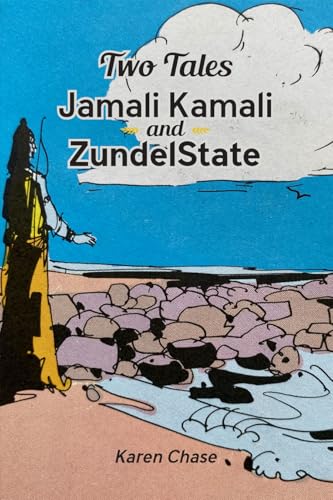
In my newly released book, Two Tales: Jamali Kamali and ZundelState, I have written two stories that did not grow from what I know but from what I don’t know. In these pages, I will talk about the first tale. Jamali and Kamali lived in sixteenth century India and are buried together in a small tomb in India. The poem is a fictional account of their love, separation, and death.
Here’s what happened. In 2004, I spent a month-long writing residency at the Sanskriti Foundation in Delhi. One morning, a week after I arrived – I hadn’t written a thing that first week and didn’t really care — the Sanskriti residents were told that later that day, we would have a chance to visit the newly restored Jamali Kamali Mosque and Tomb, which had been in the process of restoration for seven years.
Our bus arrived at the overgrown park entrance. We traipsed alongside a river full of plastic garbage, climbed through hills of brush, climbed over unrestored ruins, climbed through Balban’s Tomb, and finally arrived on top of a hill, a plateau, where the Jamali Kamali Mosque and Tomb stood. A brand-new sign at its entrance informed visitors that the Tomb held the remains of Jamali, a 16th century Sufi Court Poet and Saint and Kamali, whose identity, the sign said, was unknown.
When I entered the tomb, its beauty startled me. Looking at the two white marble graves, the conservator began to talk. He explained who Jamali was, then said, “It is believed, through Delhi’s oral tradition, that Kamali was his homosexual lover.” “What?” I blurted out, “But…. the new sign out front says his identity was unknown. I don’t understand. Why does the sign say that Kamali’s identity is unknown.” He explained that, in fact, no-one really knows for sure who Kamali was, and also the information that he may have been Jamali’s male lover would never be announced on a public sign, taking into account the beliefs of our large Muslim population.”
Deeply jarred by the disjuncture of that moment, when I returned to my Sanskriti desk, I began to write as if I were Jamali speaking to Kamali. I had nothing in mind. No direction. By the end of three weeks in Delhi, there was a draft of the first section of Jamali Kamali. Almost two years later, what began that moment in Delhi, had grown into a book-length poem.
Many people have asked me, “Why did YOU write this book? The answer is – I don’t really know.
I’m not a man. I’m not gay. I’m not Indian. I’m not Muslim. I’m not a Mughal scholar. I’m not an art historian. I’m a straight white American Jewish 21st century woman. I’ve crossed many lines here – gender, sexual orientation, time, hemisphere, religion, culture, etcetera. Without intention, I appropriated.
Since then, many people who have read Jamali Kamali, believe I was channeling the men. Others have mistaken it for a translation of Jamali’s poetry. And, strangely enough, in India, my poem has been cited numerous times as a historical record about the two men.
Opening oneself to the unknown paves the way for large-scale exploration rather than the up-close, confining details of “what I know.” The unknown is a wider plain—a vast place where options flourish. It expands the smallness of “what I know.”
Was I channeling these men? Is the poem an expression of my subconscious? Or is it the imagination at work? Are these three things separate, do they overlap, or are they the same thing? Who knows. What I do know is that when you open the mind’s flaps, leave behind what you know, and walk through a blank landscape, you may be taken aback by what you find.
About the Author

Karen Chase is the author of two collections of poems, Kazimierz Square and BEAR, as well as Jamali-Kamali: A Tale of Passion in Mughal India, a book-length homoerotic poem, published in India in 2011. Her award-winning book, Land of Stone, tells the story of her work with a silent young man in a psychiatric hospital where she was the hospital poet.
In her memoir Polio Boulevard, Chase brings the reader back to the polio outbreak of the 1950s that crippled our country. In her lively sickbed she experiences puppy love, applies to the Barbizon School of Modeling, and dreams of Franklin Delano Roosevelt. The Larooco Log: FDR on the Houseboat, a project that grew directly out of her memoir, follows Franklin Delano Roosevelt during a Florida winter when he lived on a houseboat, attempting to regain use of his paralyzed legs. History Is Embarrassing, her collection of essays, was published in 2024, and Two Tales: Jamali Kamali and ZundelState, in 2025.
Karen Chase’s poems, stories and essays have appeared in The New Yorker, The New Republic, The Gettysburg Review and Southwest Review, among others. Her poems have been anthologized in The Norton Introduction to Poetry, Andrei Codrescu’s An Exquisite Corpse Reader, and Billy Collins’ Poetry 180. Chase and her husband, the painter Paul Graubard, live in Western Massachusetts.
