
1) Tell us a little bit about yourself. How did you get into writing?
I’m A. Pāj Turner, a retired U.S. Army Chief Warrant Officer 5 and Navy veteran who transitioned into storytelling after more than 30 years of service. My military career gave me discipline, perspective, and a deep sense of community responsibility. Writing became my way to channel those experiences into something creative, impactful, and lasting. What began as journaling and personal reflection evolved into a passion for crafting narratives that challenge, inspire, and provoke thought.
⸻
2) What inspired you to write your book?

I was inspired by the legacy of Tulsa’s Greenwood District, also known as Black Wall Street, and the broader history of communities that were dismantled by greed and systemic injustice. I wanted to reimagine what could happen if someone returned home determined to correct those injustices using unconventional strategies. My own experiences in leadership and logistics gave me insight into how systems work—and how they can be re-engineered to empower rather than oppress.
⸻
3) What theme or message do you hope readers will take away from your book?
The central theme is empowerment: the belief that ordinary people, when united with vision and purpose, can transform their communities. I also explore moral gray areas—what sacrifices are justified in pursuit of justice? Ultimately, I want readers to walk away questioning how far they themselves would go to address generational inequality and uplift those around them.
⸻
4) What drew you into this particular genre?
I’ve always been drawn to stories that mix social realism with elements of suspense, strategy, and moral dilemma. Blending historical possibilities with modern struggles allowed me to create a narrative that feels both grounded and cinematic. It’s a genre that gives space for action, intellect, and heart—while also carrying a message that matters.
⸻
5) If you could sit down with any character in your book, what would you ask them and why?
I’d sit down with Richie Tomlison, the protagonist. I’d ask him, “Do you ever worry that your sacrifices will cost you more than you gain?” Because his journey is one of heavy moral weight—balancing personal loss against the pursuit of community liberation. I think his answer would reveal not only his convictions, but also his humanity.
⸻
6) What social media site has been the most helpful in developing your readership?
Instagram has been the most effective for me. The visual nature of the platform allows me to share stills, teasers, and behind-the-scenes content that bring the story world to life. It’s also where collaboration with actors, influencers, and readers builds a sense of community around the project. Pairing visuals with storytelling really resonates with today’s audience.
⸻
7) What advice would you give to aspiring or just starting authors out there?
Don’t wait for perfect conditions—start writing and keep refining. Be disciplined like it’s a mission, but flexible enough to let your story evolve. Also, understand that writing is only half the journey; building an audience and sharing your story with the world requires just as much dedication. Believe in your voice, invest in your craft, and don’t let rejection discourage you.
⸻
8) What does the future hold in store for you? Any new books/projects on the horizon?
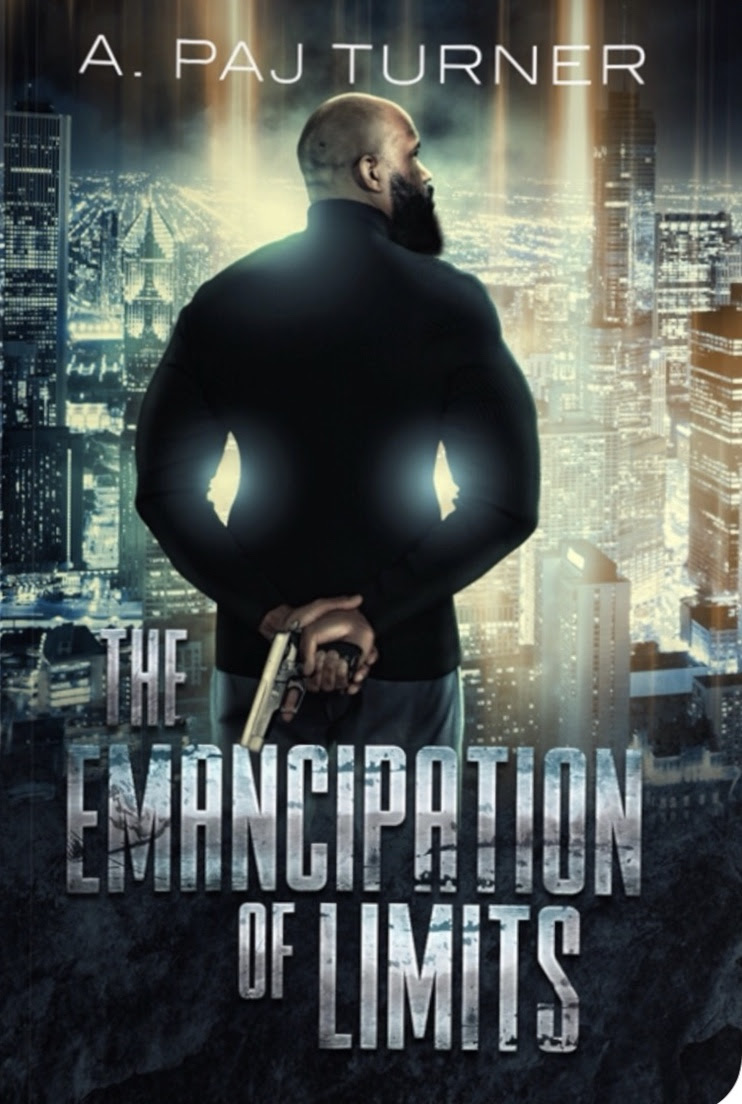
The novel The Emancipation of Limits has already been adapted into a pilot presentation, and we’re building it into a six-season TV series. It was recently selected for the Black Hollywood Film Festival, which is an exciting step forward. Beyond that, I’m developing additional novels and film projects, each centered on themes of justice, identity, and empowerment. My goal is to create a body of work that entertains while leaving a lasting impact.
About the Author

My name is A. PAJ Turner and I was born on the 29th of December, 1971, in Chicago, IL. My parents are Russell Leon Turner Sr. and Joann Turner. They divorced when I was two and he was an absent father to my brother and I. He died in 2002, of natural causes, but had two strokes that probably aided with his passing. He was fifty-two when he passed. My older brother, Russell Jr, took the role as my guardian and protector as he ensured if harm ever came our way, he would shield me at all cost. He was my first superhero and I looked up to him because he had abilities that I felt I could never obtain.
My early childhood was a typical middle-class environment in the 1970’s. My mom worked for Illinois Bell and my grandfather, Richard Watson Sr., who lived with us was my first and the example of what a man should be like. I did everything an inner-city kid would do for fun. Ring doorbells and run, play hide and go seek, kill-the-man, baseball, and other mischievous things. Snowball, rock and crabapple fights,was the thing to do in our neighborhood. When Michael Jordan touched down in Chicago, every child dream was to be like Mike, so basketball became my dream.
My mom did not want Public School education for my brother and I, so she sent us to catholic schools from Kindergarten through High School. I wasn’t the best student, I understood the work, but school just didn’t interest me. My grades showed it and my brother, my defense attorney pleaded his case to mom on why my grades was the way they were. I was proud that he would represent me. As my mom stood there, frowning with her hands on her hip with her leather belt folded in her right hand, she listened. When he told her, my F wasn’t really an F, what he did wrong was or trying to drag a teacher’s work ethic through the mud…. In short, he never won a case. It would have made more sense for my brother to tell her that I was adopted. He never hesitated to tell me that. He reasoning was because I didn’t have many baby pictures.
Eighth grade was the last straw for my mom and grandfather. I remember my grandfather and I was having a conversation about my grades. He said that he didn’t want to die knowing I was doing bad in school. That destroyed me! They last thing I ever wanted was for him to die and not showing him what I could become. I honor rolled in High School and went on to Kennedy King Jr. College on a basketball scholarship. One night, heading to a home game, I got held at gunpoint. I was at the wrong place at the wrong time. My uncle, Richard Watson Jr., convinced me to join the military and don’t look back. I did just that.