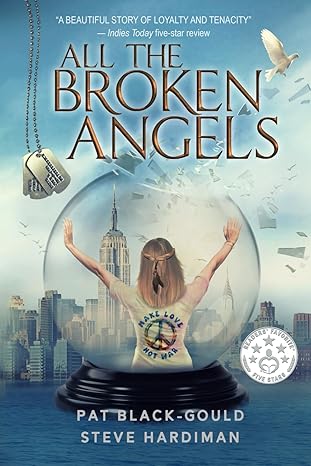
All the Broken Angels by Pat Black-Gould and Steve Hardiman Review

I received a free copy of this book in exchange for a fair and honest review. All opinions are my own. 

Two cousins are torn apart by the Vietnam War and the tragedies that follow in authors Pat Black-Gould and Steve Hardiman’s “All the Broken Angels.”

Advertisements

The Synopsis

Two cousins. Two paths. One unforgettable era. This award-winning historical fiction novel follows the transformative journey of Cate and Albie. Cousins and best friends, they are raised in 1960s New Jersey under the watchful eyes of their family and strict Catholic school nuns. Their bond seems unbreakable. Then the Vietnam War erupts, tearing them apart.

  • Albie, driven by faith and patriotism, enlists in the military and is stationed at a base along the South China Sea nicknamed Paradise.
  • Cate protests the war, challenges her upbringing, and seeks purpose by immersing herself in the bohemian counterculture of New York’s Greenwich Village while enduring life in a low-rent tenement in the gritty Hell’s Kitchen district.

Tragedy strikes, and her world unravels. With the support of her family and an eclectic group of friends—artists, activists, and veterans—Cate embarks on a journey of resilience and personal transformation. Travel back to a pivotal era when men marched off to war and women burned their bras. This compelling novel explores the:

  • Emotional toll of the Vietnam War
  • Rise of feminism and LGBTQ+ movements
  • Conflict between faith, patriotism, rebellion, and personal freedom
  • Strength in kinship, friends, found family, and community

All the Broken Angels is a profound exploration of love, loss, and the indomitable spirit of a generation that resonates far beyond the final page.

The Review

What a thought-provoking and compelling read. The authors wrote in a way that felt very transportive, allowing the reader to feel transported back in time to an era of war, the fight for peace, and the evolution of a society as a whole. The authors found a perfect balance between character development and historical context, allowing the era to come to life on the page without sacrificing the originality and heart behind each character’s evolution throughout the narrative. 

Balance was the key to this book. The authors were able to present each side of this conflict, from the soldiers and veterans impacted physically and mentally from the war, to the protestors and activists who seek to end the war and fight against injustice, while touching upon some important themes. The culture and family dynamics that were explored through these characters were especially unique, as readers were able to not only get a glimpse into how this conflict impacted a family torn apart by differing values, but also connected by a shared belief and a love for one another. 

The Verdict

Thoughtful, engaging, and heartfelt, authors Pat Black-Gould and Steve Hardiman’s “All the Broken Angels” is a must-read historical fiction meets drama narrative. The complex themes of social justice, equality, gay pride, veteran rights, and so much more were so subtly yet passionately written about, and the relatability of the character and the depth of detail about the era will resonate with so many readers that they will return to this book again and again. If you haven’t yet, be sure to grab your copy today!

Rating: 10/10

Advertisements

About the Authors

Pat Black-Gould, PhD, is an award-winning author, speaker, and clinical psychologist whose work bridges storytelling and the human psyche. Previously, Pat worked as a director, producer, and playwright in New York and New England.

https://www.patblackgould.com/

Steve Hardiman has worked as an IT and communications consultant, and talk-radio host and producer. His writing includes ghost-written nonfiction articles selected as cover stories in multiple industrial trade publications and scripts for over seventy instructional videos.

Recently retired, he and his wife Angela are raising their grandson. In his spare time, he writes, travels, and is an avid photographer. All the Broken Angels is his first work of published fiction.

Interview with Author Sharifullah Dorani

1) Tell us a little bit about yourself. How did you get into writing?

Before I start, I would like to thank you for the interview and your review of The Lone Leopard

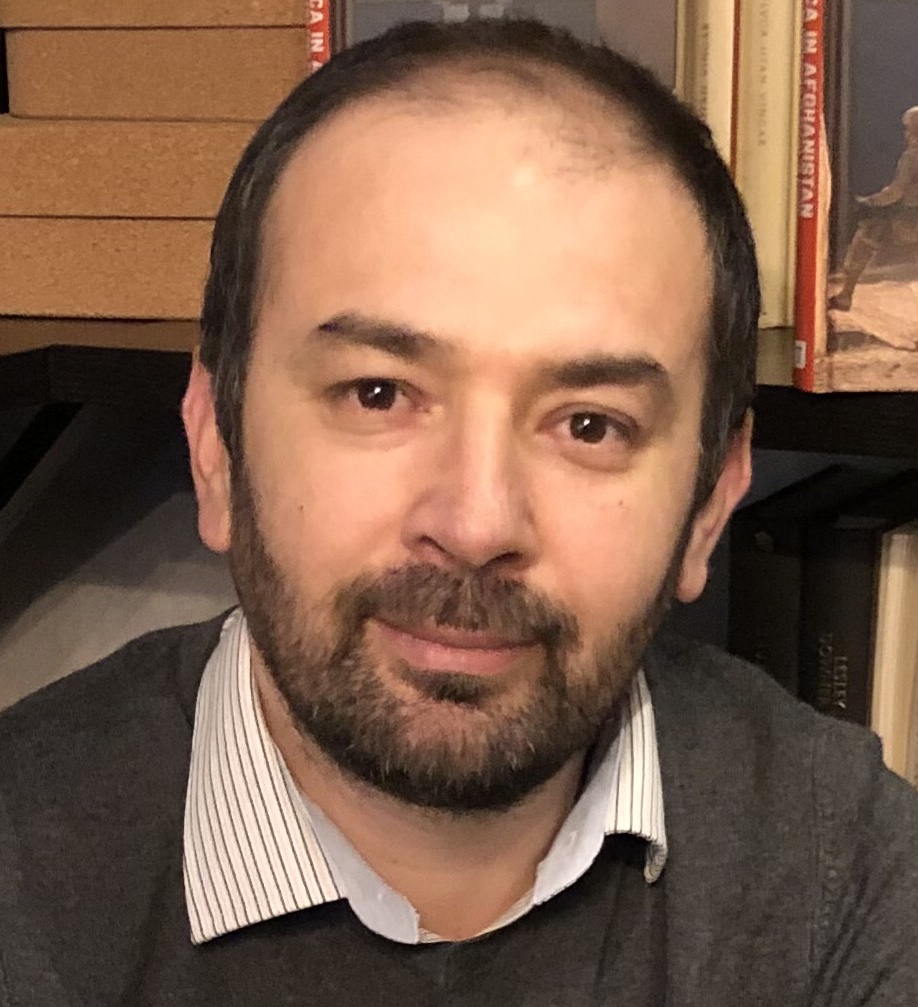
I was born and brought up in Kabul, Afghanistan, and claimed asylum alongside my parents in the UK in 1999. I finished all my higher education in the UK. I am married and live with my wife and three children in a quiet town in England. 

How did I get into writing? I love writing, especially about my country Afghanistan. Therefore, I did my PhD on Afghanistan and subsequently published some two dozen articles and a book (more below) on my native land. 

The idea for writing The Lone Leopard, however, was actually conceived in 1992 when the ‘pro-Communist’ Najibullah regime collapsed and the mujahideen took over Kabul. Turning Shia against Sunni and vice versa, setting Afghanistan’s main ethnic groups of Pashtun, Tajik, Hazara and Uzbek against each other, and accusing each other of uniting with the remnants of pro-Communist members and thus not being Islamic enough, the 15 or so mujahideen groups fought each other in the streets of Kabul, killing tens of thousands of innocent Kabulis, displacing hundreds of thousands, and turning half of Kabul into mudbrick rubble with bombs, rockets and cannon fire.

Taking refuge in the basements of our blocks while the gunfire, shelling and fighting continued, I decided (if I made it alive) to write about what we ordinary Afghans went through. Unlike thousands of Kabulis, I was fortunate enough to live, and 18 years later, in 2010, I started writing about the experience: after 12 years of writing/rewriting (and extensive research, including consulting nearly a thousand sources), The Lone Leopard is the result.

Advertisements

2) What inspired you to write your book?

I’ve partly answered this question above. I’d also like to add that my only inspiration is my people and country. I wanted to tell the contemporary Afghan and Afghanistan story from an Afghan perspective. Ahmad, the protagonist of my novel, therefore, gives a first-hand account of what I (and most Afghans) have experienced over the past four decades in Afghanistan (and in exile). My previous book, America in Afghanistan, published in 2019 by IB Tauris/Bloomsbury, was praised by reviewers for its Afghan perspectives, and is found at, among other institutions, Oxford and Harvard.

3) What theme or message do you hope readers will take away from your book?

The reader will get to know a great deal about the principles of Afghan culture, particularly independence, courage, loyalty, justice, revenge, righteousness, pride, honour, chastity, hospitality, love, forgiveness, faith (Islam) and respect of elders (parents in particular), among others, and some of these themes, in addition to jealousy, prejudice, betrayal, guilt and atonement, the book explores.

The Lone Leopard is a historical war drama. Once the reader reads it, I hope they will see how things have been in Afghanistan; they will understand the history and politics of the past four decades in Afghanistan; and they will see the real Afghan and Afghanistan. 

The Lone Leopard is a work of contemporary literary fiction, too, as it is solely based on human relations. The focus of the novel is primarily on the lives of Ahmad (15, a conservatively traditional Pashtun, dutiful child, gifted student, thoughtful but faint-hearted) and Frishta (16, progressive, Tajik, women’s rights activist, compassionate, outspoken and brave): will the faint-hearted Ahmad learn from Frishta to fight his cowardly side and stand up for himself and for what is right, even if his stance opposes traditions/his controlling mother; will the fearless Frishta journey from a middle-class girl to ‘the president of Afghanistan’; will Ahmad and Frishta with conflicting personalities/backgrounds fall in love; will the middle-class Wazir (15, Ahmad’s best friend/classmate: Pashtun, fearless, the school gangster, pro-mujahideen) ever fulfil his dreams of killing a Communist and joining jihad; and will the loveable Baktash (15, Ahmad’s best friend/classmate: Tajik/Hazara, timid but lovable, pro-Communism) live a normal life without getting bullied for being different. So, the reader will get drawn into a time (the 1980s-2010s) when historical events – several invasions of Afghanistan over the past four decades in particular – give rise to nationalistic and religious conflicts and impact the lives of the four characters and their families. 

 Moreover, The Lone Leopard is a mother-son relationship story, as familial aspects constitute a significant part of the narrative, especially (the importance of) parental respect, which you have highlighted (and liked) in your review. 

Incidentally, in addition to the Western reader, when writing the novel, I had the future Afghan generations in mind, especially for them to see what mistakes their ancestors committed and how they should avoid repeating them. One of them is how discrimination, alienation and division can destroy a country; and how unity, inclusion and empowerment of people – regardless of their sex, tribe, ethnic origin, religion, etc. – can help build a better country and, by extension, a better world.

4) What drew you into this particular genre?

The Lone Leopard can fit into several genres: literary fiction, women’s fiction, young adult fiction, coming-of-age, family drama, war drama, and romance. For me, however, it will always remain historical fiction drama, the story of contemporary Afghanistan. I chose the historical genre because I have a PhD in IR/history, have taught the history of Afghanistan and have lived through the historical periods The Lone Leopard covers. As a creative writing teacher may say, ‘write what you know’. 

Advertisements

5) What social media site has been the most helpful in developing your readership?

I am not very good at social media and only use Twitter. I also have a LinkedIn account, but I have not made much use of it. 

6) What advice would you give to aspiring or just starting authors out there?

Read more, research a lot, and get a good command of creative writing techniques before starting your book. And keep it consistent: make sure you write/research/read every day, even if it is for half an hour. Oh, one more thing: start today; don’t wait for tomorrow. 

7) What does the future hold in store for you? Any new books/projects on the horizon?

My next book will focus on why the Doha Peace Agreement between the Taliban and America failed and the possible consequences of the failure for Afghanistan, the region and the international community.

Advertisements

About the Author

SHARIFULLAH DORANI was born and raised in Kabul, Afghanistan, and claimed asylum in the UK in 1999. He has undergraduate and master’s degrees in Law from The University of Northampton and UCL, respectively. He completed his PhD on the US War in Afghanistan at Durham University and authored the acclaimed America in Afghanistan. Sharifullah frequently returns to Afghanistan to carry out research. He is currently South Asia and the Middle Eastern Editor at The Centre for Strategic Research and Analysis (CESRAN International) and has written nearly two dozen articles on Afghanistan (and the broader region), international relations and law. He lives with his family in Bedford, England.