I received a free copy of this book in exchange for a fair and honest review. All opinions are my own.
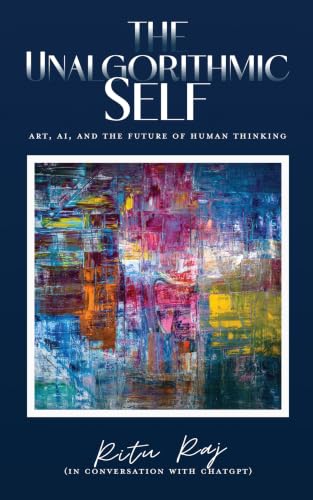
Author Ritu Raj speaks to the emotional intelligence that AI cannot replicate in the book “The Unalgorithmic Self.”
THE SYNOPSIS

A machine can answer a question. Only a human can wonder.
A machine can predict a pattern. Only a human can break one.
We already live in an algorithmic world. The shows we watch are tuned to pull on our emotions. Even the toothbrush in your bathroom was probably sold to you by an algorithm. So where do we come in? What becomes of the soul, the heart, and, at the end of the day, love?
In The Unalgorithmic Self, painter Ritu Raj takes up that question.
Across thirty chapters on the body, emotion, memory, imagination, identity, uncertainty, love, ethics and art, Raj names the part of human life that refuses reduction: the fact that your life has an inside. A profile may approximate your tendencies, but it cannot contain your becoming. A model may predict your next click, but it cannot witness the quiet moment when you decide to change.
Drawing on Arendt, Levinas, Nussbaum, Heidegger and Hans Jonas, and on a working life spent both in the studio and in building technology, this is not a book against AI. It is a book about remembering ourselves. The question is not whether machines will become more human, but whether humans will remember what makes them human.
Written openly in conversation with an AI model, with the ideas and the values firmly the author’s own, it is a book for anyone who uses these tools and wants to remain the author of their own life.
THE REVIEW
In an era of history in which humanity must contend with the growing technology of artificial intelligence, understanding and being able to identify what makes a person a person is more important now than ever before. The author does a fantastic job detailing and passionately exploring how humanity continues to set itself apart from AI in meaningful ways. The authors’ unique background in both the tech space and the arts made them uniquely qualified to write about this topic and discuss not only the ways in which humanity remains relevant and vital to the world, but why technology like AI should be viewed more as a collaborative effort instead of a replacement for human intuition.
An insightful and engaging read, the book highlights how emotion, memories, and, of course, love help distinguish humans from artificial intelligence. While AI can become more intelligent and learn, it cannot replicate human emotion, which is its own form of intelligence; therefore, true art and any field will always be dominated by humanity because AI cannot infuse passion and love into artificially created works of art. The author’s unique insight into how this technology can be properly utilized as a tool and collaborative effort rather than a replacement by big companies was much appreciated and needed in a time in which companies refuse to take accountability and recognize the importance of human artists in this world.
THE VERDICT
Compelling, engaging, and thought-provoking, Author Ritu Raj’s “The Unalgorithmic Self” is a must-read non-fiction book on artificial intelligence, technology, the arts, and philosophy as a whole. The level of detail and knowledge readers gain from understanding this technology, along with the deep-seated philosophical debate spurred by humanity’s emotional intelligence in the art space, makes this a rich, dynamic book readers will not be able to put down anytime soon. If you haven’t yet, please be sure to grab your copy today!
Rating: 10/10
ABOUT THE AUTHOR

Ritu Raj is an abstract painter, author and entrepreneur. He grew up in Delhi, the son of the art critic K.B. Goel, and painted as a child among the abstract artists his father wrote about.
Today he works from RituStudio in Phoenix, Arizona, where his signature technique, Organic Movement, lets thread take the place of the brush and makes gravity a collaborator. He has made more than 250 paintings and is represented by Jarrow & Goodman in Los Angeles.
Mathematics gave him a second grammar for the questions painting asks, and three decades of founding and building companies, among them Avasta, Wag Hotels, SideCar and Diamond Foundry, tested it at scale.
He is the creator of ArtGraph, a language for abstract art, and the author of The Shape of Seeing, on how abstraction arrives, and The Unalgorithmic Self, a philosophical inquiry into what AI cannot reach. Painting, writing and building are, for him, one inquiry.
https://www.rituart.com/the-unalgorithmic-self-book


Leave a Reply