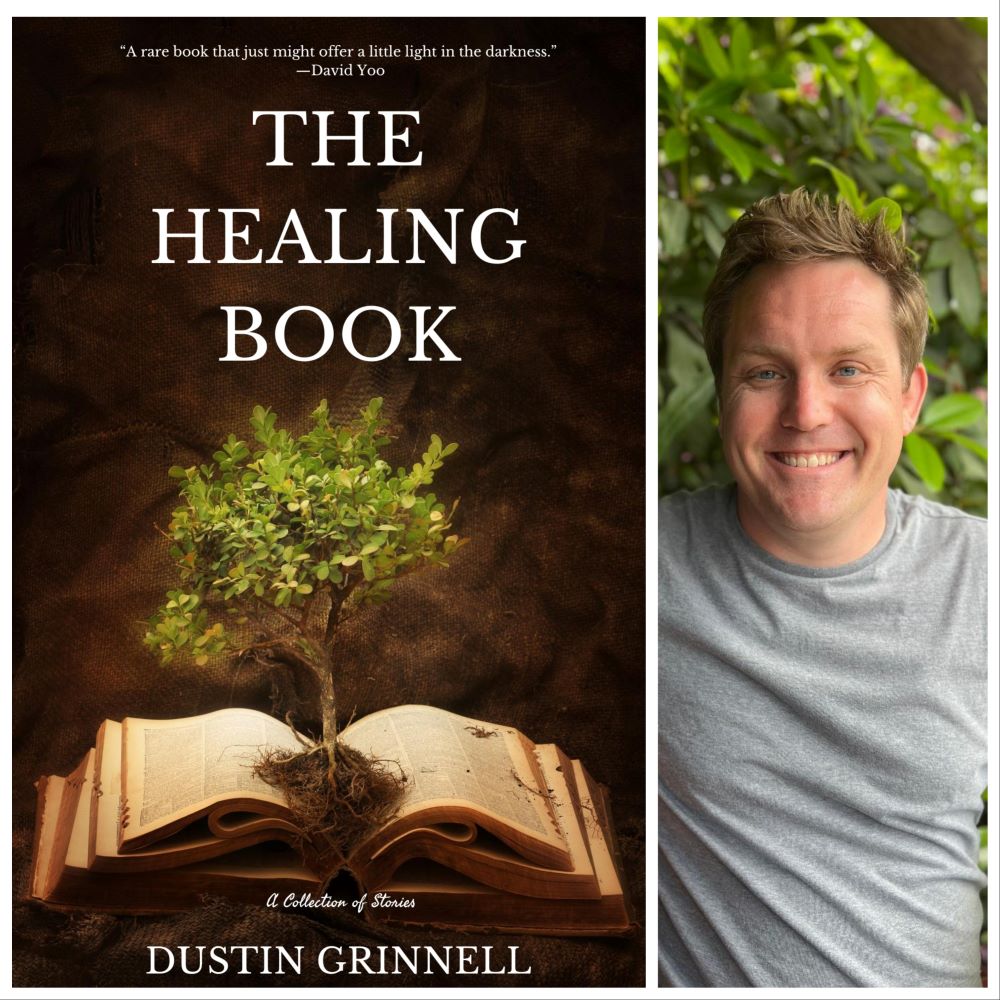
Can you briefly share your new book and background?

When I was studying to get my MFA in fiction, I discovered the power of writing from personal experiences, or “writing what you know.” As a result, my new collection of short stories, The Healing Book, is influenced by autofiction and draws from lived experiences, such as jobs I’ve had, places I’ve lived, and encounters with different people. Writing from my own experiences not only strengthened my writing, but also served as a means of working through those experiences, giving them words, making sense of them, and allowing me to come to terms with and, hopefully, let them go.
The introduction of the book delves into my personal experience with books throughout my life and describes how reading Zen and the Art of Motorcycle Maintenance during an unfulfilling job inspired a life-changing transformation. The central theme of the collection explores the concept of bibliotherapy, which I wrote about for Hektoen International, where books are used as a means of healing. The book’s title story, “The Healing Book,” which was published by Intima: A Journal of Narrative Medicine, follows a physician attempting to cure his wife’s terminal cancer by writing a book capable of healing her body.
Is there one story that stands out to you, and can you explain how it came together?
The Healing Book is a collection of thirteen short stories that explore different aspects of healing. The book’s first short story, “Beyond Medicine,” is probably my favorite. It follows a junior neurosurgeon in Boston who travels to Peru to address her depression through an ayahuasca ceremony with a shaman. A story exploring healing and self-discovery, it was inspired by travel writer Kira Salak’s experience in a similar ceremony, as detailed in her National Geographic Adventure article “Hell and Back.” The surgical elements of the story were also influenced by Jon Franklin’s award-winning feature article, “Mrs. Kelly’s Monster.” If you want to read it, “Beyond Medicine” appeared in ParaABnormal Magazine.
You’ve written several book-length novels. Why short stories?
I like writing short stories, because they let me experiment with different narration styles and voices and different ways to convey a story. It was exhilarating to feed my collected ideas through the woodchipper of experimental forms, style, and voices and see what transpired. Another appeal of a short story was the speed with which I could write them. For years, I’ve been accumulating ideas to eventually develop into fictional narratives. But I often wondered if they would ever get their chance to mature into full-length books. I feared many of my ideas for stories might die in their respective folders. Novels can take years to complete, but short stories take weeks or months. I can write a short story in a month and then revise it with freelance or journal editors as I continue writing others. Such speed allows me to get these concepts off my hard drive and into the world.
What are some of your influences as a writer?
I grew up on the dystopian novels of 1984, Brave New World, and Fahrenheit 451, and I enjoy exploring the consequences of man’s inventions. Perhaps because I’m philosophically minded, I have found solace in science fiction since childhood. The genre satisfies my curiosities about the world. These were stories about hubris and man against nature. They were morality plays. They allow readers to imagine future possibilities.
As a writer of sci-fi, I also wish to push the boundaries of the genre. As the “literature of ideas,” I want to preserve its cerebral qualities, but also give my stories an emotional core. For example, my short story, “A Case of Aphantasia,” which published in Ars Medica, is a piece of “soft” sci-fi, akin to science fiction writer Ted Chiang’s “The Story of Your Life.” The story focuses less on the details of technology as “hard” sci-fi does, and more on how technology affects people’s psychology and their emotional lives. I intend to help pioneer this sub-genre of sci-fi, which I refer to as “Science Fiction with Heart” in my Writer’s Digest analysis of the movie, Her, a perfect example of “soulful science fiction” of which Chiang was described to write in The New Yorker in 2017.
What’s a lesson from your book that you want to share?
While writing The Healing Book, I explored various healing therapies, and I came across a quote from Hippocrates that stuck with me: “I would rather know the person who has the disease than the disease the person has.” I encourage anyone who works in a healing profession to consider the social, emotional, and psychological factors that may influence a patient’s health. Additionally, I like to point out the significant impact of the placebo effect, emphasizing the importance of kind words and comforting gestures. It’s also important to be aware of the potential negative effects, known as the nocebo effect, where words and behaviors can drive negative outcomes.
Is there a take-home message you want to share with our audience?
Several years ago, I attended a Narrative Medicine Conference, where I met a primary care doctor who discussed alternative forms of care, including using books to help patients navigate through illnesses. I encourage healthcare providers to integrate books into their treatment plans, inspired by examples like dermatologist David Elpern in Western Massachusetts, who I wrote about for The Boston Globe who “prescribes” books to patients. Consider if a particular book could offer a new perspective on a patient’s condition or help them express thoughts they find challenging. The power of bibliotherapy can be a valuable complement to traditional medical approaches.
About the Author

Dustin Grinnell is a fiction writer and essayist based in Boston. He’s the author of the short story collection, The Healing Book (Finishing Line Press), The Empathy Academy (Atmosphere Press), and a collection of personal essays, Lost & Found: Reflections on Travel, Career, Love and Family (Peter Lang Group). His creative nonfiction has appeared in many magazines and literary journals, including The LA Review of Books, The Boston Globe, The Washington Post, New Scientist, Vice, Salon, and Writer’s Digest, among others. He’s also the host of the podcast, Curiously. See more of his work at his website.
https://www.finishinglinepress.com/product/the-healing-book-by-dustin-grinnell
https://www.instagram.com/dustin.grinnell

Leave a Reply