1) Tell us a little bit about yourself. How did you get into writing?
I have always wanted to write. For as long as I can remember, writing was there somewhere within me, but it took a long time before it could truly take shape.
When I was eleven years old, an inner voice told me that one day I would meet a woman who would play an essential role in my life. For years, that experience remained like a guiding thread. When that encounter finally happened, something opened up within me, and writing became possible.
I try to use storytelling as a way of exploring memory, consciousness, identity, and what may lie behind the appearances of the world we live in.
2) What inspired you to write your book?

EXODUS grew out of a collection of personal experiences, encounters, dreams, journeys, readings, and also “old memories” that, for a very long time, seemed to me like separate pieces.
Then, gradually, I began to see connections emerging between them. Certain experiences I had in the places explored in the book began to resonate with much older recollections, and with the sense that our existence may not be limited to a single lifetime.
At a certain point, I felt the need to connect these fragments, as though I finally had to put together the pieces of an old puzzle.
3) What theme or message do you hope readers will take away from your book?
Probably the memory that needs to be awakened within each of us.
Not only personal or historical one, but something far more deeply buried: the memory of what we truly are behind the roles, the conditioning, and the narratives we have learned to accept as true.
EXODUS invites the reader not to stop at the surface of things. It encourages us to question our relationship with history, time, love, consciousness, and our own origins.
I am not trying to tell readers what to believe. I would rather the book create a resonance within them, raise questions, perhaps even awaken the feeling that there is something they had forgotten.
4) What drew you into this particular genre?
I do not think I truly chose a literary genre at the outset.
Rather, it was the content of the book that naturally determined its form. EXODUS lies at the crossroads of autobiographical narrative, metaphysical fiction, philosophy, spirituality, and the initiatory quest.
Certain experiences could not be expressed solely in the form of an essay or a conventional novel. I needed a literary space free enough to allow reality, symbolism, memory, and intuition to coexist.
That is probably why I naturally found myself in what is now described as hybrid territory. I think the narrative is carried by a voice and a guiding thread that move between Hermeticism and a somewhat more visionary dimension.
5) If you could sit down with any character in your book, what would you ask them and why?
I would choose the narrator at the beginning of the story. I would simply ask him: “If you knew today everything you were going to have to go through, would you still choose to take this path filled with existential suffering?”
His answer would interest me because, at the beginning of the story, he does not yet understand the meaning of what lies ahead. I would like to know whether, if he knew in advance the trials and profound self-questioning he would have to go through, he would still choose to follow this path toward a more awakened state of consciousness.
6) What social media site has been the most helpful in developing your readership?
In my case, social media and algorithms have so far brought me very little visibility. What really matters are human connections: word of mouth, reader reviews, and, of course, interviews like yours, Anthony.
I will stay in touch with my readers through the blog on my website, etiennedepax.com/en. I have a few surprises in store for them related to decoding and exploring the book more deeply.
7) What advice would you give to aspiring or just starting authors out there?
First of all, I would advise them not to write by trying to guess what the market expects from them.
A book that truly matters to its author must first come from an authentic place. That does not mean ignoring readers, but it does mean avoiding the temptation to sacrifice your own voice simply to fit a trend.
I would also advise them to revise their work extensively. I have lost count of the number of times I went back through my manuscript to improve its flow, tone, interconnections, and so much more.
You should never give up too quickly. Both writing and publishing are paths filled with doubt, rejection, and periods of silence. Perseverance is probably just as important as patience.
8) What does the future hold in store for you? Any new books/projects on the horizon?
Another book is currently taking shape in my mind. It will, in a sense, be a continuation of EXODUS, with even more striking revelations, as well as answers to questions that were deliberately left unresolved in the first volume. I am simply waiting for inspiration to come so that I can build its architecture and bring all its chapters together.
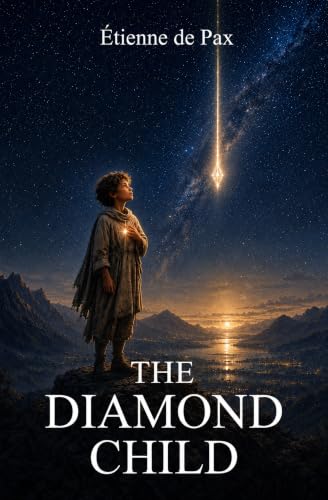
At the same time, I have published THE DIAMOND CHILD, an illustrated allegorical tale that explores, in a much more accessible form, some of the themes also present in EXODUS, but this time through the eyes of childhood.
These two worlds are very different in form, yet deeply complementary in the questions they seek to explore.
Finally, I would like to thank you, Anthony, for your review, for this interview and the thoughtful questions you have asked. I sincerely appreciate the opportunity to share more about EXODUS-The Paths of Memory and the ideas behind it with your readers.
ABOUT THE AUTHOR

Through his books, Étienne explores the meaning of our passage through this world and what may lie beyond appearances.
He is drawn to the unseen bonds between people and to the question of what becomes of the soul.
Blending symbolic language, imagination and metaphysical reflection, his work explores memory, consciousness, myth and ancient civilisations, while also questioning freedom of thought, the loss of meaning in the modern world and the possibility of awakening.
These stories invite readers into an inner, initiatory experience.
Not as an escape from reality, but as a way of revealing its deeper layers.

Leave a Reply