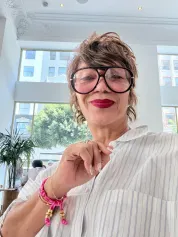
For most of my life, people have wanted to know what happened to me.
It makes sense. I was a foster child. I lived in more than 30 placements. I was abandoned, institutionalized, moved from place to place, and made a ward of the court.There are plenty of facts in my story capable of filling a room.
But somewhere along the way, I became much less interested in what happened to me and much more interested in what I made from what happened.
That distinction has become the center of my work.
I call what I do mythopoetic reclamation. That sounds fancy, but what I mean is quite simple: there is the story of what happened, and then there is the story beneath the story.
The first story contains the facts, and the second contains the meaning.
And meaning is where I believe our agency lives.
I discovered this through poetry before I had language for it. I would take an experience that had lived inside me for decades and write about it. But when I wrote it, something happened. The experience stopped being merely an event I had survived. An image would appear. A metaphor. A doorway. A rope. A wedding magazine. A child. An altar. A nervous system speaking in its own voice.
Suddenly, I could see myself differently.
The poem gave me the coordinates.
That is how I have come to understand much of my work — I help people find coordinates back to themselves.
Many of us know how to tell our stories chronologically. First this happened. Then this happened. Then somebody left. Somebody betrayed us. Somebody died. Somebody failed to love us. We survived something. We accomplished something. We got married. We got divorced. We raised children. We built careers.
But chronology is not necessarily meaning.
You can know everything that happened to you and still not know who you are.
I am interested in that gap.
I am interested in the moment when a person realizes, “Wait. I’ve been organizing my entire life around something I decided about myself when I was 8-years-old.” Or twelve. Or twenty-seven.
I am interested in what becomes possible when we stop asking only, “Why did this happen to me?” and begin asking, “What have I made this mean?”
That question changes things.
Because human beings are meaning-making creatures. We make meaning whether we know we are doing it or not. A child experiences abandonment and decides, I am not worth staying for.
A woman experiences inconsistency and decides that longing is love. Someone learns early that belonging requires disappearing and becomes extraordinarily skilled at leaving themselves before anyone else gets the chance.
Then we call it personality.
I want to interrupt that.
Not by pretending the past did not happen. Not through positive thinking. Not by polishing suffering until it becomes inspirational. I am interested in authorship.
Authorship says, “I may not have written the first chapters, but I have a relationship to the meaning I carry forward.”
That is where poetry has become such an extraordinary tool for me.
Poetry does not demand that experience behave logically. It allows contradiction. It allows the 5-year-old and the 60-year-old to occupy the same sentence. It lets grief become weather, abandonment become geography, longing become architecture.
Poetry gives psyche somewhere to put what ordinary language cannot hold.
And once something has form, we can begin to have a relationship with it.
This is why I believe poetry can become a form of psychological safety — not because every poem makes us feel safe, but because symbol and metaphor can give us enough distance to approach what might otherwise overwhelm us.
The wound becomes an image. The image becomes something we can witness. And witnessing creates possibility.
The people who may benefit from this work are not necessarily poets. In fact, you do not need to consider yourself a writer at all.
This work is for anyone who suspects that the story they have been telling about themselves has become too small for the person they are becoming.
It is for people who have survived something but do not want survival to become their identity.
It is for people who have done years of therapy, workshops, meditation, personal development, spiritual practice — and still occasionally find themselves standing inside the same old emotional house wondering, “How the hell did I get back here?”
It is for people who want more than insight.
They want a relationship with themselves.
They want self-continuity: the capacity to remain connected to themselves even when someone leaves, disapproves, disappoints, misunderstands, or cannot love them in the way they hoped.
Ultimately, this work is about coming home. Not to the person you were before life happened.
I don’t believe that person exists.
I mean coming home to the person who has lived through all of it and can finally say: “I know where I am. I know what happened. I know what I made it mean. And now, I get to decide what it means from here.”
ABOUT THE BOOK

Unladylike: A Mythopoetic Reclamation of Love by Regina Louise is a powerful poetry collection that explores self-love, healing, identity, and emotional truth through a mythopoetic lens. Blending memoir, poetic storytelling, and spiritual insight, this debut collection invites readers into a deeply personal and universal journey of reclaiming the self after trauma, heartbreak, and abandonment.
At its core, Unladylike is a book about love—not the kind conditioned by approval, performance, or survival—but love as reclamation, authorship, and embodied truth. Through lyrical, unflinching poems, Regina Louise examines the ways women and survivors are taught to contort themselves to be chosen, and what it means to return to oneself instead. These poems move through themes of inner child healing, emotional resilience, codependency, desire, grief, and personal sovereignty, offering readers both reflection and recognition.
Structured as a poetic cartography of becoming, this collection traces the evolution from silence to voice, from self-abandonment to self-devotion. Each piece acts as an excavation site where memory, the body, and identity intersect—revealing how lived experience can be transformed into meaning, agency, and self-trust. With recurring imagery of lace, mirrors, altars, and the body as archive, Unladylike creates a symbolic landscape that is both intimate and expansive.
Perfect for readers of contemporary poetry, women’s empowerment, and trauma-informed healing, Unladylike speaks to those navigating personal growth, recovering from toxic relationships, or seeking deeper self-understanding. Fans of authors like Rupi Kaur, Yrsa Daley-Ward, and Ocean Vuong will find resonance here, while discovering a voice that is wholly original and unapologetically its own
ABOUT THE AUTHOR

Regina Louise is a sought-after speaker, teacher, coach, and author. Recently she was the recipient of the prestigious Christopher Award, given to producers for stories that “affirm the human spirit.” In 2019 she received the Jordan Award for service in transforming foster care through advocacy and the arts; the Community Service Award for Children and Families from the Seneca Foundation; and the NAIMC Vision Award for original programming that “reflects the lives, spirit, and contributions of people of color and represents the ethnic and cultural diversity of the viewing audience.” She is the author of the bestselling memoirs Somebody’s Someone and Someone Has Led This Child to Believe. A Lifetime movie, I Am Somebody’s Child: The Regina Louise Story, is based on her life and was nominated for a 2020 NAACP Award for Best Director.

Leave a Reply