All three of my grandmother’s children were born out of wedlock in 1920s Chicago, and she raised them as a single mother. While today this would be typical of many families, in those days it was extremely unusual. I mention in my new memoir Scrap: Salvaging a Family that in those days unmarried women usually gave up their babies for adoption or they were raised by other family members, the identity of their mothers kept secret.


My father was born in 1928 and raised in the 1930s and 1940s. His mother was born in 1892. The form of discipline that she learned was of the “children should be seen and not heard” variety, the paddle, and a stern demeanor when dealing with children. That had to influence my father. In fact, when he was very small he was partially raised by his strict and odd grandfather who was born in 1863.
One story my father told me, that is not in Scrap, was about his grandfather. When Dad and his twin brother were about four years old, their grandfather purposefully spilled mercury on the floor and demanded that they pick it up. Imagine the mercury beading up and rolling away from them as they tried to grab it. Another story is how Dad’s grandmother’s casket was displayed in the house for days after she died. He and his brother were only three years old and, terrified, they hid under the dining room table.
When I was a kid in the 1960s and early 1970s, American culture was changing rapidly. The United States was dreaming large: the space race, the development of feminism, and overcoming racial injustices were high on the list of culture goals. But we felt threatened by the Cold War and the “Bomb.” Our grandmothers still dressed as they did in the 1940s and 1950s. Men still wore uptight suits and ties if they weren’t laboring or playing. I remember making my father a hat stand for his fedora out of a large coffee can and adhesive Contact paper. That was the early sixties.
Scrap contains many objects and details of my childhood. The caps I hammered into the driveway, the Smarties candy I used to love, Lost in Space television show, The Supremes, a payphone, these are all tangibles of the era. They will feel like memories to readers of my generation, but I hope that enough of these objects, songs, and shows will be understandable to those who are both younger and older than me. And what readers don’t notice because maybe they are not American or were born in the 21st century,
I hope they can still feel the emotions surrounding them because these are just details that remind them of a time in the past, a past fraught with all the burdens and opportunities of its era. Living through those time periods isn’t necessary for a reading of the book; after all, the main themes of understanding and forgiveness, especially within a family, are relatable to most people.
I so appreciate Anthony giving me the latitude to discuss what I wanted to say about Scrap: Salvaging a Family. Knowing a bit about the era of a childhood is helpful because family relationships do not take place in a vacuum, but within the culture at large. A culture that is shaped by events happening during those years. One’s parents grew up during an earlier period, in a different culture. And grandparents are from yet another culture. Scrap highlights events formed by experiences in the lives of three different generations.
About the Book

The hybrid flash memoir Scrap: Salvaging a Family explores the stain of childhood fear and anxiety on the adult spirit and the experience of reconciling with an aging or dying parent. A daughter has grown up in a household with an angry and abusive father. He keeps the secret of his biological father’s identity from his daughter for decades. When the elderly man faces his mortality, he finally names his father. The more the daughter learns about her father’s early life and origins, the more she understands him which leads to forgiveness for the past.
Borne of shame and trauma, the secrets uncovered in Luanne Castle’s hybrid memoir reveal her father’s complicated childhood and the impact it had on their relationship. Told in brief, strikingly vivid fragments, and through various perspectives and forms, the book as a whole presents a deeply moving and unforgettable account. We readers are privileged to bear witness to this emotional excavation, one that ultimately reminds us that love is powerful even when it’s painful and that forgiveness is the only way forward. Scrap: Salvaging a Family is a gorgeous and brilliantly original collection. I highly recommend it.
—Kathy Fish, author of Wild Life: Collected Works
The vignettes in Castle’s Scrap are beautifully rendered. With house as vessel, we are voyeurs through her domesticity, the skilled lens of speaker Luanne’s traumas and perseverance as she navigates the rawness and fragility of youth. The book is both powerful and arresting–Castle is a deft miniaturist–each story etched with a fine blade, yet a delicate touch. Scrap is a collection of constellations of the ordinary.
—Robert Vaughan, Editor-in-Chief of Bending Genres, author of ASKEW.
Luanne Castle’s Scrap is a memoir in flash. In flashes might be a more accurate term. This is a family story told in bursts of memory and image, puzzle pieces waiting to connect. It’s a young girl’s coming of age, navigating a path to womanhood out of hand-sewn dresses, gym class movies shown behind closed doors, stacks of moldering girlie magazines discovered at the dump. A girl living in the shadow of her father’s anger, violent and unpredictable as the tornadoes her family hides from. Behind the father’s anger, a missing piece. A birth certificate hinting at bastard. A hole where a father should be, a “space of unknowingness” both child and father must try to fill.
This lyrical, beautifully imagistic work is both an exploration of the long roots of generational trauma and identity erasure and a vivid look back at growing up female in mid-century America.
—Kathryn Kulpa, author of A Map of Lost Places
About the Author

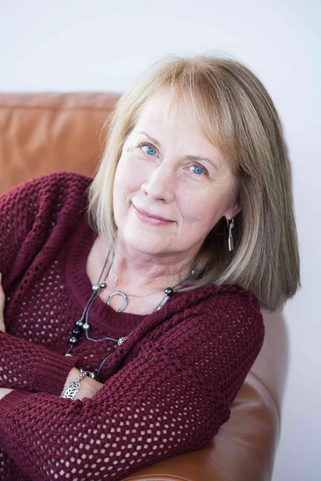
Luanne Castle’s hybrid flash memoir, Scrap: Salvaging a Family (ELJ Editions 2026) has received a starred review from Kirkus. Her story, “Garden Seasons,” was selected for Best Microfiction 2026. Her poetry and prose have appeared in Copper Nickel, River Teeth, Your Impossible Voice, JMWW, Grist, Fourteen Hills, Verse Daily, Disappointed Housewife, Lunch Ticket, Saranac Review, Pleiades, Cleaver, Moon City, Moon Park, Anti-Heroin Chic, Bending Genres, BULL, The Mackinaw, The Ekphrastic Review, Phoebe, MacQueen’s Quinterly, Gone Lawn, Burningword, Superstition Review, One Art, Roi Fainéant, Dribble Drabble, Flash Boulevard, O:JA&L, Sheila-Na-Gig, Thimble, Antigonish Review, Longridge, Paragraph Planet, Six Sentences, Gooseberry Pie, Switch, and Ginosko. She has published four award-winning poetry collections. Her ekphrastic flash and poetry collection Hunting the Cosmos is forthcoming from Shanti Arts in fall 2026. Her mixed-media art has been showcased at Rogue Agent, Does It Have Pockets, Ink in Thirds, Watershed Review, Wildscape, Mad Swirl, Raw Lit, and Thimble.
Luanne has been a Fellow at the Center for Ideas and Society at the University of California, Riverside. She studied English and Creative Writing at the University of California, Riverside (PhD); Western Michigan University (MFA); and Stanford University (Certificate). Luanne lives with her husband and four cats in Arizona along a wash that wildlife use as a thoroughfare.


Leave a Reply